
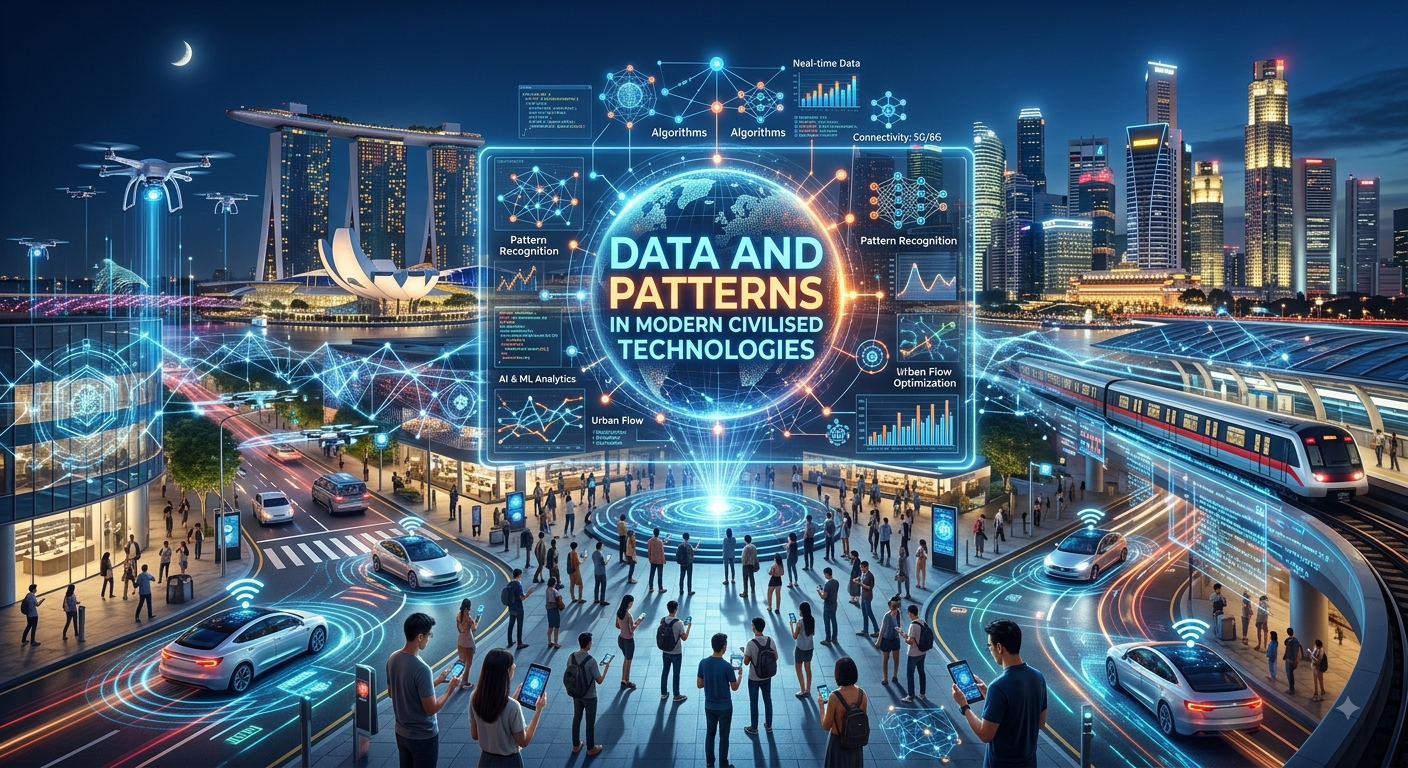
Abstract
Modern civilisation can be understood as an enormous interconnected system for producing, collecting, storing, communicating, processing, interpreting, and acting upon information. From the measurement of temperature by a sensor to the operation of a global telecommunications network, from financial transactions to artificial intelligence, the underlying technological process repeatedly follows a common principle:
Reality → Observation → Data → Structure → Pattern → Information → Knowledge → Intelligence → Decision → Action → Feedback
This framework provides a comprehensive examination of how data and patterns form the foundation of modern technology. It connects mathematics, computing, telecommunications, semiconductors, databases, artificial intelligence, robotics, cybersecurity, business, science, biology, cities, and global infrastructure into a unified conceptual architecture.
Data is not merely a collection of numbers. It can represent physical measurements, language, images, sound, location, transactions, scientific observations, machine states, human activity, and relationships between objects. NIST defines data broadly as representations of facts, concepts, or instructions suitable for communication, interpretation, or processing by humans or machines.
Information emerges when data acquires meaning within a context. Knowledge develops when information is organized, connected, interpreted, and understood. Intelligence involves using knowledge and information to reason, predict, adapt, solve problems, or support decisions.
The significance of this framework is that nearly every modern technological system can be examined through the same basic architecture.
1. Introduction: Civilisation as an Information System
Human civilisation has always depended on information.
Early societies used memory, language, symbols, drawings, counting systems, calendars, maps, written records, and physical objects to preserve and transmit knowledge.
Modern civilisation has extended these capabilities through machines.
Computers can store enormous quantities of information. Telecommunications networks can move information across continents. Sensors can observe physical environments continuously. Databases can organize billions of records. Algorithms can identify patterns. Artificial intelligence can construct models from large datasets. Robots can convert computational decisions into physical actions.
Consequently, technology can be viewed as an extension of humanity’s ability to:
- observe;
- remember;
- calculate;
- communicate;
- recognize patterns;
- predict;
- coordinate;
- decide;
- control;
- learn.
This produces a fundamental technological chain:
World → Sensors → Data → Computing → Patterns → Information → Knowledge → Decision → Action → Feedback
The system is circular rather than purely linear because every action can generate new data.
2. The Fundamental Data-to-Action Architecture
A generalized modern technology system can be represented as follows:
                PHYSICAL / SOCIAL REALITY
                         │
                         ▼
                    OBSERVATION
                         │
                         ▼
                      SENSING
                         │
                         ▼
                       DATA
                         │
                         ▼
               DATA ORGANISATION
                         │
                         ▼
                  DATA PROCESSING
                         │
                         ▼
                 PATTERN DETECTION
                         │
                         ▼
                    INFORMATION
                         │
                         ▼
                     KNOWLEDGE
                         │
                         ▼
                    INTELLIGENCE
                         │
                         ▼
                      DECISION
                         │
                         ▼
                       ACTION
                         │
                         ▼
                      FEEDBACK
                         │
                         └──────────► NEW DATA
This architecture applies to very different technologies.
For example:
Smartphone
Camera → image data → image processing → object pattern → information → application decision → display/action.
Financial system
Transaction → transaction record → database → statistical pattern → financial information → risk assessment → decision → transaction or intervention.
Industrial robot
Sensor → machine-state data → controller → pattern detection → operational state → control decision → motor movement → new sensor data.
Artificial intelligence
Training data → preprocessing → representation → model training → learned patterns → inference → output → evaluation → model improvement.
3. What Is Data?
Data is a representation of something.
It may represent:
- a number;
- a measurement;
- a location;
- a date;
- a person’s interaction with a system;
- a financial transaction;
- a sound waveform;
- an image;
- a scientific observation;
- a machine state;
- a biological measurement;
- a written statement;
- a relationship between objects.
Data can therefore be classified into multiple forms.
3.1 Numerical Data
Examples include:
- temperature;
- pressure;
- distance;
- speed;
- population;
- revenue;
- electrical voltage;
- stock prices;
- energy consumption.
3.2 Textual Data
Examples include:
- books;
- emails;
- reports;
- messages;
- legislation;
- programming code;
- scientific papers.
3.3 Visual Data
Examples include:
- photographs;
- satellite imagery;
- medical images;
- maps;
- machine-vision images.
3.4 Audio Data
Examples include:
- speech;
- music;
- environmental sounds;
- machine sounds.
3.5 Spatial Data
Examples include:
- geographic coordinates;
- road networks;
- building locations;
- satellite maps;
- geological structures.
3.6 Temporal Data
Time-series data records changes over time.
Examples include:
- electricity demand;
- weather;
- financial prices;
- heart-rate measurements;
- network traffic;
- industrial production.
3.7 Relational Data
Relational data describes relationships.
For example:
Customer
   │
   ├── owns → Account
   │
   ├── makes → Transaction
   │
   └── receives → Service
Relationships are extremely important because modern databases, knowledge graphs, recommendation systems, and AI systems often depend not only on individual values but also on relationships between entities.
4. Data Structure
Raw data becomes more useful when it is organized.
A structure determines how information is arranged and how different elements relate to one another.
Important structures include:
- tables;
- arrays;
- lists;
- trees;
- graphs;
- networks;
- matrices;
- tensors;
- databases;
- files;
- object structures;
- knowledge graphs.
For example, a simple database might contain:
| Customer | Product | Date | Amount |
|---|---|---|---|
| A | Computer | Monday | 10,000 |
| B | Phone | Monday | 8,000 |
| A | Monitor | Tuesday | 3,000 |
The individual records are data.
When these records are analyzed, patterns may emerge.
Customer A purchases computers and monitors.
That pattern can become useful information.
5. Metadata: Data About Data
A dataset becomes substantially more useful when its context is documented.
Metadata can describe:
- who created the data;
- when it was created;
- where it came from;
- what each field means;
- measurement units;
- data format;
- processing history;
- quality;
- ownership;
- permissions;
- relationships with other datasets.
NIST’s Research Data Framework emphasizes metadata, provenance, interoperability, data quality, reuse, and the ability to make data findable, accessible, interoperable, and reusable.
Without metadata, a number such as:
37.5
may be almost meaningless.
With metadata:
Temperature = 37.5 °C, measured at Location X, 12 August 2026, Sensor Y
the same value becomes interpretable.
6. The Architecture of Patterns
A pattern is a recurring structure, relationship, sequence, tendency, or regularity.
Patterns can exist in:
- nature;
- mathematics;
- language;
- biology;
- economics;
- human behaviour;
- engineering;
- networks;
- computing;
- markets;
- scientific measurements.
Examples include:
Temporal pattern
Monday → Tuesday → Wednesday → Thursday
Numerical pattern
2 → 4 → 8 → 16 → 32
Network pattern
A → B
A → C
B → D
C → D
Behavioural pattern
Observation → Repetition → Recognition → Prediction
Technology becomes powerful when it can identify patterns faster, more accurately, or at larger scales than unaided human analysis.
7. Mathematics: The Language of Patterns
Mathematics provides much of the formal language used to represent patterns.
Important mathematical concepts include:
- arithmetic;
- algebra;
- geometry;
- calculus;
- probability;
- statistics;
- matrices;
- vectors;
- graph theory;
- optimization;
- differential equations;
- information theory.
Mathematics allows technology to transform observations into models.
For example:
Observed data
      ↓
Mathematical representation
      ↓
Model
      ↓
Prediction
      ↓
Decision
Statistics is particularly important because real-world data is frequently incomplete, variable, noisy, or uncertain.
Statistical methods can help determine:
- averages;
- variation;
- correlations;
- distributions;
- trends;
- probabilities;
- relationships;
- anomalies;
- predictions.
8. Algorithms: Rules for Processing Patterns
An algorithm is a defined procedure for transforming inputs into outputs.
A simplified algorithm can be represented as:
INPUT
  ↓
PROCESS
  ↓
DECISION
  ↓
OUTPUT
For example:
Temperature
    ↓
Compare with threshold
    ↓
Is temperature too high?
    ↓
YES → activate cooling
NO  → continue monitoring
Algorithms therefore provide a bridge between information and action.
9. Computing: The General-Purpose Pattern Engine
Computing systems execute algorithms.
A simplified computer architecture consists of:
INPUT
  ↓
PROCESSOR
  ↓
MEMORY
  ↓
STORAGE
  ↓
OUTPUT
Modern computing expands this into:
Sensors
  ↓
Devices
  ↓
Networks
  ↓
Servers
  ↓
Cloud / Data Centres
  ↓
AI / Analytics
  ↓
Applications
  ↓
Users / Machines
Computers are therefore not merely calculators. They are general-purpose machines for representing, transforming, storing, transmitting, and analyzing information.
10. Semiconductors: The Physical Foundation
Modern digital information processing depends heavily on semiconductor technology.
The semiconductor industry provides the physical components required for:
- processors;
- memory;
- sensors;
- communication chips;
- graphics processors;
- AI accelerators;
- storage controllers;
- network processors.
A simplified hierarchy is:
Materials
   ↓
Semiconductors
   ↓
Transistors
   ↓
Logic circuits
   ↓
Integrated circuits
   ↓
Processors / Memory / Accelerators
   ↓
Computing systems
At the transistor level, physical electrical states can represent logical states.
Those logical states become:
Bits → Bytes → Instructions → Programs → Data Processing
Thus, an enormous amount of modern civilisation’s information activity ultimately depends on physical devices manipulating electrical and electromagnetic states.
11. Digital Representation
Computers require information to be represented in machine-processable form.
The fundamental binary representation uses:
0 and 1
These can be combined into larger structures.
Bit
 ↓
Byte
 ↓
Kilobytes
 ↓
Megabytes
 ↓
Gigabytes
 ↓
Terabytes
 ↓
Petabytes
 ↓
Exabytes
Different information types can be encoded into digital representations.
For example:
Text → characters → binary
Image → pixels → numerical values
Audio → samples → numerical values
Video → frames + audio → digital data
Sensor → measurements → numerical records
The remarkable characteristic of digital technology is that many fundamentally different forms of information can ultimately be represented using a common computational substrate.
12. Databases: Organising Civilisation’s Records
Databases provide structured mechanisms for storing and retrieving information.
Major concepts include:
- tables;
- records;
- fields;
- indexes;
- keys;
- relationships;
- queries;
- transactions;
- schemas;
- data warehouses;
- data lakes;
- distributed databases.
A database transforms:
large quantities of records
into:
searchable and manageable information resources.
Modern organizations depend on databases for:
- customers;
- accounting;
- inventory;
- logistics;
- healthcare records;
- education;
- government administration;
- scientific research;
- telecommunications;
- manufacturing.
13. Data Warehouses, Data Lakes and Data Platforms
Different data architectures serve different purposes.
Data Warehouse
Designed primarily for structured analytical data.
Data Lake
Can hold large quantities of data in diverse formats.
Data Platform
A broader ecosystem combining:
- data collection;
- storage;
- processing;
- governance;
- analytics;
- security;
- AI;
- applications.
The modern enterprise therefore increasingly operates as a data ecosystem rather than as a collection of isolated databases.
14. Telecommunications: Moving Information
Information has limited value if it cannot move between systems.
Telecommunications provides the transport layer.
A simplified architecture is:
Device
 ↓
Access Network
 ↓
Router
 ↓
Core Network
 ↓
Internet / Private Network
 ↓
Data Centre / Cloud
 ↓
Application
Technologies include:
- fibre optics;
- cellular networks;
- Wi-Fi;
- satellites;
- microwave links;
- undersea cables;
- routers;
- switches;
- radio systems.
NIST’s definition of ICT explicitly includes technologies for gathering, storing, transmitting, retrieving, processing, displaying, organizing, managing, securing, and exchanging data and information.
15. Networks: Patterns of Connection
A network is fundamentally a system of relationships.
Examples include:
- computer networks;
- transportation networks;
- electrical grids;
- social networks;
- biological networks;
- financial networks;
- supply chains.
A network can be represented as:
NODE ───── NODE
 │           │
 │           │
 NODE ───── NODE
In mathematical terms, graph theory provides a powerful framework for studying nodes and connections.
Network analysis can investigate:
- connectivity;
- centrality;
- bottlenecks;
- redundancy;
- paths;
- clusters;
- communities;
- resilience.
16. Artificial Intelligence and Machine Learning
Artificial intelligence adds another layer to the data-and-pattern architecture.
Machine learning systems can use historical data to identify patterns and build models for prediction or decision support. NIST’s Research Data Framework describes machine learning as using statistics and mathematical models to detect patterns in historical data and make predictions about new data.
A simplified machine-learning architecture is:
DATA
 ↓
CLEANING
 ↓
FEATURES / REPRESENTATIONS
 ↓
TRAINING
 ↓
MODEL
 ↓
VALIDATION
 ↓
INFERENCE
 ↓
OUTPUT
 ↓
FEEDBACK
The model is not simply a database.
A database stores records.
A trained model represents learned statistical or computational relationships that can be applied to new inputs.
17. Artificial Intelligence as a Pattern System
AI systems can perform different forms of pattern-related activity.
Classification
“What category does this input belong to?”
Regression
“What numerical value is likely?”
Clustering
“Which observations are similar?”
Anomaly Detection
“Which observation differs significantly from expected patterns?”
Prediction
“What may happen next?”
Recommendation
“Which option appears relevant?”
Generation
“What new content can be produced based on learned representations and instructions?”
Reasoning and Decision Support
“What conclusions or actions can be derived from the available information?”
NIST describes an AI system broadly as a data system, software, hardware, application, tool, or utility that operates in whole or in part using AI.
18. Generative AI
Generative AI represents a major evolution in information-processing systems.
Traditional software often follows explicitly programmed rules.
Machine learning systems can learn statistical relationships.
Generative systems can produce new outputs such as:
- text;
- images;
- audio;
- software code;
- structured information;
- other forms of digital content.
The general architecture remains:
Training Data
      ↓
Learning Process
      ↓
Model
      ↓
Prompt / Input
      ↓
Inference
      ↓
Generated Output
      ↓
Evaluation
The quality of the output remains strongly influenced by data quality, model design, evaluation, system architecture, and the context in which the system operates.
19. Data Quality
A technologically advanced system can still produce poor results if its data is poor.
Important data-quality dimensions include:
- accuracy;
- completeness;
- consistency;
- timeliness;
- validity;
- relevance;
- uniqueness;
- provenance.
A useful principle is:
Poor data → unreliable patterns → unreliable information → unreliable decisions.
This is particularly important in AI.
The objective should therefore not simply be:
More data
but:
More useful, trustworthy, relevant, well-governed data.
20. Data Governance
Data governance establishes how data should be managed.
It can address:
- ownership;
- access;
- quality;
- privacy;
- security;
- retention;
- classification;
- standards;
- accountability;
- interoperability;
- provenance.
A mature organization therefore needs both:
technology architecture
and
governance architecture.
NIST’s data framework emphasizes data stewardship, governance, documentation, standards, interoperability, provenance, and reuse as important elements of a sustainable data ecosystem.
21. Cybersecurity and the Protection of Information
Every information system creates potential security requirements.
A simplified security architecture is:
DATA
 ↓
IDENTITY
 ↓
ACCESS CONTROL
 ↓
ENCRYPTION
 ↓
MONITORING
 ↓
DETECTION
 ↓
RESPONSE
 ↓
RECOVERY
Important objectives include:
Confidentiality
Only authorized parties should access information.
Integrity
Information should not be improperly altered.
Availability
Authorized users should be able to access systems when required.
These objectives apply to:
- databases;
- cloud systems;
- networks;
- mobile devices;
- industrial systems;
- AI systems;
- government systems;
- business platforms.
22. AI Security
AI introduces additional considerations.
Data-driven systems can be affected by:
- poor-quality training data;
- model errors;
- unexpected inputs;
- manipulated data;
- privacy problems;
- model misuse;
- unreliable outputs.
NIST has developed AI-focused resources addressing testing, evaluation, verification, validation, and AI risk management.
Therefore:
AI capability must be accompanied by AI assurance.
The goal is not merely to make a model powerful.
It must also be evaluated for:
- reliability;
- robustness;
- security;
- transparency;
- appropriate use;
- limitations;
- performance.
23. Human-Computer Interaction
Technology ultimately interacts with people or other machines.
Interfaces include:
- keyboards;
- touchscreens;
- voice;
- cameras;
- sensors;
- dashboards;
- augmented interfaces;
- application programming interfaces;
- robotic controls.
The interface transforms human intent into machine-readable input and machine output into human-readable information.
Human
 ↓
Intent
 ↓
Interface
 ↓
Digital Input
 ↓
Processing
 ↓
Output
 ↓
Human Interpretation
Good technology therefore requires not only computational capability but also understandable and usable interfaces.
24. Business and Economic Systems
Businesses increasingly function as data-processing systems.
Consider a simplified company:
Customers
   ↓
Sales
   ↓
Transactions
   ↓
Database
   ↓
Analytics
   ↓
Management Information
   ↓
Decision
   ↓
Operations
   ↓
New Customer Data
Data can support:
- demand forecasting;
- inventory management;
- pricing analysis;
- customer service;
- logistics;
- accounting;
- marketing;
- financial planning;
- risk analysis;
- operational optimization.
This makes information infrastructure a core component of modern economic infrastructure.
25. Supply Chains as Data Networks
A supply chain is simultaneously:
a physical network
and
an information network.
Physical flow:
Raw Materials
 ↓
Factory
 ↓
Warehouse
 ↓
Transport
 ↓
Distribution
 ↓
Customer
Information flow:
Orders
 ↓
Production Data
 ↓
Inventory Data
 ↓
Shipment Data
 ↓
Tracking Data
 ↓
Customer Data
The efficiency of the physical system increasingly depends on the quality and speed of the information system.
26. Robotics: Connecting Data to the Physical World
Robotics closes the gap between computation and physical action.
A robot can be represented as:
SENSORS
   ↓
DATA
   ↓
PROCESSING
   ↓
PERCEPTION
   ↓
DECISION
   ↓
CONTROL
   ↓
ACTUATORS
   ↓
PHYSICAL ACTION
   ↓
SENSORS
This is a feedback-control system.
Robotics therefore combines:
- mechanical engineering;
- electronics;
- sensors;
- control theory;
- software;
- AI;
- communications;
- data processing.
27. Automation
Automation occurs when a system performs defined operations with reduced direct human intervention.
Automation can range from:
simple rule-based automation
to:
adaptive AI-enabled automation.
For example:
IF condition occurs
       ↓
THEN perform action
More advanced systems can operate as:
Observe
 ↓
Interpret
 ↓
Predict
 ↓
Decide
 ↓
Act
 ↓
Observe again
This creates increasingly autonomous technological systems.
28. Science and Engineering
Science is fundamentally dependent on measurement and patterns.
The scientific process can be represented as:
Observation
 ↓
Measurement
 ↓
Data
 ↓
Analysis
 ↓
Pattern
 ↓
Hypothesis
 ↓
Experiment
 ↓
Evidence
 ↓
Model
 ↓
Prediction
 ↓
Testing
Engineering then converts scientific understanding into practical systems.
Examples include:
- bridges;
- aircraft;
- satellites;
- processors;
- power grids;
- communication networks;
- medical instruments;
- manufacturing systems.
29. Biology as an Information System
Biological systems also contain enormous quantities of structured information.
Examples include:
- DNA sequences;
- proteins;
- cellular signaling;
- neural activity;
- metabolic pathways;
- ecological relationships.
A simplified biological information system is:
DNA
 ↓
RNA
 ↓
Protein
 ↓
Cellular Function
 ↓
Organism
 ↓
Environment
 ↓
Feedback
Biology therefore provides another domain in which information, structure, patterns, networks, and feedback interact.
30. The Human Brain as a Pattern System
Human intelligence depends heavily on recognizing relationships and patterns.
The brain receives information through sensory systems:
Sight
Sound
Touch
Smell
Taste
       ↓
Neural Processing
       ↓
Pattern Recognition
       ↓
Memory
       ↓
Interpretation
       ↓
Decision
       ↓
Action
Modern AI research frequently draws inspiration from aspects of biological information processing, although artificial neural networks are mathematical computational systems rather than biological brains.
31. Smart Cities
A modern city can be viewed as a large distributed information system.
Potential data sources include:
- traffic sensors;
- public transport systems;
- electricity meters;
- water systems;
- weather stations;
- telecommunications;
- building systems;
- environmental sensors;
- administrative databases.
The architecture becomes:
CITY
 ↓
SENSORS
 ↓
NETWORKS
 ↓
DATA PLATFORM
 ↓
ANALYTICS / AI
 ↓
CITY MANAGEMENT
 ↓
ACTION
 ↓
FEEDBACK
Applications can include:
- traffic management;
- energy optimization;
- infrastructure monitoring;
- public transport planning;
- environmental monitoring;
- emergency coordination.
32. Digital Twins
A digital twin is a computational representation of a physical object, system, or process.
Conceptually:
PHYSICAL SYSTEM
      ↕
   SENSOR DATA
      ↕
DIGITAL REPRESENTATION
      ↕
SIMULATION / ANALYTICS
      ↕
PREDICTION
      ↕
PHYSICAL ACTION
Digital twins can potentially be applied to:
- factories;
- buildings;
- vehicles;
- machines;
- infrastructure;
- energy systems;
- cities.
Their power comes from connecting physical reality with computational models.
33. Simulation
Simulation allows systems to be studied computationally without necessarily experimenting directly on the physical system.
Examples include:
- weather;
- traffic;
- aircraft;
- manufacturing;
- economics;
- engineering;
- population systems;
- energy networks.
A simulation generally follows:
REAL SYSTEM
 ↓
MODEL
 ↓
INPUT PARAMETERS
 ↓
COMPUTATION
 ↓
SIMULATED OUTPUT
 ↓
COMPARISON WITH REALITY
Simulation becomes particularly powerful when combined with large datasets and machine learning.
34. The Data Lifecycle
A comprehensive data lifecycle can be represented as:
1. CREATE
      ↓
2. CAPTURE
      ↓
3. VALIDATE
      ↓
4. STORE
      ↓
5. ORGANIZE
      ↓
6. PROCESS
      ↓
7. ANALYZE
      ↓
8. INTERPRET
      ↓
9. SHARE
      ↓
10. USE
      ↓
11. ARCHIVE
      ↓
12. DELETE / RETIRE
At every stage, governance, security, quality, and documentation can be applied.
35. Data Patterns Across Time
Patterns can be classified according to time.
Static Patterns
Remain relatively stable.
Periodic Patterns
Repeat at regular intervals.
Seasonal Patterns
Change according to recurring cycles.
Trending Patterns
Move consistently in a particular direction.
Sudden Patterns
Appear rapidly.
Anomalous Patterns
Depart from expected behaviour.
Long-Term Patterns
Become visible only across extended periods.
Time-series analysis allows machines and humans to distinguish these different behaviours.
36. Data Patterns Across Space
Patterns can also exist geographically.
Examples include:
- population density;
- rainfall distribution;
- urban development;
- agricultural production;
- road congestion;
- disease distribution;
- geological formations.
Geographic information systems combine:
location + data + analysis
to reveal spatial relationships.
37. Data Patterns Across Networks
Network patterns describe how entities connect.
For example:
Person → Organisation
Organisation → Supplier
Supplier → Factory
Factory → Distributor
Distributor → Customer
A network perspective can reveal:
- central nodes;
- dependencies;
- clusters;
- bottlenecks;
- isolated components;
- alternative routes.
This is useful in telecommunications, logistics, finance, biology, cybersecurity, and social analysis.
38. From Information to Knowledge
Data and information should not be treated as identical.
A useful conceptual ladder is:
DATA
↓
organized data
↓
INFORMATION
↓
interpreted information
↓
KNOWLEDGE
↓
applied knowledge
↓
INTELLIGENCE
↓
DECISION
↓
ACTION
NIST’s glossary describes information in terms including meaningful representations of facts, data, opinions, or knowledge, emphasizing the importance of context and meaning.
The distinction is important:
Data: recorded values.
Information: meaningful interpretation of data.
Knowledge: understanding of relationships, causes, procedures, and implications.
Intelligence: useful capability to assess situations and support action.
39. The Knowledge Graph
A knowledge graph represents entities and relationships.
For example:
Country
   │
   ├── contains → City
   │                │
   │                └── contains → Company
   │                                  │
   │                                  └── produces → Product
   │
   └── has → Population
This structure is particularly valuable because knowledge is often relational rather than isolated.
A statement becomes more informative when connected to other statements.
40. Feedback: The Missing Dimension
One of the most important principles of modern technology is feedback.
A simple system:
INPUT → PROCESS → OUTPUT
becomes much more powerful when feedback is added:
             ┌───────────────┐
             │               ↓
INPUT → PROCESS → OUTPUT → MEASUREMENT
             ↑               │
             └── FEEDBACK ───┘
Feedback allows systems to:
- correct errors;
- stabilize operations;
- learn;
- optimize;
- adapt;
- detect changes.
Feedback is fundamental to:
- robotics;
- control systems;
- AI;
- manufacturing;
- telecommunications;
- economics;
- biological systems.
41. The Architecture of Modern Civilised Technology
A comprehensive layered model can therefore be constructed.
LAYER 1 — PHYSICAL REALITY
Matter, energy, environment, humans

LAYER 2 — SENSING
Sensors, cameras, microphones, instruments

LAYER 3 — DATA
Measurements, records, observations

LAYER 4 — CONNECTIVITY
Networks, fibre, wireless, satellites

LAYER 5 — COMPUTING
Processors, memory, storage, data centres

LAYER 6 — DATA MANAGEMENT
Databases, data lakes, metadata, governance

LAYER 7 — ANALYTICS
Statistics, visualization, modelling

LAYER 8 — ARTIFICIAL INTELLIGENCE
Machine learning, inference, generative systems

LAYER 9 — APPLICATIONS
Business, science, government, education, industry

LAYER 10 — DECISION
Human and machine decision support

LAYER 11 — AUTOMATION
Software agents, machines, robots

LAYER 12 — PHYSICAL ACTION
Industrial, commercial, domestic and infrastructure operations

LAYER 13 — FEEDBACK
Measurement, monitoring, learning and optimization
This is a generalized architecture rather than a single mandatory technical standard.
42. The Seven Fundamental Transformations
Modern technology can be summarized through seven major transformations:
1. Reality → Data
Sensors and human observation convert reality into representations.
2. Data → Information
Processing gives data context and meaning.
3. Information → Knowledge
Analysis reveals relationships and understanding.
4. Knowledge → Intelligence
Models and reasoning support prediction and decision-making.
5. Intelligence → Decision
A system selects or recommends an action.
6. Decision → Action
Software, humans, or machines execute the decision.
7. Action → New Data
The result generates new observations.
Therefore:
Modern civilisation operates through continuous information feedback loops.
43. Technology as a Stack
Another way to understand modern technology is through a stack:
                    HUMAN PURPOSE
                         │
                    APPLICATIONS
                         │
                 INTELLIGENCE / AI
                         │
                    ANALYTICS
                         │
                  DATA PLATFORMS
                         │
                    SOFTWARE
                         │
                   OPERATING SYSTEM
                         │
                    NETWORKING
                         │
                   COMPUTING
                         │
                  SEMICONDUCTORS
                         │
                     ELECTRICITY
                         │
                  PHYSICAL MATERIALS
Each layer depends on lower layers while supporting higher layers.
For example, AI depends on software, computing hardware, memory, networks, electricity, and physical semiconductor infrastructure.
44. Interoperability
One of the greatest challenges of modern civilisation is that technological systems must communicate with one another.
A hospital system may need to communicate with:
- laboratories;
- pharmacies;
- insurance systems;
- government systems;
- medical devices.
A logistics company may need communication between:
- suppliers;
- warehouses;
- trucks;
- ports;
- customers.
Interoperability therefore becomes a central technological principle.
NIST emphasizes standardized formats, metadata, vocabularies, ontologies, protocols, and interfaces as important mechanisms for interoperability and reuse.
45. Standards
Standards create common rules.
They can define:
- data formats;
- communication protocols;
- security practices;
- measurement procedures;
- interfaces;
- terminology;
- testing methods.
Without standards, technological ecosystems become fragmented.
Standards therefore enable:
compatibility + interoperability + scalability + reliability.
46. Scalability
A system designed for 100 records may fail when handling 100 million records.
Scalability asks:
Can the system continue operating effectively as demand increases?
Scalability may involve:
- larger databases;
- distributed computing;
- parallel processing;
- cloud infrastructure;
- caching;
- load balancing;
- optimized algorithms;
- specialized hardware.
Modern digital systems must often scale simultaneously in:
- users;
- data;
- geographic coverage;
- transactions;
- computation.
47. Distributed Computing
Instead of using one machine, modern systems can distribute work across many machines.
                 TASK
                  │
          ┌───────┼───────┐
          ↓       ↓       ↓
       NODE A   NODE B   NODE C
          │       │       │
          └───────┼───────┘
                  ↓
                RESULT
This allows large workloads to be processed in parallel.
Distributed computing is fundamental to:
- cloud computing;
- large databases;
- internet services;
- scientific computing;
- AI training;
- large-scale analytics.
48. Cloud Computing
Cloud computing abstracts computing infrastructure into services.
Instead of an organization owning every physical resource directly, computing resources can be provisioned through network-accessible infrastructure.
Conceptually:
USER
 ↓
APPLICATION
 ↓
CLOUD SERVICES
 ↓
COMPUTE + STORAGE + NETWORK
 ↓
DATA CENTRES
 ↓
PHYSICAL HARDWARE
Cloud systems therefore represent an important transformation in how computing resources are organized and consumed.
49. Edge Computing
Not every computation needs to travel to a distant data centre.
Edge computing moves some processing closer to the data source.
Sensor
 ↓
Edge Device
 ↓
Local Processing
 ↓
Immediate Decision
 ↓
Action
This can be valuable when systems require:
- low latency;
- reduced bandwidth usage;
- local resilience;
- rapid response.
Cloud and edge computing are therefore complementary architectures rather than mutually exclusive technologies.
50. The Internet of Things
IoT connects physical objects to digital networks.
A generalized IoT architecture is:
PHYSICAL OBJECT
 ↓
SENSOR
 ↓
EMBEDDED PROCESSOR
 ↓
NETWORK
 ↓
DATA PLATFORM
 ↓
ANALYTICS / AI
 ↓
APPLICATION
 ↓
ACTION
Examples include:
- industrial equipment;
- agricultural sensors;
- environmental monitors;
- buildings;
- vehicles;
- energy infrastructure.
IoT effectively extends the internet into the physical world.
51. Energy as the Foundation of Digital Technology
Every digital system ultimately requires energy.
A simplified dependency chain is:
ENERGY
 ↓
ELECTRONICS
 ↓
COMPUTING
 ↓
NETWORKING
 ↓
DATA CENTRES
 ↓
APPLICATIONS
 ↓
DIGITAL SERVICES
Therefore, the digital economy is simultaneously an information economy and a physical infrastructure economy.
Digital technology requires:
- electricity;
- semiconductor manufacturing;
- buildings;
- cooling;
- telecommunications infrastructure;
- physical security;
- maintenance.
52. Materials as the Physical Foundation
Digital systems depend on physical materials.
These include materials used for:
- semiconductors;
- conductors;
- optical fibre;
- batteries;
- displays;
- magnets;
- structural components.
The information economy therefore remains connected to:
geology → materials → manufacturing → electronics → computing → information.
This illustrates an important principle:
Digital systems are physical systems.
53. Modern Technology as a Cyber-Physical System
The distinction between digital and physical technology is increasingly blurred.
A cyber-physical system combines:
PHYSICAL WORLD
      ↕
SENSORS
      ↕
COMPUTING
      ↕
NETWORK
      ↕
AI / CONTROL
      ↕
ACTUATORS
      ↕
PHYSICAL WORLD
Examples include:
- automated factories;
- smart buildings;
- autonomous industrial systems;
- intelligent energy networks;
- connected transportation.
54. Pattern Recognition as a Civilisational Capability
Humanity’s technological development can be interpreted as an expanding capacity to recognize patterns.
Early humans recognized:
- seasons;
- animal movements;
- weather;
- celestial cycles.
Mathematics formalized numerical patterns.
Science formalized natural patterns.
Computers automated calculations.
Databases organized records.
Networks connected information.
Machine learning automated aspects of pattern discovery.
AI extends computational pattern processing into increasingly complex domains.
Thus:
The history of technology can partly be understood as the history of increasing human capability to capture, represent, calculate, communicate, and exploit patterns.
55. The Economics of Data
Data can have economic value because it can improve decisions and operations.
Potential sources of value include:
DATA
 ↓
Better Measurement
 ↓
Better Understanding
 ↓
Better Prediction
 ↓
Better Decisions
 ↓
Better Operations
 ↓
Economic Value
However, data itself is not automatically valuable.
Its value depends on:
- relevance;
- quality;
- accessibility;
- timeliness;
- context;
- legal and ethical usability;
- ability to connect it with other information;
- ability to convert it into useful decisions.
56. Data as Infrastructure
Modern economies increasingly depend on information infrastructure alongside traditional infrastructure.
Traditional infrastructure:
- roads;
- bridges;
- electricity;
- water;
- ports;
- railways.
Information infrastructure:
- fibre networks;
- mobile networks;
- data centres;
- cloud platforms;
- databases;
- satellites;
- digital identity systems;
- software platforms.
The two increasingly interact.
For example:
Road
 ↓
Vehicle
 ↓
GPS
 ↓
Telecommunications
 ↓
Cloud
 ↓
Traffic Data
 ↓
Analytics
 ↓
Traffic Management
57. Resilience
A technological system should not merely be efficient.
It should also be resilient.
Resilience involves the ability to:
- withstand disruption;
- detect failures;
- recover;
- continue essential operations;
- adapt.
Important mechanisms include:
- redundancy;
- backups;
- distributed architecture;
- monitoring;
- failover;
- disaster recovery;
- contingency planning.
58. Privacy and Responsible Data Use
The expansion of data collection creates legitimate questions about how information should be handled.
Responsible systems should consider:
- purpose;
- necessity;
- access;
- security;
- transparency;
- retention;
- consent where applicable;
- accountability.
The objective should be to create useful technological systems without treating every possible piece of information as something that must automatically be collected or retained.
59. Human Responsibility
Technology does not eliminate human responsibility.
People design:
- objectives;
- systems;
- policies;
- datasets;
- algorithms;
- organizations.
People also determine:
- where technology is deployed;
- who can use it;
- what decisions it influences;
- how errors are handled.
Therefore, the technological architecture must be accompanied by an institutional architecture:
TECHNOLOGY
+
PEOPLE
+
GOVERNANCE
+
ETHICS
+
LAW
+
ECONOMICS
60. A Unified Framework
The entire subject can now be summarized as:
                   REALITY
                      ↓
                 OBSERVATION
                      ↓
                   SENSING
                      ↓
                    DATA
                      ↓
                STRUCTURING
                      ↓
                   STORAGE
                      ↓
                CONNECTIVITY
                      ↓
                 PROCESSING
                      ↓
                  PATTERNS
                      ↓
                INFORMATION
                      ↓
                  KNOWLEDGE
                      ↓
                 INTELLIGENCE
                      ↓
                  DECISION
                      ↓
                   ACTION
                      ↓
                  FEEDBACK
                      ↓
                    DATA
This creates a continuous technological loop.
61. The Master Architecture of Modern Civilisation
The most comprehensive representation can be expressed as five interconnected domains.
Domain A — Physical Reality
Matter, energy, environment, humans, machines and infrastructure.
Domain B — Information Reality
Data, records, symbols, measurements, images, sound, text and relationships.
Domain C — Computational Reality
Algorithms, software, databases, networks, processors, AI and simulations.
Domain D — Decision Reality
Analysis, prediction, reasoning, planning, optimization and governance.
Domain E — Action Reality
Human behaviour, machines, robots, businesses, infrastructure and economic activity.
The complete system becomes:
PHYSICAL REALITY
       ↓
INFORMATION REALITY
       ↓
COMPUTATIONAL REALITY
       ↓
DECISION REALITY
       ↓
ACTION REALITY
       ↓
PHYSICAL REALITY
62. The Central Thesis
The central thesis of this framework is:
Modern civilisation is increasingly organized around the continuous conversion of reality into data, data into patterns, patterns into information, information into knowledge, knowledge into intelligence, intelligence into decisions, and decisions into physical or digital action.
This transformation is not limited to computers.
It exists in:
- science;
- engineering;
- medicine;
- agriculture;
- manufacturing;
- finance;
- education;
- telecommunications;
- transportation;
- government;
- commerce;
- environmental monitoring;
- robotics;
- artificial intelligence.
The technologies differ, but the underlying information architecture is remarkably similar.
63. The Future of Data and Pattern Technologies
Future technology is likely to involve increasingly integrated systems in which:
- sensors become more pervasive;
- computing becomes more distributed;
- AI becomes embedded in applications;
- databases become increasingly interconnected;
- digital twins become more sophisticated;
- robotics becomes more capable;
- networks become more intelligent;
- edge and cloud computing operate together;
- scientific simulations become increasingly data-driven;
- physical infrastructure becomes increasingly measurable.
The important question will therefore shift from:
“How much data can we collect?”
toward:
“How effectively can we convert trustworthy data into useful understanding and responsible action?”
64. Final Framework
The complete conceptual model can be condensed into one equation-like expression:
Reality + Observation + Data + Structure + Computing + Patterns + Knowledge + Intelligence + Decision + Action + Feedback = Modern Technological Systems
Or, even more simply:
DATA → PATTERN → INFORMATION → KNOWLEDGE → INTELLIGENCE → ACTION → FEEDBACK
This is the central architecture connecting modern information technology, computing, telecommunications, artificial intelligence, business systems, science, engineering, robotics, and digital infrastructure.
Data provides representation.
Patterns provide structure.
Information provides meaning.
Knowledge provides understanding.
Intelligence provides adaptive decision capability.
Technology converts those capabilities into action.
Feedback connects action back to observation.
That circular process is one of the defining characteristics of modern technological civilisation.
Conclusion
Modern civilisation should not be understood merely as a collection of machines, computers, applications, websites, networks, robots, and artificial intelligence systems.
It is better understood as an interconnected information-processing ecosystem.
At the physical level, matter and energy provide the foundation.
At the electronic level, semiconductors provide computation.
At the network level, telecommunications moves information.
At the data level, databases preserve records.
At the analytical level, mathematics and statistics reveal patterns.
At the intelligence level, AI and machine learning construct computational models.
At the application level, software converts these capabilities into useful services.
At the organizational level, businesses, governments, scientific institutions, and communities use those services to coordinate activity.
At the physical level, automation and robotics transform digital decisions into actions.
And throughout the entire system, feedback continuously generates new information.
The deepest principle is therefore not simply that data powers technology.
It is that:
Technology is a system for transforming information about reality into knowledge, decisions, and action—and then using the results of those actions to generate new information.
Understanding this pattern provides a common intellectual framework for studying computers, telecommunications, artificial intelligence, databases, networks, robotics, science, business, infrastructure, and many other components of modern civilisation.

Be First to Comment