
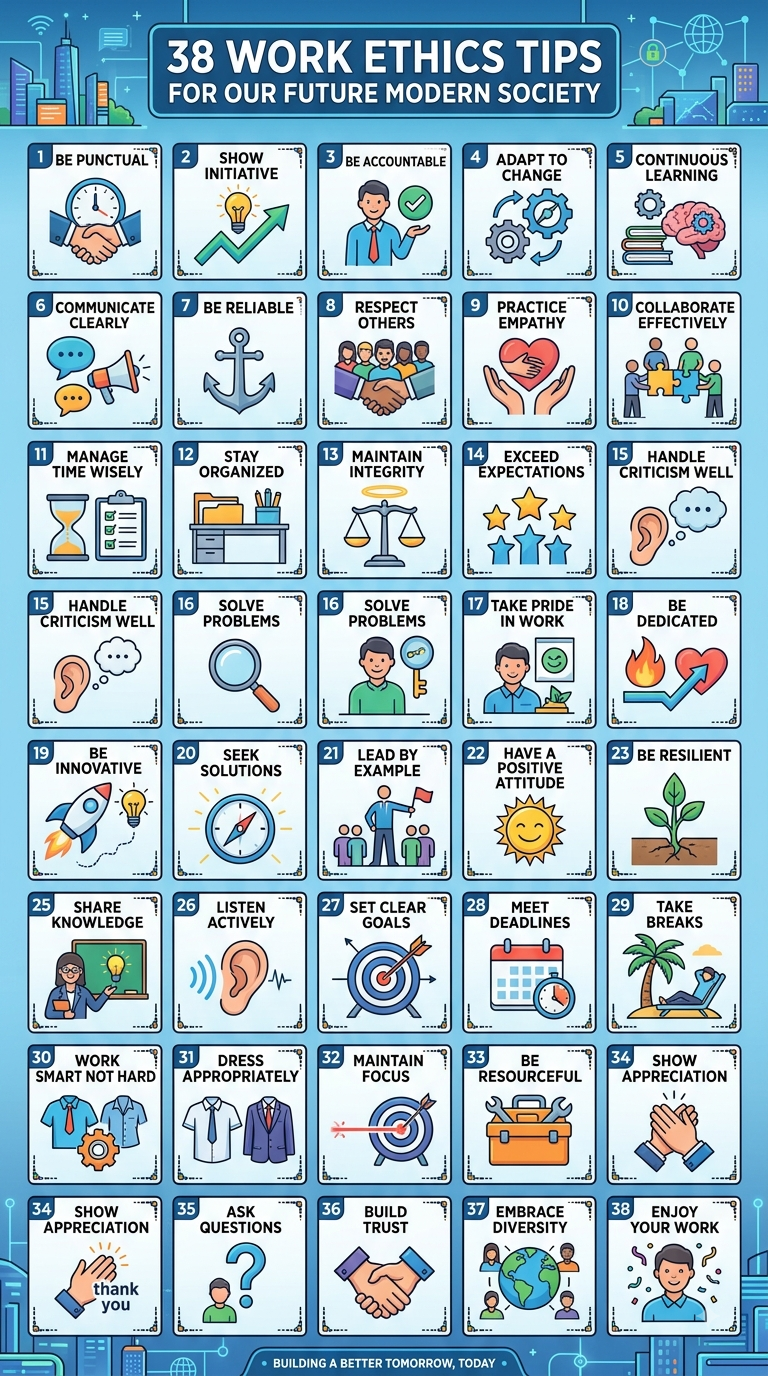
Work ethics will become increasingly important as society moves toward a highly digital, automated, knowledge-based and interconnected economy. Artificial intelligence, robotics, cloud computing, remote work, advanced manufacturing and global supply chains are changing what people do, but they do not eliminate the need for human qualities such as integrity, responsibility, discipline, judgement, cooperation and respect.
The International Labour Organization (ILO) places values such as integrity, accountability, professionalism, collaboration, respect, inclusion, resilience and innovation at the centre of ethical workplace conduct. (International Labour Organization)
For South Africa and other developing economies, strong work ethics are particularly important because productivity, skills development, enterprise growth and employment are closely connected. Recent ILO work with South African enterprises highlights clearer roles, standard procedures, quality control, continuous improvement and worker participation as practical contributors to better productivity and job quality. (International Labour Organization)
1. Integrity
Integrity means doing what is right even when nobody is watching.
A modern worker should not manipulate information, falsify records, misrepresent achievements or deliberately deceive colleagues, customers or management.
Integrity creates trust, and trust is one of the most valuable assets in an organisation.
Modern principle:
Your reputation is an invisible professional asset.
2. Accountability
Take responsibility for your decisions, actions, results and mistakes.
An accountable employee does not constantly search for someone else to blame. When something goes wrong, the correct response is:
Identify → acknowledge → investigate → correct → learn → prevent recurrence.
Accountability is particularly important in technology-driven workplaces where a small mistake can propagate rapidly through digital systems.
3. Punctuality
Time is an economic resource.
Arriving on time, attending meetings when required and completing agreed tasks within reasonable deadlines demonstrate respect for other people’s time.
Punctuality should not mean blindly following the clock; rather, it means being dependable with commitments.
4. Discipline
Discipline is the ability to perform necessary tasks consistently, including tasks that are not exciting.
A disciplined worker:
- follows procedures;
- manages time;
- meets commitments;
- maintains standards;
- avoids unnecessary distractions;
- completes assignments;
- continually improves.
Discipline converts potential into productive capability.
5. Professionalism
Professionalism is much more than clothing or appearance.
It includes:
- responsible behaviour;
- competent communication;
- reliability;
- respect;
- appropriate judgement;
- ethical conduct;
- quality work;
- continuous learning.
ILO training materials similarly describe professionalism as involving responsibility, integrity, accountability, excellence, communication and productivity. (International Labour Organization)
6. Respect Other People
A modern workplace contains people with different backgrounds, experiences, abilities, personalities and perspectives.
Respect means treating colleagues, customers, managers, suppliers and members of the public with dignity.
Respect does not require agreeing with everyone.
It requires being able to disagree constructively.
7. Communicate Clearly
Poor communication can create enormous economic waste.
Good communication should be:
Clear + Accurate + Relevant + Timely + Respectful.
Before sending an important message, ask:
“Could another person misunderstand what I am saying?”
If the answer is yes, improve the communication.
8. Listen Before Responding
Listening is an underestimated professional skill.
A strong worker does not merely wait for an opportunity to speak. They attempt to understand:
- the problem;
- the evidence;
- the other person’s position;
- the desired outcome;
- the constraints.
Good listening improves teamwork and decision-making.
9. Become a Lifelong Learner
Modern technology changes rapidly.
Skills that are valuable today may be partially replaced or transformed tomorrow.
Therefore, workers should continuously develop:
- technical knowledge;
- digital literacy;
- communication;
- mathematics;
- problem-solving;
- business understanding;
- critical thinking;
- industry knowledge.
The future worker should regard learning as part of employment rather than something that ends after school.
10. Embrace Technology Responsibly
Technology should increase human capability rather than eliminate responsibility.
Workers should learn to use:
- AI;
- automation;
- cloud systems;
- data platforms;
- collaboration software;
- digital communication;
- cybersecurity practices;
- analytical tools.
However, using technology does not remove human accountability.
AI can assist a decision; the responsible human remains accountable for how that assistance is used.
11. Verify Information
The digital economy creates enormous amounts of information.
Not everything online is accurate.
Professional workers should distinguish between:
fact → evidence → interpretation → opinion → speculation.
Before making an important decision, verify critical information using reliable sources.
12. Protect Confidential Information
Employees may have access to:
- customer information;
- financial records;
- business strategies;
- passwords;
- intellectual property;
- personal information;
- technical documentation.
Such information should be handled responsibly.
Confidentiality is not merely an IT issue. It is a fundamental professional responsibility.
13. Respect Intellectual Property
Modern economies depend heavily on intellectual property.
Workers should respect:
- patents;
- copyrights;
- trademarks;
- software licences;
- research;
- proprietary designs;
- confidential business knowledge.
Innovation becomes economically sustainable when creators receive appropriate recognition and protection.
14. Avoid Conflicts of Interest
A conflict of interest occurs when personal interests interfere, or appear to interfere, with professional responsibilities.
Examples include situations involving:
- personal financial interests;
- relatives;
- suppliers;
- customers;
- outside businesses;
- gifts or favours.
When a conflict exists, transparency is usually safer than concealment.
Ethics systems such as those used by the ILO specifically address conflicts of interest and related professional responsibilities. (International Labour Organization)
15. Do Not Abuse Your Position
Authority should be used to serve organisational objectives, not personal interests.
Managers, supervisors and senior employees have additional responsibilities because their behaviour influences the culture of an organisation.
Leadership is responsibility multiplied by influence.
16. Work as a Team
Modern production is increasingly interconnected.
A successful project may require:
engineers + programmers + designers + accountants + managers + technicians + administrators + customers + suppliers.
No single person necessarily possesses all the knowledge required.
Teamwork therefore becomes an economic capability.
17. Share Knowledge
Knowledge becomes more valuable when it can be transferred.
A good employee should help colleagues understand systems, procedures and lessons learned.
This reduces organisational dependence on a single individual.
The objective is to build institutional intelligence, not personal information monopolies.
18. Take Initiative
Do not wait for instructions for every small problem.
If you identify a legitimate opportunity to improve:
- identify the problem;
- understand its cause;
- develop possible solutions;
- assess risks;
- communicate appropriately;
- implement or recommend an improvement.
Initiative turns workers from passive task performers into problem solvers.
19. Solve Problems Systematically
Instead of immediately asking:
“Who caused this?”
Ask:
“What caused this?”
A strong problem-solving process examines:
Problem → Evidence → Root Cause → Options → Decision → Implementation → Measurement.
This approach is especially valuable in manufacturing, engineering, IT, administration and government.
20. Focus on Quality
Quality means meeting defined requirements consistently.
Quality should apply to:
- products;
- services;
- documents;
- data;
- software;
- communication;
- customer service;
- administrative processes.
A culture of quality reduces rework, waste, complaints and unnecessary costs.
21. Respect Safety
Productivity should never require unnecessary exposure to dangerous working conditions.
The ILO recognises a safe and healthy working environment as one of the fundamental principles and rights at work. (International Labour Organization)
Every employee should:
- follow safety procedures;
- report hazards;
- use required protective measures;
- avoid reckless behaviour;
- participate in safety training.
22. Respect Equality and Inclusion
A modern society should enable people to contribute according to their capabilities rather than being unfairly excluded.
The ILO identifies elimination of discrimination in employment and occupation as one of its fundamental principles and rights at work. (International Labour Organization)
A professional workplace should judge people primarily according to relevant:
competence + conduct + performance + responsibility.
23. Treat Customers Honestly
Customers are not merely sources of revenue.
They are participants in the economic system.
Honest customer service means:
- accurate information;
- realistic promises;
- transparent pricing;
- reliable delivery;
- appropriate complaint handling;
- respect for customer rights.
Short-term deception can destroy long-term business value.
24. Respect Company Resources
Company resources include much more than money.
They include:
- computers;
- vehicles;
- machinery;
- electricity;
- internet bandwidth;
- buildings;
- working hours;
- databases;
- intellectual property;
- human expertise.
Responsible employees use resources for legitimate purposes and avoid unnecessary waste.
25. Avoid Waste
Waste is an economic problem.
It can involve:
materials + energy + time + money + labour + information + capacity.
A future-oriented worker should continually ask:
“Can this process be performed better with fewer unnecessary resources?”
Responsible workplace practices can improve productivity while supporting decent work. (International Labour Organization)
26. Develop Financial Responsibility
Workers should understand that every organisation operates within financial constraints.
Even employees who never handle money directly influence costs through:
- productivity;
- material consumption;
- equipment use;
- errors;
- overtime;
- delays;
- rework.
Basic financial literacy should therefore become an important workplace skill.
27. Control Your Emotions Professionally
Professionalism does not mean having no emotions.
It means learning to manage emotions so they do not unnecessarily damage decisions or relationships.
When conflict occurs:
Pause → understand → communicate → solve.
Avoid turning a technical disagreement into a personal conflict.
28. Accept Constructive Criticism
Feedback is an instrument for improvement.
A mature worker asks:
“What can I learn from this?”
rather than automatically interpreting criticism as an attack.
At the same time, criticism should be respectful, evidence-based and directed toward improvement.
29. Give Credit to Others
Do not present another person’s work as your own.
Recognise:
- ideas;
- research;
- technical contributions;
- teamwork;
- creativity;
- problem-solving.
Recognition encourages collaboration and strengthens organisational trust.
30. Keep Promises Realistic
Never make commitments merely to impress someone.
A professional promise should be based on:
capacity + resources + time + knowledge + risk.
It is better to make a realistic commitment and exceed it than to make an impossible promise and disappoint everyone.
31. Adapt to Change
The future workplace will continue to experience technological and economic transformation.
The ILO notes that digitalisation, demographic changes, climate change and economic volatility are reshaping the world of work and increasing the importance of proactive skills and employment strategies. (International Labour Organization)
Therefore:
Adaptability is becoming a core professional skill.
32. Think Critically
Do not accept every instruction, claim or piece of information without evaluation.
Critical thinking asks:
- What is the evidence?
- What assumptions are being made?
- What alternatives exist?
- What could go wrong?
- Who benefits?
- What are the long-term consequences?
Critical thinking protects organisations from poor decisions.
33. Think Long-Term
A weak work culture focuses only on:
“How do I finish today’s task?”
A stronger culture asks:
“What will this decision produce five, ten or twenty years from now?”
Long-term thinking is essential for infrastructure, education, technology, environmental sustainability, business development and national economic planning.
34. Protect the Environment
Modern work ethics should include environmental responsibility.
Organisations should consider:
- energy efficiency;
- material efficiency;
- recycling;
- pollution prevention;
- sustainable procurement;
- responsible water use;
- responsible waste management;
- lifecycle impacts.
Economic development and environmental responsibility should increasingly be treated as connected objectives.
35. Be Resilient
Problems are inevitable.
Projects fail. Technology breaks. Markets change. Customers complain. Economic conditions fluctuate.
Resilience means recovering, learning and adapting rather than permanently abandoning the objective.
A resilient worker asks:
“What did this failure teach us?”
36. Build a Culture of Continuous Improvement
The workplace should never assume:
“This is how we have always done it.”
Instead:
Observe → Measure → Improve → Test → Standardise → Repeat.
Recent ILO-supported work in South African enterprises has highlighted approaches such as Kaizen, 5S, standard operating procedures, visual management and daily problem-solving as practical tools for improving productivity and workplace organisation. (International Labour Organization)
37. Put Human Dignity at the Centre
Technology may transform work, but people remain central to society.
Economic systems should therefore pursue:
productivity + innovation + decent work + dignity + opportunity.
The ILO’s framework of fundamental principles and rights at work includes freedom of association and collective bargaining, elimination of forced labour and child labour, non-discrimination, and safe and healthy working environments. (International Labour Organization)
This provides an important ethical foundation for the future workplace.
38. Leave the Organisation Better Than You Found It
This may be the most powerful work ethic of all.
When you leave a job, project, organisation or institution, ask:
- Did I improve a process?
- Did I teach someone something?
- Did I solve a problem?
- Did I reduce waste?
- Did I improve quality?
- Did I strengthen teamwork?
- Did I create useful knowledge?
- Did I treat people with dignity?
A great worker does not merely consume a position.
A great worker builds institutional value.
The 38 Principles at a Glance
| No. | Work-Ethics Principle | Core Purpose |
|---|---|---|
| 1 | Integrity | Build trust |
| 2 | Accountability | Own results |
| 3 | Punctuality | Respect time |
| 4 | Discipline | Create consistency |
| 5 | Professionalism | Maintain standards |
| 6 | Respect | Preserve dignity |
| 7 | Clear communication | Prevent misunderstandings |
| 8 | Listening | Improve understanding |
| 9 | Lifelong learning | Remain capable |
| 10 | Responsible technology | Use technology wisely |
| 11 | Information verification | Improve decisions |
| 12 | Confidentiality | Protect information |
| 13 | Intellectual property | Protect innovation |
| 14 | Conflict-of-interest awareness | Preserve impartiality |
| 15 | Responsible authority | Prevent abuse |
| 16 | Teamwork | Combine capabilities |
| 17 | Knowledge sharing | Build institutional intelligence |
| 18 | Initiative | Encourage problem-solving |
| 19 | Systematic problem-solving | Address root causes |
| 20 | Quality | Reduce defects |
| 21 | Safety | Protect people |
| 22 | Equality and inclusion | Expand opportunity |
| 23 | Customer honesty | Build reputation |
| 24 | Resource responsibility | Reduce misuse |
| 25 | Waste reduction | Improve efficiency |
| 26 | Financial responsibility | Understand economic impact |
| 27 | Emotional maturity | Manage conflict |
| 28 | Constructive feedback | Improve performance |
| 29 | Give credit | Reward collaboration |
| 30 | Realistic commitments | Build reliability |
| 31 | Adaptability | Survive change |
| 32 | Critical thinking | Improve judgement |
| 33 | Long-term thinking | Build sustainability |
| 34 | Environmental responsibility | Protect future resources |
| 35 | Resilience | Recover from setbacks |
| 36 | Continuous improvement | Raise productivity |
| 37 | Human dignity | Humanise economic development |
| 38 | Leave things better | Create lasting value |
A Future Work-Ethics Equation
A useful conceptual model is:
Strong Work Ethics = Integrity + Discipline + Competence + Responsibility + Respect + Learning + Teamwork + Accountability + Innovation
But these values should not operate independently.
They form an ecosystem:
Education → Skills → Work Ethics → Productivity → Innovation → Enterprise Growth → Employment → Household Income → Economic Development → Social Stability
If any major component is weak, the entire system can become less effective.
Why This Matters for South Africa
For South Africa, work ethics should be considered alongside skills development, productivity, entrepreneurship, education, infrastructure, technological adoption and employment creation.
The ILO’s South African work highlights persistent challenges including skills gaps, weak workplace systems, market-access constraints, energy disruptions and import competition, while also showing how better organisational systems can improve productivity and job quality. (International Labour Organization)
This means that work ethics should not be reduced to telling employees to “work harder.”
A modern productivity strategy should instead ask:
Are people properly educated?
Do they have the right tools?
Are procedures clear?
Are managers competent?
Are workers treated fairly?
Are performance standards measurable?
Is technology being used effectively?
Are mistakes analysed rather than simply punished?
Is continuous improvement part of the culture?
That is a much more sophisticated understanding of workplace performance.
The Future Modern Worker
The worker of the future will increasingly need to combine human intelligence with technological capability.
A highly valuable worker may therefore possess:
Human skills
- integrity;
- communication;
- empathy;
- judgement;
- creativity;
- leadership;
- teamwork.
Analytical skills
- mathematics;
- statistics;
- logic;
- critical thinking;
- systems thinking;
- problem-solving.
Digital skills
- AI literacy;
- data literacy;
- cybersecurity awareness;
- cloud technologies;
- automation;
- digital collaboration.
Professional ethics
- accountability;
- confidentiality;
- responsibility;
- respect;
- reliability;
- continuous learning.
The objective is not to create workers who merely obey instructions. It is to develop people capable of thinking, creating, collaborating, improving systems and acting responsibly.
Final Principle
The 38 work ethics can ultimately be condensed into one philosophy:
Do your work honestly, learn continuously, respect people, protect resources, solve problems, use technology responsibly, accept accountability and leave every organisation, community and system better than you found it.
That philosophy is particularly relevant to the transition toward a digital, AI-assisted and highly automated economy. Technology can increase the speed and scale of production, but ethical human behaviour determines whether that increased capability produces trust, prosperity, safety and social progress.
The future of work therefore should not be defined only by AI, robots, machines and software.
It should also be defined by the quality of the human beings operating, designing, managing and governing those systems.


Be First to Comment