
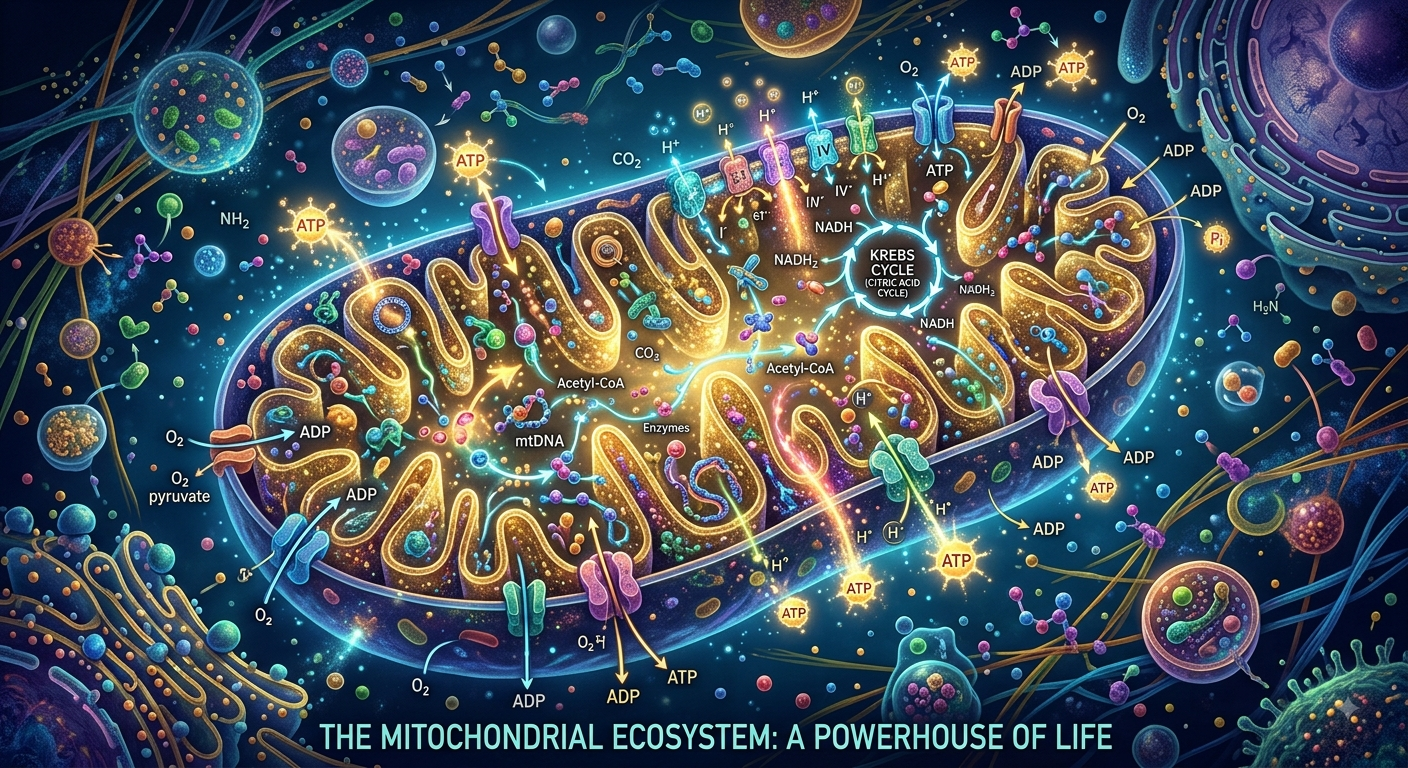
The mitochondrial ecosystem is a useful way of understanding mitochondria not as simple cellular “powerhouses,” but as dynamic biological systems that interact continuously with the nucleus, cytoplasm, other organelles, metabolites, nutrients, oxygen, cellular signaling pathways, and the surrounding environment.
Modern biology recognizes mitochondria as multifunctional organelles involved in energy production, metabolism, calcium regulation, signaling, programmed cell death, cellular stress responses and other processes. (National Institutes of Health)
1. What is a mitochondrion?
A mitochondrion is a membrane-bound organelle found in almost every type of human cell. The plural is mitochondria.
Mitochondria convert chemical energy contained in nutrients into ATP (adenosine triphosphate), the principal immediately usable energy currency of cells. The U.S. National Institutes of Health estimates that mitochondria provide roughly 90% of the energy required by the human body. (National Institutes of Health)
However, describing them only as energy generators is incomplete.
Mitochondria also participate in:
- cellular metabolism
- calcium handling
- redox regulation
- production and control of signaling molecules
- programmed cell death
- biosynthetic pathways
- cellular stress responses
- maintenance of mitochondrial DNA
- communication with other organelles
- adaptation to changing energy demands
This is why “mitochondrial ecosystem” is a more powerful conceptual model than simply “mitochondrial power plant.”
2. The mitochondrial ecosystem at a glance
A simplified model is:
Food + Oxygen + Cellular Inputs
↓
Metabolic Pathways
↓
Mitochondria
↓
Electron Transport + Proton Gradient
↓
ATP + Heat + Metabolic Intermediates + Signals
↓
Cellular Work
↓
Growth + Movement + Repair + Communication + Brain Activity + Organ Function
At the same time, mitochondria continuously receive information from the cell:
Nucleus ↔ Mitochondria ↔ Cytoplasm ↔ Other Organelles
This makes the mitochondrion a communication and control node, not merely a battery.
3. The architecture of mitochondria
A mitochondrion has several important structural components.
Outer mitochondrial membrane
The outer membrane forms the boundary between the mitochondrion and the cytoplasm.
It contains proteins that regulate the movement of molecules into and out of the organelle.
Intermembrane space
Between the outer and inner membranes is the intermembrane space.
During oxidative phosphorylation, this region becomes important because protons are accumulated there.
Inner mitochondrial membrane
The inner membrane is highly specialized.
It contains major components of the respiratory machinery and is largely impermeable to ions such as protons unless they pass through appropriate proteins.
Cristae
The inner membrane forms folds called cristae.
These folds greatly increase the membrane’s functional surface area and organize molecular machinery involved in energy conversion.
Mitochondrial matrix
Inside the inner membrane is the matrix.
The matrix contains enzymes involved in metabolic pathways such as the citric acid cycle and contains mitochondrial DNA and mitochondrial ribosomes.
The double-membrane organization and specialized internal architecture are fundamental to mitochondrial function. (NCBI)
4. The mitochondrial energy system
The central energy pathway can be simplified into several stages.
Stage 1 — Nutrient breakdown
Carbohydrates, fats and proteins are metabolized into smaller molecules.
For example:
Glucose → Pyruvate
through glycolysis.
Pyruvate can subsequently contribute carbon to mitochondrial metabolism.
Stage 2 — Citric acid cycle
Within mitochondria, carbon-containing molecules are progressively oxidized.
The citric acid cycle, also called the Krebs cycle or TCA cycle, generates electron carriers such as:
- NADH
- FADH₂
These carriers transport high-energy electrons toward the respiratory chain.
Stage 3 — Electron transport
Electrons pass through protein complexes embedded in the inner mitochondrial membrane.
Their movement is coupled to proton translocation across the membrane.
This establishes an electrochemical gradient.
Stage 4 — ATP synthesis
The proton gradient provides the driving force for ATP synthase.
ATP synthase uses this energy to convert:
ADP + phosphate → ATP
ATP can then be used throughout the cell.
5. The mitochondrion as an energy-conversion machine
A useful engineering analogy is:
Chemical energy in food
→ electron-transfer reactions
→ electrochemical gradient
→ ATP
→ cellular work
But the analogy has limits.
A machine built by humans normally has fixed components and externally supplied controls.
Mitochondria are self-regulating biological systems capable of changing their structure, number, metabolic activity and interactions according to cellular conditions.
6. Mitochondrial DNA
One of the most fascinating characteristics of mitochondria is that they possess their own DNA.
Human mitochondrial DNA contains 37 genes. Most mitochondrial proteins, however, are encoded by nuclear DNA and imported into mitochondria. (National Institutes of Health)
This creates a remarkable genetic partnership:
Nuclear genome
↕
Mitochondrial genome
The two genetic systems must coordinate to maintain mitochondrial function.
Mitochondrial DNA is generally inherited maternally in humans. (Genome.gov)
7. The evolutionary ecosystem
The origin of mitochondria is connected to one of biology’s most important evolutionary transitions.
The leading explanation is the endosymbiotic theory.
According to this model, an ancient host cell incorporated a bacterium capable of efficient aerobic energy metabolism. Instead of being destroyed, the bacterium established a long-term symbiotic relationship with its host.
Over evolutionary time, the symbiont became the mitochondrion.
Evidence supporting this history includes mitochondrial DNA, their double membranes, bacterial-like features and their evolutionary relationship to bacteria. (NCBI)
This means every mitochondrion can be viewed as the descendant of an ancient biological partnership.
8. Why mitochondria changed the history of life
The emergence of mitochondria was enormously important for eukaryotic evolution.
Efficient energy metabolism helped support cells with:
- larger genomes
- greater internal organization
- extensive membrane systems
- complex signaling
- larger cellular structures
- multicellular organization
Mitochondrial biology therefore connects molecular evolution to the emergence of complex life.
A simplified evolutionary sequence is:
Ancient microbial life
↓
Symbiotic association
↓
Mitochondrial integration
↓
Complex eukaryotic cells
↓
Multicellular organisms
↓
Plants, fungi and animals
The precise evolutionary history is an active scientific research area, but the importance of mitochondrial endosymbiosis is firmly established in modern cell biology. (PubMed)
9. Mitochondrial dynamics
Mitochondria are not static objects.
They continuously undergo:
Fusion ↔ Fission
Fusion
Two mitochondrial structures can merge.
This can help exchange mitochondrial contents and maintain functional networks.
Fission
A mitochondrion can divide.
Fission is important for mitochondrial distribution, quality control and cellular adaptation.
Together, these processes create a continuously changing mitochondrial network.
This is one reason the term ecosystem is appropriate.
10. Mitochondrial quality control
Mitochondria are constantly exposed to metabolic stress.
Cells therefore have systems for identifying and managing damaged mitochondria.
Important mechanisms include:
- mitochondrial protein quality control
- antioxidant defenses
- mitochondrial dynamics
- mitophagy
- DNA maintenance
- replacement of damaged components
Mitophagy refers broadly to the selective removal of damaged or unwanted mitochondria through cellular degradation pathways.
This creates a cycle:
Build → operate → monitor → repair → recycle → replace
That resembles maintenance systems in engineered infrastructure.
11. Mitochondria and cellular communication
Mitochondria communicate with the rest of the cell through metabolites, ions, proteins and signaling molecules.
They interact particularly closely with:
Nucleus
The nucleus provides most mitochondrial proteins through nuclear gene expression.
Endoplasmic reticulum
The endoplasmic reticulum and mitochondria exchange signals and participate in calcium and lipid-related processes.
Peroxisomes
These organelles participate with mitochondria in aspects of lipid metabolism and cellular redox management.
Lysosomes
Lysosomes participate in degradation and recycling pathways connected to mitochondrial quality control.
Cytoskeleton
The cytoskeleton helps position and transport mitochondria within cells.
Therefore, the mitochondrial ecosystem is actually part of a much larger cellular ecosystem.
12. Mitochondria and calcium
Mitochondria participate in the regulation of intracellular calcium ions (Ca²⁺).
Calcium is an important cellular signal.
It influences processes such as:
- muscle contraction
- metabolism
- secretion
- neuronal signaling
- enzyme activity
Mitochondria can take up calcium and use calcium-related information to adjust metabolic activity.
However, excessive mitochondrial calcium loading can contribute to cellular dysfunction.
13. Mitochondria and programmed cell death
Mitochondria also participate in apoptosis, a controlled form of programmed cell death.
This is an important distinction:
Cell death is not always an accident.
Sometimes an organism deliberately removes cells because they are:
- damaged
- unnecessary
- potentially dangerous
- no longer required during development
Mitochondrial signaling is an important component of some apoptotic pathways. (National Institutes of Health)
14. Mitochondria and reactive oxygen species
Energy production involving oxygen can produce reactive oxygen species (ROS).
ROS are not simply “bad substances.”
At controlled levels, reactive molecules can participate in cellular signaling.
At excessive levels, oxidative stress can damage cellular components.
The mitochondrial ecosystem therefore requires balance:
Energy production
↕
Redox signaling
↕
Antioxidant protection
↕
Cellular adaptation
This is an example of biological systems operating within narrow functional ranges.
15. Mitochondria in the brain
The brain has exceptionally high energy requirements.
Neurons require continuous ATP production to maintain:
- electrical gradients
- neurotransmission
- ion transport
- synaptic activity
- cellular maintenance
Recent research is expanding the scientific view of mitochondria in neuroscience. A 2026 review of more than 250 studies discussed mitochondrial involvement in cognition, memory, motivation, stress responses and other brain functions. (Popular Mechanics)
This does not mean mitochondria independently “create intelligence.” Rather, neuronal activity depends on extremely sophisticated energy and metabolic systems in which mitochondria are important participants.
16. Mitochondria in muscles
Muscle cells require enormous quantities of ATP.
Consequently, muscle cells contain large populations of mitochondria.
During physical activity:
Muscle demand ↑
↓
ATP demand ↑
↓
Respiratory metabolism ↑
↓
Mitochondrial workload ↑
The mitochondrial system adapts to repeated changes in energy demand.
17. Mitochondria and metabolism
Mitochondria sit at the intersection of numerous metabolic pathways.
They process or participate in the metabolism of:
- carbohydrates
- fatty acids
- amino acids
- ketone-related substrates
- intermediates used to synthesize cellular molecules
Therefore:
Mitochondria = energy system + metabolic hub
rather than simply:
Mitochondria = battery
18. Mitochondria and heat
Not all energy captured from nutrients becomes ATP.
Some energy is released as heat.
Specialized mitochondrial mechanisms can increase heat production, particularly in tissues containing brown adipose tissue.
This demonstrates another important principle:
Biological energy conversion is not perfectly efficient—and that inefficiency can itself have physiological value.
19. Mitochondrial ecosystems differ between tissues
There is no single universal mitochondrial configuration.
Mitochondria in:
- neurons
- skeletal muscle
- heart muscle
- liver
- kidneys
- endocrine tissues
can have different demands and characteristics.
Cells with high energetic requirements generally require substantial mitochondrial capacity. (National Institutes of Health)
This means mitochondrial biology is strongly connected to cell specialization.
20. The mitochondrial network
A useful conceptual diagram is:
                    NUCLEAR DNA
                        │
                        ▼
                 Gene expression
                        │
                        ▼
              ┌─────────────────┐
              │  MITOCHONDRIA   │
              │                 │
 Nutrients →  │   Metabolism    │
 Oxygen   →   │   ATP           │
 Calcium  →   │   Signaling     │
 Stress   →   │   Quality Ctrl  │
              └─────────────────┘
                 │     │     │
                 ▼     ▼     ▼
               ATP   Signals  Heat
                 │
                 ▼
          CELLULAR ACTIVITIES
But the real system is even more interconnected:
                  NUCLEUS
                     ↕
ENDOPLASMIC ↔ MITOCHONDRIA ↔ CYTOSOL
 RETICULUM       ↕
                     ↕
                 LYSOSOMES
                     ↕
                PEROXISOMES
This network is the mitochondrial ecosystem within the cellular ecosystem.
21. Mitochondrial diseases
Because mitochondria perform so many functions, mitochondrial dysfunction can affect multiple organs.
Potentially affected systems include:
- nervous system
- muscles
- heart
- liver
- kidneys
- endocrine system
NIH notes that mitochondrial dysfunction is associated with a broad range of diseases and biological disorders. (National Institutes of Health)
This illustrates a major systems-biology principle:
When a central biological network performs many interconnected functions, disruption of that network can produce effects across multiple organs.
22. Mitochondria and ageing
Mitochondrial biology is also an important area of ageing research.
Researchers investigate relationships among:
Mitochondrial DNA
→ metabolism
→ oxidative stress
→ quality control
→ cellular signaling
→ tissue function
→ age-related changes
It is important, however, not to reduce ageing to a single mitochondrial mechanism. Ageing results from interactions among many biological systems.
23. Mitochondria as information processors
One of the most interesting ways to conceptualize mitochondria is as biological information processors.
They continuously receive information about:
- nutrient availability
- oxygen availability
- cellular energy demand
- calcium concentration
- cellular stress
- metabolic state
- hormonal signals
- inflammatory signals
They then alter:
- ATP production
- metabolism
- redox state
- mitochondrial dynamics
- signaling
- quality-control activity
Thus:
Input → sensing → processing → response
is another useful systems-level description of mitochondrial biology.
24. The mitochondrial ecosystem as an energy network
We can therefore construct a broader model:
Level 1 — Environment
Food, oxygen, temperature and external conditions.
↓
Level 2 — Organism
Circulatory, respiratory, digestive, nervous and endocrine systems.
↓
Level 3 — Tissue
Muscle, brain, liver, heart and other tissues.
↓
Level 4 — Cell
Nucleus, cytoplasm and organelles.
↓
Level 5 — Mitochondrion
Membranes, cristae, matrix, DNA and metabolic machinery.
↓
Level 6 — Molecular machinery
Electron carriers, respiratory complexes, ATP synthase, enzymes and transport proteins.
↓
Level 7 — Chemistry
Electrons, protons, metabolites, oxygen and phosphate.
This is essentially a nested energy ecosystem.
25. Why the concept matters
The mitochondrial ecosystem provides a bridge between several disciplines:
| Field | Mitochondrial connection |
|---|---|
| Biology | Cellular organization |
| Chemistry | Oxidation and reduction |
| Physics | Energy and electrochemical gradients |
| Genetics | Mitochondrial and nuclear genomes |
| Evolution | Endosymbiosis |
| Neuroscience | Neuronal energy and signaling |
| Medicine | Mitochondrial disorders |
| Ageing science | Cellular maintenance |
| Bioengineering | Energy-conversion systems |
| Systems biology | Network interactions |
This makes mitochondrial science an unusually interdisciplinary subject.
26. A powerful engineering analogy
The mitochondrial ecosystem can be compared conceptually with a modern technology ecosystem.
Data center
Electricity → computation → heat → cooling → maintenance.
Mitochondrial system
Nutrients + oxygen → biochemical energy → heat + metabolic products → cellular regulation + maintenance.
But there is an even deeper similarity.
A modern data center contains:
- power systems
- processors
- networks
- sensors
- cooling
- monitoring
- redundancy
- maintenance
- automated control
Mitochondria contain analogous functional categories, although the underlying biology is fundamentally different.
That makes mitochondrial biology particularly interesting from a future bioengineering and systems-engineering perspective.
27. The future of mitochondrial science
Research is moving toward increasingly sophisticated views of mitochondrial biology.
Important areas include:
Mitochondrial medicine
Understanding mitochondrial dysfunction and developing better treatments.
Mitochondrial genetics
Understanding interactions between mitochondrial and nuclear genomes.
Metabolic engineering
Manipulating cellular metabolism for biotechnology.
Single-cell biology
Studying mitochondrial differences between individual cells.
Mitochondrial imaging
Observing mitochondrial structures and dynamics in living cells.
Neuroscience
Understanding how mitochondrial metabolism interacts with neuronal function.
Cancer biology
Studying how altered metabolism contributes to cancer biology.
Regenerative medicine
Investigating how energy metabolism influences tissue repair and cellular states.
28. The central thesis
The traditional statement is:
Mitochondria are the powerhouses of the cell.
A more modern statement is:
Mitochondria are dynamic metabolic, energetic, genetic, signaling and quality-control hubs embedded within a larger cellular ecosystem.
Their importance comes not from one function, but from the interaction of many functions.
The complete conceptual chain is:
Evolution
↓
Endosymbiosis
↓
Mitochondrial integration
↓
Energy conversion
↓
Metabolic regulation
↓
Cellular signaling
↓
Quality control
↓
Tissue function
↓
Organ function
↓
Whole-organism biology
29. Final perspective
The mitochondrial ecosystem is one of the most remarkable examples of systems engineering created by evolution.
A microscopic structure contains its own genome, operates sophisticated molecular machinery, transforms chemical energy into ATP, communicates with the nucleus and other organelles, changes its architecture, responds to cellular conditions, participates in quality control and contributes to decisions about cellular survival.
Modern research is therefore moving beyond the simplistic image of mitochondria as tiny batteries. The evidence supports a much richer picture: mitochondria are dynamic biological networks at the intersection of energy, metabolism, information, evolution and cellular decision-making. (National Institutes of Health)
For a broader Millennium Tech Saga research framework, this topic could be placed between “The Anatomy of the Human Cell”, “Human Body Electrical Circulation”, “Quantum Physics”, “Materials Science”, and “Artificial Intelligence Architecture” because mitochondria provide a fascinating biological example of how energy, information, computation-like control, networks and physical matter interact to produce a functioning system.

Be First to Comment