
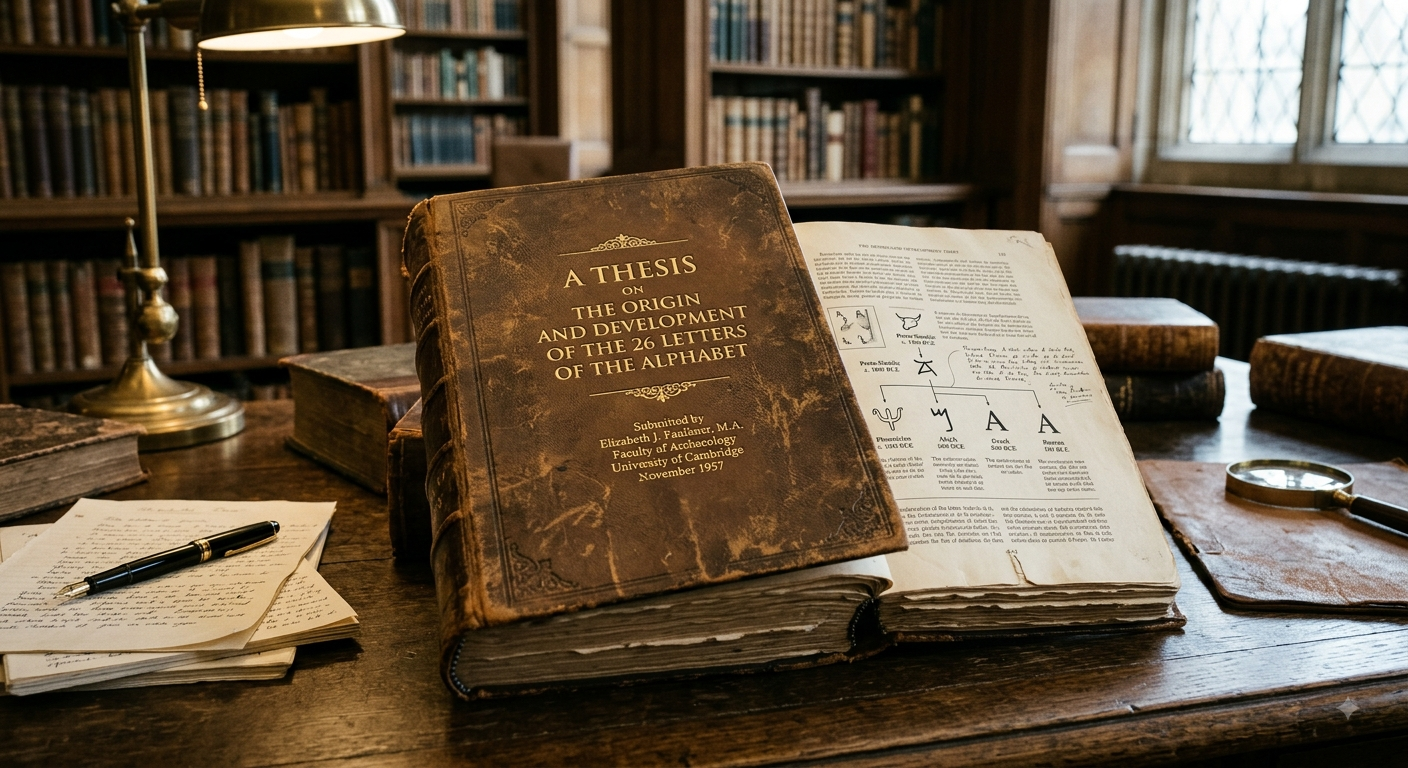
The 26-letter English alphabet is not a system invented at one particular moment. It is the product of thousands of years of experimentation, cultural exchange, linguistic change, writing technology, and adaptation. Its ancestry can be broadly traced through early alphabetic writing in the Levant → Phoenician → Greek → Old Italic/Etruscan → Latin → medieval European scripts → modern Latin alphabet. (Wikipedia)
One important distinction is necessary: the 26-letter alphabet is specifically the modern English/Latin alphabet, not the original alphabet of antiquity. Early Latin had fewer letters, and several modern letters—particularly J, U, and W—developed much later as distinct alphabetic characters. (Roman History)
A THESIS ON THE ORIGIN AND DEVELOPMENT OF THE 26 LETTERS OF THE ALPHABET
Abstract
The modern 26-letter Latin alphabet is one of humanity’s most influential information technologies. It provides the basic symbolic infrastructure for writing English and many other languages and has become deeply embedded in education, science, commerce, government, computing, telecommunications, publishing, and global culture.
The alphabet did not emerge as a complete 26-character system. Instead, its development represents a long historical chain of adaptation. Early alphabetic traditions emerged in the ancient Near East, with Proto-Sinaitic and related early alphabetic systems playing an important role in the history of alphabetic writing. The Phoenician script subsequently became a major transmission point. Greek adapted the system and made a particularly important innovation by systematically representing vowels. The Greek tradition then influenced the Etruscans and other peoples of ancient Italy, eventually contributing to the development of the Latin alphabet.
The Romans initially used an alphabet substantially different from today’s 26-letter system. Over centuries, letters changed their shapes, sounds, positions, and functions. G developed from C; I and J eventually became differentiated; V developed into separate U and V functions; and W emerged from a doubled form of V/U. Y and Z entered the Latin alphabet in connection with Greek vocabulary. Lowercase letters evolved through Roman cursive, minuscule traditions, and medieval manuscript practices. Printing and Renaissance scholarship subsequently helped stabilize the forms that became familiar to modern readers.
This thesis examines that development chronologically and analyzes all 26 modern letters as products of a long technological and cultural evolution.
1. Introduction
Writing is one of humanity’s greatest information technologies.
Before writing, knowledge had to be transmitted primarily through memory, speech, demonstration, symbols, ritual, and physical artifacts. Writing transformed this limitation by allowing information to persist beyond the lifetime and immediate presence of the speaker.
The alphabet represents a particularly important development because it uses a relatively small inventory of signs to represent the sounds of spoken language.
The modern English alphabet contains:
A B C D E F G H I J K L M N O P Q R S T U V W X Y Z
These 26 symbols appear simple to a modern reader. A child can learn them within a short period. Yet behind them lies a historical process extending across several millennia.
The 26 letters therefore should not be understood merely as classroom symbols. They constitute the endpoint of a long technological evolution in human communication.
2. What Is an Alphabet?
An alphabet is a writing system in which symbols are used principally to represent units of speech at approximately the phonemic level.
This distinguishes alphabets from several other kinds of writing systems.
2.1 Logographic systems
A logographic system uses symbols associated with words or morphemes.
Examples include many signs in ancient Egyptian writing and Chinese characters.
2.2 Syllabaries
A syllabary uses signs representing syllables.
Examples include Linear B and several later writing systems.
2.3 Abjads
An abjad primarily represents consonants, with vowels receiving less systematic representation.
The Phoenician writing system is commonly classified in this way.
2.4 Alphabets
A full alphabet systematically represents both consonants and vowels.
Greek was particularly important in this respect because it adapted inherited signs to represent vowel sounds. (World History Encyclopedia)
3. The Deep Prehistory of Alphabetic Writing
The alphabet did not arise in isolation.
Ancient civilizations had already developed sophisticated writing systems long before alphabetic writing appeared.
Egyptian hieroglyphs and Mesopotamian cuneiform demonstrate that humans could develop complex visual systems capable of recording language.
The important breakthrough associated with early alphabetic writing was the reduction of the number of symbols required to represent spoken language.
Instead of maintaining hundreds of signs, a relatively small inventory could be combined in different ways.
This principle eventually became enormously powerful.
4. Proto-Sinaitic and Early Alphabetic Writing
One important stage in the history of alphabetic writing is commonly associated with Proto-Sinaitic writing, found in the Sinai region and generally dated to the second millennium BCE.
The traditional account connects early alphabetic signs with Semitic-speaking populations who adapted aspects of Egyptian writing.
However, the earliest history remains an active scholarly subject.
A 2024 archaeological discovery at Umm el-Marra in northern Syria produced inscribed clay cylinders radiocarbon-dated to around 2400 BCE. Some researchers have proposed that these signs could represent an even earlier form of alphabetic writing, although their interpretation remains debated. Consequently, it is better to describe the origins of alphabetic writing as an evolving field of research rather than as a completely settled historical sequence. (Live Science)
This uncertainty is scientifically important.
History should distinguish between:
documented evidence → scholarly interpretation → hypothesis.
5. The Phoenician Contribution
The Phoenician script became one of the most important transmission stages in alphabetic history.
Phoenician communities were active traders and maritime participants throughout the eastern Mediterranean.
Their writing system contained approximately 22 principal signs and primarily represented consonantal sounds.
The significance of Phoenician was not simply the number of letters.
Its greater importance was the combination of:
- A relatively small symbol inventory
- A recognizable ordering of signs
- Reusable signs representing linguistic sounds
- Adaptability to different languages
- Geographic diffusion through Mediterranean interaction
The first two signs were aleph and bet, from which the Greek term alphabet ultimately derives through alpha and beta. (World History Encyclopedia)
6. From Phoenician to Greek
Greek-speaking communities adapted the Phoenician writing tradition around the early first millennium BCE.
The Greek adaptation was revolutionary because Greek writers needed to represent vowel sounds that were not systematically represented in the Phoenician consonantal system.
Consequently, several inherited consonantal signs were reassigned to vowel functions.
This produced a writing system much closer to the modern concept of a full alphabet.
The Greek alphabet subsequently developed regional varieties. Western Greek traditions became particularly important for the later development of scripts in Italy. (Wiley Online Library)
7. From Greek to the Etruscans
Greek colonization and commerce in southern Italy provided an important route by which Greek writing traditions entered Italy.
The Etruscans adapted a western Greek alphabetic tradition.
The Etruscan writing system subsequently influenced other peoples of ancient Italy, including the Latins.
Evidence indicates that an Etruscan 26-character “model alphabet” existed by approximately the 7th century BCE, although not every one of those signs was necessarily required by the Etruscan language. (Wikipedia)
This demonstrates a crucial principle:
An alphabet can contain symbols that a particular language does not need.
8. The Birth of the Latin Alphabet
The Latin alphabet emerged in ancient Italy during the first millennium BCE.
The Latins adapted an Old Italic alphabet ultimately connected to western Greek traditions through the Etruscan cultural environment.
The early Latin alphabet was substantially smaller than the modern English alphabet.
One reconstruction of the early Latin inventory contains:
A B C D E F Z H I K L M N O P Q R S T V X
This was a 21-letter system. (dlab @ EPFL)
The modern alphabet therefore represents the result of many later modifications rather than the original Roman system.
9. The Transformation from 21 Letters to 26
The modern 26-letter alphabet can be understood as a layered system.
Early Latin
Approximately 21 letters.
Classical Latin
Approximately 23 letters.
Medieval Latin writing
Letterforms and writing conventions became increasingly diverse.
Early modern European writing
I/J and U/V distinctions became clearer, while W developed as an independent letter.
Modern English
The familiar 26-letter alphabet became established.
This evolution illustrates an important concept:
Letters can change independently of the language system they serve.
A letter can change:
- shape
- pronunciation
- position
- name
- grammatical function
- relationship with another letter
10. Development of the Individual 26 Letters
10.1 A — A
A is descended through the alphabetic tradition from the Semitic aleph.
Its earliest ancestor had a pictorial association traditionally connected with an ox head. Through successive changes in writing orientation and stylization, the sign developed into forms resembling Greek alpha and eventually Latin A.
Modern A therefore represents thousands of years of graphical simplification.
10.2 B — B
B traces its ancestry through Greek beta and earlier Semitic forms.
The early sign is traditionally associated with bet, meaning “house.”
Its graphical development eventually produced the Latin B.
The two enclosed areas of uppercase B represent a highly simplified descendant of much older writing forms.
10.3 C — C
C has a particularly interesting history.
Its ancestor was associated with the Semitic letter gimel and Greek gamma.
In early Latin, the C-shaped sign could represent a sound corresponding to both modern K and G.
Eventually, Romans developed G as a modified form of C to distinguish the voiced /g/ sound from /k/.
Thus:
C → C + modified C → G
This is one of the clearest examples of one letter producing another.
10.4 D — D
D descends through the Phoenician, Greek, and Italic traditions.
Its ancient ancestor is associated with dalet.
The Greek form developed into delta, while the Latin form became D.
The modern capital D preserves a basic structure recognizable across thousands of years of alphabetic evolution.
10.5 E — E
E is connected to an ancient Semitic sign traditionally associated with he.
Greek developed the sign into epsilon.
Latin subsequently adopted it as E.
The modern capital E is therefore a highly stabilized geometric form descended from much older writing traditions.
10.6 F — F
F has an especially interesting history because its ancestry passes through the ancient Semitic and Greek/Italic traditions.
An early sign associated with the /w/ sound ultimately contributed to several later letter histories.
In the Latin tradition, F came to represent the /f/ sound.
Its modern form preserves the basic vertical structure with two horizontal strokes.
10.7 G — G
G is one of the letters created within the Latin tradition rather than simply inherited as a separate letter from the earliest alphabet.
Romans modified C to distinguish /g/ from /k/.
The new letter was called G.
This development demonstrates that alphabets are not fixed objects. Speakers and writers can modify an existing system when linguistic requirements create a practical need.
10.8 H — H
H descends through Greek and Latin from an ancient Semitic sign.
Greek eta developed in a different direction from the Latin H tradition.
The Latin H became associated with the /h/ sound.
The uppercase form has remained relatively stable for a very long period.
10.9 I — I
I is descended from the ancient alphabetic tradition through Greek iota and Latin I.
Originally, I served both vowel and consonantal functions.
The distinction between I and J developed much later.
Therefore, ancient Romans did not possess the modern distinction between:
I / i
and
J / j.
10.10 J — J
J is one of the youngest members of the modern 26-letter English alphabet.
It developed from the historical use of I.
In medieval and later European handwriting, I acquired modified forms and extended strokes. Eventually, J became recognized as a distinct letter.
Therefore:
I → differentiated I/J → J
This is a classic example of a new alphabetic character emerging from an existing one.
10.11 K — K
K has an ancient ancestry and was present in early Latin.
It corresponds broadly to the Greek kappa tradition.
Although K was less dominant in classical Latin than C, it survived and became important in later languages.
Modern English uses K extensively for /k/ sounds.
10.12 L — L
L descends through Greek lambda and earlier alphabetic traditions.
Its basic shape became stabilized in Latin writing.
The modern L is therefore a relatively conservative descendant of an ancient letter.
10.13 M — M
M is descended from an ancient Semitic letter traditionally associated with mem and through Greek mu.
Its early association is connected with water in traditional letter-name interpretations.
The Roman M became visually similar to the modern uppercase M.
It is one of the letters whose basic capital form has remained remarkably recognizable.
10.14 N — N
N derives from an ancient alphabetic sign associated with nun, followed by Greek nu and Latin N.
Its modern uppercase form is structurally simple:
vertical → diagonal → vertical
This illustrates how alphabetic signs can become highly geometric through repeated handwriting and inscription.
10.15 O — O
O has one of the most visually straightforward histories.
It is connected with an ancient sign associated with an eye and developed through Greek omicron into Latin O.
The circular form survived with relatively little alteration.
O is therefore an excellent example of graphical continuity.
10.16 P — P
P descends through Greek pi and earlier alphabetic traditions.
The Latin P developed its characteristic vertical stem and upper loop.
The letter demonstrates how a symbol can retain its structural identity even while handwriting styles change substantially.
10.17 Q — Q
Q is an unusual letter.
Its ancient ancestry is connected with the Semitic and Greek traditions and ultimately the Latin alphabet.
In Latin, Q was closely associated with the sound sequence represented by QV.
Modern English retained Q, usually in combination with U.
Thus Q demonstrates another important principle:
A letter’s historical survival does not necessarily mean that it remains independently common in every linguistic environment.
10.18 R — R
R developed through the Greek rho tradition.
Its Latin form eventually acquired the characteristic diagonal leg.
This makes modern R visually distinguishable from P despite their related historical forms.
10.19 S — S
S descends from an ancient alphabetic sign through Greek sigma and the Italic/Latin traditions.
The shape changed significantly across different scripts.
Nevertheless, the modern S remains recognizably related to its ancient predecessors.
10.20 T — T
T descends through Greek tau and earlier alphabetic traditions.
Its basic cross-like shape has remained remarkably stable.
T is therefore another example of long-term graphical continuity.
10.21 U — U
U is closely related historically to V.
Classical Latin used V for sounds that modern readers distinguish as U and V.
Over the medieval and early modern periods, different graphic conventions increasingly separated the vowel U from consonantal V.
Eventually:
V → U + V
became a practical modern distinction.
10.22 V — V
V is the continuation of the Latin V tradition.
In classical Latin, V represented sounds that covered what modern languages separate into U, V, and historically related functions.
Modern V became standardized as a distinct consonantal letter.
10.23 W — W
W is another comparatively late addition.
Its name and form are strongly connected to the concept of a double U, although historically its graphic form also reflects the use of doubled V in traditions where V and U were not yet sharply distinguished.
Thus:
U/V → VV or UU → W
The modern W is consequently a particularly clear example of a letter emerging from a graphic combination.
10.24 X — X
X comes through Greek chi and western Greek/Italic traditions.
Its crossed shape became one of the most recognizable symbols in the Latin alphabet.
In Latin, X represented a consonant cluster approximately corresponding to /ks/.
10.25 Y — Y
Y entered Latin in connection with Greek.
Romans increasingly needed to represent Greek words and sounds.
Y was therefore adopted as a Greek-derived letter, particularly in learned vocabulary.
It became the modern Y.
Y is consequently an example of cultural borrowing driven by vocabulary and linguistic contact.
10.26 Z — Z
Z has an especially interesting history because it was removed from early Latin and later returned.
Early Latin possessed Z, but it was eventually removed from the standard Latin alphabet because of changes in Latin pronunciation.
After Rome’s increasing interaction with Greek culture, Z was restored for representing Greek words.
Thus the history of Z illustrates that alphabetic evolution is not always linear:
letter introduced → letter removed → letter reintroduced.
11. The Special History of G, J, U, V and W
Five letters deserve special attention because their modern identities emerged comparatively late or through major differentiation:
G, J, U, V, W
They demonstrate that the modern alphabet is not simply an unchanged inheritance from ancient Rome.
G
C → modified C → G
J
I → differentiated I/J → J
U
V/I-U writing conventions → U
V
Latin V → modern V
W
VV/UU → W
This group provides perhaps the clearest evidence that the modern alphabet is a historical process rather than an ancient fixed package.
12. Uppercase and Lowercase Letters
The modern distinction between uppercase and lowercase letters also developed gradually.
Ancient Roman inscriptions famously used monumental capital forms.
However, everyday handwriting required faster and more efficient forms.
Roman cursive writing evolved.
Later, various minuscule scripts developed during the medieval period.
Carolingian minuscule became particularly influential in European manuscript culture.
Renaissance humanists subsequently adopted and refined letterforms based partly on earlier manuscripts.
The modern typography of:
A B C
and
a b c
therefore represents the convergence of several historical writing traditions.
13. The Printing Revolution
The invention of movable-type printing in Europe transformed the development of alphabetic standardization.
Printing created powerful incentives for consistency.
Printers needed:
- repeatable letterforms
- standardized type pieces
- predictable spacing
- punctuation conventions
- consistent spelling
- reproducible fonts
The printing press therefore did not invent the alphabet.
Instead, it helped standardize and distribute particular forms of alphabetic writing.
This was enormously important for European languages.
14. The Alphabet and the English Language
The modern English alphabet is essentially the Latin alphabet adapted to English.
However, English pronunciation contains more sounds than can be represented by 26 individual letters.
Consequently, English uses combinations such as:
sh
ch
th
ph
and many others.
English also has a complex historical relationship between spelling and pronunciation.
For example, the same letter can represent multiple sounds, while the same sound can sometimes be represented by different letters.
Therefore:
26 letters ≠ 26 sounds.
This distinction is essential.
The alphabet is a writing technology, while spoken language contains a much richer and continuously changing sound system.
15. The Alphabet as an Information Technology
The alphabet can be viewed as an ancient information-compression technology.
Consider the problem faced by a writing system.
A language may contain thousands of words and many different grammatical forms.
Instead of creating a unique symbol for every word, an alphabet provides a relatively small set of reusable components.
For example:
C + A + T
can represent a word.
Changing the arrangement produces:
A + C + T
or other combinations.
The power comes from combinatorial reuse.
A small number of symbols can generate an enormous number of written expressions.
This principle resembles modern digital information systems.
16. From Alphabet to Computing
The historical importance of the alphabet extends into computing.
Modern computers encode text digitally.
Letters are assigned numerical codes.
Examples include systems such as:
- ASCII
- Unicode
- UTF-8
Under these systems, a visible character is represented computationally as data.
For example:
A → digital code → binary representation → electronic storage/transmission
The journey is therefore remarkable:
spoken sound → symbol → written character → printed character → encoded character → digital data
The alphabet has consequently become part of the architecture of modern information technology.
17. The Alphabet and Global Civilization
The Latin alphabet is now used by languages across Europe, Africa, the Americas, Oceania, and parts of Asia.
Its spread resulted from many historical processes:
- Roman expansion
- Christianity
- European education
- colonial administration
- printing
- international commerce
- scientific communication
- modern telecommunications
- computing
- globalization
Its global use should therefore not be attributed to a single civilization or invention.
It is the result of successive cultural transmissions and adaptations.
18. A Simplified Evolutionary Chain
The broad historical model can be represented as:
Early writing traditions
↓
Early alphabetic traditions
↓
Proto-Sinaitic and related early alphabetic systems
↓
Phoenician
↓
Greek
↓
Western Greek / Old Italic traditions
↓
Etruscan
↓
Old Latin
↓
Classical Latin
↓
Medieval Latin scripts
↓
Printing-era Latin typography
↓
Modern Latin alphabet
↓
26-letter English alphabet
This should be understood as a simplified model rather than a single straight evolutionary line. Different scripts influenced one another, regional variants existed, and several stages remain subjects of scholarly debate.
19. Timeline of Major Development
| Period | Major development |
|---|---|
| 3rd millennium BCE | Complex writing traditions already established in Egypt and Mesopotamia |
| 2nd millennium BCE | Early alphabetic traditions develop in the Near East |
| c. 2nd–1st millennium BCE | Phoenician alphabet becomes an important alphabetic tradition |
| c. 8th century BCE | Greek alphabet develops from Phoenician |
| 8th–7th centuries BCE | Greek-derived scripts spread through the Mediterranean |
| c. 7th century BCE | Old Latin alphabet develops in Italy |
| 7th–3rd centuries BCE | Latin alphabet undergoes significant modification |
| 3rd century BCE | Z disappears from ordinary Latin usage and G develops |
| 1st century BCE | Y and Z become associated with Greek loanwords in Latin |
| Late Antiquity | Roman and later manuscript writing styles diversify |
| Middle Ages | I/J and U/V distinctions gradually develop |
| Medieval period | W develops as a distinct letter in European writing traditions |
| 15th century onward | Printing accelerates standardization |
| Early modern period | Modern European alphabetic conventions become increasingly stable |
| Modern era | English standardizes around 26 letters |
| Digital era | Latin letters become digitally encoded through systems such as Unicode |
20. The 26 Letters as a Historical Family
The letters should not be viewed as 26 independent inventions.
They form a historical family.
Some remained relatively stable:
O, T, I, M, N
Others underwent major transformations:
C → G
I → J
V → U/V
VV/UU → W
Some were temporarily removed:
Z
Some were borrowed or reintroduced:
Y and Z
This makes the alphabet analogous to an evolutionary system in which existing symbols are modified, specialized, merged, separated, lost, and sometimes restored.
21. The Alphabet as a Human Knowledge Infrastructure
The alphabet became much more than a writing system.
It supports:
Education
Reading and writing are foundational educational technologies.
Science
Scientific knowledge depends upon precise written notation.
Law
Contracts, legislation, regulations, and legal records depend heavily upon writing.
Commerce
Businesses use alphabetic writing for invoices, records, labels, contracts, accounting, and communication.
Government
Administrative systems require persistent records.
Literature
Stories, poetry, philosophy, and historical works can survive across generations.
Technology
Programming languages, documentation, databases, interfaces, and technical standards extensively use Latin characters.
Telecommunications
Text messages, email, websites, and digital documents depend upon character encoding.
22. From Stone Inscriptions to Artificial Intelligence
The historical trajectory becomes especially remarkable when viewed over several thousand years.
A simplified technological sequence is:
Human speech
↓
symbolic representation
↓
writing
↓
alphabetic writing
↓
manuscripts
↓
printing
↓
typewriters
↓
telegraphy
↓
computers
↓
digital text
↓
Internet
↓
large-scale language processing
↓
artificial intelligence
Modern AI systems process enormous quantities of textual information.
The characters themselves may appear insignificant—a simple A, B, C, or Z—but they are fundamental components of the written information infrastructure from which modern computational language technologies developed.
23. The 26 Letters and the Future
The alphabet is unlikely to disappear simply because digital technology has emerged.
Instead, digital technology has made alphabetic characters more portable.
The same character can now exist simultaneously as:
- handwriting
- printed text
- digital text
- website content
- database information
- electronic documents
- machine-readable data
- speech-to-text output
- AI training data
The physical medium changes while the symbolic system survives.
This demonstrates a fundamental property of successful information technologies:
They can outlive the technologies originally used to produce them.
24. Important Historical Qualification
It is tempting to describe the history as:
Egyptian hieroglyphs → Phoenician → Greek → Etruscan → Latin → English.
This is useful as a teaching model, but it is too simple to represent the entire scholarly picture.
Writing systems evolved through contact, borrowing, reinterpretation, regional variation, and independent innovation.
Even the earliest stages of alphabetic writing remain an area of active archaeological and linguistic research.
For example, recent discoveries in Syria have generated discussion about whether alphabetic writing may have existed considerably earlier than traditionally assumed. Scholars have not reached a universal conclusion about the interpretation of those signs. (Live Science)
A serious thesis should therefore distinguish the well-established history of later Latin development from the more uncertain origins of alphabetic writing itself.
25. Conclusion
The modern 26-letter alphabet is the product of a historical process extending over thousands of years.
Its story begins long before modern English and even before Rome.
Early alphabetic traditions emerged in the ancient Near East. Phoenician writing became a major vehicle for the transmission of alphabetic principles. Greek communities adapted the system and developed a full alphabetic representation that included vowels. Greek-derived traditions reached Italy, where the Etruscans and other Italic peoples influenced the development of Latin writing.
The Romans subsequently created and modified their own alphabet. Over time, letters disappeared, returned, split into separate characters, and changed their sounds and shapes. G emerged from C; J developed from I; U and V differentiated; W developed from doubled forms of earlier letters; Y and Z were associated with Greek-derived vocabulary.
The modern 26-letter alphabet is therefore not an ancient artifact preserved unchanged. It is a living technological inheritance.
Its importance extends far beyond literacy. The same alphabetic characters now participate in books, newspapers, legal documents, scientific papers, business records, programming languages, websites, databases, mobile communication, Internet infrastructure, and artificial intelligence.
The extraordinary lesson is that a system consisting of only 26 basic symbols can encode an effectively unlimited quantity of human knowledge.
From ancient inscriptions to digital information systems, the alphabet represents one of humanity’s most successful technologies for converting language into durable information.
Its history is consequently not merely the history of letters.
It is part of the history of human civilization, knowledge preservation, communication, education, science, commerce, computing, and the transformation of information itself.
Final Evolutionary Formula
Ancient symbolic communication
→ early writing
→ early alphabetic experimentation
→ Phoenician
→ Greek
→ Old Italic traditions
→ Etruscan
→ Latin
→ Medieval scripts
→ printing
→ modern Latin typography
→ 26-letter English alphabet
→ digital character encoding
→ Internet
→ AI and machine-readable language
The 26 letters are therefore best understood not as 26 isolated symbols, but as the visible endpoint of a multi-millennial information technology that continues to evolve in the digital age.






Be First to Comment