
1. Executive Summary
A cellular network can be understood as a gigantic distributed electromagnetic and computing system. Its antennas convert electrical signals into radio-frequency electromagnetic waves and receive electromagnetic energy from mobile devices. Behind each antenna is a chain of radio, digital processing, transport, synchronization, software, and core-network infrastructure.
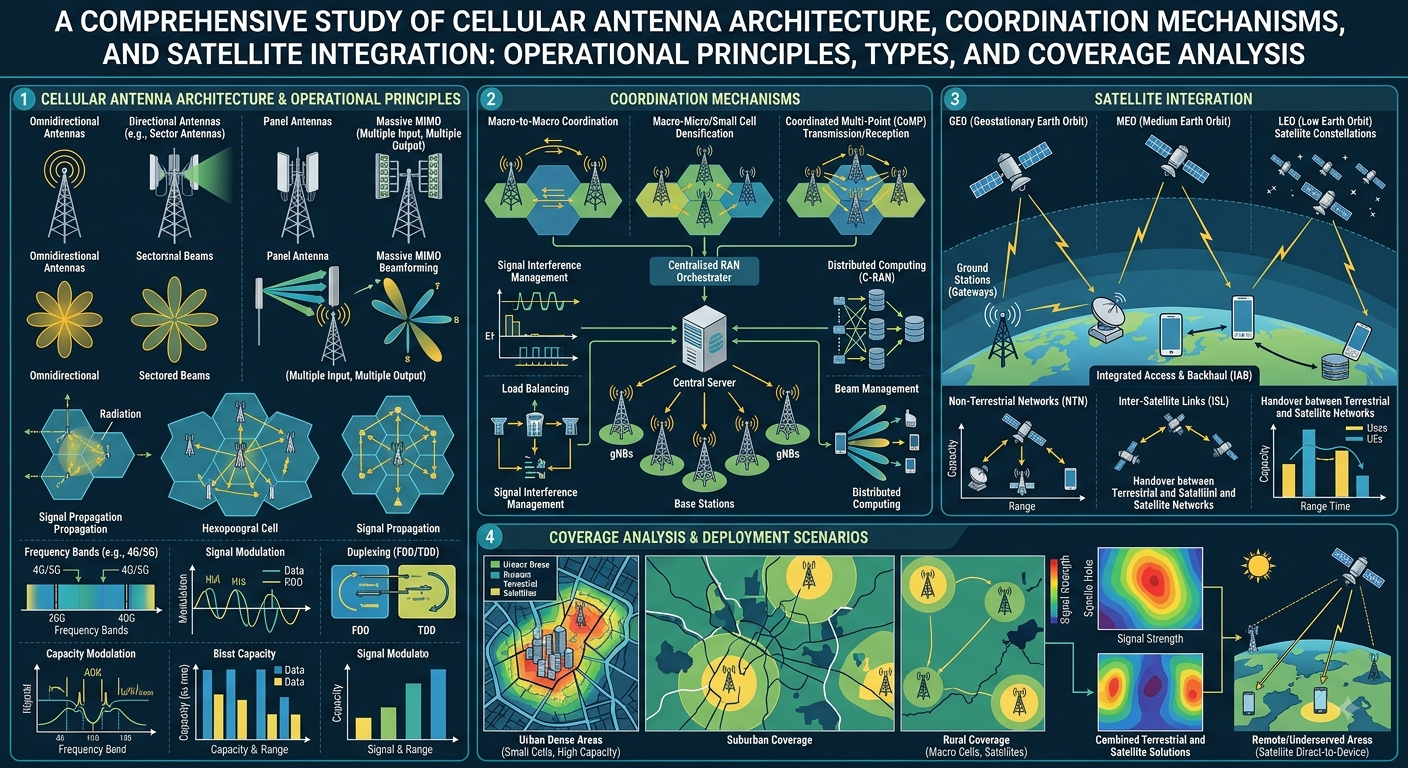
modern mobile connectivity is no longer simply a cell tower → phone relationship. It is becoming a coordinated system involving antennas, radio units, baseband processing, beamforming, terrestrial cells, transport networks, core networks, satellites, and increasingly AI-assisted orchestration.
The basic architecture has evolved approximately as:
2G → 3G → 4G LTE → 5G NR → 5G-Advanced → 6G
At the same time, the geographic architecture is evolving from:
Terrestrial tower → terrestrial tower + small cells → heterogeneous networks → terrestrial + satellite NTN → integrated terrestrial/non-terrestrial networks.
The significance of satellite integration is that a mobile network can potentially extend connectivity beyond the geographical and economic limits of conventional terrestrial infrastructure. 3GPP’s NTN work specifically addresses satellite access, mobility, timing, synchronization, handover, radio-resource management and integration with 5G systems. (ITU)
2. The Cellular Antenna as the Network’s Electromagnetic Interface
The antenna is the point at which the digital telecommunications system interacts with physical space.
A simplified transmission chain is:
Application → Core Network → Transport → Baseband → Radio Unit → Power Amplifier → Antenna → Electromagnetic Wave → User Equipment
The reverse process occurs during reception:
Phone → Antenna → Radio receiver → Analog/Digital conversion → Baseband → Transport → Core Network → Application
An antenna therefore does not independently provide cellular service. It is one component of a much larger radio-access system.
3. Fundamental Cellular Antenna Functions
A cellular antenna performs several fundamental functions:
Transmission
Converts RF electrical energy into electromagnetic radiation.
Reception
Captures electromagnetic energy and converts it into an electrical signal.
Directionality
Controls where radio energy is concentrated.
Polarization
Controls the orientation of the electromagnetic field.
Beam formation
Multiple antenna elements can cooperate to create electronically controlled beams.
Spatial separation
Multiple users can be served simultaneously through spatial processing.
Frequency operation
Antennas are engineered for particular frequency ranges and bandwidths.
4. Antenna Architecture
A modern cellular antenna system can contain:
- Antenna elements
- Feed networks
- Filters
- Duplexers
- Phase-control components
- Remote electrical tilt mechanisms
- RF amplifiers
- Radio units
- Digital interfaces
- Baseband processing
- Synchronization systems
- Network-management software
The physical antenna may therefore represent only the visible portion of a much larger radio system.
5. Major Cellular Antenna Types
5.1 Omnidirectional antennas
An omnidirectional antenna attempts to provide approximately 360-degree horizontal coverage.
They are useful in applications where coverage around the installation is required.
Their fundamental advantage is simplicity.
Their limitation is that they provide less spatial discrimination than sectorized or highly directional systems.
5.2 Sector antennas
Sectorization divides the geographic area around a site into sectors.
A common conceptual configuration is:
360° → 3 × approximately 120° sectors
Other configurations can use different sector widths.
Sectorization improves:
- frequency reuse
- interference management
- capacity
- spatial separation
- traffic distribution
A cellular site is therefore often better understood as a collection of directional radio sectors rather than one antenna covering everything.
6. Massive MIMO
One of the most important developments in 5G is Massive Multiple-Input Multiple-Output (Massive MIMO).
Instead of treating an antenna as one radiating element, a system can use an array containing many elements.
Conceptually:
Antenna Element 1
Antenna Element 2
Antenna Element 3
…
Antenna Element N
The signals can be controlled in amplitude and phase.
This enables:
Digital information → multiple RF paths → antenna array → controlled electromagnetic wavefront
and, in reception:
Wavefront → multiple antenna elements → signal processing → separated information streams
7. Beamforming
Beamforming is fundamental to modern 5G antenna architecture.
Instead of radiating all energy equally in every direction, the network can electronically form a beam toward a desired user or geographic region.
A simplified representation is:
User A ← Beam 1
User B ← Beam 2
User C ← Beam 3
while the antenna array dynamically adjusts its transmission pattern.
This can improve:
- signal quality
- spectral efficiency
- coverage
- capacity
- interference management
Beamforming becomes particularly important at higher frequencies because propagation characteristics make directional transmission increasingly valuable.
8. Analog, Digital and Hybrid Beamforming
There are three important architectural approaches.
Analog beamforming
RF phase control is performed largely in the analog domain.
Advantages include relatively low hardware complexity.
Digital beamforming
Signals are digitally processed across multiple antenna elements.
This provides greater flexibility but can require substantially more digital processing and RF-chain resources.
Hybrid beamforming
Combines analog and digital processing.
It attempts to balance:
Performance + flexibility + power consumption + hardware cost.
9. Antenna Tilt
Cellular antennas can be tilted downward or electronically adjusted.
The purpose is to control the geographic footprint of a cell.
Too little downward tilt can allow a signal to travel farther than desirable, potentially increasing interference.
Too much tilt can reduce coverage.
Therefore:
Antenna orientation = coverage geometry + interference management + capacity planning.
10. Cellular Coordination
Modern cellular networks do not operate as isolated towers.
They coordinate radio resources between neighboring cells.
Important coordination mechanisms include:
- interference coordination
- mobility management
- beam coordination
- carrier aggregation
- dual connectivity
- multi-TRP transmission
- load balancing
- handover
- spectrum management
- power control
The objective is to transform thousands of individual radio sites into one coordinated network.
11. Inter-Cell Interference
Imagine two neighboring cells transmitting on overlapping frequencies.
Their signals can interfere with one another.
A simplified representation is:
Cell A → User A
Cell B → User B
If the transmissions overlap spatially and spectrally, interference can occur.
Coordination attempts to optimize:
Signal + interference + available spectrum + user demand.
This becomes increasingly sophisticated in dense urban networks.
12. Small Cells
Large macro sites are not sufficient for every environment.
Small cells can be deployed in locations such as:
- dense urban districts
- shopping areas
- transport hubs
- campuses
- industrial facilities
- indoor environments
The resulting architecture becomes:
Macro Cell
↓
Small Cells
↓
Indoor Systems
↓
User Equipment
This is a heterogeneous network.
13. Distributed Radio Architecture
Modern cellular infrastructure can separate processing functions.
A simplified architecture is:
Antenna
↓
Radio Unit (RU)
↓
Distributed Unit (DU)
↓
Centralized Unit (CU)
↓
5G Core
This functional separation supports increasingly flexible network architectures.
Open and disaggregated approaches such as Open RAN seek to create more modular combinations of network components.
14. The Transport Network
The antenna cannot function as an isolated object.
The radio access network requires transport.
Typical technologies include:
- fiber
- microwave
- millimeter-wave transport
- Ethernet
- IP networks
- optical transport
Thus:
Antenna → Radio → Transport → Core
is fundamental to terrestrial cellular architecture.
15. The Cellular Core
The core network manages many functions beyond radio transmission.
These include:
- authentication
- mobility
- session management
- policy
- charging
- routing
- service connectivity
- security
- network slicing
In 5G, the architecture is increasingly software-defined and cloud-oriented.
16. Coverage Is More Than Distance
A common misconception is:
“The strongest antenna automatically provides the largest coverage.”
Real coverage depends on many variables.
Radio factors
- frequency
- transmit power
- antenna gain
- antenna height
- antenna pattern
- polarization
- bandwidth
- receiver sensitivity
Environmental factors
- buildings
- terrain
- vegetation
- atmospheric conditions
- obstacles
- reflections
Network factors
- interference
- cell loading
- scheduling
- spectrum allocation
- mobility
- beam management
Consequently:
Coverage ≠ simple geometric radius.
17. Frequency and Coverage
Lower frequencies generally propagate farther and penetrate obstacles better than higher frequencies.
This produces an important strategic relationship:
| Frequency region | General characteristic |
|---|---|
| Low band | Broad coverage |
| Mid band | Balance of coverage and capacity |
| Higher band | High capacity, shorter propagation range |
| mmWave | Very high capacity, highly directional |
The best mobile network therefore usually combines multiple frequency layers.
18. Coverage Architecture
A national mobile network can be conceptualized as a hierarchy:
National Network
↓
Regional Network
↓
Metro Network
↓
Macro Sites
↓
Small Cells
↓
Indoor Systems
↓
User Devices
Satellite systems introduce another layer:
LEO/MEO/GEO satellites
↓
Satellite beams
↓
Ground infrastructure / compatible terminals
↓
Users
19. Satellite Integration
Satellite integration fundamentally changes the geographical architecture of telecommunications.
Traditional model:
Phone → Cell Tower → Terrestrial Transport → Core
Satellite model:
Phone/Terminal → Satellite → Ground Gateway/Core
Integrated model:
Phone
↙ ↓ ↘
Terrestrial Cell | Satellite NTN | Other Access
↓
Common/Core Network
This is the direction of terrestrial–non-terrestrial network convergence.
3GPP Release 17 established normative NTN support, while subsequent work continues to expand integration and capabilities. (3GPP)
20. What Is NTN?
NTN = Non-Terrestrial Network.
It encompasses network infrastructure that is not located entirely on conventional terrestrial towers.
Examples include:
- LEO satellites
- MEO satellites
- GEO satellites
- high-altitude platforms
- other aerial platforms in appropriate architectures
3GPP’s NTN framework specifically considers satellite radio interfaces and associated functions such as synchronization, mobility, switchover and radio-resource management. (ITU)
21. LEO, MEO and GEO
LEO — Low Earth Orbit
LEO satellites operate relatively close to Earth.
Advantages include:
- lower latency than GEO
- potentially high link capacity
- smaller coverage footprints
- rapid movement relative to Earth
Challenge:
The satellite moves rapidly across the sky, requiring sophisticated tracking and handover.
MEO — Medium Earth Orbit
MEO provides an intermediate architecture.
It can provide broader coverage than LEO while generally having different latency and constellation requirements.
GEO — Geostationary Earth Orbit
GEO satellites remain apparently fixed over a particular longitude.
Advantages:
- very large geographic footprint
- stable pointing geometry
- mature satellite architecture
Major limitation:
High propagation latency compared with LEO.
22. Satellite Beam Architecture
A satellite does not necessarily transmit one enormous uniform signal.
Modern satellites can create multiple beams.
Conceptually:
Satellite
↙ ↓ ↘
Beam A | Beam B | Beam C
Each beam can cover a different geographic region.
This resembles terrestrial cellular sectorization in an important conceptual sense.
Thus satellite systems can also use:
- frequency reuse
- beam shaping
- beam steering
- beam hopping
- resource allocation
23. Terrestrial–Satellite Handover
A future integrated network could potentially support:
Terrestrial → Satellite
and
Satellite → Terrestrial
transitions.
For example:
A user leaves an urban region and enters a remote area.
The network could transition from:
Cellular coverage
to
Satellite coverage
and eventually return to terrestrial service.
3GPP explicitly identifies service continuity between terrestrial and satellite access as an architectural requirement. (3GPP)
24. Why Satellite Integration Is Difficult
Satellite links introduce challenges that terrestrial cellular systems do not normally experience at the same scale.
These include:
Large propagation distance
The signal travels much farther.
Doppler
A moving satellite produces significant frequency shifts.
Timing
Longer propagation distances affect timing relationships.
Moving coverage
LEO satellites continuously change position.
Handover
Users may need to transition between satellite beams and satellites.
Link budget
Received power can be substantially lower than in terrestrial environments.
Atmospheric effects
Higher-frequency links can experience atmospheric attenuation and other propagation effects.
3GPP NTN channel work explicitly considers path loss, line-of-sight probability, atmospheric absorption and ionospheric/tropospheric effects. (Nature)
25. Timing and Synchronization
Terrestrial cellular systems depend heavily on precise timing.
NTN makes this more difficult.
The network must account for:
Propagation delay + satellite movement + Doppler + timing advance.
Consequently, NTN specifications include enhancements to timing, synchronization and related procedures. (ITU)
26. Satellite Architecture: Transparent vs Regenerative
Two important concepts are:
Transparent payload
The satellite primarily relays the radio signal.
Conceptually:
User → Satellite Relay → Gateway → Network
Regenerative payload
More network processing occurs aboard the satellite.
Conceptually:
User → Satellite Processing → Network
Regenerative architectures can move some processing closer to the user but introduce greater onboard complexity.
Current research describes both transparent and regenerative 5G NTN architectures. (Nature)
27. Direct-to-Device / Direct-to-Cell
An especially important development is satellite connectivity involving ordinary mobile devices.
The broader objective is to reduce the requirement for specialized satellite terminals in certain services.
However, performance depends heavily on:
- spectrum
- satellite antenna capability
- terrestrial-device antenna characteristics
- link budget
- regulatory authorization
- satellite constellation geometry
- network architecture
Direct-to-device and standards-based NTN are related but are not identical architectural concepts; current research distinguishes commercial direct-to-cell approaches from standardized 3GPP NTN architectures. (arXiv)
28. The Future: One Network, Multiple Layers
The long-term architecture can be represented as:
                    SPACE LAYER
        ┌───────────────────────────────┐
        │       LEO / MEO / GEO         │
        │       Satellite Beams         │
        └───────────────┬───────────────┘
                        │
                 Satellite Links
                        │
              ┌─────────▼─────────┐
              │   NTN Network     │
              └─────────┬─────────┘
                        │
────────────────────────┼────────────────────────
                TERRESTRIAL LAYER
                        │
        ┌───────────────▼───────────────┐
        │       5G / 6G Core            │
        └───────────────┬───────────────┘
                        │
              ┌─────────▼─────────┐
              │ CU / DU / RU      │
              └─────────┬─────────┘
                        │
             ┌──────────▼──────────┐
             │ Macro / Small Cells │
             └──────────┬──────────┘
                        │
                   USER DEVICES
This is increasingly becoming a multi-layer connectivity ecosystem rather than a conventional cellular network.
29. AI and Network Coordination
AI can potentially become an important coordination layer.
Instead of configuring networks only through predetermined rules, future systems can analyze:
- traffic demand
- user mobility
- antenna performance
- interference
- satellite positions
- weather
- spectrum utilization
- network congestion
- predicted handovers
and continuously optimize network resources.
Recent ITU research describes architectures in which satellite telemetry and ephemeris information are used for predictive handover and coverage analytics, together with AI-based orchestration across terrestrial and satellite networks. (ITU)
30. From Static Cells to Dynamic Connectivity
The traditional cellular model is relatively static:
Tower → Fixed Cell → Users
The emerging model is dynamic:
Tower + Small Cell + Satellite + Beam + Edge Computing + AI
The network can dynamically determine:
Who should connect → through which access network → using which beam → at what frequency → with what resources.
This is one of the most important conceptual transitions in telecommunications.
31. Coverage Comparison
| Architecture | Main strength | Main limitation |
|---|---|---|
| Macro cellular | Large terrestrial coverage | Infrastructure cost |
| Small cell | High capacity | Smaller coverage |
| mmWave | Very high capacity | Shorter effective range |
| LEO NTN | Broad geographic reach | Moving satellites/handover |
| MEO | Large coverage | Higher latency than LEO |
| GEO | Huge footprint | High latency |
| Hybrid TN + NTN | Resilience and broad coverage | High architectural complexity |
32. Rural South African Application
For a country such as South Africa, hybrid architecture could be particularly significant.
A conceptual rural connectivity model would be:
Fiber/Microwave Core
↓
Regional Cellular Sites
↓
Remote Macro Cells
↓
Satellite Backhaul / NTN
↓
Remote Communities
This could reduce the need to provide the same terrestrial infrastructure density everywhere.
However, satellite should not simply be viewed as a replacement for terrestrial networks. Its strongest strategic role is often as a complementary layer, particularly where terrestrial infrastructure is difficult or uneconomic.
33. Industrial Applications
Integrated terrestrial–satellite networks can potentially support:
- agriculture
- mining
- logistics
- maritime communications
- environmental monitoring
- disaster response
- remote infrastructure
- transportation
- IoT
- emergency communications
This is especially important for geographically dispersed assets.
34. Mining Example
Consider a remote mining operation.
A conventional architecture could require:
Mine → Microwave/Fiber → Cellular Network
A hybrid architecture could provide:
Mine
↙ ↓ ↘
Local 5G | Satellite | Microwave
↓
Edge/Core Infrastructure
This creates redundancy.
If one connectivity path becomes unavailable, another may remain available, depending on the system design.
35. Antenna + Satellite Convergence
The antenna itself is becoming more intelligent.
Future antenna systems increasingly combine:
RF electronics + antenna arrays + beamforming + software + sensing + AI control.
The boundary between:
antenna engineering
and
network engineering
is therefore becoming increasingly blurred.
36. The Complete Connectivity Stack
A useful way to study the entire system is through seven layers:
Layer 1 — Electromagnetic layer
Radio waves, propagation and antennas.
Layer 2 — RF layer
Amplification, filtering, frequency conversion and RF chains.
Layer 3 — Radio-access layer
5G NR, scheduling, MIMO, beamforming and mobility.
Layer 4 — Transport layer
Fiber, microwave, satellite and IP transport.
Layer 5 — Core network
Authentication, sessions, routing, policy and mobility.
Layer 6 — Application/edge layer
Cloud, edge computing, IoT and applications.
Layer 7 — Intelligence layer
AI-driven optimization, prediction and orchestration.
This provides a powerful framework for understanding modern telecommunications.
37. Major Research Questions for the Thesis
Your thesis can investigate questions such as:
- How does antenna architecture determine cellular coverage?
- How does Massive MIMO increase capacity?
- How does beamforming alter coverage and interference?
- How do neighboring cells coordinate?
- How does mobility management work?
- How does frequency influence coverage?
- How do macro cells and small cells cooperate?
- How does 5G RAN architecture divide processing between RU, DU and CU?
- How do satellites integrate with 5G?
- What changes when the satellite itself becomes a radio access node?
- How does LEO mobility affect handover?
- How are Doppler and timing handled?
- What is the difference between satellite backhaul and direct satellite access?
- How can terrestrial and satellite networks provide service continuity?
- How can AI optimize hybrid networks?
- What are the economics of terrestrial versus satellite coverage?
- How could integrated NTN/TN architecture contribute to universal connectivity?
38. Strategic Significance
The deeper significance of this subject is that telecommunications infrastructure is moving from a geographic network toward a three-dimensional connectivity system.
The traditional network primarily occupies the Earth’s surface:
Ground → Tower → User
The emerging network occupies:
Ground + Air + Space
with connectivity potentially moving dynamically between these layers.
3GPP’s NTN work explicitly addresses this convergence, including satellite access, mobility, service continuity, satellite backhaul and interaction with terrestrial 5G networks. (3GPP)
39. Proposed Thesis Structure
For a full academic version, I would structure the work as follows:
- Introduction to Cellular Communications
- History of Cellular Antennas
- Electromagnetic Principles
- Antenna Types and Architectures
- Sectorization and Cell Planning
- MIMO and Massive MIMO
- Beamforming and Beam Management
- Inter-Cell Coordination
- Radio Access Network Architecture
- RU, DU and CU Architecture
- 5G NR
- Small Cells and Dense Networks
- Coverage and Propagation Analysis
- Mobility and Handover
- Satellite Communications
- LEO, MEO and GEO Architectures
- 5G Non-Terrestrial Networks
- Satellite–Terrestrial Integration
- Direct-to-Device Connectivity
- AI-Based Network Orchestration
- 6G and Future Antenna Architecture
- South African Applications
- Economic and Infrastructure Implications
- Technical Challenges
- Future Research
- Conclusion
Conclusion
The modern cellular antenna should no longer be viewed simply as a metal structure mounted on a tower. It is the electromagnetic interface of an enormous distributed computing and communications system.
The evolution can be summarized as:
Antenna → Sector → Cell → Multi-cell Network → Massive MIMO → Intelligent Beamforming → Cloud RAN → 5G → NTN → Terrestrial/Satellite Convergence → AI-Orchestrated 6G
The most important architectural development is the transition from isolated terrestrial cellular infrastructure toward coordinated heterogeneous networks containing macro cells, small cells, advanced antenna arrays, fiber/microwave transport, edge computing, satellites and intelligent network orchestration.
Current standards work already provides a foundation for this transition: 3GPP Release 17 introduced normative NTN requirements, while current research is investigating deeper terrestrial–satellite coordination, predictive handover and AI-driven orchestration for future networks. (3GPP)
That makes your proposed study relevant not only to antenna engineering, but also to telecommunications, satellite engineering, computer networks, AI, infrastructure planning, rural connectivity, industrial automation and the emerging 6G economy.




Be First to Comment