
Abstract
Intelligence Quotient (IQ) is one of the most widely used psychological measurements for assessing aspects of human cognitive ability. Although IQ tests cannot fully capture the richness of human intelligence, they provide valuable insights into reasoning, problem-solving, learning ability, memory, and information processing. Modern psychology recognizes that intelligence is multidimensional and is influenced by genetics, education, nutrition, health, environment, motivation, and lifelong learning.
This thesis explores the concept of IQ, the meaning of normal and average intelligence, characteristics of highly intelligent individuals, limitations of IQ testing, biological foundations of intelligence, and practical methods for developing cognitive abilities.
Chapter 1: Introduction
Human civilization has always depended on intelligence. Every scientific discovery, engineering breakthrough, artistic masterpiece, and technological innovation has originated from the human brain.
Intelligence enables people to:
- Learn from experience
- Solve unfamiliar problems
- Adapt to changing environments
- Recognize patterns
- Make logical decisions
- Create new knowledge
- Build civilizations
Psychologists developed IQ tests to estimate certain cognitive abilities using standardized methods.
However, IQ represents only one dimension of human capability.
Chapter 2: What is IQ?
IQ stands for Intelligence Quotient.
Originally, it was calculated as:
IQ = (Mental Age ÷ Chronological Age) × 100
Today, most modern IQ tests use statistical standardization rather than this original formula. Scores are designed so that the population average is 100, with most people clustering around that value.
IQ tests typically measure:
- Logical reasoning
- Mathematical reasoning
- Pattern recognition
- Spatial visualization
- Working memory
- Processing speed
- Verbal comprehension
They generally do not directly measure creativity, emotional intelligence, wisdom, morality, leadership, or practical life skills.
Chapter 3: Biological Foundations of Intelligence
The human brain contains approximately 86 billion neurons connected through trillions of synapses.
Cognitive performance depends on factors such as:
- Neuronal connectivity
- Synaptic efficiency
- Brain plasticity
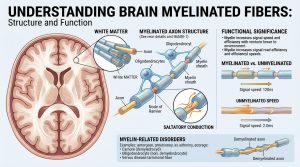
- White matter organization
- Healthy blood circulation
- Adequate sleep
- Nutrition
- Physical exercise
Important brain regions include:
- Frontal lobe — planning and reasoning
- Parietal lobe — spatial processing
- Temporal lobe — memory and language
- Occipital lobe — visual processing
- Hippocampus — memory formation
- Prefrontal cortex — executive decision-making
Chapter 4: Distribution of IQ
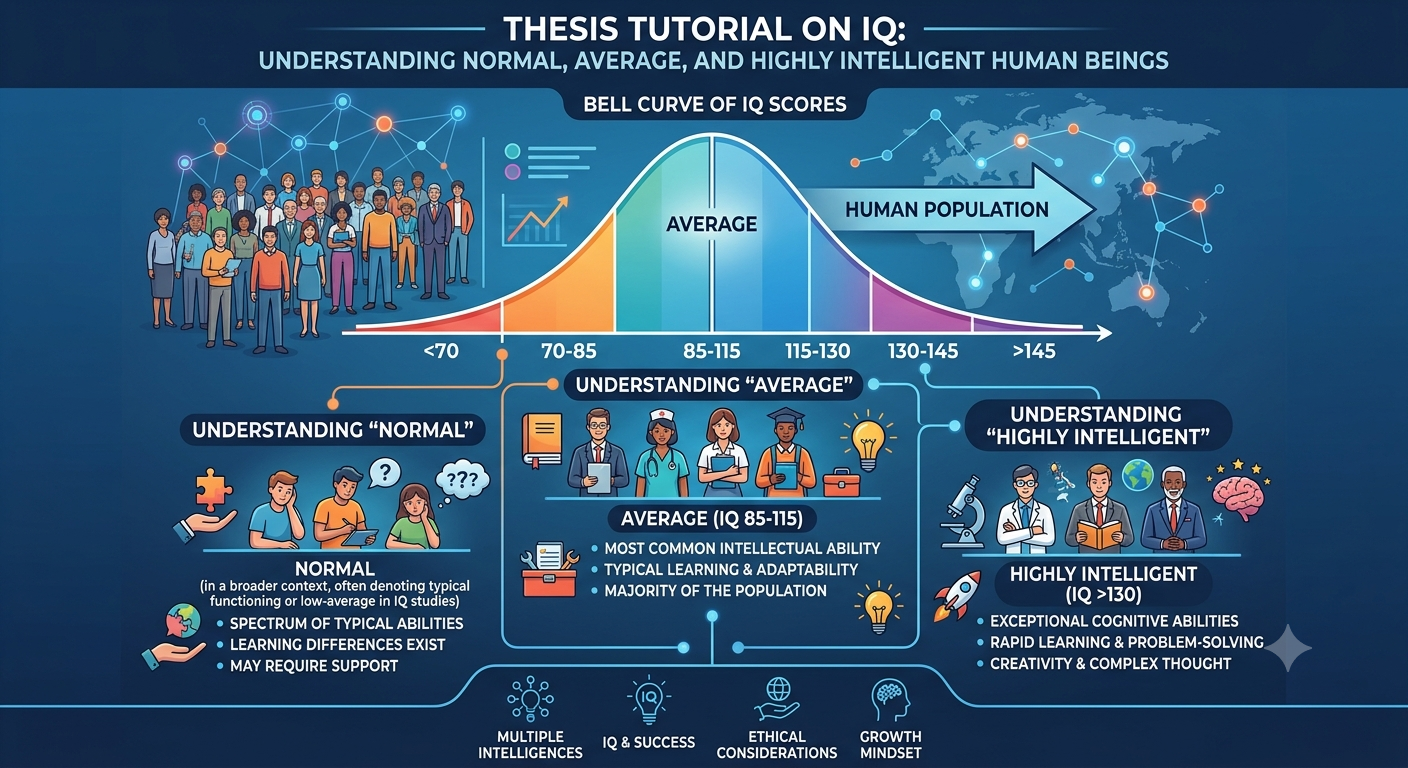
IQ scores are designed to follow an approximately normal (bell-shaped) distribution, meaning most people score near the average and fewer people are found at the extremes.
Approximate ranges are:
| IQ Range | General Interpretation | Approximate Share of Population |
|---|---|---|
| Below 70 | Significantly below average (requires clinical assessment) | ~2% |
| 70–84 | Below average | ~14% |
| 85–115 | Average range | ~68% |
| 116–129 | Above average | ~14% |
| 130 and above | Very high intelligence | ~2% |
These ranges are approximate and can vary slightly depending on the specific IQ test.
Chapter 5: Characteristics of Average Intelligence (IQ 85–115)
People within the average IQ range typically:
- Learn effectively in standard educational settings.
- Solve everyday practical problems.
- Understand common concepts and instructions.
- Adapt to routine work and social environments.
- Develop expertise through education and experience.
Most teachers, engineers, technicians, entrepreneurs, nurses, mechanics, and professionals fall within or near this range. Success depends on many factors beyond IQ, including perseverance, opportunity, training, and motivation.
Chapter 6: Characteristics of Above-Average and Highly Intelligent Individuals
Individuals with higher IQs often demonstrate:
- Rapid learning
- Strong abstract reasoning
- Excellent pattern recognition
- Faster acquisition of complex concepts
- Strong analytical thinking
- Curiosity
- Long-term strategic planning
- Advanced mathematical reasoning
Many scientists, mathematicians, researchers, inventors, and engineers score above average on cognitive tests. However, high IQ alone does not guarantee success, creativity, or leadership.
Chapter 7: Intelligence Beyond IQ
Researchers increasingly recognize multiple dimensions of human ability, including:
- Emotional intelligence (understanding and managing emotions)
- Creative intelligence (generating novel ideas)
- Practical intelligence (solving real-world problems)
- Social intelligence (working effectively with others)
- Moral reasoning and ethical judgment
- Cultural knowledge and communication
A person may excel in one area while being average in another.
Chapter 8: Factors Influencing Cognitive Development
Intellectual development is shaped by both biological and environmental influences:
- Genetics
- Prenatal health
- Early childhood nutrition
- Quality of education
- Reading habits
- Language exposure
- Physical activity
- Sleep quality
- Mental stimulation
- Stress management
- Social environment
Healthy environments support cognitive growth throughout life.
Chapter 9: Developing Intellectual Ability
Although IQ tends to be relatively stable over adulthood, many cognitive skills can improve through practice and learning. Helpful habits include:
- Reading widely
- Studying mathematics and logic
- Learning new languages
- Playing strategy games
- Practicing problem-solving
- Regular physical exercise
- Adequate sleep
- Balanced nutrition
- Continuous education
- Lifelong curiosity
These activities strengthen knowledge, expertise, and many aspects of cognitive performance.
Chapter 10: Limitations of IQ Testing
IQ tests have important limitations:
- They measure only selected cognitive abilities.
- Performance can be influenced by health, fatigue, stress, or testing conditions.
- They do not directly measure creativity, wisdom, empathy, or character.
- Cultural and educational experiences can affect performance.
- A single score should not define a person’s overall potential.
Modern psychologists therefore interpret IQ alongside broader educational, developmental, and behavioral information.
Chapter 11: Intelligence and Society
Societies benefit when they foster intellectual development through:
- High-quality education
- Scientific research
- Innovation
- Public health
- Libraries
- Universities
- Technical training
- Lifelong learning opportunities
Investing in human capital supports economic growth, technological advancement, and improved quality of life.
Chapter 12: Conclusion
IQ provides a useful, standardized estimate of certain cognitive abilities, especially reasoning, problem-solving, and learning. Most people fall within the average range of approximately 85–115, while smaller proportions score significantly above or below this range.
However, intelligence is broader than any single test score. Creativity, emotional intelligence, practical skills, perseverance, ethics, collaboration, and continuous learning all contribute to meaningful achievement. Individuals across the IQ spectrum can make valuable contributions to society when supported by education, opportunity, and healthy environments.
A balanced understanding of intelligence recognizes both the usefulness of IQ assessment and the many other human qualities that shape success and progress.


Be First to Comment