
A Comprehensive Strategic Article
Executive Summary
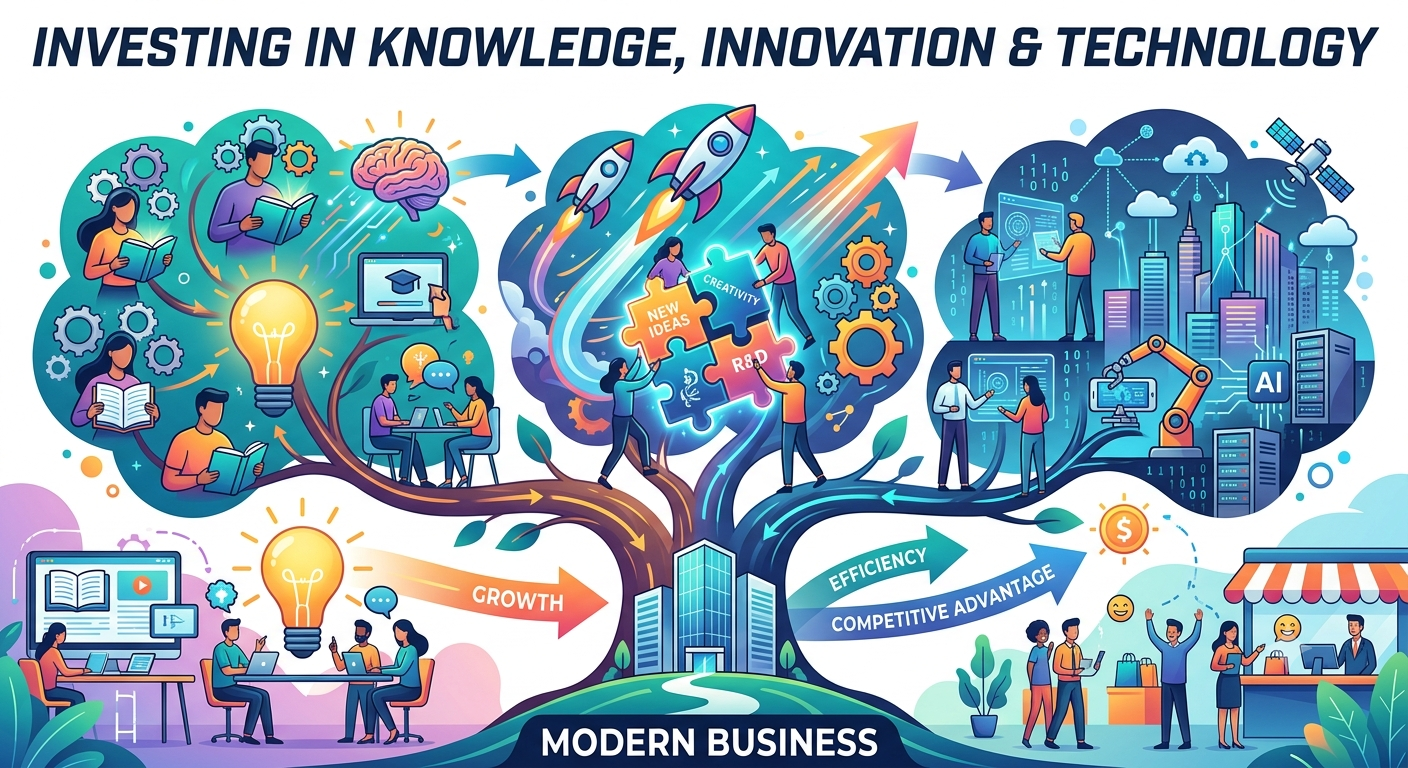
In the 21st-century economy, the world’s most successful organizations are increasingly distinguished not by the amount of physical assets they own, but by the quality of their knowledge, their ability to innovate, and their effective use of technology.
Historically, businesses competed primarily through access to land, labor, machinery, or natural resources. Today, while those resources remain important, sustainable competitive advantage is increasingly built on intangible assets such as expertise, intellectual property, data, digital capabilities, organizational learning, and technological innovation.
Businesses that consistently invest in knowledge, innovation, and technology tend to be better equipped to:
- Increase productivity
- Improve customer satisfaction
- Reduce operating costs
- Respond to market changes
- Create new products and services
- Expand internationally
- Build long-term resilience
This article presents a comprehensive framework for understanding how these three pillars work together.
Part 1: The Three Strategic Investment Pillars
Imagine a three-legged stool:
Knowledge provides understanding.
↓
Innovation transforms understanding into value.
↓
Technology scales that value efficiently.
Without one of these pillars, long-term growth becomes difficult.
Pillar One: Investing in Knowledge
What is Knowledge?
Knowledge is organized understanding acquired through learning, experience, research, observation, and practice.
Knowledge helps organizations answer questions such as:
- What do customers want?
- How does our industry work?
- What problems exist?
- How can processes improve?
- What new opportunities are emerging?
Knowledge becomes an asset when it can be shared, retained, and applied repeatedly.
Types of Business Knowledge
1. Industry Knowledge
Understanding:
- Market trends
- Regulations
- Competitors
- Supply chains
- Customer behavior
2. Technical Knowledge
Examples include:
- Engineering
- Programming
- Artificial Intelligence
- Data Science
- Manufacturing
- Agriculture
3. Financial Knowledge
Including:
- Accounting
- Investment
- Budgeting
- Cash flow
- Risk management
4. Customer Knowledge
Understanding:
- Buying behavior
- Preferences
- Pain points
- Demographics
- User experience
5. Operational Knowledge
Knowing:
- How work gets done
- Standard operating procedures
- Quality control
- Logistics
- Production systems
6. Leadership Knowledge
Including:
- Strategy
- Communication
- Motivation
- Negotiation
- Governance
- Ethics
Methods of Investing in Knowledge
Businesses invest through:
- Employee education
- Professional certifications
- Research
- Libraries
- Online learning
- Conferences
- Workshops
- Mentorship
- Internal documentation
- Knowledge management systems
Benefits of Knowledge Investment
Organizations become:
- Smarter
- Faster learners
- Better decision-makers
- More adaptable
- More innovative
- More resilient
Pillar Two: Investing in Innovation
What is Innovation?
Innovation is the successful application of new ideas that create value.
Innovation is not merely invention. A brilliant idea becomes an innovation when it is implemented and adopted.
Types of Innovation
Product Innovation
Creating new products.
Examples:
- Smartphones
- Electric vehicles
- AI software
- Medical devices
Process Innovation
Improving how work is performed.
Examples:
- Automation
- Robotics
- Lean manufacturing
Business Model Innovation
Changing how value is created or captured.
Examples include subscription models, marketplaces, and direct-to-consumer approaches.
Marketing Innovation
Improving customer engagement through new channels, branding, or pricing.
Organizational Innovation
Improving:
- Company structure
- Decision-making
- Culture
- Collaboration
Innovation Investment Areas
Businesses commonly invest in:
- Research and development (R&D)
- Innovation laboratories
- Startup partnerships
- Incubators
- Accelerators
- Patent development
- Design thinking
- Customer research
Innovation Culture
Successful companies encourage:
- Curiosity
- Experimentation
- Continuous improvement
- Learning from failures
- Cross-functional collaboration
Pillar Three: Investing in Technology
What is Technology?
Technology is the practical application of scientific and engineering knowledge to solve problems and improve productivity.
Modern technology spans hardware, software, communications, automation, and digital systems.
Technology Categories
Information Technology (IT)
Including:
- Computers
- Servers
- Networks
- Databases
- Cloud computing
Artificial Intelligence
Applications include:
- Predictive analytics
- Computer vision
- Recommendation systems
- Natural language processing
- AI assistants
- Autonomous agents
Automation
Including:
- Industrial robots
- Workflow automation
- Business process automation
- Intelligent automation
Cloud Computing
Benefits include:
- Scalability
- Reduced infrastructure costs
- Global accessibility
- Faster deployment
Internet of Things (IoT)
Connected devices used in:
- Agriculture
- Manufacturing
- Smart cities
- Healthcare
- Logistics
Cybersecurity
Protecting:
- Data
- Networks
- Intellectual property
- Customer information
- Critical infrastructure
Big Data Analytics
Helping organizations analyze large datasets to identify trends and support decision-making.
Why Businesses Invest in Technology
Technology enables organizations to:
- Produce faster
- Reduce errors
- Increase efficiency
- Improve quality
- Enhance customer experience
- Make data-driven decisions
How Knowledge, Innovation, and Technology Work Together
| Knowledge | Innovation | Technology |
|---|---|---|
| Understand problems | Develop solutions | Deliver solutions at scale |
| Research | Create | Implement |
| Learn | Improve | Automate |
| Observe | Experiment | Scale |
The strongest organizations continuously cycle through these three stages.
Building a Knowledge-Driven Organization
A knowledge-driven organization typically follows this cycle:
- Learn from data and experience.
- Share insights across teams.
- Generate ideas.
- Test and refine solutions.
- Implement improvements using technology.
- Measure outcomes.
- Capture lessons learned.
- Repeat.
This creates a culture of continuous learning and improvement.
Measuring Return on Investment (ROI)
Businesses assess the impact of investments using indicators such as:
Knowledge
- Employee skills
- Training completion
- Knowledge-sharing activity
- Productivity improvements
Innovation
- Number of new products
- Patents filed
- Revenue from new offerings
- Time to market
Technology
- Process automation rate
- System uptime
- Cost savings
- Customer satisfaction
- Digital adoption
- Cybersecurity performance
Challenges and Risks
Common obstacles include:
- High upfront costs
- Resistance to change
- Skills shortages
- Cybersecurity threats
- Rapid technological change
- Regulatory compliance
- Legacy systems
- Uncertain returns on innovation projects
Mitigation strategies include phased implementation, continuous training, robust governance, and regular technology reviews.
Best Practices
Successful organizations typically:
- Develop a long-term strategy.
- Invest consistently in employee learning.
- Encourage innovation at all levels.
- Build strong digital infrastructure.
- Protect intellectual property.
- Use data to guide decisions.
- Foster partnerships with universities, startups, and research institutions.
- Continuously monitor emerging technologies.
- Promote ethical use of technology and AI.
- Measure outcomes and refine investments over time.
Sector Applications
Different industries apply these pillars in distinct ways:
- Manufacturing: smart factories, automation, predictive maintenance, and digital twins.
- Healthcare: electronic health records, AI-assisted diagnostics, telemedicine, and precision medicine.
- Agriculture: precision farming, drones, sensors, weather analytics, and automated irrigation.
- Finance: digital banking, fraud detection, algorithmic risk management, and personalized financial services.
- Retail: e-commerce, inventory optimization, customer analytics, and omnichannel experiences.
- Education: online learning platforms, adaptive learning systems, virtual laboratories, and AI tutors.
- Government: digital public services, data-driven policymaking, smart infrastructure, and cybersecurity.
- Energy: smart grids, renewable energy optimization, energy storage, and predictive maintenance.
Future Trends
Over the next decade, investment is expected to focus increasingly on:
- Advanced AI and autonomous agents
- Quantum computing
- Edge computing
- Digital twins
- Robotics and autonomous systems
- Biotechnology and synthetic biology
- Advanced materials
- Clean energy technologies
- Space technologies
- Human–AI collaboration
- Cyber resilience
- Sustainable and circular business models
Organizations that combine these technologies with strong knowledge management and a culture of innovation are likely to be better positioned for long-term success.
A Strategic Maturity Framework
Organizations can view their progress through five stages:
| Stage | Knowledge | Innovation | Technology |
|---|---|---|---|
| 1. Foundation | Basic training and documentation | Incremental improvements | Core IT systems |
| 2. Development | Structured learning and analytics | Dedicated R&D and process innovation | Cloud adoption and automation |
| 3. Integration | Enterprise knowledge sharing | Cross-functional innovation | Integrated digital platforms and AI-assisted workflows |
| 4. Optimization | Continuous learning culture | Data-driven innovation portfolio | Advanced analytics, automation, and cybersecurity |
| 5. Leadership | Organization-wide knowledge ecosystem | Innovation embedded in strategy | Scalable, adaptive, and emerging technologies |
Conclusion
Investing in knowledge, innovation, and technology is not a one-time project but a continuous strategic commitment. Knowledge equips organizations to understand problems and opportunities, innovation transforms ideas into valuable products, services, and processes, and technology enables those innovations to be delivered efficiently and at scale.
Businesses that align these three pillars with clear leadership, skilled people, ethical governance, and long-term strategic planning are generally better prepared to compete in an increasingly digital, knowledge-based global economy. In the modern era, sustainable success depends not only on what a business owns, but also on what it knows, how effectively it innovates, and how intelligently it applies technology.



Be First to Comment