
Time is one of the most fundamental dimensions in science, engineering, technology, economics, biology, astronomy, and everyday life. It provides the framework for measuring change, organizing events, synchronizing systems, and understanding the universe.
1. What is Time?
Time is the continuous progression of existence from the past, through the present, into the future.
Unlike length, mass, or temperature, time flows in one direction (known as the Arrow of Time).
Time enables us to measure:
- Motion
- Growth
- Aging
- Change
- Energy transfer
- Communication
- Computation
- Evolution
- History
2. The Modern SI Unit of Time
The international standard unit is the
Second (s)
Since 1967, one second has been officially defined as:
The duration of 9,192,631,770 oscillations of radiation produced by the transition between two energy levels of the Cesium-133 atom.
Modern atomic clocks use this definition.
Accuracy:
Modern atomic clocks lose less than one second in hundreds of millions of years.
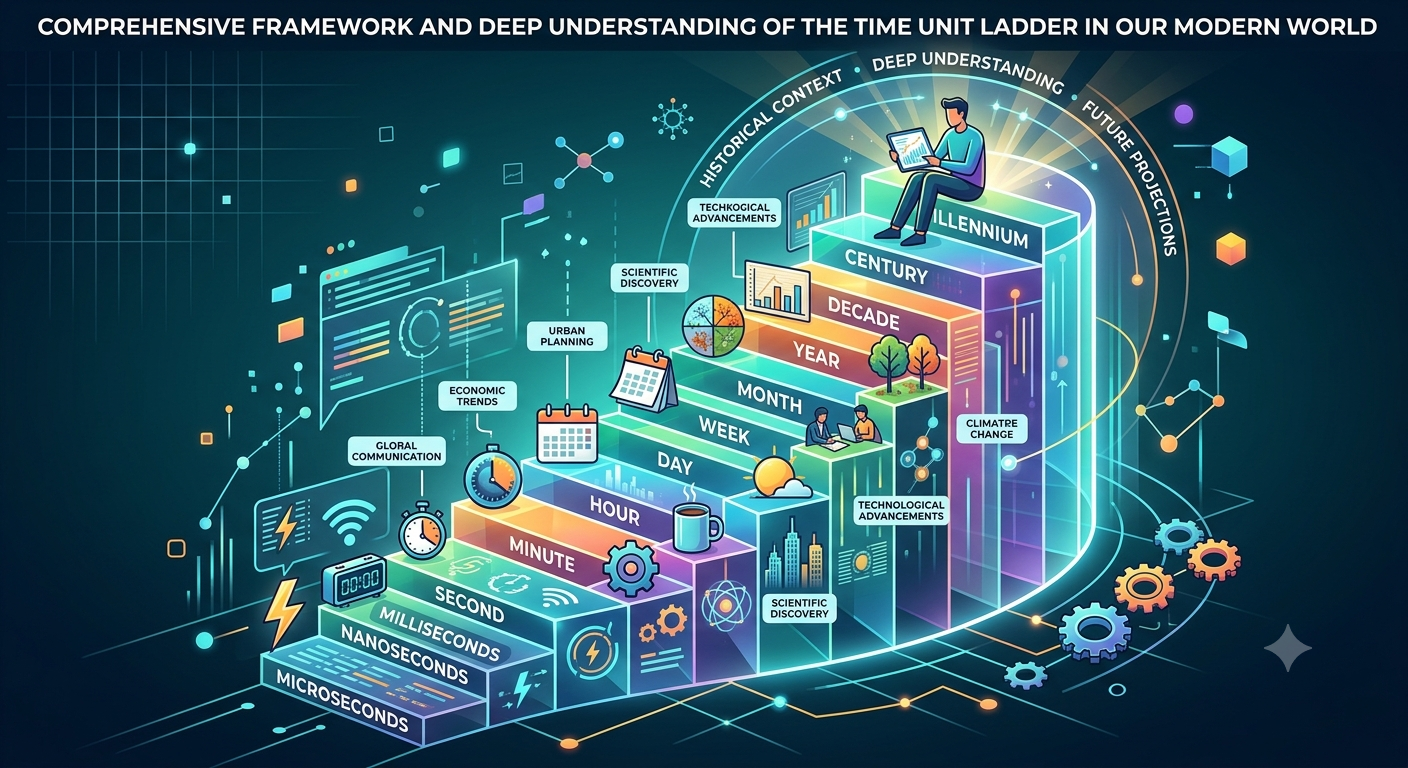
3. The Complete Time Ladder
Level 1 — Planck Time
Smallest meaningful unit in modern physics.
1 Planck Time
≈
5.39 × 10⁻⁴⁴ seconds
Occurs in
- Quantum Gravity
- Early Universe
- Black Hole Physics
Level 2 — Yoctosecond
10⁻²⁴ seconds
Used in
- Nuclear reactions
- Particle collisions
Level 3 — Zeptosecond
10⁻²¹ seconds
Used for
- Electron movement
- Light passing through atoms
Level 4 — Attosecond
10⁻¹⁸ seconds
Used in
- Electron dynamics
- Laser physics
Level 5 — Femtosecond
10⁻¹⁵ seconds
Applications
- Chemistry
- Molecular bonds
- Ultrafast lasers
Level 6 — Picosecond
10⁻¹² seconds
Applications
- Fiber optics
- Computer chips
Level 7 — Nanosecond
10⁻⁹ seconds
Applications
- CPUs
- Computer memory
- GPS timing
- Telecommunications
Level 8 — Microsecond
10⁻⁶ seconds
Applications
- Electronic sensors
- Radar
- Digital cameras
Level 9 — Millisecond
10⁻³ seconds
Applications
- Human reaction time
- Video games
- Internet latency
Level 10 — Second
Base SI unit
Examples
- Heartbeat
- Stopwatch
- Atomic clock
Level 11 — Minute
60 seconds
Examples
- Cooking
- Meetings
- Telephone calls
Level 12 — Hour
60 minutes
Examples
- Work
- School
- Flights
Level 13 — Day
24 hours
Earth rotates once.
Level 14 — Week
7 days
Used worldwide for calendars and business planning.
Level 15 — Month
Approximately
28–31 days
Based historically on the Moon’s orbit.
Level 16 — Quarter
3 months
Used in
- Businesses
- Finance
- Government reporting
Level 17 — Year
365.2422 days
Earth completes one orbit around the Sun.
Level 18 — Leap Year
366 days
Occurs every four years with century-year exceptions to keep calendars aligned with Earth’s orbit.
Level 19 — Decade
10 years
Level 20 — Century
100 years
Level 21 — Millennium
1000 years
Examples
- 1st Millennium
- 2nd Millennium
- 3rd Millennium
4. Geological Time Ladder
Scientists studying Earth history use much larger divisions.
| Unit | Approximate Duration |
|---|---|
| Age | Millions of years |
| Epoch | Tens of millions of years |
| Period | 50–100 million years |
| Era | Hundreds of millions of years |
| Eon | Billions of years |
Earth is about 4.54 billion years old.
5. Cosmological Time Ladder
The universe operates on even larger scales.
| Time | Event |
|---|---|
| 10⁻⁴³ s | Planck Epoch |
| 10⁻³⁶ s | Cosmic Inflation |
| 1 second | First particles stabilize |
| 3 minutes | Most hydrogen and helium nuclei form |
| 380,000 years | Light separates from matter (Cosmic Microwave Background) |
| 13.8 billion years | Present age of the universe |
6. Human Biological Time
Humans experience time biologically through rhythms.
| Scale | Example |
|---|---|
| Milliseconds | Nerve impulses |
| Seconds | Breathing |
| Minutes | Digestion begins |
| Hours | Sleep cycles |
| Days | Circadian rhythm |
| Months | Hormonal cycles |
| Years | Aging |
| Decades | Human lifespan stages |
7. Computer Time Ladder
Modern computers operate at extremely small time scales.
| Unit | Example |
|---|---|
| Nanoseconds | CPU operations |
| Microseconds | SSD access |
| Milliseconds | Web requests |
| Seconds | Program execution |
| Minutes | Data backups |
| Hours | AI model training jobs |
| Days | Large cloud computations |
8. Internet Time
Digital networks depend on precise timing.
Examples include:
- Data packet transmission
- Streaming
- Financial trading
- Cloud synchronization
- GPS navigation
- Blockchain timestamping
Even differences of a few nanoseconds can matter in high-frequency systems.
9. Financial Time
Markets organize activity across multiple horizons.
| Unit | Example |
|---|---|
| Milliseconds | High-frequency trading |
| Seconds | Price updates |
| Minutes | Intraday trading |
| Hours | Market sessions |
| Days | Daily closing prices |
| Months | Quarterly earnings |
| Years | Long-term investing |
10. Engineering Time
Engineers design systems over varying durations.
Examples:
- Bridge lifespan (100+ years)
- Satellites (10–20 years)
- Nuclear plants (40–80 years)
- Aircraft (30–40 years)
- Smartphones (3–7 years)
- Batteries (thousands of charge cycles)
11. Time in Physics
Physics treats time differently across theories:
- Classical Mechanics: Time is absolute and flows uniformly.
- Special Relativity: Time depends on relative motion; moving clocks run slower.
- General Relativity: Gravity affects the passage of time; stronger gravity causes clocks to tick more slowly.
- Quantum Mechanics: Time is typically treated as an external parameter rather than a quantum observable, and its ultimate role remains an active area of research.
12. The Hierarchical Time Pyramid
Universe
│
├── Billions of Years
│
├── Millions of Years
│
├── Thousands of Years
│
├── Centuries
│
├── Decades
│
├── Years
│
├── Months
│
├── Weeks
│
├── Days
│
├── Hours
│
├── Minutes
│
├── Seconds
│
├── Milliseconds
│
├── Microseconds
│
├── Nanoseconds
│
├── Picoseconds
│
├── Femtoseconds
│
├── Attoseconds
│
├── Zeptoseconds
│
├── Yoctoseconds
│
└── Planck Time
13. Why Understanding the Time Ladder Matters
A strong grasp of time scales helps in many fields:
- Physics: Understanding motion, relativity, and the universe.
- Astronomy: Measuring stellar and cosmic evolution.
- Engineering: Designing reliable systems with appropriate lifespans.
- Computer Science: Optimizing algorithms, processors, and networks.
- Artificial Intelligence: Coordinating training, inference, and distributed computing.
- Medicine: Monitoring biological rhythms, diagnostics, and treatment timing.
- Finance: Managing markets, investments, and risk over different horizons.
- History and Archaeology: Placing events within human and geological timelines.
- Project Management: Planning tasks from seconds to years.
Key Takeaway
The time unit ladder spans an extraordinary range—from the Planck time (about (5.39 \times 10^{-44}) seconds), which represents the smallest meaningful interval in current physical theories, to billions of years, covering the age of planets, stars, and the universe. Every scientific discipline, technology, and human activity operates somewhere on this ladder, making time one of the most universal frameworks for understanding both nature and civilization.

Be First to Comment