
Introduction
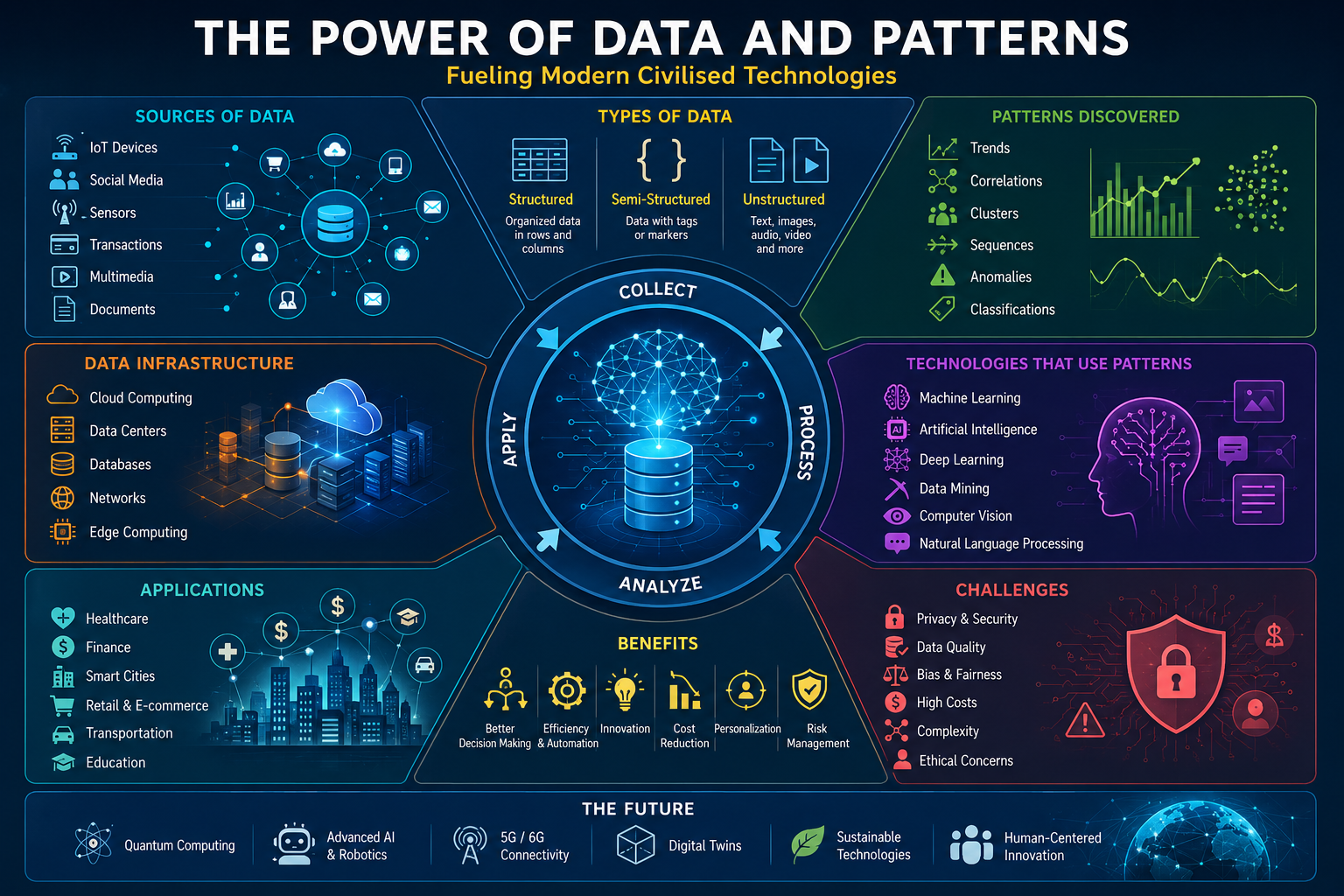
In the modern digital world, data has become one of the most valuable resources in human civilisation. Every activity performed through smartphones, computers, satellites, sensors, financial systems, healthcare devices, transportation systems, and social media produces data. Modern technologies depend on the collection, analysis, storage, and interpretation of this data to improve decision-making, automation, efficiency, security, and innovation.
Patterns are meaningful relationships, structures, trends, or behaviours discovered within data. Through pattern recognition, organisations and technologies can predict future outcomes, detect problems, understand human behaviour, and improve systems. The combination of data and patterns forms the foundation of technologies such as Artificial Intelligence (AI), Machine Learning, robotics, smart cities, cloud computing, cybersecurity, e-commerce, healthcare systems, and autonomous vehicles.
This thesis framework explains the anatomy, categories, significance, challenges, and future of data and patterns in modern civilisation.
Page 1 — Understanding Data in Modern Technology
1.1 Definition of Data
Data refers to raw facts, numbers, symbols, images, audio, video, measurements, or observations collected from different sources. Data becomes useful when it is processed into information.
Examples include:
- Customer names
- GPS locations
- Medical records
- Banking transactions
- Social media posts
- Sensor readings
- Weather information
- Video surveillance footage
1.2 Types of Data
Structured Data
Organised in tables, rows, and databases.
Examples:
- Banking systems
- Excel spreadsheets
- Payroll systems
Unstructured Data
Not organised in predefined formats.
Examples:
- Videos
- Emails
- Images
- Voice recordings
Semi-Structured Data
Contains both organised and unorganised elements.
Examples:
- XML files
- JSON documents
- Web applications
1.3 Sources of Modern Data
Modern civilisation generates data from multiple systems:
| Source | Example |
|---|---|
| Smartphones | User behaviour and communication |
| Satellites | Climate monitoring |
| IoT Sensors | Smart homes and factories |
| Healthcare Devices | Heart monitoring |
| Financial Systems | Digital payments |
| Social Media | Human interaction patterns |
| Transport Systems | Traffic monitoring |
| Data Centres | Cloud computing services |
1.4 Characteristics of Big Data
Modern technologies operate using Big Data, defined by the “5 Vs”:
Volume
Massive amounts of data generated daily.
Velocity
Speed at which data is generated and processed.
Variety
Different forms of data such as text, audio, and video.
Veracity
Accuracy and trustworthiness of data.
Value
The usefulness and economic importance of data.
Page 2 — Patterns and Pattern Recognition
2.1 Definition of Patterns
Patterns are repeated trends, structures, relationships, or behaviours found within data.
Examples:
- Customer buying habits
- Weather changes
- Disease spread trends
- Cyberattack signatures
- Traffic movement
2.2 Importance of Pattern Recognition
Pattern recognition helps machines and organisations:
- Predict future events
- Detect fraud
- Improve security
- Personalise recommendations
- Automate systems
- Improve medical diagnosis
2.3 Types of Patterns
Statistical Patterns
Based on probabilities and numerical trends.
Behavioural Patterns
Human habits and interactions.
Visual Patterns
Images, facial recognition, fingerprints.
Temporal Patterns
Patterns based on time sequences.
Spatial Patterns
Location-based relationships.
2.4 Pattern Recognition Technologies
Modern technologies use advanced computational systems for pattern analysis:
| Technology | Purpose |
|---|---|
| Artificial Intelligence | Automated decision-making |
| Machine Learning | Learning from data |
| Neural Networks | Simulating human brain learning |
| Computer Vision | Image interpretation |
| Natural Language Processing | Understanding human language |
2.5 Machine Learning and Patterns
Machine learning systems analyse millions of datasets to discover hidden relationships.
Applications include:
- Fraud detection
- Medical diagnosis
- Stock market analysis
- Voice assistants
- Recommendation systems
Examples:
- Google search predictions
- Netflix movie recommendations
- Amazon customer purchasing suggestions
Page 3 — Data Infrastructure and Modern Technologies
3.1 Data Centres
Data centres are facilities that store, process, and distribute digital information.
Functions include:
- Cloud storage
- Web hosting
- AI computation
- Financial transaction processing
- Video streaming
Large technology companies operate massive data centres worldwide.
Examples include:
3.2 Cloud Computing
Cloud computing allows users to access computing resources through the internet.
Benefits:
- Scalability
- Remote access
- Cost efficiency
- Global communication
- Business continuity
Cloud services power:
- Banking apps
- Government systems
- Online learning
- Streaming platforms
- AI systems
3.3 Internet of Things (IoT)
IoT connects physical devices to the internet for data collection and automation.
Examples:
- Smart refrigerators
- Smart traffic lights
- Industrial sensors
- Wearable devices
IoT systems continuously generate large volumes of data for pattern analysis.
3.4 Artificial Intelligence Systems
AI systems depend on massive datasets and pattern learning.
Applications:
- Autonomous vehicles
- Healthcare diagnostics
- Robotics
- Language translation
- Cybersecurity systems
AI learns through recognising patterns in historical data.
3.5 Cybersecurity and Data Protection
Modern civilisation depends heavily on secure data systems.
Cybersecurity protects:
- Personal information
- Financial systems
- Government databases
- Corporate infrastructure
Pattern analysis helps detect:
- Fraud
- Malware
- Hacking attempts
- Unusual network behaviour
Page 4 — Applications of Data and Patterns
4.1 Healthcare
Modern healthcare uses data analytics to improve medical services.
Applications include:
- Disease prediction
- Patient monitoring
- Drug development
- Medical imaging analysis
AI systems identify disease patterns faster than traditional methods.
Examples:
- Cancer detection
- Heart disease prediction
- Epidemic monitoring
4.2 Banking and Financial Systems
Financial institutions use data patterns for:
- Fraud detection
- Credit scoring
- Investment forecasting
- Risk management
Digital banking systems process millions of transactions every second.
4.3 Smart Cities
Smart cities use sensors and real-time data to improve urban management.
Functions include:
- Traffic control
- Energy optimisation
- Waste management
- Water distribution
- Public safety monitoring
4.4 E-Commerce and Marketing
E-commerce platforms analyse consumer behaviour patterns.
Benefits:
- Personalised advertising
- Product recommendations
- Supply chain optimisation
- Customer retention
Examples:
- Online shopping platforms
- Digital marketing systems
- Consumer analytics
4.5 Transportation and Logistics
Modern transportation depends on data systems.
Applications:
- GPS navigation
- Autonomous driving
- Fleet management
- Airline scheduling
- Shipping optimisation
Pattern analysis improves:
- Fuel efficiency
- Delivery speed
- Route planning
Page 5 — Challenges and Risks of Data Technologies
5.1 Privacy Concerns
Large-scale data collection creates privacy risks.
Challenges include:
- Surveillance
- Identity theft
- Data misuse
- Personal tracking
Citizens increasingly demand stronger digital privacy laws.
5.2 Cybercrime
Modern digital systems face threats such as:
- Hacking
- Ransomware
- Financial fraud
- Data breaches
Cybercriminals exploit weak security systems.
5.3 Bias in Artificial Intelligence
AI systems can become biased when trained on poor-quality data.
Risks include:
- Discrimination
- Incorrect predictions
- Unfair automated decisions
Ethical AI development is becoming essential.
5.4 Environmental Challenges
Large data centres consume enormous resources.
Main concerns:
- Electricity consumption
- Water cooling requirements
- Electronic waste
- Carbon emissions
Technology companies are investing in renewable energy systems.
5.5 Information Overload
Modern civilisation produces excessive information daily.
Challenges:
- Misinformation
- Fake news
- Data complexity
- Mental fatigue
Society requires better digital literacy and critical thinking skills.
Page 6 — Future of Data and Patterns in Human Civilisation
6.1 Future Technologies
Future civilisation will depend more heavily on intelligent data systems.
Emerging technologies include:
| Technology | Future Impact |
|---|---|
| Quantum Computing | Faster problem solving |
| Advanced AI | Human-like automation |
| Smart Robotics | Industrial transformation |
| Brain-Computer Interfaces | Human-machine communication |
| 6G Networks | Ultra-fast communication |
| Digital Twins | Virtual simulations of reality |
6.2 Predictive Civilisation
Future systems will increasingly predict human needs.
Examples:
- Predictive healthcare
- Smart agriculture
- Automated transportation
- Energy optimisation
- Disaster forecasting
Pattern recognition will become central to governance and economics.
6.3 Ethical and Responsible Technology
Future technological development requires:
- Ethical AI
- Data protection laws
- Human-centred innovation
- Sustainable infrastructure
- Transparent algorithms
Society must balance innovation with human rights and environmental protection.
Conclusion
Data and patterns form the foundation of modern civilisation and technological advancement. Every digital system — from healthcare and finance to transportation and Artificial Intelligence — depends on the ability to collect, process, analyse, and interpret information. Pattern recognition allows machines and organisations to understand behaviour, improve efficiency, predict outcomes, and automate complex systems.
Despite the enormous benefits, data technologies also introduce major challenges such as privacy risks, cybersecurity threats, environmental pressure, and ethical concerns. The future of civilisation will depend on responsible management of intelligent systems and sustainable digital infrastructure.
As humanity moves deeper into the digital era, data will continue to shape economies, governments, education, science, communication, and everyday life. Understanding data and patterns is therefore essential for building a secure, intelligent, and sustainable future for modern society.



Be First to Comment