
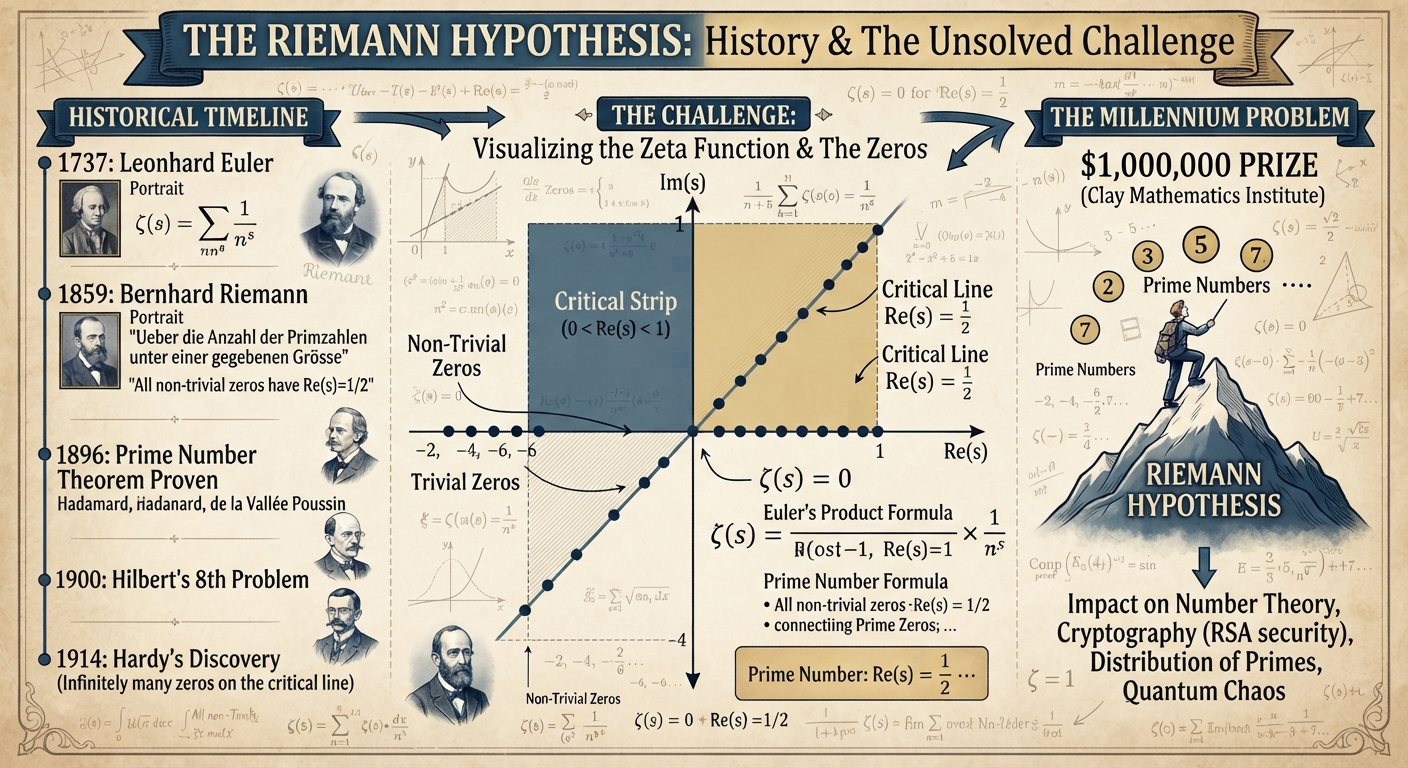
History, Mathematical Architecture, Fundamental Principles, Unsolved Challenges and Its Significance to Modern Science
The Riemann Hypothesis in simple terms — HDD23 – A Chris Sadler Production
Visualizing Complex Functions | Kara van Kessel
10
Advanced mathematics and number theory
Open mathematical problem
Abstract
The Riemann Hypothesis (RH) is one of the most important unsolved problems in mathematics. It concerns the hidden mathematical structure governing the distribution of prime numbers.
First proposed by the German mathematician Bernhard Riemann in 1859, the hypothesis suggests that all non-trivial zeros of a mathematical function known as the Riemann zeta function lie on one particular vertical line in the complex-number plane.
Although its statement is relatively short, its implications reach deeply into:
- Number theory and prime-number distribution.
- Complex analysis.
- Mathematical functions and infinite series.
- Probability and statistical patterns.
- Quantum physics and mathematical modelling.
- Computational mathematics.
- The fundamental architecture of numerical patterns.
The central challenge is that mathematicians can establish many properties of the zeta function and verify enormous numbers of its zeros computationally, but no one has yet produced a complete mathematical proof that every non-trivial zero lies on the critical line.
This thesis develops the subject from its historical foundations to its modern mathematical challenges.
PART I — HISTORICAL DEVELOPMENT
Chapter 1. Understanding the mathematical world before Riemann
To understand why the Riemann Hypothesis matters, we must first understand prime numbers.
A prime number is a whole number greater than 1 that can only be divided exactly by 1 and itself.
The first prime numbers are:
\[ 2,\;3,\;5,\;7,\;11,\;13,\;17,\;19,\;23,\;29 \]
Prime numbers are fundamental because every integer greater than 1 can be expressed uniquely as a product of prime numbers.
For example:
\[ 60=2^2\times3\times5 \]
This is called the Fundamental Theorem of Arithmetic.
Prime numbers therefore operate like the elementary building blocks of the positive integers.
1.1 Ancient mathematical foundations
The study of prime numbers goes back thousands of years.
Important historical contributors include:
| Mathematician | Contribution |
|---|---|
| Euclid | Established that infinitely many primes exist |
| Eratosthenes | Developed the sieve for finding primes |
| Leonhard Euler | Developed important relationships involving prime numbers and infinite series |
| Carl Friedrich Gauss | Investigated the distribution of prime numbers |
| Bernhard Riemann | Connected prime distribution to complex analysis |
1.2 The fundamental mystery
Prime numbers appear irregularly.
Consider:
\[ 2,\;3,\;5,\;7,\;11,\;13,\;17,\;19,\;23,\;29 \]
There is no simple fixed distance between consecutive primes.
Sometimes consecutive primes are close together; sometimes they are separated by much larger gaps.
Yet beneath this apparent irregularity, there is a remarkably structured statistical pattern.
The central question became:
Can mathematics explain the underlying distribution of prime numbers, even though individual prime numbers appear unpredictable?
This question provides the historical foundation of the Riemann Hypothesis.
Chapter 2. Bernhard Riemann and the year 1859
File:Portrait of Bernhard Riemann (1826-1866), Mathematician (2551069295).jpg – Wikimedia Commons
Bernhard Riemann (1826–1866)
German mathematician whose work transformed number theory, geometry and mathematical analysis.
In 1859, he published a short but extraordinarily influential paper on the number of primes below a given numerical limit.
His paper was titled:
On the Number of Prime Numbers Less Than a Given Magnitude.
Riemann introduced a powerful approach that connected prime numbers to the behaviour of a complex mathematical function.
Before his work, prime numbers were primarily investigated through arithmetic relationships and numerical counting.
Riemann introduced a new perspective: instead of studying primes individually, study a function whose mathematical behaviour contains information about all primes.
That function became known as the Riemann zeta function.
2.1 Why this was revolutionary
Riemann’s innovation connected three major mathematical areas:
- Prime numbers.
- Infinite mathematical series.
- Complex analysis.
This connection allowed mathematicians to investigate prime-number distribution through the locations of special points called zeros.
The extraordinary insight was that information about the zeros of the zeta function could reveal information about the distribution of prime numbers.
Chapter 3. The Riemann zeta function: The mathematical engine
Ramanujan Summation: The Truth Behind 1+2+3+… = -1/12
The Riemann zeta function is the central mathematical object behind the hypothesis.
It is written as:
\[ \boxed{\zeta(s)} \]
The variable \(s\) is a complex number.
A complex number has two components:
\[ s=\sigma+it \]
Where:
- \(\sigma\) is the real component.
- \(t\) is the imaginary component.
- \(i\) is the imaginary unit, defined by \(i^2=-1\).
3.1 The original mathematical definition
The zeta function is initially defined by an infinite series:
\[ \boxed{ \zeta(s)=\sum_{n=1}^{\infty}\frac{1}{n^s} } \]
Expanding this expression gives:
\[ \zeta(s)=1+\frac{1}{2^s} +\frac{1}{3^s} +\frac{1}{4^s} +\frac{1}{5^s}+\cdots \]
For this infinite series to converge in its ordinary form, the real part of \(s\) must be greater than 1.
That is:
\[ \operatorname{Re}(s)>1 \]
An important breakthrough in complex analysis allows mathematicians to extend the zeta function beyond this initial region.
This process is called analytic continuation.
It allows the function to be studied throughout the complex plane, except for a simple pole at \(s=1\).
3.2 Why infinite series matter
An infinite series adds an unlimited sequence of mathematical terms.
For example:
\[ 1+\frac12+\frac14+\frac18+\frac1{16}+\cdots=2 \]
This illustrates how infinitely many terms can approach a finite value.
The zeta function uses a much more sophisticated version of this idea. Its terms encode information about all positive integers.
3.3 Euler’s product formula: The connection to prime numbers
One of the most extraordinary discoveries in number theory was the relationship between the zeta function and prime numbers.
For \(\operatorname{Re}(s)>1\), Euler’s product formula states:
\[ \boxed{ \zeta(s)= \prod_{p\text{ prime}} \frac{1}{1-p^{-s}} } \]
Expanded:
\[ \zeta(s)= \frac{1}{1-2^{-s}} \times \frac{1}{1-3^{-s}} \times \frac{1}{1-5^{-s}} \times\cdots \]
Why is this important?
Because the infinite sum contains all positive integers, while the infinite product is constructed using only prime numbers.
The Fundamental Theorem of Arithmetic explains why this works: every positive integer greater than 1 has a unique prime factorisation.
PPT – Mathematical Ideas that Shaped the World PowerPoint Presentation – ID:2732021
The fundamental discovery: The zeta function provides a mathematical bridge between the complete number system and its prime-number building blocks.
This is the foundation of the Riemann Hypothesis. Clay Mathematics Institute+2
PART II — THE CENTRAL HYPOTHESIS
Chapter 4. What exactly does the Riemann Hypothesis claim?
The hypothesis concerns the zeros of the zeta function.
A zero is a value of the input for which the function produces zero.
Mathematically:
\[ \zeta(s)=0 \]
However, the zeta function has different categories of zeros.
4.1 Trivial zeros
The trivial zeros occur at negative even integers:
\[ -2,-4,-6,-8,-10,\ldots \]
These are established mathematical results.
4.2 Non-trivial zeros
The non-trivial zeros are located in a region called the critical strip:
\[ \boxed{0<\operatorname{Re}(s)<1} \]
They have complex coordinates.
The first few non-trivial zeros occur approximately at:
\[ s=\frac12+14.134725i \]
\[ s=\frac12+21.022040i \]
\[ s=\frac12+25.010858i \]
\[ s=\frac12+30.424876i \]
Notice the important feature: each has a real component equal to one-half.
4.3 The critical line
What Is the Riemann Zeta Function? | Baeldung on Computer Science
The critical strip is the area between two vertical boundaries:
\[ \operatorname{Re}(s)=0 \]
and
\[ \operatorname{Re}(s)=1 \]
At the centre of this region is the critical line:
\[ \boxed{\operatorname{Re}(s)=\frac12} \]
The Riemann Hypothesis states:
\[ \boxed{ \zeta(s)=0 \implies \operatorname{Re}(s)=\frac12 } \]
for every non-trivial zero.
In ordinary language:
Every non-trivial zero of the Riemann zeta function must lie precisely on the same vertical line in the complex-number plane.
This is the entire central proposition.
It does not say that all zeros of the zeta function lie on that line. The trivial zeros are outside the critical strip.
The National Institute of Standards and Technology’s Digital Library of Mathematical Functions describes the critical strip, the symmetry of the zeros and the critical-line formulation. visiblecement.nist.gov+1
Chapter 5. Understanding the complex plane
To understand the challenge, it helps to understand how mathematicians visualise complex numbers.
The complex plane has two axes:
- Horizontal axis: real component.
- Vertical axis: imaginary component.
Fields Medalist Nears Solution to ‘The Devil’s Problem,’ the Riemann Hypothesis – DongA Science
For example:
\[ s=0.5+14i \]
This represents a point with:
- Horizontal position: 0.5.
- Vertical position: 14.
Another example:
\[ s=0.5+21i \]
This represents another point on the same vertical line.
The challenge is to establish that every non-trivial zero, including infinitely many zeros at increasingly large imaginary coordinates, has exactly the same horizontal coordinate.
A computer can calculate many such points. But a mathematical proof must establish the proposition for every one of them.
Chapter 6. The functional equation and the symmetry of zeros
The zeta function has an important mathematical relationship called its functional equation.
One useful form is:
\[ \boxed{ \zeta(s)= 2^s\pi^{s-1} \sin\left(\frac{\pi s}{2}\right) \Gamma(1-s)\zeta(1-s) } \]
Here, \(\Gamma\) represents the gamma function, which extends the factorial function beyond ordinary positive integers.
For example:
\[ \Gamma(n)=(n-1)! \]
for positive integers \(n\).
The functional equation connects the behaviour of the zeta function at \(s\) with its behaviour at \(1-s\).
This produces important symmetry in the zero distribution.
There is also complex conjugate symmetry:
If \(\rho\) is a zero, its complex conjugate \(\overline{\rho}\) is also a zero.
Consequently, non-trivial zeros are symmetric about:
- The real axis.
- The critical line.
However, symmetry does not prove that all zeros lie on the line of symmetry.
This distinction is fundamental.
A mathematical object can have symmetry while still containing points away from its axis of symmetry.
The hypothesis requires a much stronger result.
PART III — WHY PRIME NUMBERS ARE CONNECTED TO THE HYPOTHESIS
Chapter 7. The prime-counting function
Mathematicians need a way to count how many prime numbers exist below a particular number.
This is done using the prime-counting function:
\[ \boxed{\pi(x)} \]
It means the number of primes less than or equal to \(x\).
For example:
\[ \pi(10)=4 \]
because the primes below or equal to 10 are:
\[ 2,\;3,\;5,\;7 \]
Similarly:
\[ \pi(20)=8 \]
because the primes are:
\[ 2,\;3,\;5,\;7,\;11,\;13,\;17,\;19 \]
7.1 Gauss’s contribution
Ritratto di Carl Friedrich Gauss, 1840 | Stampa d’arte
Carl Friedrich Gauss (1777–1855)
Gauss investigated the frequency of prime numbers and developed an approximation for their distribution.
The Prime Number Theorem establishes that:
\[ \boxed{ \pi(x)\sim\frac{x}{\ln x} } \]
The symbol \(\sim\) means that the ratio of the two expressions approaches 1 as \(x\) becomes very large.
This means:
\[ \lim_{x\to\infty} \frac{\pi(x)}{x/\ln x}=1 \]
The theorem tells us approximately how frequently prime numbers occur as numbers become larger.
7.2 A simple interpretation
Consider the expression:
\[ \frac{1}{\ln x} \]
For large values of \(x\), this provides an approximate indication of the probability that a number around that magnitude is prime.
As numbers become larger, primes become less frequent on average.
But they never disappear.
The Prime Number Theorem was independently proved in 1896 by Jacques Hadamard and Charles Jean de la Vallée Poussin.
This was a major achievement inspired by Riemann’s mathematical framework. Clay Mathematics Institute+1
Chapter 8. How the zeros control prime-number fluctuations
This is where the Riemann Hypothesis becomes extraordinarily important.
The Prime Number Theorem describes the average distribution of prime numbers.
But prime numbers do not follow a perfectly smooth distribution.
There are fluctuations around the average.
The zeros of the zeta function are mathematically connected to these fluctuations.
A simplified representation of the relationship is:
\[ \text{Prime distribution} = \text{Main trend} + \text{Fluctuations} \]
The Riemann explicit formula makes this connection much more precise by expressing weighted prime-counting quantities through sums involving the non-trivial zeros.
One illustrative version is:
\[ \psi(x)= \sum_{n\leq x}\Lambda(n) \]
where the von Mangoldt function is:
\[ \Lambda(n)= \begin{cases} \ln p,&n=p^k\\ 0,&\text{otherwise} \end{cases} \]
Here \(p\) is a prime number and \(k\) is a positive integer.
The explicit formula relates \(\psi(x)\) to the non-trivial zeros \(\rho\) of the zeta function, with additional terms and suitable convergence conventions.
A simplified structural representation is:
\[ \psi(x) \approx x-\sum_\rho\frac{x^\rho}{\rho} +\text{other terms} \]
The sum over the zeros is responsible for much of the oscillatory behaviour.
8.1 Why the real component matters
Suppose a non-trivial zero is:
\[ \rho=\sigma+it \]
Then:
\[ x^\rho=x^\sigma e^{it\ln x} \]
This expression has two important components:
- \(x^\sigma\) controls the size of the contribution.
- \(e^{it\ln x}\) produces oscillatory behaviour.
If the Riemann Hypothesis is true:
\[ \sigma=\frac12 \]
Therefore, the contribution of the zero has a magnitude governed by:
\[ x^{1/2}=\sqrt{x} \]
This is the mathematical reason that the hypothesis gives a powerful restriction on the size of prime-number fluctuations.
It is not merely a claim about where points appear in a diagram. It is a claim about how accurately we can understand the behaviour of prime numbers.TU Delft Repository+2
PART IV — THE HISTORICAL BATTLE TO PROVE THE HYPOTHESIS
Chapter 9. The development from 1859 to the modern mathematical era
The Riemann Hypothesis has survived more than 160 years of mathematical investigation.
Investigación de la hipótesis de Riemann: Novedades en Wolfram Language 12
The following timeline highlights some major developments.
| Year | Mathematician or development | Significance |
|---|---|---|
| Ancient Greece | Euclid | Proved infinitely many primes exist |
| 1737 | Leonhard Euler | Published important work connecting primes and the zeta function |
| Around 1790s | Carl Friedrich Gauss | Investigated prime-number distribution |
| 1859 | Bernhard Riemann | Formulated the hypothesis |
| 1896 | Hadamard and de la Vallée Poussin | Independently proved the Prime Number Theorem |
| 1900 | David Hilbert | Included the problem among his famous mathematical challenges |
| 1914 | G. H. Hardy | Proved infinitely many non-trivial zeros lie on the critical line |
| 1940s–1950s | Atle Selberg | Advanced understanding of the proportion of zeros on the critical line |
| 1970s | Hugh Montgomery and others | Developed important insights into statistical zero distribution |
| 1980s–2000s | Computational mathematics | Greatly expanded numerical investigations |
| 2000 | Clay Mathematics Institute | Designated it a Millennium Prize Problem |
| 2026 | Modern mathematical research | The hypothesis remains unproved |
Clay Mathematics Institute+3
Chapter 10. David Hilbert and the challenge of mathematical completeness
Understanding science: what we cannot know: 2 | OpenLearn – Open University
David Hilbert (1862–1943)
One of the most influential mathematicians of the twentieth century.
In 1900, Hilbert presented 23 mathematical problems that he believed would shape mathematical research in the twentieth century.
The Riemann Hypothesis appeared as part of his eighth problem.
Hilbert’s broader vision was that mathematics should systematically investigate its deepest unresolved questions.
The Riemann Hypothesis became one of the most enduring examples of this ambition.
It is important to understand that the problem is not difficult because its statement is complicated.
It is difficult because the mathematical structures required to prove it are extraordinarily interconnected.
Chapter 11. G. H. Hardy: The breakthrough of 1914
G. H. Hardy (1877–1947)
British mathematician who established an important theorem about the zeros of the zeta function.
In 1914, Hardy proved that infinitely many non-trivial zeros lie on the critical line.
This was an important breakthrough.
Before Hardy, Riemann’s hypothesis remained an extraordinary conjecture supported by mathematical reasoning and numerical observations.
Hardy established that the critical line really does contain infinitely many zeros.
However, there is an enormous difference between these two statements:
- Infinitely many zeros lie on the critical line.
- Every non-trivial zero lies on the critical line.
The second statement is the Riemann Hypothesis.
Hardy’s achievement did not settle the question, but it established an important part of the mathematical structure.
Chapter 12. Selberg and the proportion of zeros
Atle Selberg portrait on the occasion of receiving the Wolf Foundation Prize in Mathematics
Atle Selberg (1917–2007)
Norwegian mathematician whose work significantly advanced analytic number theory.
Selberg developed methods that established stronger results about how many zeros lie on the critical line.
Subsequent work by other mathematicians improved these results.
A positive proportion of the non-trivial zeros are now known to lie on the critical line.
But a positive proportion is not 100%.
For example, imagine examining one million zeros:
- Proving that a substantial proportion lie on the line is significant.
- Proving that all one million lie on the line would still not establish that every zero in an infinite sequence lies there.
The challenge is the infinite nature of the problem.
PART V — WHY THE HYPOTHESIS IS SO DIFFICULT TO PROVE
Chapter 13. The five fundamental mathematical obstacles
Schüler & Lehrer – Universität Passau
The Riemann Hypothesis involves several layers of mathematical difficulty.
13.1 Obstacle one: Infinite mathematical structures
The hypothesis concerns infinitely many non-trivial zeros.
Even if mathematicians calculate an extraordinary number of zeros, the remaining infinite collection must still be addressed.
A proof must establish a universal mathematical statement.
It cannot simply rely on an increasingly large collection of examples.
13.2 Obstacle two: Complex analysis
The zeta function is not an ordinary arithmetic function.
It is a complex-valued function involving:
- Infinite series.
- Analytic continuation.
- Complex differentiation.
- Poles and zeros.
- Functional equations.
- Contour integration.
These mathematical structures interact in sophisticated ways.
13.3 Obstacle three: Controlling the zeros
The zeros are not positioned at simple, regularly spaced intervals.
Their distribution has intricate mathematical properties.
Researchers need to understand:
- Where zeros occur.
- How frequently they occur.
- Whether zeros can be repeated.
- How closely neighbouring zeros can approach each other.
- Whether zeros can exist away from the critical line.
A complete proof must eliminate every possibility of a non-trivial zero away from the line.
13.4 Obstacle four: Connecting local and global mathematics
A local mathematical result concerns a particular region or collection of values.
A global result concerns the entire mathematical structure.
Researchers may establish strong results in particular regions, but the hypothesis demands control over the complete infinite collection.
This is a major conceptual obstacle.
13.5 Obstacle five: Finding the right mathematical framework
The most difficult mathematical discoveries sometimes require a new way of looking at an existing problem.
The Riemann Hypothesis may require a deeper connection between mathematical disciplines, or a new technique within existing ones.
There is no established guarantee that any particular proposed method will produce a proof.
Chapter 14. Computational mathematics: Can computers solve the hypothesis?
Artificial intelligence research must remain an American priority
Computers have transformed the investigation of the Riemann Hypothesis.
Modern computational mathematics can evaluate the zeta function at extremely large complex values and investigate its zeros.
14.1 What computers actually do
A computational investigation generally involves:
- Evaluating the zeta function numerically.
- Locating candidate zeros.
- Checking whether they lie on the critical line.
- Applying numerical error bounds.
- Verifying the results with rigorous mathematical techniques.
The distinction between an approximate numerical calculation and a rigorous numerical verification is important.
Ordinary floating-point calculations can introduce rounding errors.
Rigorous verification methods use techniques such as interval arithmetic to control numerical uncertainty.
14.2 The scale of computational verification
The Clay Mathematics Institute’s current problem description reports that the first 10 trillion non-trivial zeros have been checked computationally and satisfy the hypothesis.
This is extraordinary numerical evidence.
Nevertheless:
\[ 10^{13}\neq\infty \]
No matter how large the number of verified zeros becomes, numerical verification alone does not prove the statement for all zeros. Clay Mathematics Institute+1
14.3 What artificial intelligence could contribute
Artificial intelligence and machine learning may assist mathematical research through:
- Discovering patterns in numerical data.
- Suggesting relationships between mathematical expressions.
- Searching large spaces of possible identities.
- Assisting with symbolic calculations.
- Checking proposed proof steps.
- Helping formalise mathematical arguments.
However, an AI-generated proof must still satisfy the standards of mathematical rigour.
A convincing explanation, numerical pattern or computer-generated argument is not automatically a valid proof.
PART VI — THE DEEPER MATHEMATICAL ARCHITECTURE
Chapter 15. The relationship between the Riemann Hypothesis and other branches of mathematics
The hypothesis sits at the intersection of several major mathematical disciplines.
| Mathematical discipline | Connection to the hypothesis |
|---|---|
| Number theory | Prime numbers and their distribution |
| Complex analysis | Zeta-function zeros and analytic continuation |
| Algebra | Number systems and algebraic structures |
| Calculus | Infinite series, integration and differentiation |
| Probability | Statistical models of zero distribution |
| Linear algebra | Connections to spectral theory and operator ideas |
| Mathematical physics | Quantum chaos and spectral statistics |
| Computational mathematics | Numerical investigation and verification |
15.1 Connection to probability and statistics
The distribution of zeros has remarkable statistical properties.
Researchers have discovered relationships between the spacing of zeta zeros and the statistical behaviour of eigenvalues of certain random matrix models.
One particularly influential connection involves random Hermitian matrices and the Gaussian Unitary Ensemble.
This does not mean that the zeta zeros are random.
Rather, their statistical patterns resemble those found in certain random mathematical systems.
This observation has generated an important research area connecting number theory, probability and mathematical physics.
15.2 Connection to quantum physics
The study of zeta zeros has inspired investigations into quantum systems.
In mathematical physics, an operator can have eigenvalues: special numbers associated with the behaviour of that operator.
Some researchers have explored whether a suitable self-adjoint operator might have eigenvalues related to the imaginary parts of the non-trivial zeta zeros.
This is associated with the Hilbert–Pólya idea.
The reasoning is interesting:
- Self-adjoint operators have real eigenvalues.
- The imaginary components of zeta zeros are real numbers.
- A suitable spectral interpretation might help explain the structure of those zeros.
However, the existence of a fully satisfactory operator establishing the Riemann Hypothesis remains an open research challenge.
15.3 Connection to geometry
Riemann’s influence extends beyond number theory.
His work on geometry helped establish the mathematical foundations of differential geometry.
However, it is important not to confuse two different subjects:
- Riemannian geometry studies geometric spaces equipped with metrics.
- The Riemann Hypothesis studies the zeros of the Riemann zeta function.
They share Riemann’s mathematical legacy, but they are distinct fields.
Chapter 16. What would be established if the hypothesis were proved?
Conditional mathematical consequences
If the Riemann Hypothesis is true, it would establish powerful statements about the regularity of prime-number distribution.
One important consequence concerns the Chebyshev function:
\[ \psi(x)=\sum_{n\leq x}\Lambda(n) \]
Under the Riemann Hypothesis:
\[ \boxed{ \psi(x)=x+O\left(\sqrt{x}\log^2x\right) } \]
The symbol \(O\) describes an upper bound on the magnitude of the error, up to a constant factor.
In ordinary language, the difference between the weighted prime-counting function and its main approximation would be tightly controlled.
Other important consequences include:
- Stronger estimates for errors in prime-number counting.
- Improved bounds in several problems involving prime gaps.
- Important results for arithmetic functions.
- Stronger estimates in analytic number theory.
- Consequences for certain problems involving algebraic and number-theoretic structures.
The hypothesis is not a formula that predicts the next prime number exactly.
Its importance is that it would impose a powerful universal constraint on prime-number irregularities.DLMF+2
Chapter 17. Does the Riemann Hypothesis have practical applications?
The hypothesis is primarily a fundamental mathematical problem.
Its importance should not be exaggerated by claiming that proving it would immediately transform every modern technology.
Nevertheless, the mathematics surrounding it has connections to important areas.
| Field | Potential relevance |
|---|---|
| Cryptography | Mathematical understanding of primes and integer arithmetic |
| Computer science | Algorithms involving number theory |
| Computational mathematics | Efficient numerical methods |
| Data science | Mathematical analysis of patterns and distributions |
| Physics | Spectral theory and quantum statistical models |
| Scientific research | Development of analytical and computational techniques |
An important distinction concerning cybersecurity
Prime numbers play a major role in some public-key cryptographic systems.
However, proving the classical Riemann Hypothesis would not automatically break modern encryption.
The hypothesis concerns the distribution of prime numbers, not a direct method for factoring arbitrary large integers.
Its importance to cryptography is therefore mathematical and indirect, rather than an immediate ability to defeat encryption.
PART VII — THE UNSOLVED CHALLENGE
Chapter 18. Why has nobody proved it after more than 160 years?
The fundamental difficulty is the difference between mathematical evidence and mathematical certainty.
Consider the following three levels of knowledge:
Level 1 — Established mathematics
Known mathematical properties
The zeta function has a functional equation, trivial zeros and infinitely many non-trivial zeros.
Level 2 — Strong numerical evidence
Computational verification
Enormous numbers of non-trivial zeros have been checked and found on the critical line.
Level 3 — Unresolved
Universal mathematical proof
No accepted proof establishes that every non-trivial zero lies on the critical line.
The most important challenge is establishing the universal statement.
Mathematicians must demonstrate that there cannot exist even one non-trivial zero outside the critical line.
That requires more than observing a pattern. It requires a proof derived from valid mathematical principles.
Chapter 19. Six major directions of mathematical investigation
These are important research approaches, not guaranteed solutions.
| Research direction | Central question |
|---|---|
| Analytic number theory | Can the behaviour of the zeta function be controlled more precisely? |
| Spectral theory | Can zeta zeros be interpreted as eigenvalues of a suitable operator? |
| Random matrix theory | Can statistical patterns reveal deeper structural constraints? |
| Algebraic number theory | Can ideas from more general zeta functions provide new methods? |
| Computational mathematics | Can rigorous calculations establish stronger intermediate results? |
| Mathematical logic | Can formal mathematical systems help discover and verify a proof? |
19.1 The Hilbert–Pólya approach
This is particularly interesting.
The idea is to find a self-adjoint operator whose spectrum corresponds to the imaginary parts of the non-trivial zeta zeros.
If an appropriate operator could be constructed with all the necessary properties, its mathematical structure might provide a route to proving the hypothesis.
But finding and establishing such an operator remains a substantial challenge.
19.2 The generalised Riemann Hypothesis
The classical Riemann Hypothesis concerns the ordinary zeta function.
There is also a broader family of conjectures involving other zeta functions, including Dedekind zeta functions and Dirichlet L-functions.
These generalisations extend the investigation into algebraic number theory and the distribution of prime numbers in more complicated mathematical systems.
Proving the classical hypothesis would be a major achievement, but it would not automatically settle every generalised version.
PART VIII — THE MILLENNIUM PRIZE AND ITS MODERN STATUS
Chapter 20. The Clay Mathematics Institute
In 2000, the Clay Mathematics Institute designated the Riemann Hypothesis as one of seven Millennium Prize Problems.
The institute established a prize of:
\[ \boxed{\$1,000,000} \]
for an acceptable solution to each problem, subject to its formal rules and verification requirements.
The seven problems are:
- P versus NP.
- Hodge Conjecture.
- Poincaré Conjecture.
- Riemann Hypothesis.
- Yang–Mills Existence and Mass Gap.
- Navier–Stokes Existence and Smoothness.
- Birch and Swinnerton-Dyer Conjecture.
The Poincaré Conjecture has been solved. The Riemann Hypothesis remains open.
The official Clay Mathematics Institute listing continues to classify it as an active Millennium Prize Problem. Clay Mathematics Institute+1
Official mathematical reference: Clay Mathematics Institute — Riemann Hypothesis.
PART IX — A PRACTICAL MATHEMATICAL LEARNING ARCHITECTURE
Chapter 21. What must a student understand before attempting the hypothesis?
The Riemann Hypothesis is an advanced university-level research problem.
Understanding it requires a progression through mathematics.
Best Books For Math at Shanita Parker blog
I recommend the following educational architecture.
Mathematical mastery pathway
- Stage 1 — Mathematical foundations
- Arithmetic and algebra.
- Fractions and exponents.
- Logarithms.
- Mathematical proofs.
- Sequences and series.
- Stage 2 — Calculus
- Limits.
- Differentiation.
- Integration.
- Infinite series.
- Convergence and divergence.
- Stage 3 — Advanced mathematical analysis
- Real analysis.
- Complex numbers.
- Complex functions.
- Analytic functions.
- Contour integration.
- Stage 4 — Number theory
- Prime numbers.
- Prime factorisation.
- Modular arithmetic.
- Arithmetic functions.
- Prime-number distribution.
- Stage 5 — Complex analysis and analytic number theory
- Gamma functions.
- Zeta functions.
- Euler products.
- Analytic continuation.
- Functional equations.
- The Prime Number Theorem.
- Stage 6 — Research-level mathematics
- Zero distribution.
- Explicit formulas.
- Spectral theory.
- Random matrix theory.
- Advanced analytic number theory.
Chapter 22. Mathematical research and computational experimentation
A useful way to explore the hypothesis educationally is through Python.
The following example calculates the first few approximate non-trivial zeros using the mathematical library mpmath.
import mpmath as mp

mp.mp.dps = 30

# First five approximate zero heights
heights = [
    14.134725,
    21.022040,
    25.010858,
    30.424876,
    32.935062
]

for t in heights:
    s = mp.mpf("0.5") + 1j * t

    result = mp.zeta(s)

    print("Complex input:", s)
    print("Zeta value:", result)
    print()
This experiment illustrates how to evaluate the zeta function along the critical line.
The numerical results should be understood as approximations, not as a proof of the Riemann Hypothesis.
Suggested research exercises
- Investigate the first ten prime numbers.
- Calculate the number of primes below 100.
- Compare prime counts with \(x/\ln(x)\).
- Investigate complex numbers and the critical strip.
- Examine the first five non-trivial zeta zeros.
- Investigate the functional equation.
- Explain why numerical evidence cannot prove an infinite mathematical statement.
PART X — FINAL SYNTHESIS
Chapter 23. The deeper meaning of the Riemann Hypothesis
The Riemann Hypothesis represents a fundamental question about mathematical order.
Prime numbers appear irregular when observed individually, but their overall distribution follows remarkably precise mathematical laws.
Riemann discovered that the zeros of a complex function provide an extraordinary way of understanding this distribution.
His insight connected arithmetic, infinite series and complex analysis into a unified mathematical framework.
The hypothesis asks whether all non-trivial zeros of this function occupy one precise vertical line.
If true, it would establish an exceptionally strong constraint on the fluctuations in prime-number distribution.
But the problem remains unresolved because the mathematical evidence, however extensive, is not a substitute for a universal proof.
The seven most important lessons
| No. | Fundamental lesson |
|---|---|
| 1 | Prime numbers are the fundamental building blocks of positive integers. |
| 2 | Euler established a profound connection between primes and infinite series. |
| 3 | Riemann connected prime distribution with complex analysis. |
| 4 | The zeta function’s non-trivial zeros occupy the critical strip. |
| 5 | The hypothesis claims that all those zeros lie on the critical line. |
| 6 | The positions of the zeros are connected to fluctuations in prime distribution. |
| 7 | Numerical verification is powerful evidence, but a complete proof remains necessary. |
The Riemann Hypothesis: A 2026 Status Report | MathLumen | MathLumen
Conclusion: How far has modern mathematics progressed?
The Riemann Hypothesis demonstrates both the extraordinary capabilities and the limitations of modern mathematical knowledge.
Mathematics has established the Prime Number Theorem, developed sophisticated methods for analysing complex functions, discovered profound statistical patterns among zeta zeros and computationally verified enormous collections of zeros.
Yet the central question remains unanswered.
This makes the Riemann Hypothesis more than a problem about prime numbers. It is an investigation into the relationship between mathematical order, infinite structures, numerical patterns and the limits of mathematical proof.
The ultimate challenge is not to demonstrate that the first trillion zeros follow the expected pattern. It is to establish, with mathematical certainty, why every non-trivial zero must follow that pattern.
PART XI — RECOMMENDED PRIMARY RESEARCH LIBRARY
These are useful starting points for studying the original mathematics and subsequent developments.
1. Bernhard Riemann — 1859 original paper: Riemann’s original manuscript.
2. Clay Mathematics Institute: Official Riemann Hypothesis problem description.
3. National Institute of Standards and Technology: Digital Library of Mathematical Functions — Zeros of the Riemann zeta function.
4. NIST mathematical reference: Mathematical applications of the zeta function.
5. Cambridge University Press: Mathematical research and academic publications.
My recommended next research project
The most productive continuation would be a dedicated mathematical thesis titled:
The Riemann Zeta Function: Complete Mathematical Architecture from Basic Arithmetic to Advanced Complex Analysis.
It would investigate the zeta function independently and progressively, including:
-
- The mathematical origins of the zeta function.
-
- Euler’s infinite product architecture.
-
- Complex numbers and mathematical planes.
-
- Infinite series and convergence.
-
- Analytic continuation.
-
- The gamma function and functional equation.
-
- Trivial and non-trivial zeros.
-
- The critical strip and critical line.
-
- The explicit formula and prime-number distribution.
-
- Computational experiments and the remaining research challenges.
This would provide the mathematical foundations needed to understand not just what the Riemann Hypothesis says, but precisely how its mathematical architecture works.






Be First to Comment