
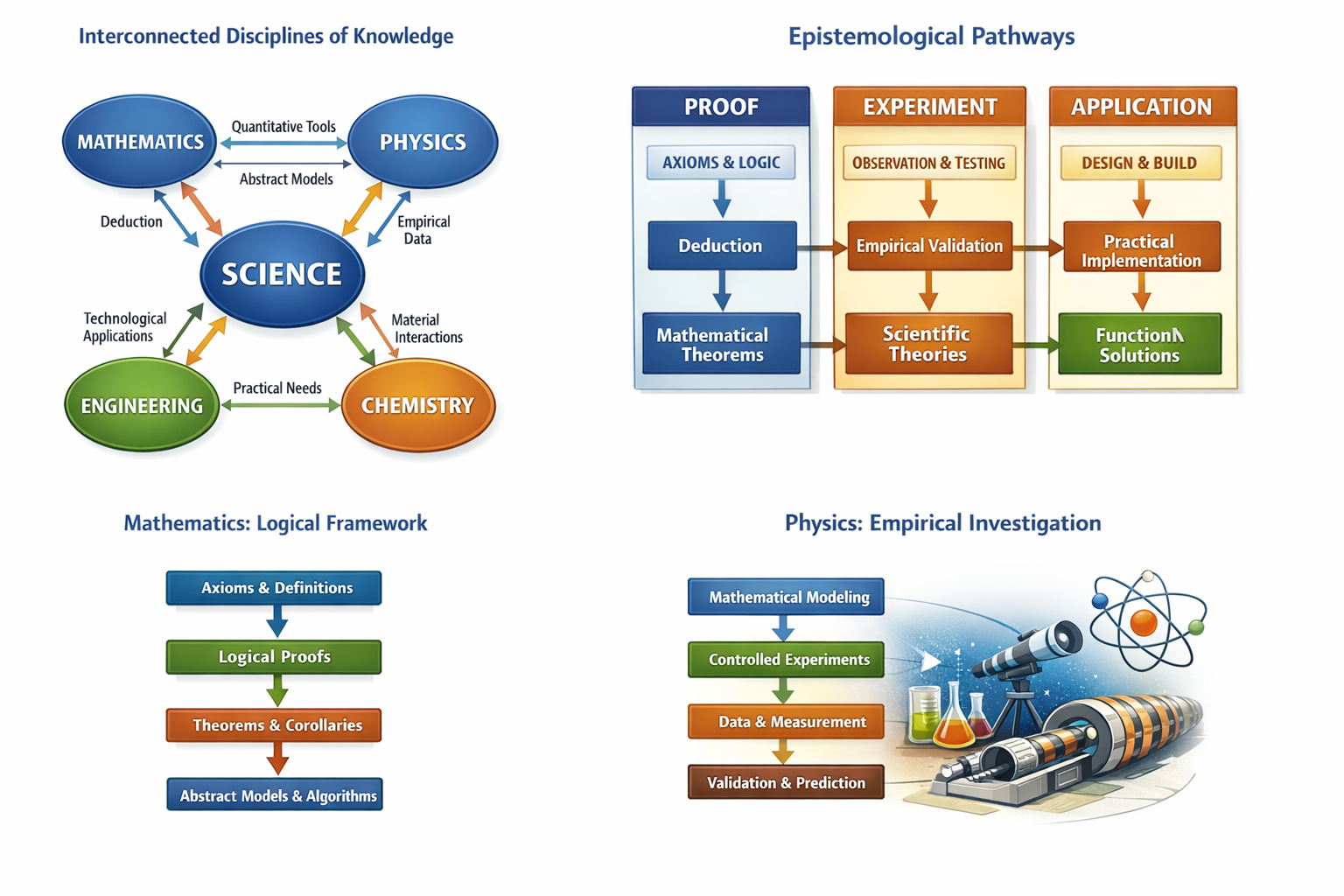
These five disciplines form an interconnected yet distinct intellectual ecosystem. While they share methodological overlap and inform one another, each possesses unique epistemological foundations, objects of study, and relationships to reality. Understanding their differences illuminates how human knowledge is organized and how we engage with the natural world.
Mathematics: The Study of Abstract Structure
Mathematics stands apart as fundamentally non-empirical. It investigates abstract structures, patterns, and relationships through rigorous deduction from axioms. Mathematical truths are necessarily true within their axiomatic systems, independent of physical reality.
Core characteristics: Mathematics deals with idealized objects like numbers, sets, functions, and geometric forms that don’t require physical instantiation. A theorem proven about triangles remains true regardless of whether physical triangles exist. The discipline advances through proof rather than experiment. When mathematicians say something is “true,” they mean it follows necessarily from accepted axioms through valid logical steps.
Relationship to reality: Mathematics maintains an ambiguous relationship with the physical world. While remarkably effective at describing natural phenomena—what physicist Eugene Wigner called “the unreasonable effectiveness of mathematics”—mathematical objects themselves are abstractions. The number π exists as a mathematical constant whether or not perfect circles exist in nature.
Methodology: Mathematical knowledge progresses through conjecture, proof, and the construction of increasingly sophisticated theoretical frameworks. Mathematicians value elegance, generality, and internal consistency. A mathematical statement is accepted when proven, not when experimentally verified.
Science: Systematic Empirical Investigation
Science represents a broad methodology for understanding the natural world through systematic observation, experimentation, and theory-building. It encompasses numerous disciplines unified by commitment to empirical evidence and testable explanations.
Core characteristics: Science seeks to describe, explain, and predict natural phenomena. Unlike mathematics, scientific knowledge is always provisional, subject to revision based on new evidence. Scientific theories are never “proven” in the mathematical sense but rather become increasingly well-supported or face falsification.
The scientific method: While no single “scientific method” exists, scientific inquiry generally involves observation, hypothesis formation, prediction, experimentation, and refinement of theories. Crucially, scientific claims must be falsifiable—they must make predictions that could, in principle, be proven wrong.
Scope: Science includes physics and chemistry but extends far beyond to biology, geology, astronomy, psychology, and numerous other fields. What unifies these is methodological commitment to evidence-based reasoning rather than subject matter.
Physics: The Fundamental Science of Matter and Energy
Physics occupies a special position as the most fundamental natural science, investigating the basic constituents of reality and the laws governing their behavior.
Core characteristics: Physics seeks the most general and fundamental explanations of natural phenomena. It studies matter, energy, space, time, and the forces that govern their interactions. Physics aims to reduce complex phenomena to simpler underlying principles.
Theoretical depth: Physics uniquely combines mathematical sophistication with empirical investigation. Theoretical physics develops mathematical models that capture the essential features of physical systems, from quantum mechanics describing subatomic particles to general relativity explaining gravitation and spacetime. Experimental physics tests these models against reality.
Reductionism and emergence: Physics traditionally pursues reductionist explanations, seeking to understand complex systems in terms of simpler components and laws. However, modern physics also recognizes emergent phenomena where complex systems exhibit properties not obviously predictable from their constituents.
Relationship to mathematics: Physics is mathematically intensive but remains fundamentally empirical. Physical theories must correspond to measurable reality. When mathematical predictions conflict with experiments, physics must revise its theories regardless of mathematical elegance.
Chemistry: The Science of Matter’s Transformations
Chemistry studies matter’s composition, structure, properties, and transformations. While built on physics’ foundations, chemistry has distinct character and concerns.
Core characteristics: Chemistry focuses on atoms, molecules, and the bonds between them. Chemists investigate how substances interact, transform, and form new compounds. The discipline bridges physics’ fundamental laws and biology’s complexity.
Theoretical foundations: Chemistry rests on quantum mechanics—chemical bonds arise from quantum interactions between electrons. However, chemistry rarely works directly from quantum first principles. Instead, chemists employ models, heuristics, and empirical patterns that capture relevant behavior without full quantum mechanical calculations.
Practical orientation: Chemistry maintains stronger practical orientation than physics. Chemical knowledge directly enables material synthesis, pharmaceutical development, and industrial processes. Chemists often work backward from desired properties to design molecules and reactions.
The molecular perspective: Chemistry’s distinctive contribution is thinking in terms of molecular structure and reactivity. While physics explains why atoms behave as they do, chemistry explores the vast space of possible molecular arrangements and transformations.
Engineering: Applied Problem-Solving Through Technical Design
Engineering fundamentally differs from mathematics and the sciences in its primary orientation toward practical problem-solving and artifact creation rather than knowledge generation.
Core characteristics: Engineering applies scientific and mathematical knowledge to design, build, and optimize systems, structures, devices, and processes that serve human needs. Engineers work under real-world constraints—cost, materials, safety, manufacturability—absent from pure science.
Design methodology: Engineering follows iterative design processes: identifying needs, conceptualizing solutions, analyzing feasibility, prototyping, testing, and refining. Unlike science, which asks “what is?” and “why?”, engineering asks “what could be?” and “how can we make it?”
Trade-offs and optimization: Engineers constantly balance competing requirements. A bridge must be strong enough, light enough, cheap enough, and constructable within schedule. There’s rarely a single “correct” solution but rather better and worse designs given specific constraints and priorities.
Relationship to science: Engineering depends on scientific knowledge but isn’t simply “applied science.” Engineers must work with incomplete information, use approximations, and make judgments based on experience. They often employ empirical rules of thumb and established practices rather than deriving everything from first principles.
Innovation and creativity: Engineering requires creativity in imagining novel solutions and adapting existing principles to new problems. While constrained by physical laws, engineering solutions are not uniquely determined by those laws.
Key Distinctions and Interactions
Truth and validity: Mathematics seeks necessary truths within formal systems. Science seeks empirical truths about nature, always provisional. Engineering seeks effective solutions, evaluated by performance rather than truth.
Abstraction versus instantiation: Mathematics deals with pure abstractions. Science studies natural phenomena in their concrete existence. Engineering creates artificial objects that instantiate chosen properties.
Discovery versus invention: Science discovers pre-existing natural patterns. Mathematics arguably discovers (or invents, philosophically contentious) abstract structures. Engineering clearly invents artifacts that wouldn’t exist without human design.
Specialization within unity: Physics and chemistry illustrate how sciences specialize while remaining interconnected. Chemistry’s phenomena ultimately obey physical laws, yet chemical explanations provide understanding at their appropriate level without reducing everything to quantum mechanics. This represents explanatory pluralism—different levels of description serving different purposes.
Mutual dependence: These disciplines form an ecosystem. Mathematics provides the language for physics and engineering. Physics provides foundations for chemistry and constraints for engineering. Chemistry enables material science crucial for engineering. Engineering builds instruments enabling scientific discovery. Scientists and engineers use mathematical tools, while applied problems motivate mathematical development.
Epistemological Implications
These distinctions raise profound questions about knowledge. How do mathematical abstractions relate to physical reality? What makes scientific knowledge reliable despite its provisional nature? How do higher-level sciences like chemistry maintain autonomy while depending on physics? What constitutes good engineering when optimal solutions don’t exist?
The boundaries between these disciplines are neither arbitrary nor absolute. They reflect different aspects of human intellectual engagement with reality—the abstract (mathematics), the discovered (science), the fundamental (physics), the transformational (chemistry), and the constructed (engineering). Together, they demonstrate the multifaceted nature of human understanding and our capacity to comprehend, explain, and reshape the world.





Be First to Comment