
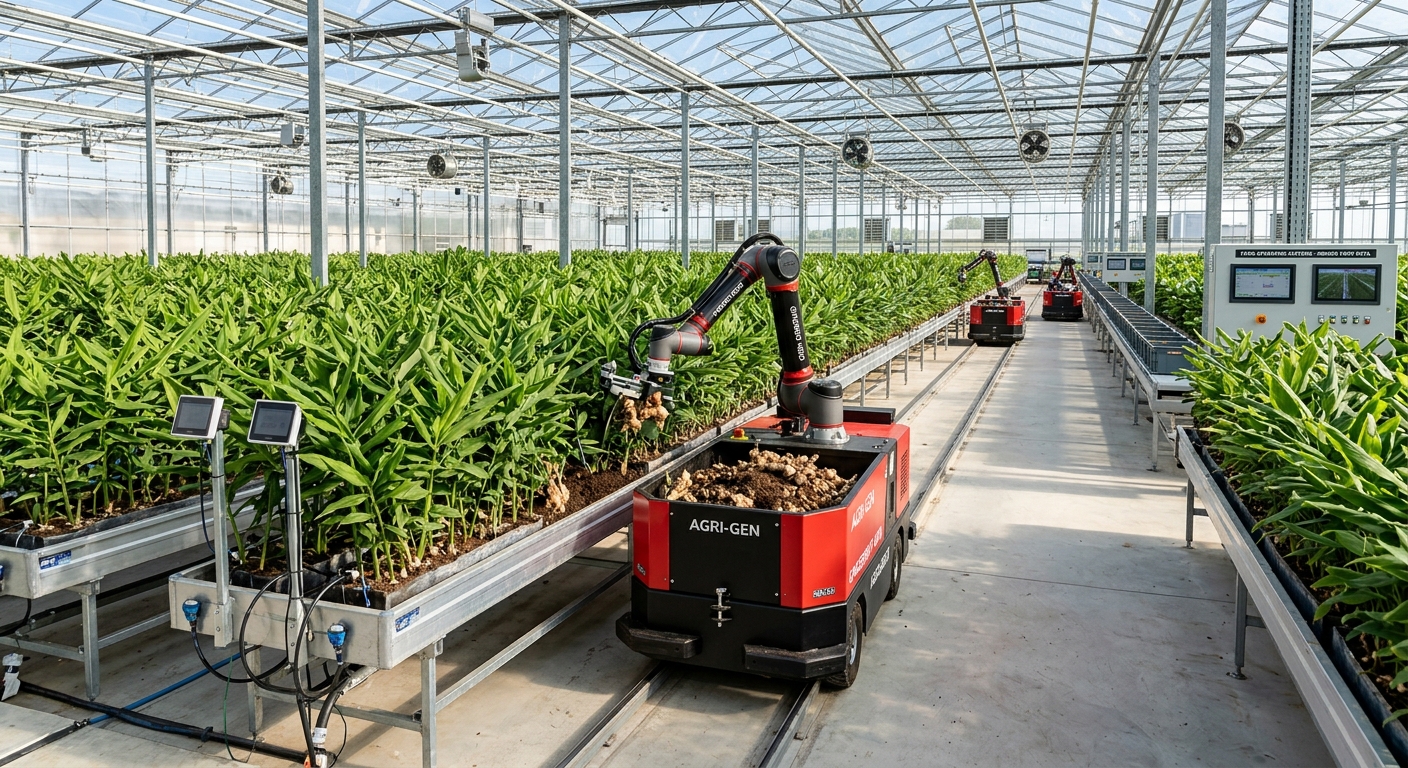
The architecture, technology, management, science and economic significance of intelligent ginger production
Ginger farm with drip irrigation.
Автоматизация сельского хозяйства: как беспилотные тракторы и дроны меняют агробизнес
11
Abstract
A fully automated ginger farm is an agricultural production system that combines soil science, agricultural engineering, robotics, artificial intelligence (AI), Internet of Things (IoT) sensors, automated irrigation, climate monitoring, data analytics and digital farm management to produce ginger with greater consistency and less unnecessary manual work.
The objective is not simply to operate machines without people. It is to build an integrated farming ecosystem in which soil preparation, planting, water delivery, nutrient management, crop monitoring, disease detection, weed management, harvesting and post-harvest handling are coordinated through data and automated equipment.
For South African agriculture, particularly in areas where water availability, labour costs, weather variability and access to technical expertise affect production, automation offers opportunities to improve resource efficiency and farm management. However, successful ginger production still depends on sound agronomy, healthy planting material, appropriate soil conditions and careful management of crop diseases.
Central thesis: The most effective automated ginger farm is one in which biological knowledge determines what the crop needs, sensors measure actual field conditions, software supports decisions, machines perform suitable tasks, and human operators supervise the complete system.
Chapter 1: Understanding the ginger plant and its production requirements
Commercial cultivation of ginger in a village agriculture field
Simak, Ini 5 Tahapan Budidaya Tanaman Obat
Ginger Plants | Start Your Herb Garden Today — Nurserylive
9
Ginger, scientifically known as Zingiber officinale, is a tropical herbaceous plant cultivated primarily for its underground rhizome. The rhizome is the commercially valuable part used in food, beverages, processing and other products.
Unlike crops grown mainly for their fruit or seeds, ginger production depends heavily on developing healthy underground rhizomes.
1.1 The biological architecture of ginger
Common Ginger, True Ginger (Zingiber officinale) – MyGardenLife
1. Leaves and stems
Capture sunlight and produce carbohydrates through photosynthesis. These resources support rhizome development.
How to grow ginger: expert tips for this cooking ingredient | Gardeningetc
2. Roots
Absorb water and dissolved nutrients and help anchor the plant in the soil.
Unique Agriculture Commodities | Iowa Agriculture Literacy
3. Rhizome
An underground modified stem that stores energy and develops into the harvested ginger product.
1.2 The main environmental requirements
| Production factor | Why it matters | What automation can do |
|---|---|---|
| Soil structure | Supports roots and rhizome expansion | Use soil surveys and field mapping |
| Drainage | Prevents prolonged waterlogging and root-zone damage | Monitor moisture and control irrigation |
| Soil moisture | Supports plant growth without saturating the soil | Adjust irrigation according to sensor readings |
| Temperature | Influences sprouting and crop development | Monitor soil and air temperature |
| Nutrients | Support foliage, roots and rhizome growth | Guide fertilizer application from soil tests |
| Light | Supplies energy for photosynthesis | Monitor shading and crop development |
| Plant health | Determines crop survival and marketable yield | Use scouting records, cameras and alerts |
Automation cannot compensate for unsuitable soil, infected planting material or a poorly designed drainage system. The farm must be biologically sound before it becomes technologically advanced.
Chapter 2: The complete architecture of an automated ginger farm
The farm should be designed as one connected system rather than a collection of unrelated machines.
1. Environmental and soil data
Weather, moisture, temperature, pH, drainage and crop observations
2. Farm control system
Sensors, programmable controllers, farm software and AI-assisted decisions
3A. Water and nutrients
Pumps, valves, filters and fertigation
3B. Field operations
Land preparation, planting, weeding and harvesting
4. Harvest and quality management
Cleaning, grading, weighing, traceability, storage and dispatch
Human supervision and safety
Checks, approvals, maintenance, alarms, emergency stops and quality control operate across every stage.
The system works through a continuous cycle:
- Measure: Collect information about the field and plants.
- Analyse: Compare readings with agronomic targets.
- Decide: Determine whether action is needed.
- Act: Activate irrigation, equipment or an alert where appropriate.
- Verify: Measure the result and record it.
This is called a feedback-control system. It is fundamental to precision agriculture because an automated action should be based on actual conditions rather than a fixed schedule alone.
Chapter 3: Site selection and automated land preparation
สยามคูโบต้า เปิด “KUBOTA Farm” ฟาร์มสร้างประสบการณ์เกษตรสมัยใหม่บนพื้นที่กว่า 220 ไร่
National Soil Monitoring Program | NRM North
Package of practices Ginger production
12
The first major engineering decision is to determine whether the land can support ginger profitably.
3.1 Digital land assessment
Before purchasing machinery or installing sensors, map the farm and assess:
- Field boundaries, slope and elevation.
- Soil texture, depth, structure and organic matter.
- Soil pH and nutrient levels.
- Drainage and areas prone to waterlogging.
- Water availability, quality and pumping requirements.
- Road access, electricity, communications and distance to buyers.
A GPS-enabled field map can divide the farm into management zones. This matters because one part of the field may retain more water than another, even when both receive the same irrigation.
Soil sampling and laboratory analysis should establish the initial fertiliser and soil-improvement plan. Sensors complement laboratory tests; they do not replace them.
3.2 Automated soil preparation
Suitable equipment may include:
- GPS-guided tractors for repeatable field operations.
- Soil-working implements for loosening compacted soil where necessary.
- Bed-forming equipment to establish consistent planting rows.
- Laser or GPS surveying equipment for drainage planning.
- Automated machinery for distributing approved soil amendments at prescribed rates.
The goal is to produce a loose, well-structured rooting zone with adequate drainage. Machinery should not operate on excessively wet soil, where it can cause compaction.
Important design principle: Automate the measurement and repeatability of soil preparation, but base the depth of cultivation, amendments and bed dimensions on the actual soil survey and the chosen production system.
3.3 Why drainage deserves special attention
Ginger is vulnerable to diseases affecting its roots and rhizomes. Poor drainage and contaminated planting material or equipment can contribute to serious crop losses. The University of Florida’s ginger production guide emphasises avoiding waterlogging and maintaining sanitation. Ask IFAS – Powered by EDIS+1
An automated drainage design can combine:
- Elevation maps and planned surface-water channels.
- Moisture sensors at representative locations.
- Water-level sensors in drainage sumps where required.
- Alerts for unusually wet zones.
- Pump controls where engineered drainage requires pumping.
Drainage automation should not simply pump water away whenever a sensor detects moisture. The system needs suitable thresholds, knowledge of the soil and protection against unnecessary water loss.
Chapter 4: Automated planting and crop establishment
大姜生姜带芽姜种山东二号高产姜种已催芽易种黄姜种姜芽姜苗包邮_虎窝淘
Vegetable Planter VP1000F Folding Series
タネ生姜を植付して、生姜栽培がスタート! | やとわれ講師のあちこちさる記
9
Planting establishes the starting conditions for the entire production cycle. Uneven spacing, inconsistent planting depth and unhealthy seed rhizomes can create uneven crop growth that remains visible at harvest.
4.1 Planting material management
A modern farm should record each batch of planting rhizomes, including:
- Supplier and variety.
- Delivery and inspection dates.
- Planting-material health and condition.
- Batch identification and quantity.
- Any approved pre-plant treatment.
- Field and planting date.
Planting material should be sourced from a reputable supplier, with suitable health documentation where available. Equipment and containers must be cleaned between batches to reduce the movement of soilborne pathogens.
4.2 Automated planting equipment
A mechanised planter can potentially control:
| Function | Automated capability |
|---|---|
| Row positioning | GPS guidance |
| Spacing | Metering mechanism or controlled placement |
| Planting depth | Adjustable opener and depth-control mechanism |
| Quantity | Material counters and batch records |
| Coverage | Digital maps showing planted rows |
| Fault detection | Alerts for blockages, missed placements or inconsistent operation |
A planter designed for potatoes or other crops should not be assumed to handle ginger seed pieces correctly. Rhizomes vary in size and shape, so the feeding and placement mechanism needs to be tested with the selected planting material.
4.3 Crop establishment monitoring
After planting, cameras and field inspections can help record emergence and identify gaps.
The software can compare the expected plant count with the observed number of emerging plants. If one section performs poorly, the farm manager can investigate planting depth, seed quality, moisture, temperature or disease before making decisions about replanting.
Automation reduces inconsistency, but it cannot guarantee that every rhizome will sprout.
Chapter 5: Intelligent irrigation and water management
Ginger farm with drip irrigation.
Installation – Soil Moisture Sense
PKYDrip Irrigation Automation Systems | Smart Farm Infrastructure
9
Water management is one of the most valuable opportunities for automation. Ginger needs sufficient moisture for healthy growth, but excessive water can damage the root zone and favour disease.
The Agricultural Research Council’s ginger information and a South African university-affiliated study provide useful local context for production and water-use research. ARC Agricultural Research Council+1
5.1 The irrigation architecture
Water source
Borehole, reservoir or approved supply
Filtration and water-quality checks
Protect emitters and assess suitability for irrigation
Pump, flow meter and pressure monitoring
Automated valves and irrigation zones
Drip lines or another agronomically appropriate delivery system
Root-zone moisture verification
Confirm that water reached the intended soil zone
5.2 How the intelligent irrigation controller works
A conventional timer opens a valve at a preset time. An intelligent controller considers the moisture in the root zone, recent rainfall, weather forecasts, crop stage and the water-holding characteristics of the soil.
For example:
- Sensors measure moisture at representative depths.
- The controller checks readings against calibrated thresholds.
- The software considers recent rainfall and irrigation history.
- If irrigation is justified, the appropriate valve opens.
- Flow and pressure readings confirm that water is moving correctly.
- The controller stops or raises an alarm if abnormal flow, pressure or excessive moisture is detected.
Thresholds must be calibrated for the specific soil and irrigation system. A single sensor should not control a large field with substantially different soil conditions.
5.3 Water-use calculation
Irrigation volume can be estimated using:
\[ V=A\times d \]
Where:
- \(V\) = water volume in cubic metres.
- \(A\) = irrigated area in square metres.
- \(d\) = applied water depth in metres.
For example, applying a theoretical 10 mm of water across 1,000 m² requires:
\[ 1{,}000\times0.01=10\text{ m}^3 \]
That is 10,000 litres before accounting for application losses, rainfall and soil-water storage.
This is a calculation example, not a recommendation to apply 10 mm at every irrigation. The correct amount depends on measured field conditions and crop requirements.
5.4 Managing a South African borehole
Where a borehole supplies the farm, automation should include:
- Pump protection against dry running.
- Water-level monitoring where appropriate.
- Flow and pressure measurements.
- Electricity consumption monitoring.
- Water-quality testing.
- A reservoir or contingency supply where economically justified.
The water system should be designed around the borehole’s sustainable yield, not just the pump’s maximum rated capacity.
Chapter 6: Automated fertilisation and nutrient management
The purpose of intelligent fertilisation is to supply the nutrients required by the crop without excessive application, nutrient imbalance or unnecessary expense.
6.1 The nutrient-management system
Stage 1 — Measure
Soil tests, water tests, crop observations and nutrient records establish the starting conditions.
Stage 2 — Calculate
Farm software calculates a nutrient programme based on crop requirements, soil supply and previous applications.
Ceres Automated Fertigation Systems – Growhaus Supply
Stage 3 — Apply
A fertigation system doses compatible fertilisers through irrigation water under controlled conditions.
Asian male farmer supervise his ginger plants cultivation. Organic farming
Stage 4 — Verify
Records, soil tests and crop assessments help determine whether the programme needs adjustment.
6.2 Essential nutrients
| Nutrient | Main functions |
|---|---|
| Nitrogen (N) | Supports leaf and stem growth and the production of photosynthetic tissue |
| Phosphorus (P) | Supports energy transfer and plant development |
| Potassium (K) | Supports water regulation, enzyme activity and plant function |
| Calcium (Ca) | Contributes to cell walls and tissue development |
| Magnesium (Mg) | Forms part of chlorophyll |
| Sulphur (S) | Supports the formation of proteins and other essential compounds |
| Micronutrients | Support enzymes and numerous metabolic processes |
The quantities required depend on the soil, water, variety, growing system and crop stage. The farm should not use a universal fertiliser recipe without testing.
6.3 Safety rules for automated fertigation
- Prevent fertiliser from flowing backwards into the water source.
- Monitor injector operation and flow rates.
- Use compatible fertiliser products and suitable filtration.
- Avoid mixing incompatible concentrated products.
- Include automatic shutdowns for abnormal flow or dosing.
- Keep application logs and have a qualified operator verify the programme.
AI can recommend changes, but significant nutrient adjustments should be based on agronomic evidence and approved operating limits.
Chapter 7: Artificial intelligence and the digital brain of the farm
Precision Agriculture Solution Dashboard by Adrian on Dribbble
Artificial intelligence can help transform farm data into useful decisions. It should support, rather than replace, agronomic judgement.
7.1 The five intelligence layers
- Data collection: Sensors, weather stations, cameras, machinery and human observations generate data.
- Data processing: Software checks units, missing readings, unusual values and sensor faults.
- Analysis: Models identify patterns, estimate crop conditions and detect deviations from expected development.
- Decision support: The system recommends irrigation changes, field inspections, maintenance or other appropriate interventions.
- Controlled execution: Approved commands are sent to equipment, followed by verification and a recorded result.
7.2 Practical applications of AI
| AI application | Example in ginger production |
|---|---|
| Computer vision | Identify missing plants or visible leaf abnormalities |
| Predictive analytics | Estimate harvest timing and potential yield |
| Anomaly detection | Flag unusual moisture, pressure or pump readings |
| Weather analysis | Support irrigation planning and extreme-weather preparation |
| Disease-risk assessment | Highlight field zones requiring closer inspection |
| Optimisation | Compare water use, energy consumption and production outcomes |
A camera may detect unusual leaf colour, but it cannot reliably diagnose every disease from an image alone. Nutrient deficiencies, heat stress, water stress and infections can produce similar symptoms. Important findings need confirmation through inspection and, when appropriate, laboratory testing.
7.3 A practical example
Suppose the controller detects that one field zone is drying faster than the others.
The software can compare:
- Soil moisture at different depths.
- Recent irrigation volume.
- Flow and pressure records.
- Rainfall and local temperature.
- Plant appearance and previous field performance.
It may identify a blocked irrigation line, a faulty sensor or a genuine increase in water demand. The system can then issue an inspection alert or perform a permitted corrective action.
This is more valuable than automatically increasing irrigation whenever a sensor reports low moisture, because the reading itself might be incorrect.
Chapter 8: Automated pest, weed and disease management
Asian male farmer supervise his ginger plants cultivation. Organic farming
Bedenker E-Vario Weeder gaat samenwerking met Mechan aan – akkerbouwbedrijf.nl
12
Crop protection is a particularly important part of ginger automation because diseases associated with the soil and planting material can undermine the entire harvest.
8.1 A digital crop-surveillance network
The farm can combine:
- Fixed cameras overlooking selected crop areas.
- Mobile cameras mounted on suitable agricultural vehicles.
- Scheduled human inspections.
- Field maps identifying pest or disease observations.
- Weather and soil-moisture records.
- Digital records of crop treatments and their outcomes.
Each observation should include a date, field zone, crop stage, suspected problem and confidence level.
8.2 Early-warning workflow
Detect an abnormal condition
Compare observations with historical records
Alert the crop manager
Inspect, confirm and select an appropriate intervention
8.3 Integrated pest management
An automated farm should prioritise prevention and targeted intervention.
- Start with clean planting material.
- Clean machinery and tools between fields or production batches.
- Prevent waterlogging and manage drainage.
- Monitor pests and crop symptoms regularly.
- Use crop rotation where practical and appropriate.
- Apply only registered crop-protection products, following their labels and applicable regulations.
- Record every intervention and evaluate its effectiveness.
Mechanical weeding, camera-guided cultivation and selective application systems may reduce unnecessary chemical use. However, they require suitable field conditions and may not control every weed or disease.
8.4 Why crop rotation matters
Ginger can be affected by soilborne pests and pathogens that persist in production areas. South African farming experience has highlighted the challenge of managing land between ginger crops. A rotation plan, clean growing media or a carefully managed protected-production system may help address this issue. Farmer’s Weekly SA+1
Automation cannot eliminate the biological risks associated with repeatedly planting susceptible crops in contaminated soil.
Chapter 9: Automated weed control and crop maintenance
Weed management protects ginger from competition for light, nutrients, water and space.
A modern farm may use three complementary methods:
- Mechanical control: Precision-guided cultivation between rows.
- Optical control: Cameras identify weed locations to guide targeted operations.
- Digital monitoring: Maps and field inspections identify recurring weed hotspots.
The machine must distinguish crop plants from weeds accurately enough for the task. Early in the season, small ginger shoots can be damaged by aggressive machinery, so crop rows should be mapped and protective operating zones established.
Other maintenance operations can include irrigation-line inspection, drainage maintenance, mulch management and monitoring the stability of raised beds.
Chapter 10: Automated harvesting and post-harvest processing
Nine research projects that will supercharge Australia’s ginger industry | AgriFutures Australia
8
Harvesting is one of the most technically demanding parts of a fully automated ginger farm. The valuable rhizomes grow underground, where their exact shape and depth can vary.
10.1 Harvest readiness
Harvesting decisions should consider:
- The intended market: young ginger or mature ginger.
- Crop age and growth stage.
- Rhizome size and quality.
- Plant senescence and seasonal conditions.
- Weather and soil moisture.
- Buyer specifications and storage requirements.
South Africa’s Agricultural Research Council describes ginger as a crop commonly cultivated on an annual production cycle, with the above-ground growth dying back after approximately eight to nine months under the described production conditions. Actual timing varies with the environment and management system. ARC Agricultural Research Council+1
10.2 The harvesting machinery
A mechanised harvesting system can include:
- A tractor or suitable powered carrier.
- A lifting mechanism that loosens soil beneath the rhizomes.
- Conveyors or screens to separate soil from the crop.
- Inspection stations for damaged or diseased material.
- A controlled transfer system to harvesting crates.
A suitable ginger harvester must be tested for digging depth, soil type, rhizome damage and throughput. Equipment designed for potatoes may offer useful engineering principles but is not automatically suitable for ginger.
10.3 Automated washing and grading
After lifting, the crop can move through a processing line with:
- Controlled washing or dry-cleaning equipment, depending on the market.
- Visual inspection.
- Weight measurement.
- Size grading.
- Defect detection.
- Batch identification.
- Packing and labelling.
Washing must not create unnecessary injury or spread contamination between batches. Clean water, equipment sanitation and the buyer’s product specifications should determine the process.
10.4 Storage and traceability
The farm should record the identity of each harvested batch, field of origin, harvest date, treatment history and storage conditions.
Temperature and humidity sensors can alert staff to unsuitable storage conditions. Storage targets should be selected according to whether the ginger is intended for fresh sale, seed, processing or longer-term storage.
Chapter 11: Automated farm infrastructure and energy management
An intelligent farm requires reliable physical infrastructure. Poor electricity supply, undersized pumps, unstable network connections or badly designed storage facilities can undermine an otherwise advanced system.
11.1 Essential infrastructure
Solut Enerji | Enerjinin Teknolojik Formu
Water infrastructure
Borehole or other water supply, storage tanks, filtration, pumps, irrigation pipes, valves and drainage.
Energy infrastructure
Grid electricity or appropriately designed solar generation, motor controls, protection devices and backup arrangements.
Alianza entre Auravant y Metos para mejorar la toma de decisiones agron�micas – Grandes cultivos
Communication infrastructure
Field sensor networks, gateways, cellular or other connectivity where available, and local data storage.
Todo lo que necesitas saber sobre cámaras frías
Post-harvest infrastructure
Handling areas, grading equipment, clean storage, packing facilities and transport access.
11.2 Solar-powered automation
Solar energy can supply suitable pumps, controllers, sensors and communications equipment. However, the energy design must be based on actual power consumption.
The engineer should calculate:
\[ E=P\times t \]
Where \(E\) is energy consumed in kilowatt-hours, \(P\) is electrical power in kilowatts, and \(t\) is operating time in hours.
For example, a 2 kW pump running for 5 hours consumes 10 kWh before accounting for starting loads, conversion losses and other system requirements.
A complete design must account for the borehole’s sustainable yield, pump head, required flow, seasonal solar availability, battery requirements where applicable and backup power.
11.3 Reliable operation when the internet fails
The farm should not become unusable when connectivity is lost.
Critical irrigation controls should be able to operate locally using programmed rules, with safe fallback settings and alarms. The cloud or internet connection can support reporting, remote monitoring and advanced analysis, but it should not be the only means of preventing an unsafe machine operation.
Chapter 12: Farm management software and the digital dashboard
The software is the information centre of the operation. It connects agronomy, machinery, labour, inventory, finance and sales.
Illustrative ginger-farm dashboard
Example layout only — no live farm equipment or sensor data is connected.
Crop establishment
Track
Emergence and plant gaps
Water management
Monitor
Moisture, flow and pressure
Crop protection
Inspect
Disease alerts and field checks
Financial control
Analyse
Costs, revenue and cash flow
The dashboard should answer five questions:
- What is happening in the field right now?
- Which operations require attention?
- Are irrigation and equipment working correctly?
- How much has the crop cost to produce so far?
- What yield, quality and financial outcome is expected?
12.1 The essential software modules
| Module | Information managed |
|---|---|
| Field management | Boundaries, beds, crop zones and planting dates |
| Irrigation | Moisture readings, water use, flow, pressure and pump status |
| Crop health | Inspections, photographs, pest and disease observations |
| Machinery | Operating hours, maintenance and fault records |
| Inventory | Planting material, fertiliser, packaging and other supplies |
| Labour | Work assignments, attendance and completed tasks |
| Harvest | Weights, grades, losses, batch identity and destination |
| Accounting | Purchases, operating costs, sales, assets and cash flow |
| Sales | Orders, buyer requirements, deliveries and payments |
Data should be recorded consistently. If one machine reports litres while another reports cubic metres, or if timestamps are incorrect, the resulting analytics may be misleading.
Chapter 13: Cybersecurity and protection of the automated farm
An automated farm is also a digital infrastructure system. Its controllers, cameras, software, networks and remote-access services need protection.
Recommended safeguards include:
- Unique accounts and strong authentication.
- Separate networks for operational equipment and ordinary office devices where practical.
- Restricted permissions for irrigation, dosing and machinery controls.
- Regular backups of farm records and configuration files.
- Software updates and secure device configuration.
- Logs of changes to critical settings.
- Manual override and emergency-stop mechanisms.
- A tested response plan for sensor failure, power loss or unauthorised access.
Critical actions should have clear limits. For example, remote access should not permit an unverified command to operate a machine in an occupied area or apply a large quantity of fertiliser without safeguards.
Chapter 14: Economic architecture and financial viability
Full automation should be treated as an investment that must demonstrate measurable value. A sophisticated farm is not necessarily a profitable farm.
14.1 The capital investment categories
| Investment category | Examples |
|---|---|
| Land and soil preparation | Surveying, field preparation, beds and drainage |
| Water infrastructure | Borehole assessment, storage, pumps and irrigation |
| Machinery | Tractors, planters, weeders and harvesting equipment |
| Automation | Sensors, controllers, valves, gateways and software |
| Protected production | Shade structures or tunnels, if justified |
| Post-harvest | Cleaning, grading, packing and storage |
| Energy | Electrical supply, solar and backup systems |
| Working capital | Planting material, labour, fertiliser, maintenance and packaging |
The investment budget should separate initial capital costs from annual operating costs. It should also include repairs, replacement parts, software subscriptions where applicable, depreciation and financing costs.
14.2 The economic equations
Gross revenue
\[ \text{Revenue}=\text{Marketable yield}\times\text{Average selling price} \]
Operating margin
\[ \text{Operating margin}=\text{Revenue}-\text{Operating costs} \]
Break-even marketable yield
\[ Y_{\mathrm{BE}}= \frac{\text{Annual fixed costs}} {\text{Price per kg}-\text{Variable cost per kg}} \]
The break-even equation applies when the selling price exceeds the variable cost per kilogram, and costs and yield are measured over a consistent period.
14.3 A hypothetical financial example
Suppose a farm sells 10,000 kg of ginger at R30 per kilogram. Assume annual operating costs are R180,000 and exclude initial capital investment, financing and tax.
| Item | Illustrative amount |
|---|---|
| Marketable ginger sold | 10,000 kg |
| Selling price | R30/kg |
| Revenue | R300,000 |
| Operating costs | R180,000 |
| Surplus before excluded costs | R120,000 |
These are invented example figures, not a forecast of South African ginger prices, yields or farm profitability.
The example demonstrates why a financial plan must use realistic marketable yield, verified buyer prices, actual input quotations and a full cost estimate.
14.4 Measuring the value of automation
Automation should be assessed against a comparable non-automated or partially automated production method.
Useful indicators include:
- Labour hours per tonne of marketable ginger.
- Litres of water per kilogram produced.
- Electricity consumption per irrigation cycle.
- Percentage of plants established successfully.
- Marketable yield per square metre.
- Percentage of crop lost to disease or damage.
- Cost per kilogram produced.
- Equipment downtime and maintenance cost.
- Return on invested capital and payback period.
Automation creates financial value when the savings and production improvements exceed its additional operating, maintenance and capital costs.
Chapter 15: Choosing the right production system
A fully automated ginger farm can be designed around open-field cultivation, protected cultivation or hydroponic production. Each approach has different engineering and financial requirements.
Option A — Automated open-field farm
Best for evaluating field-scale production
Uses soil cultivation, mechanised planting, sensor-guided irrigation, GPS-assisted machinery and mechanised harvesting. It can offer lower infrastructure costs than a fully enclosed facility, but rainfall, soil variability and soilborne diseases remain major challenges.
Option B — Automated shade-net or tunnel farm
Offers greater control over heat, light and rainfall exposure. It may simplify environmental monitoring and irrigation management, although construction, ventilation and maintenance add costs.
资中是个好地方丨无土栽培、智能化控制 这个智慧农业园里种植的生姜远销欧洲|川观新闻
Option C — Automated soilless ginger farm
Uses bags or containers containing an appropriate growing medium, with controlled irrigation and nutrient delivery. It may improve control over the growing environment and facilitate replacement of contaminated media, but requires careful management of water, nutrients, hygiene and waste.
A March 2025 report in Farmers Weekly described a commercial ginger operation in Limpopo using hydroponic bags and protected cultivation. The reported results demonstrate that this production approach exists in South Africa, but they should not be treated as a guaranteed yield or profitability benchmark for a new farm. Farmer’s Weekly SA
Recommendation: Compare the three systems using a small pilot, a detailed engineering design and a financial model before committing to full-scale automation.
Chapter 16: A practical implementation roadmap
Building the farm in stages reduces the risk of spending heavily on technology before confirming that the crop and business model work.
Phase 1 — Feasibility and research
Before construction
Assess the land, soil, climate, water supply, market demand, planting material and expected costs. Decide whether open-field or protected production is most suitable.
Phase 2 — Engineering and infrastructure
Prepare the production site
Establish drainage, irrigation, power, communications, field access and any necessary shade or growing structures.
Phase 3 — Basic automation
Prove the control systems
Install moisture sensors, automated irrigation valves, flow meters, weather monitoring and a farm dashboard. Test alarms and manual overrides.
Phase 4 — Pilot crop
Validate biological performance
Plant a manageable test area, record crop establishment and disease observations, and measure water, labour, nutrient and energy use.
Phase 5 — AI and machinery integration
Expand after successful testing
Introduce crop-image analysis, predictive maintenance, precision planting, mechanised weeding and harvesting equipment where the business case justifies them.
Phase 6 — Commercial scaling
Scale with evidence
Evaluate harvested yield, quality, disease losses, operating costs, sales and equipment reliability before expanding production.
Chapter 17: Staffing and human responsibilities
A fully automated farm still needs skilled people. Automation changes their work from repetitive manual operations toward supervision, maintenance, analysis and quality assurance.
| Role | Main responsibility |
|---|---|
| Farm manager | Production strategy, targets and overall performance |
| Agronomist | Soil fertility, crop nutrition, planting and crop health |
| Irrigation technician | Pumps, sensors, valves, filtration and water efficiency |
| Automation engineer | Controllers, machinery integration and fault diagnosis |
| Data or AI specialist | Data quality, analytics, model performance and reporting |
| Machinery operator | Safe operation, inspections and maintenance |
| Quality supervisor | Harvest handling, grading, traceability and hygiene |
| Finance and sales manager | Budgeting, buyer relationships, stock and cash flow |
On a smaller farm, one person may cover multiple roles. The essential requirement is that the relevant skills and responsibilities are covered, whether by employees or external specialists.
Chapter 18: Risk management and system resilience
The farm should be designed for failure as well as normal operation.
| Risk | Preventive or corrective measure |
|---|---|
| Borehole failure | Monitor water levels, protect pumps and prepare a contingency plan |
| Electricity outage | Design safe backup power and local control |
| Sensor malfunction | Use calibration, plausibility checks and backup measurements |
| Irrigation blockage | Monitor flow and pressure and inspect filters |
| Disease outbreak | Maintain hygiene, inspect crops and isolate affected batches where appropriate |
| Equipment breakdown | Keep essential spares and a maintenance schedule |
| AI error | Require validation, operating limits and human review of consequential decisions |
| Poor market prices | Secure buyer information and model alternative sales scenarios |
| Data loss or cyberattack | Back up records and restrict access to critical systems |
A resilient system does not assume every sensor, machine or AI model will always be correct. It identifies failures, limits their consequences and provides a safe way to continue operating.
Chapter 19: The future of fully automated ginger farming
The next generation of ginger farms will increasingly combine robotics, machine vision, predictive analytics and digital twins.
A digital twin is a computer-based representation of a real farm. It uses field maps, crop records, machinery data and environmental measurements to help managers understand current conditions and evaluate possible decisions.
Potential future capabilities include:
- Autonomous vehicles that follow mapped routes and avoid obstacles.
- Robotic systems that inspect plants and detect gaps in crop rows.
- AI models that estimate yield from field observations.
- Automated grading systems that identify size and visible defects.
- Predictive maintenance that identifies possible equipment failures before they interrupt operations.
- Digital planning tools that compare water use, crop health, costs and production outcomes.
These capabilities should be introduced only after testing their reliability, safety and economic value. Some can be implemented with existing agricultural equipment, while others require specialised machinery and further development.
Chapter 20: Research questions for a ginger automation project
A scientifically managed project should collect evidence instead of assuming that automation automatically improves production.
The following research questions can guide a pilot farm:
- Does sensor-controlled irrigation reduce water consumption compared with a suitable conventional schedule?
- Which growing system gives the best balance between marketable yield, disease risk and capital expenditure?
- Can automated monitoring identify crop problems early enough to improve management decisions?
- How accurately can a machine plant ginger rhizomes of different sizes?
- What proportion of harvested ginger can be recovered without unacceptable mechanical damage?
- Does the investment in automation reduce the total cost per kilogram of marketable ginger?
- How reliable are the sensors and controllers under local weather and operating conditions?
The farm should establish baseline measurements, repeat trials where practical and compare results using consistent methods.
South African research at the University of Pretoria and the Agricultural Research Council has examined ginger production and irrigation management, providing a useful scientific foundation for such work. MDPI+1
Chapter 21: Final conclusion
A fully automated ginger farm is an integrated agricultural engineering system built around the needs of a living crop.
Its success depends on six connected foundations:
Farmers can measure soil health by analyzing its color – Earth.com
1. Sound agronomy
Suitable soil, healthy planting material and correct crop management.
Drip Irrigation System Setup Guide for Farmers | Fabrice HARINDIMANA posted on the topic | LinkedIn
2. Water and nutrient control
Reliable irrigation, measured fertilisation and effective drainage.
3. Intelligent monitoring
Sensors, data analysis and timely alerts.
Driverless tractors: Which manufacturer is leading the race? – Farmers Weekly
4. Appropriate machinery
Mechanised planting, crop maintenance and harvesting.
Procuring Ginger Oil Wholesale: Navigating Quality and Regulation – Shiva Exports India
5. Quality and traceability
Careful handling, consistent grading and reliable records.
The Role of Farmers Dashboards in Modern Agriculture
6. Financial discipline
Verified market demand, controlled costs and evidence-based expansion.
The most important principle is to automate progressively, measure everything that matters and scale only when the evidence supports expansion.
Recommended starting point for a South African project
To convert this thesis into an actual farm blueprint, the next step is to establish the farm’s size, available capital and production method. Those choices determine the required machinery, sensor network, water system, software, buildings and financial model.
Build your ginger farm blueprint
Share whatever details you already know. Estimates are acceptable.1. Available land100–500 m² — small pilot1,000 m²3,000 m²1 hectare or moreNot decided yet2. Approximate investment budgetUnder R50,000R50,000–R250,000R250,000–R1 millionOver R1 millionNot decided3. Preferred production systemOpen fieldShade net or tunnelHydroponic or soillessCompare all three before deciding4. Water supplyBoreholeMunicipal supplyDam or reservoirRainwater or other sourceNot secured yet5. Main objectiveCommercial ginger salesResearch and educational demonstrationDevelop an AI farming technology systemDevelop my farm blueprint
Further reading and scientific references
- Agricultural Research Council — Ginger production information for South Africa.
- Gatabazi et al. (2019), Evaluating Growth, Yield, and Water Use Efficiency of African and Commercial Ginger Species in South Africa, published in Water. Read the scientific study.
- University of Florida IFAS Extension — Ginger, Galangal, and Turmeric Production.
- Illinois Extension — Ginger growing and irrigation resources.



Be First to Comment