


15
Abstract
Land preparation is one of the most important foundations of successful ginger farming. It involves understanding the soil, assessing the land, managing water, improving soil fertility, controlling weeds, and creating the right physical environment for ginger rhizomes to develop.
In the modern agricultural economy, ginger (Zingiber officinale) is an important crop used in food, beverages, traditional preparations, cosmetics, and industrial processing. Its commercial success depends not only on planting good seed rhizomes but also on establishing a healthy soil environment before planting begins.
This thesis explains the scientific principles, agricultural methods, economic significance, environmental considerations, and practical procedures involved in preparing land for ginger cultivation. It is particularly relevant to farmers and agricultural entrepreneurs working in South Africa, where rainfall patterns, soil conditions, and irrigation requirements can vary considerably between regions.
Central argument: Good land preparation is not simply digging or ploughing the soil. It is the deliberate management of the soil’s physical structure, chemistry, biology, and water movement to create conditions in which ginger can establish, grow, and produce a marketable harvest.
Chapter 1: Understanding ginger as an agricultural crop

Ginger is a tropical herbaceous plant cultivated primarily for its underground rhizome, the thickened stem that develops beneath the soil surface.
Unlike crops grown mainly for their fruits or seeds, ginger farming focuses on producing healthy, well-developed rhizomes. This makes the condition of the soil especially important.
1.1 The basic structure of the ginger plant

Leaves and shoots
These capture sunlight and support photosynthesis, producing the energy and sugars the plant needs for growth.

Roots
The roots absorb water and dissolved mineral nutrients and help anchor the plant. Compacted or waterlogged soil can restrict their development.

Rhizomes
These are the principal commercial product. They expand through the soil and require adequate space, moisture, oxygen, and nutrients.
1.2 Why land preparation is particularly important for ginger
Ginger performs best in loose, fertile, well-drained soil rich in organic matter. Its underground rhizomes can be damaged by unsuitable conditions.
Poor land preparation may contribute to:
- Waterlogging and rhizome rot.
- Restricted root and rhizome development.
- Uneven plant growth.
- Nutrient deficiencies or imbalances.
- Greater weed competition.
- Increased production costs and reduced marketable yield.
Good preparation cannot eliminate every disease or weather risk, but it can substantially improve the growing environment.
Chapter 2: The scientific foundation of land preparation
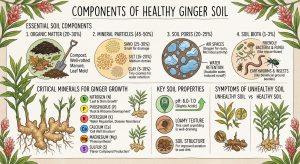
Land preparation should be guided by four interconnected soil systems.
1. Soil physics
Soil texture, structure, pore spaces, compaction, drainage, and the ability of rhizomes to expand.
2. Soil chemistry
Soil pH, nutrient availability, salinity, and the balance of nitrogen, phosphorus, potassium, and other essential elements.
3. Soil biology
Microorganisms, decomposers, beneficial soil organisms, and the organisms that can cause crop diseases.
4. Soil-water relationships
How rainfall and irrigation enter the soil, move through it, remain available to roots, or drain away.
These systems interact. For example, compacted soil can reduce air circulation and drainage, which can weaken roots and create conditions favourable to some root and rhizome diseases.
The goal is therefore to prepare the land as a complete biological production system rather than treating soil as an inert material.
Chapter 3: Selecting the right land for ginger farming

The first decision is not how to plough the land. It is whether the land is suitable for ginger.
3.1 Essential soil requirements
| Soil characteristic | Recommended condition | Agricultural significance |
|---|---|---|
| Soil texture | Sandy loam or friable loam | Supports rhizome expansion and drainage |
| Soil pH | Approximately 5.5–6.5 | Generally favourable for nutrient availability |
| Organic matter | Good supply of mature compost or suitable organic matter | Improves soil structure and moisture management |
| Soil depth | Deep, loose, well-aerated topsoil | Provides room for roots and rhizomes |
| Drainage | Good; no prolonged standing water | Reduces waterlogging and rot risk |
| Sunlight | Adequate light, with shade considered in very hot conditions | Supports healthy plant growth |
| Water supply | Reliable irrigation or dependable rainfall | Maintains moisture during active growth |
These are general starting points rather than guarantees. Local soil conditions, cultivar, climate, and production method influence the final requirements. Agricultural production guidance supports testing the soil before applying lime or fertiliser.
Ministry of Agriculture and Fisheries+2
3.2 Understanding soil texture

Sandy soil
Drains quickly and is easy to work, but may lose water and nutrients rapidly. Organic matter and carefully managed irrigation can help.

Loamy soil
Often a good balance of drainage, aeration, water retention, and workability. It is a strong starting point for ginger cultivation.

Clay-rich soil
Can retain useful nutrients and moisture, but may become compacted and waterlogged. Raised beds and drainage improvements may help where appropriate.
Important principle: Do not judge soil quality by colour alone. Dark soil is not automatically fertile, and red soil is not automatically unsuitable. Soil analysis and an assessment of drainage and structure provide better evidence.
Chapter 4: Soil testing before land preparation

Soil testing is the foundation of evidence-based farming. It helps replace guesswork with measurable information.
4.1 What should be tested?
A laboratory soil test should ideally assess:
- pH: whether the soil is acidic or alkaline.
- Nutrients: available phosphorus, potassium and other nutrients, with nitrogen recommendations where appropriate.
- Organic matter: the soil’s supply of decomposed plant and animal material.
- Salinity: whether soluble salts may interfere with water uptake.
- Texture and structure: the proportions of sand, silt and clay and the condition of the soil.
- Drainage and compaction: whether water and air can move through the growing zone.
Where the land has a history of crop disease, or is close to potentially contaminated water or waste, additional assessments may be appropriate.
4.2 How to collect a useful soil sample
- Divide the farm into areas that appear to have similar soil and management history.
- Collect several small samples from each area at the depth recommended by the soil laboratory.
- Combine the samples from each uniform area in a clean container and mix them thoroughly.
- Submit the required amount to a reputable agricultural soil laboratory, clearly identifying each field or bed.
- Request recommendations specifically for ginger or the closest suitable crop category, explaining the irrigation system and intended yield.
Avoid mixing soil from visibly different areas, manure heaps, old fertiliser storage locations, or unusual patches into one representative sample.
4.3 Why soil pH matters
Soil pH influences how readily plants can obtain nutrients.
- If soil is too acidic, some nutrients can become less available, while aluminium or manganese may reach harmful levels.
- If soil is too alkaline, certain micronutrients can become less available.
- Correcting pH without testing can waste money or create new nutrient imbalances.
Agricultural lime should therefore be applied according to laboratory recommendations, not simply because ginger is being planted.
Ministry of Agriculture and Fisheries+1
Chapter 5: The practical process of preparing the land
The following sequence provides a practical framework for a small or commercial ginger-growing project.
Step 1: Survey the land
Before using machinery, inspect the field.
Identify:
- The direction and steepness of the slope.
- Low areas where water accumulates.
- Existing drainage channels.
- Access routes for workers and equipment.
- The source and quality of irrigation water.
- Areas where previous crops suffered from root or rhizome diseases.
Create a basic farm map showing the growing area, water supply, paths, drainage routes, and storage or compost areas.
Why it matters: Good planning helps prevent expensive mistakes before planting begins.
Step 2: Clear weeds and unwanted vegetation
Remove weeds, invasive plants, and crop residues that could interfere with planting or carry pests and diseases.
Do not automatically burn all vegetation or remove every organic residue. Healthy, disease-free plant material may be suitable for composting. Suspected diseased material should be managed safely to avoid spreading pathogens.
Where chemical weed control is considered, use only locally registered products and follow their labels and applicable agricultural guidance.
Step 3: Correct drainage problems

Drainage is one of the most important elements of ginger land preparation.
Excess water fills soil pores that would otherwise contain air. Roots become oxygen-stressed, and conditions may become favourable for rhizome-rotting diseases.
Possible improvements include:
- Raised planting beds.
- Shallow drainage furrows between beds.
- Proper outlets that allow excess water to leave the field.
- Diversion of clean runoff away from growing areas where necessary.
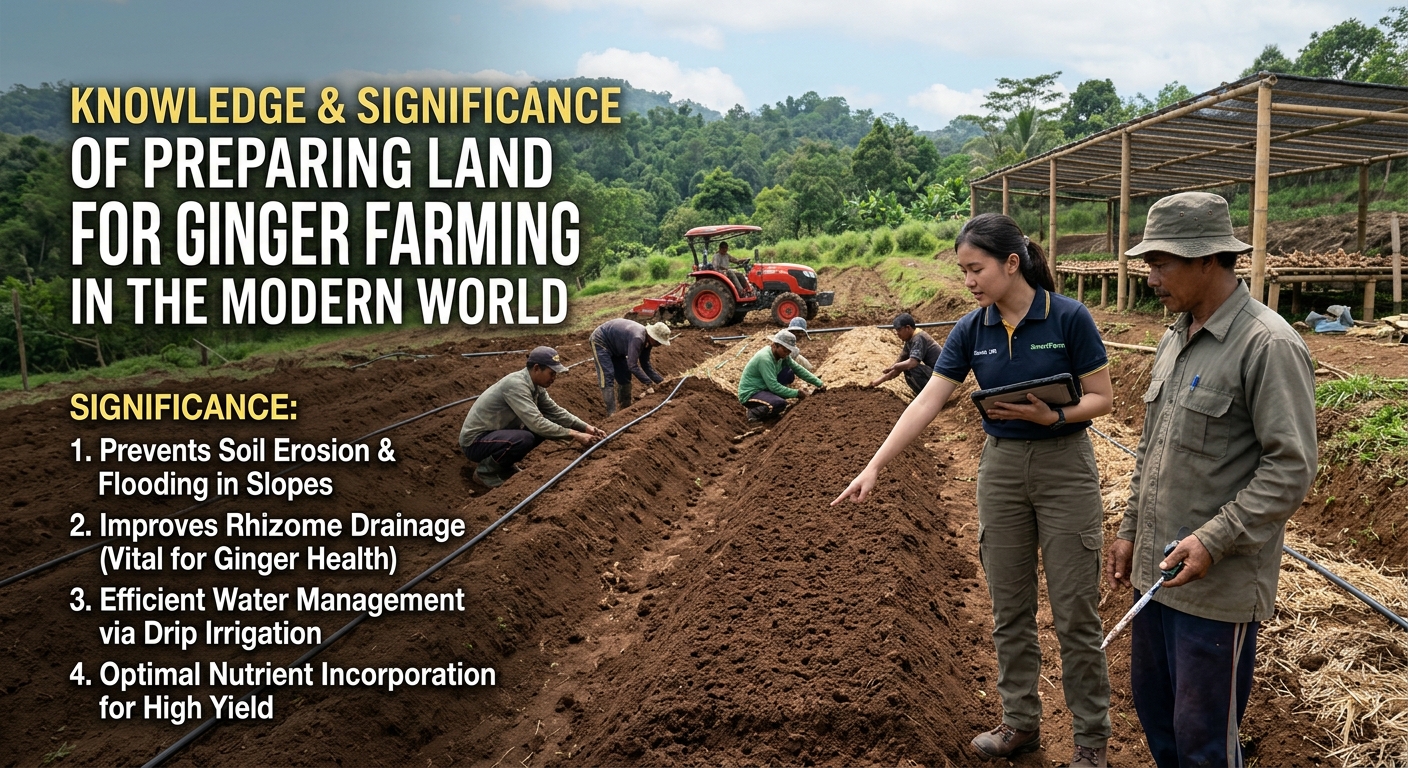
- Contour-aligned beds and erosion controls on suitable sloping land.
Do not direct contaminated runoff into the ginger field or neighbouring properties.
Step 4: Loosen compacted soil
Cultivation should break up restrictive compaction and create a workable planting zone without unnecessarily pulverising the soil.
Depending on soil conditions, a farmer may use a hand hoe, fork, cultivator, plough, or other suitable equipment.
Avoid working very wet soil because machinery and foot traffic can create additional compaction. Excessive tillage can also destroy soil structure and increase erosion.
The necessary cultivation depth depends on the existing soil profile and the depth of the planned beds. It should not be determined by a universal ploughing-depth rule.
Step 5: Incorporate suitable organic matter

Mature compost and appropriately treated, well-decomposed manure can improve soil structure, biological activity, and nutrient supply.
Potential benefits include:
- Improved aggregation and friability.
- Better moisture retention in coarse soils.
- Improved aeration in appropriately managed beds.
- Gradual nutrient release.
- Greater support for beneficial soil organisms.
However, more organic matter is not always better. Excessive or immature manure can cause salinity, nutrient imbalances, ammonia injury, or food-safety problems.
Use material with a known source and appropriate maturity. Base application rates on soil tests, nutrient analysis, and local recommendations. Fresh animal manure should not be treated as interchangeable with mature compost.
Step 6: Correct soil pH and nutrient deficiencies
Apply lime or other soil amendments only where testing indicates a need.
Phosphorus, potassium, nitrogen, sulphur, and micronutrient requirements depend on the soil and production system. Ginger has a substantial potassium requirement, but this does not justify applying large amounts without assessment.
Mix amendments into the intended root zone where appropriate, and plan any additional fertiliser applications according to crop development and expert recommendations.
Step 7: Form planting beds or ridges

Raised beds create a defined area for planting while helping excess water drain away.
An initial trial layout might use beds around 1 metre wide and 15–25 centimetres high, with paths or drainage channels between them. These are illustrative dimensions, not universal specifications. Bed height and width should be adjusted to soil type, rainfall, slope, machinery, and drainage requirements.
On flat, wet-prone land, drainage may require a different design. On slopes, beds must be arranged to reduce runoff and erosion rather than directing water rapidly downhill.
Step 8: Prepare the final seedbed
The final seedbed should be:
- Loose enough to permit root and rhizome development.
- Firm enough to avoid excessive settling.
- Free from large obstacles that interfere with planting.
- Moist but not saturated.
- Uniform enough for consistent planting depth.
Remove remaining weeds, inspect the irrigation system, and confirm that drainage channels function before planting.
Step 9: Protect soil health before planting
Use clean tools and machinery where possible, especially when moving between fields with different disease histories.
Do not repeatedly plant ginger in the same soil without considering disease and pest risks. Rotation with suitable non-host crops, clean planting material, and sound water management can help reduce risks, although rotation alone does not guarantee disease elimination.
agroinvest.gov.jm+2
Chapter 6: Understanding raised beds, ridges and drainage channels
A well-designed ginger field is an engineered growing environment. The shape of the land affects water movement, soil aeration, erosion, labour, and harvesting.

6.1 The basic field layout
Raised bed — ginger planting zone
Loose soil, organic matter and suitable moisture
Excess water moves into the furrows
Furrow or drainage channel
Carries excess water towards a safe outlet
Controlled discharge or collection
Field drainage outlet
Prevents prolonged water accumulation without causing erosion
The objective is not to drain every drop of water from the soil. Ginger needs a dependable supply of moisture. The objective is to remove excess water while preserving enough moisture for healthy growth.
6.2 Why drainage matters economically
Imagine two plots with the same ginger variety, planting material, and fertiliser programme.
- Plot A has compacted soil and standing water after heavy rain.
- Plot B has a loose growing zone and properly functioning drainage.
Plot B may have healthier roots, fewer waterlogging problems, and more uniform rhizome development. However, the actual difference in yield depends on weather, disease pressure, management, and other conditions.
This demonstrates an important agricultural principle: protecting the growing environment can be just as important as supplying additional fertiliser.
Chapter 7: Modern technology in land preparation


8
Modern agriculture combines traditional knowledge with measurement, machinery, and digital tools.
| Technology | Application | Significance |
|---|---|---|
| GPS and digital mapping | Mapping field boundaries, slopes and work areas | Improves planning and repeatability |
| Soil laboratory testing | Measuring pH and nutrients | Reduces guesswork in fertiliser decisions |
| Moisture sensors | Monitoring soil water | Helps manage irrigation more accurately |
| Drip irrigation | Delivering water near the plant | Can reduce water losses when properly designed |
| Weather monitoring | Tracking rainfall and temperature | Supports decisions about planting and irrigation |
| Farm-management software | Recording inputs, labour, costs and yields | Helps identify profitable and unprofitable practices |
| Drone or satellite imagery | Identifying uneven crop growth or drainage patterns | Supports targeted field inspections |
These technologies do not have to be introduced simultaneously. For a small farm, laboratory soil testing, basic mapping, well-designed drainage, and careful recordkeeping may provide more immediate value than expensive machinery.
Precision agriculture becomes especially useful as the farm grows and the cost of mistakes increases.
Chapter 8: The importance of water management
Ginger requires sufficient moisture during active growth, but it does not tolerate prolonged waterlogging well. The correct balance depends on the soil, climate, crop stage, and irrigation system.
Texas A&M AgriLife Extension Service+1
8.1 The soil-water balance
The following simplified equation explains the principle:
\[ \Delta S=P+I-ET-D-R \]
Where:
- \(\Delta S\) = change in soil water storage.
- \(P\) = rainfall.
- \(I\) = irrigation.
- \(ET\) = evapotranspiration, the combined water loss from soil and plants.
- \(D\) = drainage below the growing root zone.
- \(R\) = surface runoff.
This equation explains why irrigation cannot be planned independently of drainage and rainfall.
For example, adding more irrigation to a field that already contains excess water can worsen root-zone oxygen shortages. Conversely, a sandy field in hot, dry weather may need more frequent irrigation than a heavier soil.
8.2 Rainwater harvesting
Where practical and legally permitted, farms can capture clean runoff in suitable storage structures for later irrigation. Any storage system must be designed with appropriate overflow, water-quality, and safety controls.
In South Africa, seasonal rainfall and water availability can make irrigation planning particularly important. A reliable water source should be assessed before substantial expenditure on land preparation or planting material.
Chapter 9: Land preparation for ginger farming in South Africa

South African farmers need to evaluate their specific growing region rather than assume that ginger will perform equally well everywhere.
Research conducted at the University of Pretoria examined ginger cultivation under rain-shelter conditions in Pretoria, illustrating the relevance of managed growing environments to South African production. It does not, by itself, establish that every local climate or soil is suitable for commercial production.
MDPI+1
9.1 Regional considerations
- Limpopo and other warmer areas: Assess heat, irrigation reliability, rainfall timing, soil drainage, and the availability of suitable planting material.
- Gauteng and the Highveld: Consider cooler periods, frost risk, planting-season timing, and whether a protected growing environment is necessary.
- KwaZulu-Natal and other humid areas: Pay particular attention to heavy rainfall, field drainage, disease history, and erosion.
- Other regions: Conduct a local suitability assessment before committing to commercial production.
These are broad considerations, not a guarantee that a specific farm is suitable.
9.2 A practical South African pre-planting checklist
Field readiness checklist
0/10Map the proposed ginger fieldObtain a laboratory soil testConfirm irrigation-water availability and qualityAssess drainage after rainfall or irrigationCheck the history of soil-borne diseasesSource healthy, traceable planting rhizomesObtain locally appropriate fertiliser recommendationsEstimate labour, input and irrigation costsPlan crop rotation and weed controlPrepare a basic farm budget and production record
Reset checklistCopy checklist
Chapter 10: Environmental sustainability and soil conservation
Land preparation should improve agricultural production without damaging the land’s ability to support future crops.
10.1 Preventing soil erosion
Excessive cultivation and poorly planned drainage can wash away fertile topsoil.
Sustainable measures include:
- Maintaining ground cover where appropriate.
- Establishing contour-aligned beds on suitable slopes.
- Avoiding unnecessary tillage.
- Using stable drainage outlets.
- Keeping clean runoff separate from contaminated water.
- Maintaining vegetation strips where they can safely slow runoff.
10.2 Maintaining soil organic matter
Organic matter supports soil aggregation, biological activity, and moisture management. Regularly returning suitable composted material to the soil can help maintain these benefits.
However, organic inputs should be balanced with crop nutrient needs. Excess nutrients can leach into groundwater or run off into streams.
10.3 Crop rotation and biodiversity
Repeated ginger production in the same field can increase the risk of accumulating certain soil-borne pests and diseases.
Rotating with appropriate crops that do not host the same important pathogens may help interrupt disease cycles. Rotation plans must be selected according to the farm’s actual disease risks; some pathogens survive in soil or affect multiple plant species.
Chapter 11: The economic significance of proper land preparation
Land preparation is an investment, and its value should be measured against the cost of production and the quality of the eventual harvest.
11.1 The financial chain
Suitable land and soil assessment
Better drainage and soil structure
Improved crop establishment potential
Potentially higher marketable yield and quality
Potentially better farm profitability
Each stage depends on good management; profit is not guaranteed by land preparation alone.
11.2 Understanding the return on investment
Farmers should compare the cost of preparing the land with the expected reduction in production risks and the potential improvement in saleable output.
For a simple model:
\[ \text{Net profit}=\text{Total revenue}-\text{Total production costs} \]
Total costs should include land preparation, soil testing, planting material, compost, fertiliser, irrigation, labour, pest and disease management, harvesting, transport, and marketing.
For instance, expensive machinery may not be justified on a small plot if suitable manual methods can produce a good seedbed. Conversely, drainage improvements may be worth the cost if the existing field repeatedly suffers from waterlogging.
The correct decision depends on measured conditions and a realistic budget.
Chapter 12: Common mistakes to avoid
| Mistake | Why it matters | Better approach |
|---|---|---|
| Planting without soil testing | May lead to incorrect amendments and fertiliser expenditure | Test first and follow recommendations |
| Choosing a waterlogged field | Increases the risk of poor root health and rhizome rot | Assess drainage and suitability |
| Applying fresh or excessive manure | Can damage plants or cause nutrient and contamination problems | Use appropriate, mature organic material |
| Over-tilling the soil | Can damage structure and increase erosion | Cultivate only as much as necessary |
| Ignoring disease history | May introduce ginger into an unsuitable field | Review previous crops and field health |
| Using unreliable planting material | Can introduce pests and disease | Source healthy, traceable rhizomes |
| Irrigating without checking soil moisture | Can lead to water stress or excessive wetness | Monitor rainfall, soil moisture and drainage |
| Spending heavily before planning the market | Can leave the farm with unprofitable production | Research buyers, grades, volumes and prices |
Chapter 13: A suggested preparation timeline
The exact schedule depends on the planting season, local climate, soil condition, and the time needed to correct drainage or soil problems.
Phase 1
Early planning
Assess and test
Survey the land, obtain soil and water tests, investigate disease history, and prepare the budget.
Phase 2
Correction
Improve the site
Correct drainage and compaction problems, apply necessary soil amendments, and plan irrigation.
Phase 3
Seedbed
Form beds and inspect
Incorporate suitable organic matter, establish beds, check drainage outlets, and control weeds.
Phase 4
Pre-planting
Confirm readiness
Check soil moisture, planting-material quality, water supply, and the planned planting date before planting.
The timeline is a planning framework, not a fixed number of days. For example, a field requiring substantial drainage work needs more preparation time than a field that already has suitable soil structure.
Chapter 14: The future of ginger farming
Modern ginger production will increasingly benefit from the integration of agricultural science, digital tools, and sustainable resource management.
Important areas of development include:
- Precision soil management: applying amendments according to measured soil variability.
- Water-efficient irrigation: scheduling irrigation using soil moisture and weather information.
- Disease prevention: combining clean planting material, sanitation, rotation, and early identification of disease.
- Climate-resilient production: adjusting planting dates and production methods to changing rainfall and temperature patterns.
- Digital farm records: measuring input costs, yields, losses, and selling prices.
- Value addition: exploring suitable markets for fresh ginger, dried ginger, powdered products, and other processed forms.
- Knowledge transfer: sharing proven agricultural practices with emerging farmers and younger generations.
Technology will be most effective when it solves a real problem on the farm. A soil test that prevents an expensive mistake may be more valuable than an advanced sensor that does not influence any practical decision.
Conclusion
Preparing land for ginger farming is a scientific, environmental, and economic process. Its purpose is to establish the right conditions for healthy roots, expanding rhizomes, efficient water use, and productive crop management.
The most important principles are to select suitable land, test the soil, improve drainage, maintain appropriate soil structure, use organic matter responsibly, correct nutrient deficiencies, and establish a sound long-term management plan.
For farmers in South Africa and elsewhere, the best starting point is not purchasing expensive equipment or immediately planting a large area. It is understanding the land and using that knowledge to make informed decisions.
Recommended next step: Develop a practical ginger-farming plan
A useful continuation would be a complete ginger farm development plan for South Africa, covering land size, soil preparation costs, planting material, irrigation, fertiliser, labour, expected production, market research, and a farm profitability model.




Be First to Comment