
A comprehensive thesis on artificial intelligence, scientific reasoning, problem-solving and innovation in the modern economy


12
Abstract
Artificial intelligence (AI) is transforming how humans discover knowledge, analyze complex problems, design products, operate businesses and develop new technologies. However, the greatest value of AI does not come simply from generating answers. It comes from combining AI’s computational capabilities with human critical thinking, scientific reasoning, creativity, ethical judgment and practical experimentation.
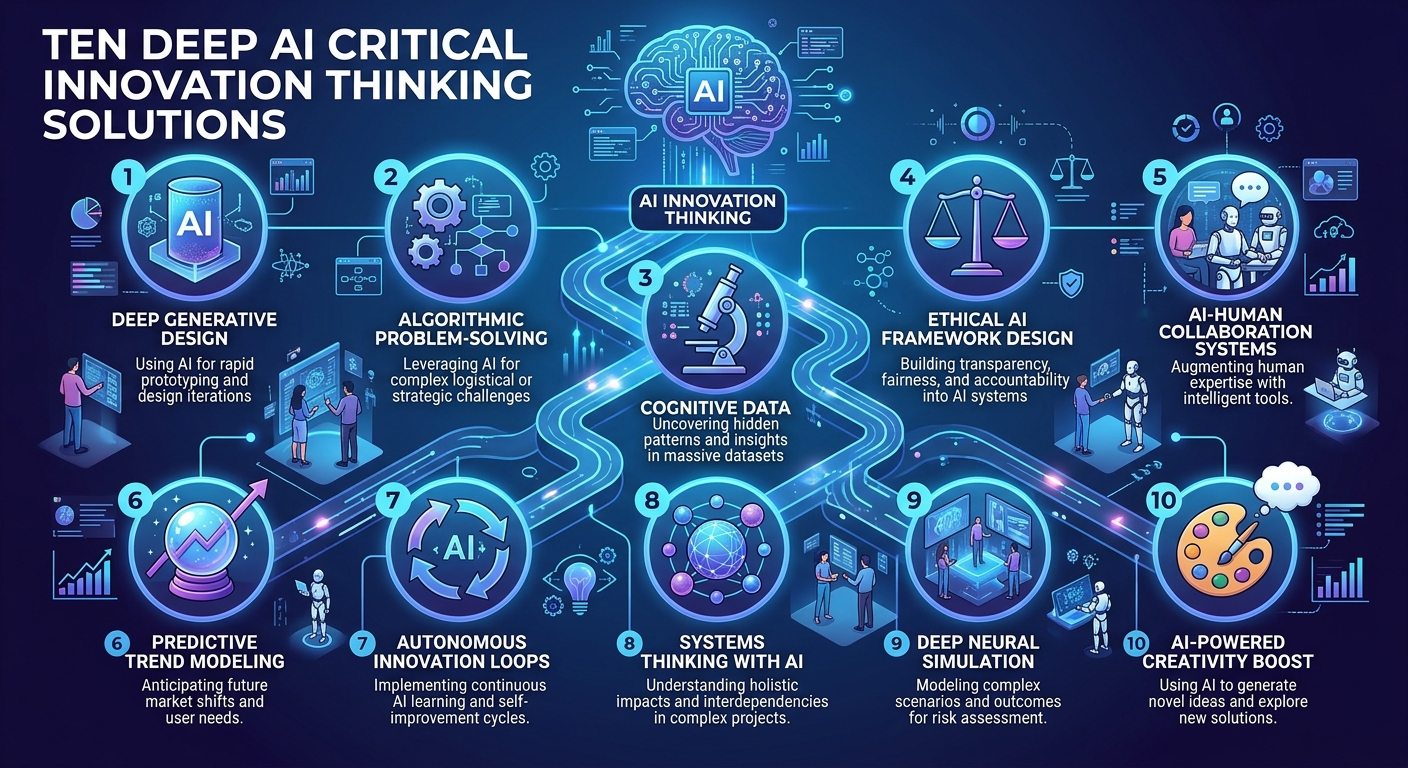
This thesis examines ten deep AI critical-innovation thinking solutions that individuals, researchers, entrepreneurs, educators and organizations can apply to real-world challenges.
The central argument is that effective AI innovation requires a continuous process:
Observe → Question → Analyze → Generate → Test → Improve → Implement → Measure.
AI can accelerate each stage, but people must define meaningful problems, evaluate evidence, make responsible decisions and determine whether an innovation genuinely improves human life.
Chapter 1. Understanding AI critical-innovation thinking
1.1 What is AI critical thinking?
AI critical thinking is the disciplined process of examining information produced by artificial intelligence, testing its reliability, identifying assumptions and deciding whether the conclusions are supported by evidence.
For example, suppose an AI system predicts that a business will experience declining sales.
A weak response is to accept the prediction immediately.
A critical-thinking response asks:
- What data produced the prediction?
- Is the data accurate and representative?
- Which assumptions influence the result?
- What alternative explanations exist?
- How reliable is the prediction?
- What experiment could test the proposed solution?
The difference is fundamental: AI can produce a prediction, but critical thinking determines how that prediction should be interpreted and used.
1.2 What is innovation thinking?
Innovation thinking is the structured process of transforming a problem, idea or discovery into a useful improvement.
Innovation may involve inventing something entirely new, but it can also mean improving an existing system, reducing waste, increasing accessibility, simplifying a process or combining established technologies in a new way.
1.3 The relationship between AI, critical thinking and innovation
1. Human intelligence
Defines goals, asks questions, supplies context and applies judgment.
2. Artificial intelligence
Analyzes information, recognizes patterns, generates alternatives and assists prediction.
3. Scientific verification
Tests claims through evidence, experiments, measurement and independent review.
4. Practical innovation
Creates measurable improvements in technology, education, business or society.
The model illustrates an important principle: AI-assisted innovation works best when human judgment, machine analysis and real-world verification reinforce one another.
Chapter 2. The ten critical-innovation thinking solutions
Solution 1 — First-principles thinking: break problems down to their foundations

The concept
First-principles thinking means breaking a complicated problem into fundamental facts, constraints and mechanisms instead of automatically accepting conventional explanations.
Rather than asking, “How do other companies solve this problem?”, ask, “What is the problem made of, what causes it, and what must be true for a solution to work?”
AI can help identify assumptions, organize evidence and compare possible explanations.
How the solution works
- Define the problem precisely.
- Separate verified facts from assumptions.
- Identify the underlying causes.
- Determine the physical, mathematical, financial or operational constraints.
- Reconstruct a solution from those foundations.
- Test whether the proposed solution works.
Example: reducing electricity waste
Imagine a small business experiencing high electricity costs.
A superficial solution might be to purchase more efficient equipment immediately.
A first-principles approach investigates:
- Which machines consume the most energy?
- How many hours does each machine operate?
- Is equipment operating when it is not needed?
- Are maintenance problems increasing consumption?
- Would scheduling or insulation reduce demand?
AI can analyze meter readings and operating schedules to identify promising improvements. Measurements then establish whether the changes actually save electricity.
Innovation principle: Do not begin with a preferred solution. Begin with the underlying truth of the problem.
Solution 2 — Systems thinking: understand the whole interconnected system

The concept
Systems thinking examines how different components interact to produce an outcome.
A modern economy is not a collection of isolated machines. It is a network of interconnected systems involving energy, finance, transport, communications, education, manufacturing and human behavior.
A change in one component can create consequences elsewhere.
For example, improving a transport system may reduce delivery delays, lower business costs, improve access to employment and increase economic productivity. However, it may also increase traffic demand if the surrounding system is poorly designed.
The AI innovation method
- Map the system’s main components.
- Identify inputs, outputs and dependencies.
- Locate bottlenecks.
- Examine feedback loops.
- Simulate alternative scenarios.
- Measure the consequences of each intervention.
A simplified model of delivery performance is:
\[ T_{\text{delivery}} = T_{\text{processing}}+ T_{\text{transport}}+ T_{\text{waiting}} \]
AI might discover that waiting time, rather than driving speed, is the largest source of delay. Improving warehouse scheduling could therefore be more effective than purchasing faster vehicles.
Where this thinking is useful
- Smart cities and infrastructure
- Supply-chain management
- Banking and digital payments
- Agriculture and food distribution
- Telecommunications
- Healthcare administration
- Industrial automation
Innovation principle: Optimize the whole system, not merely one component.
Solution 3 — Scientific hypothesis thinking: turn assumptions into testable questions
The concept
Scientific innovation begins by distinguishing what we suspect from what we have demonstrated.
AI can generate hypotheses rapidly, but a hypothesis is not a scientific discovery simply because an AI system produces it confidently.
A useful hypothesis must make a prediction that can be tested against observations.
Example: improving student learning
Suppose a school wants to know whether short, interactive lessons improve understanding.
A hypothesis could be:
Students who receive short lessons with practice questions will retain more of the material after one week than students who receive lessons without practice questions.
The investigation would involve:
- Defining what successful learning means.
- Establishing a baseline.
- Comparing appropriate groups or learning methods.
- Using the same assessment standards.
- Measuring results after a defined period.
- Considering alternative explanations before drawing conclusions.
AI can help prepare assessments, analyze anonymized results and identify patterns. Educators must still check whether the assessment measures genuine understanding.
The scientific cycle
Observation
Hypothesis
Experiment or analysis
Results and uncertainty
Revise, replicate or reject the hypothesis
Innovation principle: Replace unsupported confidence with testable evidence.
Solution 4 — Divergent and convergent thinking: generate many ideas, then select carefully
The concept
Two complementary thinking processes are essential to innovation.
- Divergent thinking: generates many different possibilities.
- Convergent thinking: evaluates those possibilities and narrows them to the most promising options.
AI is particularly useful for brainstorming across disciplines, exploring alternative designs and generating different approaches to a problem. However, a large number of suggestions does not automatically produce a good solution.
Example: developing a rural farming enterprise
An AI-assisted brainstorming session might explore:
- Poultry production
- Fish farming
- Vegetable cultivation
- Solar-powered irrigation
- Digital farm records
- Local food distribution
- Agricultural education services
- Waste-to-compost systems
The next stage evaluates each option against land availability, water supply, skills, costs, market demand, environmental impacts and local regulations.
A simple decision model is:
\[ S_i=\sum_{j=1}^{n}w_jr_{ij} \]
Where:
- \(S_i\) = total score for option \(i\)
- \(w_j\) = importance assigned to criterion \(j\)
- \(r_{ij}\) = score of option \(i\) against criterion \(j\)
The scores help organize a decision; they do not guarantee success. Poor data or inappropriate weights can produce misleading rankings.
Innovation principle: Use AI to expand the possibility space, then use evidence and judgment to narrow it.
Solution 5 — Data-driven pattern recognition: discover relationships hidden in information

The concept
Human beings can struggle to identify complex patterns across millions of observations. Machine-learning systems can analyze large datasets and identify recurring relationships that merit further investigation.
These patterns may reveal:
- Changes in customer demand
- Unusual financial transactions
- Equipment deterioration
- Agricultural production trends
- Traffic congestion
- Energy consumption patterns
- Possible disease trends in properly governed research datasets
Example: predicting equipment maintenance
A factory collects temperature, vibration and operating-hour measurements from a machine.
AI analyzes historical records and finds that certain combinations of measurements often precede equipment faults.
The system can flag machines for inspection before a breakdown occurs.
However, a pattern is not necessarily a cause. A model may also perform poorly when conditions change or when the training data do not represent current operations.
Five controls for reliable pattern recognition
- Check data accuracy and completeness.
- Separate training data from evaluation data.
- Compare AI predictions with simple baseline methods.
- Measure false alarms and missed detections.
- Monitor performance as conditions change.
Innovation principle: Let AI identify patterns, but verify what those patterns mean before acting on them.
Solution 6 — Adversarial thinking: challenge your own ideas before reality does
The concept
Adversarial thinking means deliberately searching for weaknesses in a proposal before implementing it.
Instead of asking only, “Why will this innovation succeed?”, ask:
- What could make it fail?
- Which assumptions are most fragile?
- What evidence would disprove the idea?
- How could an ordinary user misunderstand it?
- What happens under unusual conditions?
- Could the solution introduce a new problem?
AI can act as a structured critic by examining a proposal from several different perspectives.
Example: building an AI-powered financial education application
Imagine designing an application that teaches young people how budgeting, accounting, saving and digital payments work.
AI could help examine the application from the perspectives of:
| Perspective | Critical question |
|---|---|
| Student | Is the material understandable? |
| Teacher | Does it develop genuine skills? |
| Software engineer | Can the system operate reliably? |
| Cybersecurity specialist | Is personal information protected? |
| Accountant | Are calculations correct? |
| Business analyst | Is there a sustainable operating model? |
The purpose is not to make the project appear unsuccessful. It is to discover weaknesses early, when corrections are less expensive.
A practical technique: the pre-mortem
Imagine that the project has failed after one year. Ask AI to identify plausible reasons for the failure.
Then classify each risk by likelihood, impact and detectability. Investigate the most important risks before committing substantial resources.
Innovation principle: A strong idea should survive serious criticism, not merely enthusiastic approval.
Solution 7 — Interdisciplinary thinking: combine knowledge from different fields

The concept
Many important innovations emerge when knowledge from separate disciplines is combined.
For example:
- Mathematics + AI = predictive models
- Biology + computing = computational biology
- Accounting + data science = financial anomaly detection
- Agriculture + sensors + AI = precision farming
- Physics + materials science + computing = advanced materials research
- Telecommunications + AI = intelligent network management
AI can help researchers explore unfamiliar terminology, compare methods across disciplines and identify connections worth investigating.
Example: precision agriculture
A farming system could combine five disciplines:
- Soil science: understands soil structure and nutrient conditions.
- Agronomy: explains crop requirements.
- Electronics: collects measurements using sensors.
- AI and statistics: interpret the collected data.
- Economics: estimates whether an intervention is worthwhile.
Suppose soil sensors show different moisture conditions across a field. An AI-assisted system could help identify where irrigation needs investigation rather than treating the entire field identically.
The farmer must still account for sensor accuracy, crop type, soil variation, water availability and local conditions.
How to apply interdisciplinary thinking
Ask AI to identify:
- The disciplines relevant to a problem.
- The established principles each discipline contributes.
- The conflicts between their assumptions.
- The data required to integrate them.
- A small experiment that could validate the combined approach.
Innovation principle: Some of the most valuable discoveries occur at the boundaries between disciplines.
Solution 8 — Computational and mathematical thinking: convert complex ideas into models
The concept
Computational thinking involves decomposing a problem, identifying repeatable procedures, representing information and developing algorithms that can be tested.
Mathematical thinking adds quantitative relationships, constraints, uncertainty and optimization.
AI can help translate a real-world problem into a model, write code, explain equations and compare scenarios. The resulting model still requires validation.
Example: optimizing a transport operation
Suppose an organization must transport 10,000 people to an event within a defined period.
The problem involves:
- Passenger demand
- Vehicle capacity
- Departure schedules
- Route lengths
- Travel-time variability
- Loading and unloading times
- Road constraints
- Safety requirements
- Vehicle availability
If each vehicle carries \(c\) passengers per trip and completes \(k\) trips, its theoretical capacity is:
\[ C_{\text{vehicle}}=c\times k \]
For \(N\) passengers, the minimum number of vehicle-trip equivalents is:
\[ V_{\text{trips}}=\left\lceil\frac{N}{c}\right\rceil \]
This is only a starting point. Real planning must account for whether the vehicles can complete their trips in time, the number of available vehicles, route constraints and appropriate passenger-safety requirements.
AI optimization tools can explore schedules and alternative routes, while simulation can test whether the proposed operation is feasible.
The deeper lesson
A mathematical model is a simplified representation of reality. Its usefulness depends on whether it captures the constraints that matter.
Innovation principle: Convert vague problems into explicit variables, constraints and measurable objectives.
Solution 9 — Human-centered design: innovate for actual human needs
The concept
A technically impressive product can still fail if it does not solve a genuine human problem.
Human-centered design begins by understanding users, observing how they work, identifying obstacles and testing possible solutions with the people affected.
AI can help summarize interview notes, generate prototypes, analyze usability feedback and suggest alternative interfaces. It should not replace direct engagement with users.
Example: designing a digital learning platform
Imagine a learning platform intended for students with different levels of computer access.
A human-centered approach investigates:
- Whether users have reliable internet access.
- Whether the application works on low-cost devices.
- Whether the language is easy to understand.
- Whether lessons can be revisited.
- Whether the platform supports different learning needs.
- Whether students can recognize and correct errors.
- Whether teachers can evaluate genuine understanding.
A feature-rich platform that requires constant high-speed connectivity may exclude the very learners it is intended to support.
The iterative design process
Understand the user
Define the actual need
Build a small prototype
Test with real users
Learn, revise and test again
Innovation principle: The quality of an innovation is measured by the value it creates for people, not by its technical complexity alone.
Solution 10 — Ethical, strategic and future-oriented thinking: innovate responsibly
The concept
Deep innovation thinking must consider not only what technology can accomplish today, but also its long-term consequences.
AI may improve productivity and expand access to knowledge. It can also introduce risks involving privacy, bias, security, reliability, employment and excessive dependence on automated decisions.
The National Institute of Standards and Technology (NIST) provides an AI Risk Management Framework that organizes responsible AI practices around four functions: Govern, Map, Measure and Manage. These provide a practical structure for identifying and managing risks throughout an AI system’s life cycle.
NIST
+2
Example: an AI system for small-business lending
An AI-assisted lending system might estimate the probability that a borrower will repay a loan.
Before deployment, a responsible organization should examine:
- Whether the underlying data are accurate.
- Whether particular groups are unfairly disadvantaged.
- Whether the model performs reliably on new cases.
- Whether decisions can be explained appropriately.
- Whether sensitive information is protected.
- Whether people can challenge important errors.
- Who is accountable when the system causes harm.
A high predictive score alone is not sufficient to justify deployment.
Four dimensions of responsible innovation
Safety and reliability
Test performance, identify failure conditions and monitor results after deployment.
Fairness and accountability
Examine unequal impacts, establish responsibility and provide appropriate review mechanisms.
Privacy and security
Limit unnecessary data collection and protect systems against misuse and unauthorized access.
Long-term sustainability
Consider operating costs, environmental effects, skills development and consequences for future generations.
Strategic foresight
Future-oriented thinking also asks how a technology might evolve under different conditions.
Rather than predicting one certain future, organizations can develop several scenarios:
- A high-adoption scenario.
- A slower-adoption scenario.
- A scenario involving new regulation.
- A scenario involving rising operating costs.
- A scenario involving unexpected technical limitations.
AI can help construct these scenarios, but their assumptions should remain explicit and their predictions uncertain.
Innovation principle: A successful innovation should be useful today, adaptable tomorrow and responsible throughout its life cycle.
Chapter 3. The integrated AI innovation framework
The ten solutions become more powerful when they are combined into one repeatable process rather than treated as separate techniques.
The 10-stage critical-innovation engine
- Deconstruct — identify the fundamental facts and constraints.
- Map — understand the wider system and its dependencies.
- Hypothesize — define testable explanations and predictions.
- Generate — develop multiple possible solutions.
- Analyze — use data to identify relevant patterns.
- Challenge — search for weaknesses, risks and counterevidence.
- Integrate — combine knowledge from different disciplines.
- Model — quantify constraints and test scenarios.
- Prototype — build and evaluate a solution with real users.
- Govern and improve — measure outcomes, manage risks and refine the system.
The process is iterative. New evidence can send the project back to any earlier stage.
Chapter 4. Applying all ten solutions to one real-world problem
Consider a hypothetical project to improve small-scale agricultural productivity in South Africa.
The objective is to help farmers use water, electricity, labor and agricultural knowledge more efficiently.
| Thinking solution | Practical application |
|---|---|
| 1. First principles | Identify the actual causes of low productivity. |
| 2. Systems thinking | Connect water, soil, energy, equipment and distribution. |
| 3. Scientific hypotheses | Test whether a particular intervention improves yield. |
| 4. Divergent thinking | Generate several possible farming and technology approaches. |
| 5. Pattern recognition | Analyze historical yields, weather and soil measurements. |
| 6. Adversarial thinking | Examine equipment failures, poor assumptions and financial risks. |
| 7. Interdisciplinary thinking | Combine agronomy, engineering, computing and accounting. |
| 8. Mathematical thinking | Model water requirements, operating costs and production capacity. |
| 9. Human-centered design | Involve farmers in testing and evaluating the proposed system. |
| 10. Responsible innovation | Protect data, manage environmental impacts and evaluate long-term sustainability. |
Measuring whether the innovation works
A project should establish measurable indicators before implementation.
Examples include:
- Water consumed per kilogram of produce.
- Electricity consumed per production cycle.
- Total operating cost per unit of output.
- Percentage of harvest lost.
- Reliability of AI predictions.
- Income remaining after operating expenses.
The project should compare results against an appropriate baseline, account for changing conditions and avoid attributing every improvement to AI.
This is the difference between merely adopting technology and demonstrating that technology creates value.
Chapter 5. How to measure the quality of AI-assisted innovation
An innovation can be evaluated using a balanced scorecard.
| Dimension | Key question |
|---|---|
| Accuracy | Are its outputs correct enough for the intended use? |
| Originality | Does it offer a meaningful new approach? |
| Feasibility | Can it be built and operated with available resources? |
| Economic value | Does it create benefits relative to its costs? |
| Human value | Does it solve a genuine problem? |
| Robustness | Does it continue to perform under changing conditions? |
| Responsibility | Are its risks, impacts and accountability adequately managed? |
| Adaptability | Can it improve as new evidence becomes available? |
Not every dimension has equal importance in every project. A medical application, a farming tool and an educational platform will have different performance and safety requirements.
A useful decision rule is to reject solutions that fail essential safety or feasibility requirements, even if their overall scores appear attractive.
Chapter 6. The role of human intelligence in the AI economy
AI innovation does not eliminate the importance of human reasoning. It changes where human effort can be most valuable.
Humans contribute:
- Purpose: deciding which problems deserve attention.
- Context: understanding local conditions, culture and practical constraints.
- Judgment: weighing competing values and consequences.
- Creativity: imagining possibilities beyond established approaches.
- Verification: questioning claims and checking evidence.
- Responsibility: ensuring that decisions and their consequences have accountable owners.
AI contributes computational speed, information synthesis, pattern recognition, drafting, simulation and assistance with repetitive analytical tasks.
Neither capability should be confused with infallibility. Human judgments can be biased, and AI outputs can be inaccurate. Effective innovation therefore uses complementary strengths while checking the weaknesses of both.
Chapter 7. A practical daily exercise
You can develop these ten thinking methods by applying them to one manageable problem each day.
AI critical-thinking laboratory
Choose a problem and a thinking approach to create a focused exercise.Problem to investigateReducing electricity waste in a small businessThinking methodFirst principles — identify root causesSystems thinking — map connectionsScientific hypothesis — design a testDivergent thinking — generate alternativesAdversarial thinking — challenge assumptionsMathematical thinking — build a modelHuman-centered design — understand usersResponsible innovation — assess risksDesired outcomeA clear problem analysisA practical prototype or solutionA testable scientific experimentA business or implementation plan
Develop my innovation exercise
Conclusion
The ten deep AI critical-innovation thinking solutions form a practical intellectual toolkit for solving complex problems in science, technology, education, business and public infrastructure.
Their greatest strength lies in combination. First-principles reasoning identifies the problem’s foundations; systems thinking reveals dependencies; scientific methods test explanations; creative thinking generates alternatives; data analysis identifies patterns; adversarial thinking exposes weaknesses; interdisciplinary reasoning creates connections; mathematical modeling quantifies possibilities; human-centered design establishes practical usefulness; and responsible governance helps ensure that the results are safe and sustainable.
The essential lesson is this:
Do not use AI merely to produce more answers. Use AI to ask better questions, examine stronger evidence, test more possibilities and build solutions that demonstrably improve the world.
Further reading
- National Institute of Standards and Technology — AI Risk Management Framework. Guidance for managing AI risks and improving system trustworthiness.
NIST+1
- NIST AI Resource Center — AI testing, evaluation, verification and validation resources.
AIRC+1
- Organisation for Economic Co-operation and Development — OECD AI Policy Observatory. International perspectives on AI policy, governance and responsible adoption.
OECD AI+1
A natural next step would be to develop this thesis into a university-level AI innovation curriculum, with detailed case studies, mathematical models, exercises and a practical project for each of the ten thinking solutions.


Be First to Comment