
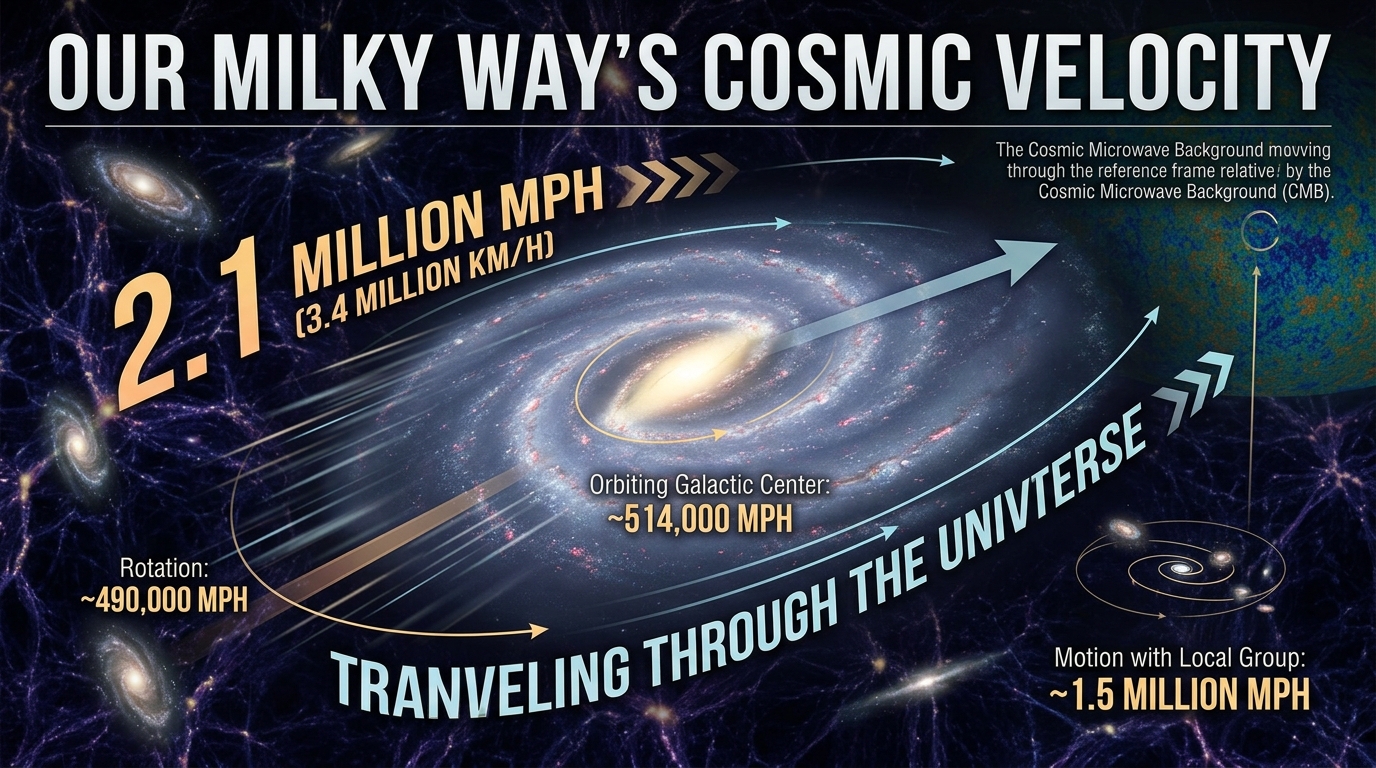
The statement “the Milky Way is travelling at about 2.1 million kilometres per hour” is broadly correct, but it needs an important scientific qualification:
2.1 million km/h is not the Milky Way’s speed through some absolute, stationary space. It is an estimated velocity relative to the Cosmic Microwave Background (CMB), the ancient radiation left over from the early universe.
Astronomers commonly express the Local Group’s motion relative to the CMB at roughly 600 km/s, while some treatments that separate the Solar System’s motion around the Galactic centre describe the Milky Way’s overall motion at about 2.1 million km/h (≈583 km/s). (NASA Science)
1. First: How fast is 2.1 million km/h?
Let’s convert it.
2,100,000 km/hour
Dividing by 60:
35,000 km/minute
Dividing again:
≈583.3 km/second
So the Milky Way’s enormous motion corresponds to approximately:
583 km every second.
For comparison, light travels about 300,000 km every second.
Therefore:
So this velocity is only about:
0.195% of the speed of light.
That is extremely fast on human scales, but still far below light speed.
NASA describes the Local Group’s motion relative to the CMB as approximately 600 km/s. (NASA Science)
2. The most important question: “Moving relative to what?”
This is the key to understanding the whole subject.
In everyday life we might say:
“A car is travelling at 100 km/h.”
But immediately we should ask:
100 km/h relative to what?
Usually the road.
In astronomy there is no universal cosmic road sitting still in an absolute sense.
Instead, astronomers can choose useful reference frames.
One particularly important reference is the:
Cosmic Microwave Background
The CMB is extremely old electromagnetic radiation produced when the early universe became transparent roughly 380,000 years after the Big Bang.
It fills the observable universe.
Because the CMB is extremely uniform, astronomers can detect our motion through it.
If we move toward one direction, the CMB radiation appears slightly blueshifted.
In the opposite direction, it appears slightly redshifted.
This creates what astronomers call the CMB dipole. NASA explains that this pattern provides evidence for the large-scale motion of our cosmic neighbourhood. (NASA Science)
3. The cosmic hierarchy of motion
One of the biggest misconceptions is imagining that Earth has only one speed.
In reality, motion occurs at many nested levels.
Think of it as a gigantic cosmic transportation system:
YOU
 │
 ▼
Earth rotates
 │
 ▼
Earth orbits the Sun
 │
 ▼
Sun orbits the Milky Way
 │
 ▼
Milky Way belongs to the Local Group
 │
 ▼
Local Group moves relative to the larger cosmic environment
 │
 ▼
Large-scale structures of the universe
 │
 ▼
Expanding universe
You are therefore participating in several different motions simultaneously.
4. Earth’s rotation
Earth rotates around its own axis.
At the equator, the rotational speed is approximately:
1,670 km/h
But this isn’t the same everywhere.
At the poles, the rotational speed approaches zero because you’re essentially rotating around a point.
So even while sitting in a chair, you are already moving through space because Earth itself is rotating.
5. Earth’s orbit around the Sun
Earth also travels around the Sun at approximately:
107,000 km/h
or about:
30 km/s.
Therefore, Earth isn’t merely rotating.
It is simultaneously travelling around the Sun.
6. The Sun’s journey around the Milky Way
The Solar System is also moving around the centre of the Milky Way.
The Sun is located approximately 26,000 light-years from the Galactic centre.
It takes roughly 225–250 million years for the Solar System to complete one orbit around the Galaxy.
This enormous orbital journey is sometimes called a Galactic year.
The Solar System therefore isn’t stationary inside the Milky Way.
It is continually travelling around the Galaxy.
7. Then comes the motion of the Milky Way itself
Now we reach your 2.1 million km/h figure.
The Milky Way is itself moving relative to the large-scale cosmic reference provided by the CMB.
Approximately:
or:
This is an extraordinary result.
NASA explains that the Local Group’s velocity relative to the CMB is around 600 km/s. (NASA Science)
A NASA educational resource similarly gives approximately 600 km/s for the Milky Way/Local Group relative to the primordial background radiation. (Cosmicopia)
8. But there is an important distinction
This is where many simplified internet explanations become misleading.
There are several different statements:
A. The Solar System’s velocity around the Milky Way
Approximately:
~220–230 km/s
or roughly:
~800,000 km/h.
B. The Solar System’s net velocity relative to the CMB
Approximately:
~370 km/s, depending on the exact reference and convention.
C. The Local Group’s velocity relative to the CMB
Approximately:
~600 km/s. (NASA Science)
Therefore, you should not simply add every speed together.
Velocity is a vector.
Direction matters.
9. Why can’t we simply add the speeds?
Suppose one person walks:
5 km/h north
while a train travels:
100 km/h east.
The person’s actual velocity relative to the ground isn’t 105 km/h in one direction.
You have to combine the two directions mathematically.
The same principle applies to galaxies.
We therefore use vector addition:
This is fundamental to understanding cosmic motion.
10. Is the Milky Way “flying through space”?
In an everyday sense, yes.
But scientifically, we must be more precise.
There is no known universal stationary platform called “absolute space” against which we can say:
“This is the one true speed of the Milky Way.”
Einstein’s theory of relativity tells us that velocity is fundamentally relational.
We therefore specify the reference frame.
For the approximately 2.1-million-km/h figure, the useful reference is the CMB.
11. What does the CMB actually tell us?
Imagine the universe as containing an enormous background of microwave radiation.
If you were perfectly at rest relative to that background, you would see the radiation statistically almost equally in every direction.
But if you move:
              Direction of motion
                     →

       radiation becomes
       slightly blueshifted

              [ OBSERVER ]

       radiation behind becomes
       slightly redshifted
This difference is incredibly small, but instruments can detect it.
The CMB therefore acts somewhat like a cosmic motion detector.
NASA describes this phenomenon through the CMB dipole: radiation in the direction of motion is blueshifted and radiation in the opposite direction is redshifted. (NASA Science)
12. Why doesn’t the enormous speed tear the Galaxy apart?
This is another fascinating point.
You might imagine:
“If the Galaxy is moving at 2.1 million km/h, shouldn’t its stars be thrown out?”
No.
The speed of the Galaxy through the larger universe is different from the relative motion of stars within the Galaxy.
Think about being inside an aircraft.
The aircraft may be travelling hundreds of kilometres per hour, while passengers walk around inside it at a few kilometres per hour.
The passengers aren’t thrown backwards simply because the aircraft is moving rapidly.
Similarly:
Milky Way’s overall motion ≠ stars being individually accelerated away from the Galaxy.
The Galaxy is a gravitationally bound system.
13. Gravity keeps the Milky Way together
The Milky Way contains enormous amounts of:
- stars
- gas
- dust
- stellar remnants
- planets
- dark matter
- a central supermassive black hole
The gravitational field of the Galaxy keeps its components bound.
The central black hole is important locally, but it is not what holds the entire Milky Way together by itself.
The Galaxy’s overall gravitational structure is dominated by the combined mass of stars, gas and especially its dark-matter halo.
14. The Milky Way is not moving through an empty universe
The Galaxy belongs to a larger gravitational environment.
The Milky Way and Andromeda are two major members of the:
Local Group
The Local Group contains numerous galaxies and dwarf galaxies.
The Local Group itself has motion relative to larger structures.
NASA describes the hierarchy as Earth orbiting the Sun, the Sun orbiting the Milky Way, the Milky Way participating in the Local Group, and the Local Group moving relative to the CMB. (NASA Science)
So cosmic motion is hierarchical.
15. What is pulling the Local Group?
This becomes considerably more complicated.
Large concentrations of matter in the universe influence the motion of galaxies through gravity.
Astronomers discuss structures including the Virgo Cluster and much larger-scale concentrations of galaxies and matter.
However, it would be misleading to imagine a single giant object somewhere in space acting like a gravitational tow truck.
Cosmic motion results from the combined gravitational influence of matter distributed across enormous distances.
16. The universe is also expanding
This is perhaps the deepest part of the subject.
The Milky Way’s motion through its local cosmic environment should not be confused with the expansion of the universe.
These are different phenomena.
Local motion
A galaxy can move relative to neighbouring galaxies because of gravity.
Cosmic expansion
On sufficiently large scales, the distances between gravitationally unbound galaxies increase because space itself is expanding.
So:
Both occur simultaneously.
17. Does the Milky Way move faster because the universe is expanding?
Not exactly.
The approximately 600 km/s CMB-relative motion represents a peculiar velocity—motion relative to the large-scale cosmic background.
The expansion of the universe is described separately using cosmological parameters such as the Hubble constant.
This distinction is essential.
18. Does our 2.1-million-km/h motion affect our everyday life?
Practically speaking:
No noticeable effect.
Why?
Because you, Earth, the atmosphere, the oceans, the Solar System and essentially everything around you are participating in the same large-scale motion.
You don’t feel the Galaxy’s speed.
Just as you don’t normally feel the constant forward velocity of a smoothly travelling airplane, you don’t feel the Milky Way’s large-scale velocity.
What we notice physically are changes in velocity—acceleration—rather than simply having a large velocity relative to some reference frame.
19. Does this speed affect time?
Special relativity tells us that relative motion affects measured time.
But at approximately:
the speed is only around:
where is the speed of light.
The relativistic Lorentz factor is:
At this speed, the effect is extremely small.
NASA specifically notes that the approximately 600 km/s motion relative to the primordial background is far below light speed, so its effect on time is negligible for ordinary purposes. (Cosmicopia)
20. How far does the Milky Way travel?
Using the approximate value:
the distance travelled in one day would be:
So, relative to this reference frame, the Galaxy would cover approximately:
50.4 million km per day.
In one year:
which gives approximately:
18.4 billion km per year.
Again, this is not a statement that the Milky Way is moving along a straight road through an absolute universe. It is a useful distance calculation based on the chosen reference frame.
21. The astonishing scale of the number
Consider:
1 second
≈583 km
1 minute
≈35,000 km
1 hour
≈2.1 million km
1 day
≈50.4 million km
1 year
≈18.4 billion km
That means the Galaxy’s large-scale motion is occurring at a rate vastly beyond anything humans experience directly.
Yet, from inside the Galaxy, everything appears relatively calm.
That is one of the great lessons of astronomy:
A system can be undergoing enormous cosmic motion while appearing locally stationary.
22. A simple mental picture
Imagine you are sitting inside a huge ship.
Inside the ship:
- people walk around,
- clocks operate normally,
- objects remain on tables,
- plants grow,
- machines function.
But outside the ship, the entire vessel is travelling extremely rapidly.
Now replace the ship with the Milky Way.
Replace the people with stars.
Replace the room with the Galaxy’s gravitational environment.
And replace the ocean with the enormous cosmic environment surrounding the Galaxy.
That is roughly the conceptual picture.
23. The deeper scientific lesson
The phrase “the Milky Way travels at 2.1 million km/h” is therefore not the complete scientific statement.
A better statement is:
The Milky Way/our cosmic neighbourhood has a large velocity relative to the cosmic microwave background, of order several hundred kilometres per second, corresponding to roughly two million kilometres per hour. The precise number depends on exactly which cosmic structure and reference frame are being discussed.
This distinction is extremely important.
24. The cosmic motion hierarchy
We can summarise the architecture like this:
                         UNIVERSE
                            │
                  Cosmic expansion
                            │
                 Large-scale structure
                            │
                    Local Group
                            │
                      MILKY WAY
                            │
                 ┌──────────┴──────────┐
                 │                     │
             Galactic orbit       Galactic motion
                 │              relative to CMB
                 │                     │
                 ▼                     ▼
               SUN              ~2.1 million km/h
                 │
                 ▼
               EARTH
                 │
          ┌──────┴──────┐
          │             │
       Rotation       Orbit
          │             │
          ▼             ▼
       ~1,670        ~107,000
        km/h           km/h
These motions occur simultaneously.
25. Final conclusion
The 2.1 million km/h figure is not science fiction. It is an expression of the enormous motion of our Galactic system relative to the Cosmic Microwave Background, although the exact numerical value depends on the chosen cosmic reference and whether one is discussing the Milky Way, Solar System, or Local Group. (Museum of Science)
The truly profound idea is not merely the number 2.1 million.
It is this:
There is no simple “stationary” Earth, stationary Sun, or stationary Milky Way.
Earth rotates.
Earth orbits the Sun.
The Sun orbits the Milky Way.
The Milky Way participates in the Local Group.
The Local Group moves relative to the cosmic microwave background.
And all of this occurs while the universe itself is expanding.
Therefore, you are not sitting still in the universe—even when you are sitting perfectly still in a chair.
That is one of the clearest everyday demonstrations of why modern physics replaced the old idea of absolute motion with the much richer concept of motion relative to a reference frame.






Be First to Comment