
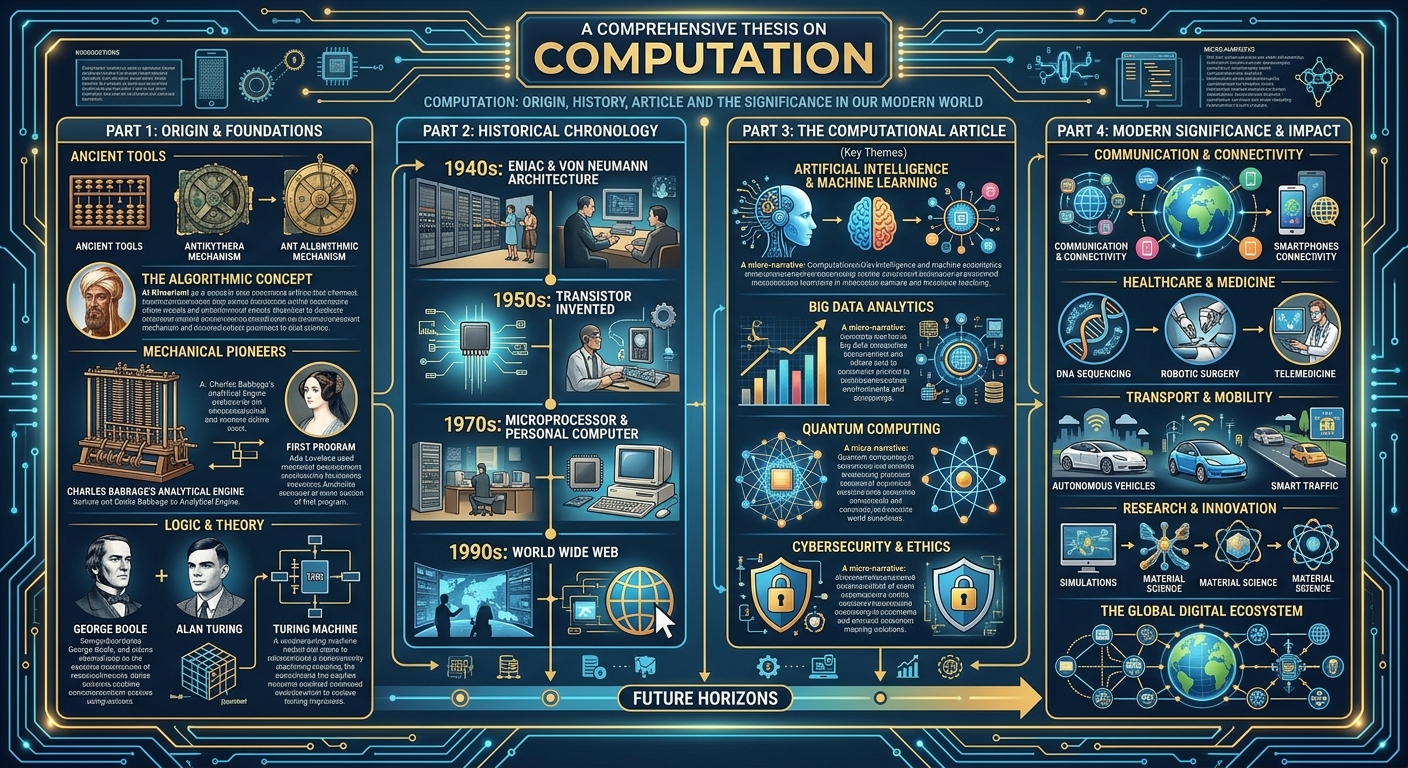
Abstract
Computation is not a recent invention. It is the 5,000-year process of humanity learning how to externalize thinking into tools. From counting stones to quantum processors, computation has evolved from a physical aid, to a mathematical idea, to a universal infrastructure that now shapes economics, science, culture, and human identity.
1. Origin: What is Computation?
Computation is the transformation of information according to rules. Long before computers, humans computed.
Three origins:
- Counting Origin: Need to track livestock, trade, time. Pebbles, tally sticks, fingers.
- Astronomical Origin: Need to predict seasons, eclipses. Babylonians and Mayans built algorithms to predict celestial motion.
- Logical Origin: Need to systematize reasoning. Aristotle’s logic, Euclid’s axioms were algorithms before we called them that.
The core insight: Information can be represented physically, and physical manipulation can yield new knowledge.
2. History: Four Great Ages of Computation
Age 1: Mechanical Computation (3000 BC – 1800s)
Goal: Automate arithmetic.
- c. 2700 BC: Abacus in Mesopotamia and China. First portable computer.
- Antikythera Mechanism (c. 100 BC): Greek bronze geared computer to predict eclipses.
- 1642: Pascal’s Pascaline – adding machine.
- 1822: Charles Babbage’s Difference Engine & Analytical Engine. First concept of a programmable computer with memory, CPU, printer. Ada Lovelace wrote the first algorithm for it.
- 1890: Herman Hollerith’s punched card tabulator for US Census. Founded IBM.
Limitation: Mechanical, slow, single-purpose.
Age 2: Theoretical Computation (1930s – 1940s)
Goal: Define what can be computed at all.
- 1931: Kurt Gödel shows mathematical limits.
- 1936: Alan Turing creates the Turing Machine – a simple abstract machine that can compute anything computable. This defines the computer.
- 1936: Alonzo Church – Lambda calculus, same idea from logic side.
- 1943-45: World War II drives practical machines. Colossus at Bletchley Park to break Enigma. ENIAC in the US for ballistic tables.
This age proved: Computation is universal. One machine can simulate any other machine.
Age 3: Electronic & Digital Revolution (1947 – 1990)
Goal: Make computation fast, cheap, and small.
- 1947: Transistor at Bell Labs. Replaces vacuum tubes.
- 1958: Integrated Circuit – Jack Kilby and Robert Noyce put many transistors on one chip.
- 1965: Gordon Moore observes Moore’s Law: transistors double every ∼2 years.
- 1971: Intel 4004 – First microprocessor.
- 1970s-80s: Personal computers – Altair, Apple II, IBM PC. Computation moves from government to individual.
- 1970s: UNIX, C, TCP/IP. The software and networking foundations of the modern internet.
Age 4: Networked & Intelligent Computation (1990 – 2026)
Goal: Connect all computers and make them learn.
- 1989-1991: World Wide Web by Tim Berners-Lee.
- 2007: iPhone. Computation becomes ubiquitous and mobile.
- 2012: AlexNet – Deep learning breakthrough.
- 2017: Transformer architecture – basis of all modern AI.
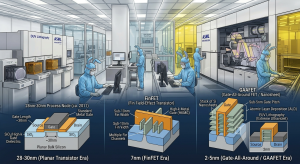
- 2020-2026: Large Language Models, generative AI, quantum prototypes, chiplet and EUV lithography pushing to 2nm and below.
We moved from computing numbers, to computing text and images, to computing intelligence.
3. The Architecture of Modern Computation
Modern computation has 4 layers:
1. Physical Layer: Silicon transistors, lithography, quantum qubits.
2. Logical Layer: Boolean algebra, logic gates, binary.
3. Algorithmic Layer: Algorithms, data structures, complexity theory ( $P$ vs $NP$).
4. System Layer: Operating systems, networks, cloud, distributed systems.
Any advance in one layer enables advances in others.
4. Significance in Our Modern World
Why does computation matter more than any other technology?
A. Economic Significance
Computation is the new industrial power. Every industry is now computational: finance is algorithmic trading, farming is precision data, medicine is genomics and AI diagnosis. Software eats the world. Companies that control computation – wafer companies, chip designers, cloud providers – control productivity.
B. Scientific Significance
- Biology: Protein folding solved by AlphaFold.
- Physics: Climate models, particle simulations.
- Chemistry: Computational discovery of new materials.
- Mathematics: Proofs that require massive computation.
Computation turned science from observing to simulating.
C. Social & Cognitive Significance
We externalize memory to search engines, navigation to maps, social connection to networks. This changes how we learn, remember, and think. Literacy in the 21st century is computational literacy.
D. Political & Power Significance
Who makes lithography machines, who fabs wafers, who trains frontier models is now a matter of national security. The 2019-2026 chip war shows computation is geopolitical.
E. Philosophical Significance
If a Turing Machine can simulate any process, is the universe itself computable? This idea drives debates on consciousness, AI sentience, and the nature of intelligence.
5. Challenges and Future Directions
- Physical Limits: Moore’s Law is slowing. We need EUV, 3D chips, photonic and quantum computing.
- Energy: Data centers use 1-2% of global electricity. Sustainable computation is critical.
- Ethics & Labor: Automation of white-collar work, bias in algorithms, misinformation.
- Beyond Von Neumann: Neuromorphic computing inspired by your earlier question – building chips like human neural electrical networks.
The next step is not just faster computation, but computation that learns, adapts, and integrates biology.
6. Conclusion
The history of computation is the history of making thought tangible.
From a Babylonian counting stone, to a Greek gear, to a Turing abstraction, to a 3nm chip in your phone, the thread is the same: we create external structures to carry our reasoning further than our brains can alone.
In the modern world, computation is no longer a tool we use. It is the environment we live in. Understanding its origin and logic is no longer optional for a modern society – it is as fundamental as reading and writing.
The Concept and Theoretical Origin of Computation
At its fundamental level, computation is the process of executing a well-defined sequence of operations—an algorithm—to transform input data into a deterministic output. While colloquially tied to physical microchips, computation is mathematically abstract.
The modern formalization of computation emerged in the 1930s as mathematicians tried to determine the limits of logic:
- Turing Machines (1936): Alan Turing conceptualized the Universal Turing Machine, a theoretical device with an infinite tape and a read/write head. It proved that any systematic calculation can be executed mechanically, establishing the blueprint for the stored-program computer.
- Lambda Calculus (1936): Developed by Alonzo Church around the same time, this framework defined computation using function abstraction and application.
- The Church-Turing Thesis: Proposes that any real-world algorithm or calculation that can be performed by a human or a physical machine can also be simulated by a Universal Turing Machine.
Historical Evolution of Computation
The realization of computational theory spans several distinct eras:
| Era | Primary Technology | Key Breakthroughs & Milestones |
| Ancient Era | Manual tools (Abacus, Astrolabe) | Structured counting systems, early geometric and astronomical positioning. |
| Mechanical (17th–19th C.) | Gears, levers, punch cards | Pascal’s mechanical calculator, Leibniz’s step reckoner, and Charles Babbage’s design of the Analytical Engine (the first general mechanical computer concept). |
| Early Electronic (1940s) | Vacuum tubes | ENIAC and Colossus; shift from mechanical gears to high-speed electronic relays. Von Neumann architecture separated CPU, memory, and I/O. |
| Silicon Era (1950s–2000s) | Transistors, Integrated Circuits | Microprocessors (Intel 4004), Moore’s Law exponential growth, software operating systems, and global networking (ARPANET to the Internet). |
| Modern Era (2010s–Present) | Cloud, GPUs, Quantum states | Massively parallel architecture for Neural Networks, distributed cloud infrastructure, and practical Quantum Computing. |
Key Areas of Significance in the Modern World
Computation has evolved from an administrative calculation tool into the primary framework through which modern society functions:
- Scientific Discovery: Systems that would take centuries to calculate manually are simulated in seconds. High-Performance Computing (HPC) drives climate modeling, drug discovery, genetic mapping, and astrophysical simulations.
- Artificial Intelligence & Automation: Machine learning algorithms allow computational systems to discern patterns, generate media, optimize supply chains, and power autonomous vehicles.
- Economic Infrastructure: Global financial markets rely on algorithmic trading, cryptographic ledgers (blockchain), and real-time transaction networks that process billions of operations per second.
- Communication & Information Topology: Global connectivity via the Internet relies on network-level routing algorithms, data encryption (RSA/ECC), and massive database indexing.
- Industrial & Physical Automation: Modern manufacturing relies on Computer Numerical Control (CNC), industrial robotics, and Internet of Things (IoT) sensors to manage power grids and infrastructure dynamically.



Be First to Comment