
Abstract
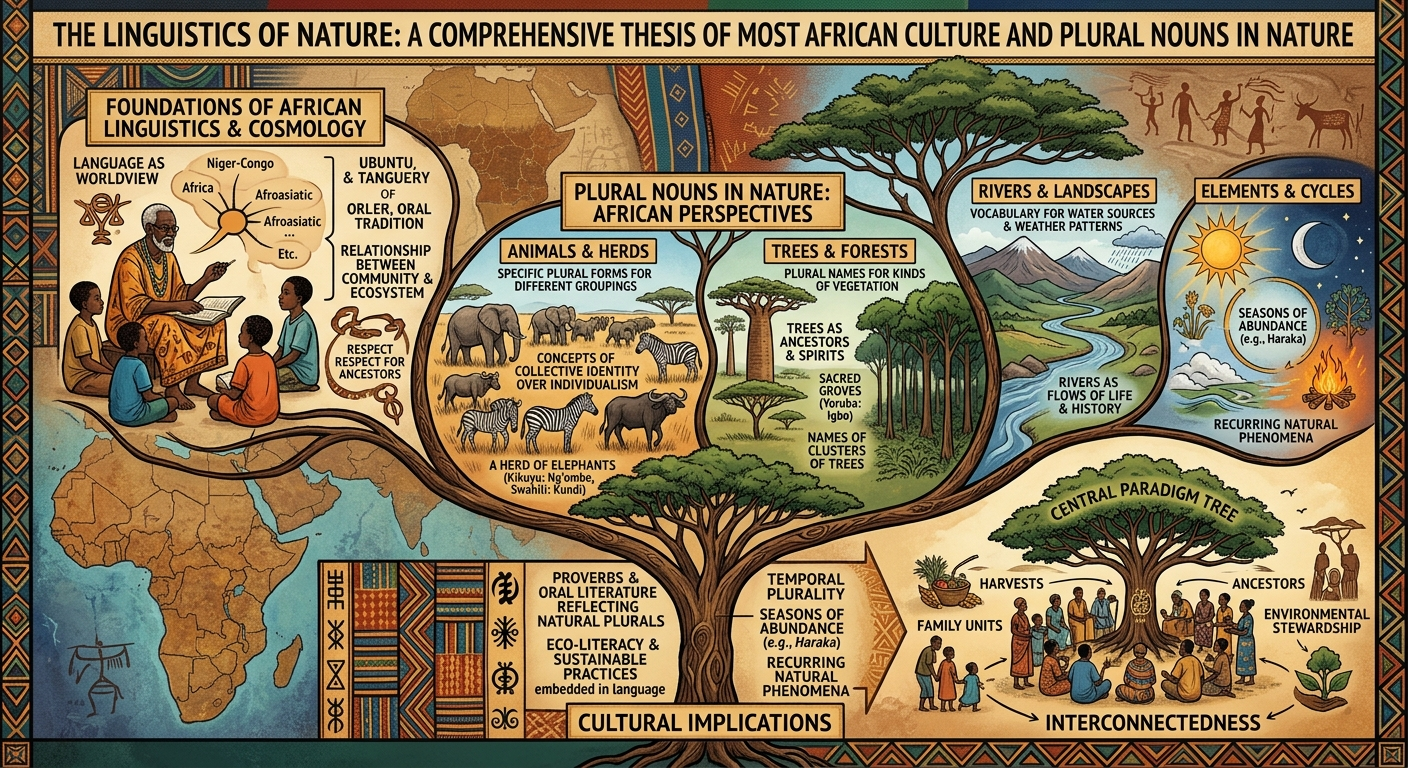
Language is one of humanity’s most powerful systems for organizing reality. Through language, people name animals, plants, landscapes, weather, seasons, rivers, mountains, stars, foods, materials, and the many relationships connecting human beings with the natural environment. The study of these relationships can be called the linguistics of nature: the investigation of how languages encode, classify, describe, and communicate knowledge about the natural world.
Africa provides an exceptionally rich field for this study. The continent contains thousands of languages belonging to several major language families, including Niger-Congo, Afroasiatic, Nilo-Saharan, and Khoisan-associated language groups. These languages have developed within extraordinarily diverse ecological environments—from the Sahara and Sahel to tropical forests, savannas, mountains, wetlands, and southern African grasslands.
African languages therefore provide many different ways of expressing plurality, classification, possession, location, movement, life, and ecological relationships. In some languages, nouns form plurals through prefixes; in others, suffixes, changes in tone, internal changes, particles, or other grammatical mechanisms are used. Some languages also classify nouns according to characteristics such as animacy, shape, material, or grammatical gender.
The study of plural nouns is consequently more than a grammatical exercise. It provides a window into how communities organize their understanding of the world.
1. Introduction: What Is the Linguistics of Nature?
The natural world contains enormous numbers of entities:
- one tree and many trees;
- one animal and many animals;
- one river and many rivers;
- one mountain and many mountains;
- one seed and many seeds;
- one bird and many birds;
- one cloud and many clouds;
- one star and many stars.
Human languages must somehow represent these relationships.
The distinction between one and more than one is known linguistically as number. The most familiar distinction is:
singular → plural
For example:
tree → trees
bird → birds
river → rivers
But languages do not all create plurals in the same way.
English frequently adds -s or -es, whereas many African languages use completely different grammatical systems.
This makes African languages particularly valuable for understanding how human beings classify nature through language.
2. Africa Is Linguistically Diverse
It is important not to speak of “African language” as though Africa possessed a single linguistic system.
Africa is a linguistic continent containing many distinct language families and hundreds of millions of speakers.
Major language groupings include:
Niger-Congo
This enormous family includes many languages of West, Central, Eastern, and Southern Africa.
Examples include:
- Swahili;
- Zulu;
- Xhosa;
- Sesotho;
- Setswana;
- Sepedi;
- Shona;
- Yoruba;
- Igbo;
- Akan;
- Lingala;
- Kikongo.
Afroasiatic
This family includes languages such as:
- Arabic varieties;
- Amharic;
- Somali;
- Hausa;
- Oromo;
- Tigrinya;
- Berber/Amazigh languages.
Nilo-Saharan-associated languages
This broad grouping includes numerous languages spoken across parts of the Nile Valley, Sahel, and East-Central Africa, although the exact classification of some languages remains debated.
Khoisan-associated languages
Southern Africa contains several distinctive language families traditionally grouped under the broad label “Khoisan.” Modern linguistic research generally treats these languages individually rather than assuming that they constitute one proven genetic family.
This diversity is essential when discussing African linguistic culture.
3. Nature as a Linguistic Universe
Nature is not simply a collection of objects.
For human communities, nature can represent:
- food;
- medicine;
- shelter;
- water;
- transportation;
- agriculture;
- spirituality;
- ancestry;
- weather;
- danger;
- economic resources;
- scientific knowledge;
- cultural identity.
Consequently, vocabulary concerning nature can become extremely sophisticated.
A community living primarily in a grassland environment may require highly developed vocabulary concerning grasses, grazing animals, water sources, seasons, and weather.
A forest community may have extensive terminology concerning:
- tree species;
- edible plants;
- medicinal plants;
- insects;
- fungi;
- animal tracks;
- soils;
- forest conditions.
Language therefore reflects human interaction with ecosystems.
4. The Concept of the Noun
A noun is a word that typically refers to a person, animal, object, place, substance, idea, or other entity.
Examples from the natural world include:
| Category | Singular concept | Plural concept |
|---|---|---|
| Plant | tree | trees |
| Animal | lion | lions |
| Bird | bird | birds |
| Insect | ant | ants |
| Landscape | mountain | mountains |
| Water | river | rivers |
| Astronomy | star | stars |
| Agriculture | seed | seeds |
| Geology | stone | stones |
| Weather | cloud | clouds |
However, these English examples conceal an important fact:
plurality is not universal in form.
Different languages grammaticalize plurality differently.
5. Plurality in African Languages
One of the most fascinating characteristics of many African languages is the importance of noun-class systems.
This is especially visible in many Bantu languages.
Instead of simply adding a plural ending, a language may change the beginning of a noun.
For example, in Swahili:
mtu → watu
meaning:
person → people
The change is not merely an English-style “-s.” The noun belongs to a grammatical class, and the singular and plural forms are associated with different class markers.
Another familiar Swahili example is:
mti → miti
meaning:
tree → trees
The change from m- to mi- expresses the number relationship.
This demonstrates an important principle:
In some African languages, plurality is integrated into a broader system of noun classification.
6. Bantu Noun Classes and Nature
Many Bantu languages organize nouns into grammatical classes.
The precise system differs from language to language, but common semantic associations include:
- people;
- plants;
- objects;
- animals;
- abstract concepts;
- locations;
- paired objects;
- substances.
The relationship between grammar and meaning is therefore particularly interesting when studying nature.
Consider the conceptual relationship:
tree → trees
The language is not necessarily thinking of the plural as simply “one tree plus another tree.”
Instead, the singular and plural may belong to systematically related noun classes.
This grammatical architecture allows speakers to build agreement throughout a sentence.
7. Swahili as an Illustrative Example
Swahili provides useful examples because it is widely studied and has a well-described noun-class system.
Examples include:
| Singular | Plural | Meaning |
|---|---|---|
| mti | miti | tree / trees |
| mto | mito | river / rivers |
| mlima | milima | mountain / mountains |
| mnyama | wanyama | animal / animals |
| ndege | ndege | bird / birds |
The last example is particularly interesting:
ndege can refer to both singular and plural depending on context.
This demonstrates that languages do not necessarily require every noun to have a visibly different singular and plural form.
8. Southern African Languages
Southern Africa contains numerous languages with highly developed systems for expressing nature.
Among them are:
- isiZulu;
- isiXhosa;
- Sesotho;
- Setswana;
- Sepedi;
- siSwati;
- Tshivenda;
- Xitsonga;
- isiNdebele.
Many of these languages belong to the Bantu branch of Niger-Congo.
Their vocabularies contain extensive terminology concerning:
- cattle;
- wild animals;
- plants;
- agriculture;
- rain;
- rivers;
- mountains;
- soils;
- seasons;
- foods;
- medicinal plants;
- landscapes.
The vocabulary of nature is therefore closely connected with everyday life.
9. Zulu and Xhosa: Number and Noun Classes
isiZulu and isiXhosa use noun-class systems in which singular and plural relationships are frequently marked through prefixes.
For example, a familiar pattern is:
um- → aba-
in appropriate noun classes.
One well-known example in isiZulu is:
umuntu → abantu
meaning:
person → people
The same general grammatical architecture appears in many Bantu languages, although the exact noun classes and forms differ.
The important linguistic lesson is that plurality is part of a larger grammatical network.
10. Sesotho and Setswana
Sesotho and Setswana similarly possess noun-class systems.
Examples involving people frequently illustrate singular/plural relationships such as:
motho → batho
meaning:
person → people
These languages demonstrate that the concept of plurality can be encoded through systematic changes in noun morphology.
Nature vocabulary operates within the same grammatical architecture.
Trees, animals, plants, rivers, stones, and other natural entities are incorporated into the language’s noun-class system.
11. Plural Nouns Are More Than “Many”
The grammatical concept of plural does not always correspond perfectly to the mathematical concept of “more than one.”
Consider several possibilities:
Singular
one tree
Plural
many trees
Collective
a group or collection treated as a unit
Mass noun
something not normally counted individually
Examples include:
- water;
- sand;
- soil;
- rain;
- grass.
A language may treat these differently.
Therefore:
grammatical number and physical quantity are related, but they are not identical.
12. Nature Contains Both Countable and Uncountable Entities
Human beings encounter nature in different forms.
Some things are naturally easy to count:
- birds;
- elephants;
- trees;
- stones;
- seeds;
- mountains.
Others are normally perceived as continuous substances:
- water;
- air;
- sand;
- smoke;
- rain;
- soil.
Language develops grammatical strategies for dealing with these differences.
This is one reason why the study of natural vocabulary can reveal how people conceptualize their environment.
13. Animal Plurals
Animals provide some of the clearest examples of linguistic plurality.
Conceptually:
one lion → lions
one elephant → elephants
one antelope → antelopes
one bird → birds
one fish → fish
one insect → insects
But languages may encode these relationships differently.
A language may use:
- prefixes;
- suffixes;
- tone;
- reduplication;
- vowel changes;
- independent plural words;
- noun-class alternation;
- context.
There is no single universal African method.
14. Plants and the Grammar of Life
Plants are particularly interesting because many African societies have historically developed extensive relationships with vegetation.
Plants provide:
- food;
- medicine;
- timber;
- fibres;
- fuel;
- construction materials;
- animal feed;
- dyes;
- cultural materials.
Consequently, plant terminology can be highly specialized.
A language may distinguish between numerous plants that English speakers might simply call “grass,” “tree,” “bush,” or “herb.”
This illustrates a fundamental principle of linguistic anthropology:
Vocabulary often becomes detailed where human ecological knowledge becomes detailed.
15. Indigenous Ecological Knowledge
African languages preserve enormous amounts of indigenous ecological knowledge.
Such knowledge can include:
- seasonal changes;
- rainfall patterns;
- animal behaviour;
- plant properties;
- soil conditions;
- agricultural cycles;
- water sources;
- grazing conditions;
- medicinal uses;
- weather signs.
Language acts as a storage system for this knowledge.
A word can contain information accumulated through generations of observation.
16. The Linguistics of Seasons
Many traditional African communities have developed sophisticated systems for understanding seasonal cycles.
Instead of thinking only in terms of:
spring → summer → autumn → winter
communities may organize time according to:
- rainfall;
- planting;
- harvesting;
- animal migration;
- flowering;
- fruiting;
- drought;
- cold;
- heat;
- winds.
This creates a close relationship between linguistic time and ecological time.
17. Rain as a Linguistic and Cultural Concept
Rain is particularly significant across many African societies.
Rain can mean:
- agricultural productivity;
- livestock survival;
- replenishment of rivers;
- drinking water;
- food security;
- ecological renewal.
Consequently, rain vocabulary can be culturally significant.
Languages may distinguish:
- light rain;
- heavy rain;
- prolonged rain;
- storm rain;
- seasonal rain;
- rain accompanied by wind;
- rain after drought.
The exact distinctions vary between languages and communities.
18. Rivers and Water
Water vocabulary is another major component of the linguistics of nature.
Humans distinguish between:
- river;
- stream;
- spring;
- lake;
- wetland;
- waterfall;
- flood;
- ocean;
- rainwater;
- groundwater.
African geography makes these distinctions especially important.
The Nile, Congo, Niger, Zambezi, Limpopo, Orange, Senegal, and numerous other river systems have shaped settlement, agriculture, transportation, economies, and cultures.
19. Mountains and Landscape
Landscape terminology reflects how humans perceive geographical space.
A community may distinguish between:
- mountain;
- hill;
- valley;
- plain;
- plateau;
- cliff;
- gorge;
- forest;
- grassland;
- desert;
- wetland.
These distinctions are not merely geographical.
Landscapes can carry:
- historical memories;
- sacred meanings;
- ancestral associations;
- political significance;
- economic value;
- community identity.
20. Nature and African Oral Tradition
African oral traditions have historically transmitted knowledge through:
- stories;
- proverbs;
- songs;
- praise poetry;
- riddles;
- genealogies;
- ceremonies;
- teachings.
Nature frequently appears in these traditions.
Animals may symbolize:
- wisdom;
- strength;
- patience;
- cunning;
- leadership;
- danger;
- cooperation.
Plants and landscapes may similarly carry cultural meanings.
Thus language becomes a bridge between ecology and cultural memory.
21. The Animal as Teacher
Many African oral traditions use animals as characters in narratives.
Examples may include:
- hare;
- tortoise;
- lion;
- elephant;
- hyena;
- jackal;
- crocodile;
- snake;
- bird.
These stories do not necessarily mean that the animal has a literal human identity.
Rather, animals provide a symbolic vocabulary through which societies can discuss:
- human behaviour;
- social responsibility;
- intelligence;
- greed;
- courage;
- cooperation;
- leadership.
Nature therefore becomes a linguistic classroom.
22. Proverbs and Nature
Proverbs frequently use natural phenomena to communicate abstract ideas.
A tree can represent:
- stability;
- ancestry;
- growth;
- community.
A river can represent:
- movement;
- continuity;
- change.
A seed can represent:
- potential;
- future generations;
- agricultural productivity.
A mountain can represent:
- endurance;
- permanence;
- challenge.
The linguistic structure is therefore:
natural phenomenon → observed characteristic → human lesson
23. The Tree as a Linguistic Model
The tree provides an excellent metaphor for understanding language itself.
A tree contains:
- roots;
- trunk;
- branches;
- leaves;
- flowers;
- fruit;
- seeds.
A language family can similarly be represented as:
language family → branches → languages → dialects → local varieties
For example, a broad language family may contain branches, and each branch may contain many languages.
This is why linguists often use a language tree metaphor.
24. Language Evolution and Biological Evolution
There is a useful conceptual similarity between linguistic and biological evolution.
Biological systems change through generations.
Languages also change through generations.
A language can:
- develop from earlier forms;
- diversify geographically;
- borrow vocabulary;
- lose older words;
- develop new grammatical structures;
- split into different varieties.
The comparison should not be taken literally—language evolution and biological evolution operate through different mechanisms—but the tree metaphor helps explain historical relationships.
25. Borrowing Between African Languages
African languages have interacted for centuries.
Languages borrow:
- words;
- names;
- expressions;
- technological terms;
- food vocabulary;
- religious terminology;
- political terminology.
Trade, migration, intermarriage, urbanization, conquest, education, religion, and modern communications have all contributed to linguistic exchange.
Consequently, the vocabulary of nature may sometimes reveal historical contact between communities.
26. Multilingualism
One of Africa’s major linguistic characteristics is multilingualism.
An individual may use:
- a home language;
- a regional language;
- a national language;
- an international language.
For example, people may communicate using combinations involving:
- isiZulu;
- Sesotho;
- Sepedi;
- Setswana;
- English;
- Afrikaans;
- isiXhosa;
- Xitsonga;
- Tshivenda.
Multilingualism allows people to move between different linguistic systems.
27. Plurality Across Languages
The concept of plurality can therefore be represented in many ways.
| Linguistic strategy | Basic idea |
|---|---|
| Prefix | marker added before noun |
| Suffix | marker added after noun |
| Internal change | noun itself changes |
| Tone | pitch pattern changes |
| Reduplication | repetition contributes to meaning |
| Particle | separate word marks plurality |
| Context | same form can represent singular/plural |
| Noun class | singular and plural belong to related classes |
No single strategy should be regarded as inherently more sophisticated than another.
Each represents a different solution to the problem of communicating number.
28. Plurality and Noun Classes
Noun-class systems are particularly important for understanding many Bantu languages.
A simplified conceptual model is:
singular noun class
↓
noun
↓
plural noun class
↓
related plural noun
The relationship may then affect other words in the sentence.
This means that noun classes can influence:
- adjectives;
- verbs;
- demonstratives;
- possessives;
- pronouns.
Consequently, number is not always confined to the noun itself.
29. Agreement: The Hidden Architecture
Consider a simplified linguistic principle:
noun → adjective → verb → other agreeing elements
If the noun changes class or number, other parts of the sentence may change as well.
This produces a grammatical network.
Therefore, a noun-class language can be understood as an interconnected system rather than a collection of isolated words.
This is one of the most important differences between simply memorizing vocabulary and studying linguistic structure.
30. Human Culture and Natural Classification
Every society classifies its environment.
People distinguish:
- edible from poisonous;
- domestic from wild;
- useful from dangerous;
- young from mature;
- wet from dry;
- fertile from infertile;
- seasonal from permanent.
Language gives names to these distinctions.
Thus:
classification is one of the fundamental functions of language.
The classification of nature is especially important because survival depends on correctly recognizing the environment.
31. Agriculture and Language
Agriculture has generated extensive environmental vocabulary.
Farmers need to distinguish:
- seed;
- seedling;
- crop;
- field;
- soil;
- fertilizer;
- weed;
- pest;
- harvest;
- drought;
- rain;
- livestock;
- grazing;
- irrigation.
These concepts create a specialized linguistic ecosystem.
Traditional agricultural knowledge may therefore be embedded within local terminology.
32. Livestock and Cattle Vocabulary
Livestock has historically been extremely important in numerous African societies.
Cattle can provide:
- milk;
- meat;
- hides;
- wealth;
- agricultural power;
- social value.
Consequently, cattle terminology can become highly detailed.
Languages may distinguish animals according to:
- age;
- sex;
- colour;
- markings;
- physical characteristics;
- breeding status;
- function.
This illustrates the principle that economic importance can influence vocabulary richness.
33. Wildlife and Linguistic Knowledge
Africa contains extraordinary biodiversity.
Among its well-known animals are:
- elephants;
- lions;
- leopards;
- cheetahs;
- rhinoceroses;
- giraffes;
- zebras;
- buffalo;
- hippopotamuses;
- crocodiles;
- antelopes;
- primates;
- birds;
- reptiles;
- insects.
African languages contain diverse names for these animals and their ecological relationships.
The linguistic record can therefore complement biological and ecological research.
34. The Plurality of Biodiversity
The word biodiversity itself expresses plurality at a deeper level.
It means biological variety across:
genes → species → ecosystems
Nature is therefore inherently plural.
A forest is not simply “a tree.”
It is an interconnected system containing:
- trees;
- shrubs;
- grasses;
- insects;
- birds;
- mammals;
- fungi;
- microorganisms;
- water;
- soil;
- minerals;
- sunlight.
Language helps humans describe this multiplicity.
35. From One to Many: A Universal Human Problem
Every human community faces the cognitive problem of distinguishing:
one
from
many.
But languages solve this problem differently.
English:
tree → trees
Swahili:
mti → miti
Southern Bantu languages:
various noun-class transformations
Other languages:
different morphological, syntactic, tonal, or contextual strategies.
This demonstrates an important principle:
Human experience may be shared, while linguistic representation can differ dramatically.
36. Nature and Grammar
Grammar can be understood as an organized system for representing relationships.
For example:
one tree
many trees
this tree
those trees
my tree
our trees
the tree grows
the trees grow
The natural object remains conceptually recognizable, while grammar communicates:
- number;
- possession;
- location;
- definiteness;
- action;
- relationship.
Language therefore turns perception into structured information.
37. Nature as a Living Dictionary
The environment can be regarded metaphorically as a living dictionary.
A person observes:
rain
and develops a word for it.
Observes:
animal tracks
and develops terminology.
Observes:
different stages of plant growth
and develops distinctions.
Observes:
seasonal winds
and develops names.
Over generations, these words become part of cultural memory.
38. Linguistic Ecology
The relationship between language and environment is sometimes studied under the broader idea of linguistic ecology.
This asks questions such as:
- How does the environment influence vocabulary?
- How does culture influence classification?
- How does language preserve ecological knowledge?
- What happens when a language disappears?
- Can traditional environmental terminology support conservation?
- How does modernization change environmental vocabulary?
These questions are increasingly important in the modern world.
39. Language Loss and Loss of Ecological Knowledge
When a language becomes endangered, the loss may involve more than grammar and vocabulary.
A community can also lose:
- traditional plant names;
- animal knowledge;
- weather terminology;
- agricultural vocabulary;
- place names;
- oral histories;
- ecological observations.
This makes language preservation relevant to cultural and environmental preservation.
40. African Place Names
Place names are another important part of the linguistics of nature.
Names may refer to:
- rivers;
- mountains;
- forests;
- animals;
- vegetation;
- soil;
- water;
- historical events;
- people.
A place name can therefore preserve information about a landscape even when the environment itself has changed.
41. Indigenous Names and Scientific Names
Modern science generally uses standardized biological classification systems.
For example, organisms receive scientific names under international naming conventions.
Local communities may simultaneously possess their own names.
These systems serve different purposes.
Scientific taxonomy
Designed for:
- global communication;
- biological classification;
- scientific precision.
Indigenous/local terminology
Often designed around:
- practical use;
- ecological observation;
- cultural meaning;
- local distinctions;
- experience.
The two systems can complement one another.
42. Traditional Knowledge and Modern Science
A productive future does not require choosing between traditional knowledge and modern science.
Instead, researchers can explore how they interact.
For example:
local ecological observation
↓
linguistic documentation
↓
scientific investigation
↓
conservation research
↓
community benefit
This approach can strengthen both scientific understanding and cultural preservation.
43. Technology and African Languages
Digital technology is changing African linguistic possibilities.
Computers and artificial intelligence can now process:
- speech;
- text;
- dictionaries;
- translation;
- pronunciation;
- grammar;
- audio recordings.
However, many African languages remain underrepresented in digital systems.
This creates an important technological challenge.
44. Artificial Intelligence and Nature Vocabulary
AI systems need linguistic data.
To build effective language technology for African languages, researchers may need:
- dictionaries;
- grammatical descriptions;
- speech recordings;
- written corpora;
- parallel translations;
- terminology databases;
- cultural context.
Nature vocabulary should be included.
An AI system that recognizes only a small portion of local environmental terminology may fail to understand important community knowledge.
45. Building an African Linguistic Knowledge Database
A comprehensive future database could organize information as:
Language
→ noun
→ singular
→ plural
→ noun class
→ pronunciation
→ definition
→ ecological category
→ cultural meaning
→ geographical distribution
→ scientific equivalent
For example:
Language: X
Word: local term
Meaning: tree species
Number: singular/plural
Ecological category: plant
Scientific identification: where reliably established
Cultural use: food/medicine/timber/etc.
Such databases could support education, conservation, translation, and AI.
46. A Pan-African Nature Lexicon
A long-term research project could create a Pan-African Nature Lexicon.
It could contain categories such as:
Animals
- mammals;
- birds;
- reptiles;
- amphibians;
- fish;
- insects.
Plants
- trees;
- shrubs;
- grasses;
- crops;
- medicinal plants;
- wild foods.
Geography
- rivers;
- lakes;
- mountains;
- valleys;
- deserts;
- forests.
Weather
- rain;
- wind;
- storms;
- drought;
- clouds;
- temperature.
Agriculture
- seeds;
- soil;
- crops;
- livestock;
- farming tools.
Astronomy
- sun;
- moon;
- stars;
- planets;
- constellations.
47. The Linguistic Tree of Nature
The entire concept can be represented as a hierarchy:
NATURE
├── Living world
│ ├── Plants
│ ├── Animals
│ ├── Fungi
│ └── Microorganisms
│
├── Physical environment
│ ├── Water
│ ├── Soil
│ ├── Rocks
│ └── Air
│
├── Climate
│ ├── Rain
│ ├── Wind
│ ├── Clouds
│ └── Temperature
│
├── Landscape
│ ├── Mountains
│ ├── Rivers
│ ├── Forests
│ ├── Grasslands
│ └── Deserts
│
└── Cosmos
├── Sun
├── Moon
├── Stars
└── Planets
Each category generates its own vocabulary.
48. Nature, Culture, and Identity
Language does not merely describe the environment.
It can become part of identity.
A community may identify itself through:
- its language;
- its land;
- its rivers;
- its animals;
- its agricultural traditions;
- its ancestral landscapes;
- its stories.
Therefore:
language + environment + history = cultural identity
This relationship is particularly important in African societies where oral traditions and local environments have historically played major roles in community life.
49. Plurality as a Philosophy of Nature
There is also a philosophical dimension.
Nature itself operates through plurality.
There is:
- one ecosystem containing many species;
- one river containing countless organisms;
- one forest containing many trees;
- one community containing many individuals;
- one continent containing many cultures;
- one humanity containing many languages.
Plurality therefore exists simultaneously at several levels.
One → many → interconnected whole
This is an important way of thinking about both nature and language.
50. Africa as a Linguistic Ecosystem
Africa can itself be understood metaphorically as a linguistic ecosystem.
Just as an ecosystem contains many species, Africa contains many languages.
Each language has:
- vocabulary;
- grammar;
- sounds;
- history;
- speakers;
- cultural knowledge;
- geographical distribution.
Languages interact like neighbouring ecological populations.
Some expand.
Some contract.
Some influence others.
Some disappear.
Some are revitalized.
51. The Importance of Linguistic Diversity
Linguistic diversity is valuable because it provides multiple ways of expressing human experience.
One language may make a distinction that another does not.
Another may possess especially detailed terminology for:
- livestock;
- plants;
- rainfall;
- landscapes;
- kinship;
- social organization.
Consequently, linguistic diversity can be viewed as a form of human intellectual biodiversity.
52. Education
African education systems can benefit from connecting language, nature, and science.
A curriculum could teach:
local language
local ecological knowledge
biology
geography
agriculture
environmental science
This would allow students to see that their home language is not merely a communication tool.
It can also be a vehicle for scientific observation and knowledge preservation.
53. Conservation
Conservation programs can benefit from understanding local terminology.
Communities often possess detailed knowledge of:
- animal habitats;
- plant distribution;
- seasonal changes;
- water availability;
- land use;
- ecological indicators.
Working with local languages can therefore improve communication between conservation scientists and communities.
54. The Future of African Linguistic Research
Future research should investigate:
- African noun-class systems.
- Plural formation across African languages.
- Indigenous plant terminology.
- Indigenous animal terminology.
- Traditional weather vocabulary.
- Agricultural language.
- Place names.
- Oral traditions.
- Ecological knowledge.
- Language change.
- Language endangerment.
- Digital preservation.
- AI translation.
- African-language educational technology.
- Scientific terminology development.
55. A Research Framework
A comprehensive research project could use the following methodology.
Step 1 — Identify the language
Determine its family, geographical area, and major dialects.
Step 2 — Collect nature vocabulary
Record words for:
- animals;
- plants;
- water;
- landscapes;
- weather;
- agriculture.
Step 3 — Document number
For every noun, record:
singular → plural
where the language grammatically distinguishes them.
Step 4 — Document noun classes
Determine whether the noun belongs to a grammatical class.
Step 5 — Document meaning
Record cultural and ecological meanings.
Step 6 — Record pronunciation
Create audio recordings with community consent.
Step 7 — Compare languages
Identify similarities and differences.
Step 8 — Digitize
Create searchable databases and educational resources.
Step 9 — Preserve
Store recordings, dictionaries, stories, and grammatical information securely.
Step 10 — Return knowledge to communities
Research should benefit the speakers whose knowledge is being documented.
56. A Comparative Model
A future comparative table could look like this:
| Concept | Language A | Language B | Language C | Language D |
|---|---|---|---|---|
| tree | singular | singular | singular | singular |
| trees | plural | plural | plural | plural |
| animal | singular | singular | singular | singular |
| animals | plural | plural | plural | plural |
| river | singular | singular | singular | singular |
| rivers | plural | plural | plural | plural |
| mountain | singular | singular | singular | singular |
| mountains | plural | plural | plural | plural |
The important research question is not merely:
“What is the word?”
It is also:
“How does the language construct the relationship between one and many?”
57. The Deeper Meaning of Plural Nouns
Plural nouns reveal something fundamental about human cognition.
Humans perceive:
individuality
and
multiplicity.
We recognize:
one elephant
but also:
a population of elephants.
We recognize:
one tree
but also:
a forest.
We recognize:
one person
but also:
a community.
Language converts these perceptions into grammatical structures.
58. Nature and the Concept of Community
The relationship between singular and plural can therefore become a powerful metaphor.
One tree is an organism.
Many trees form a woodland or forest ecosystem.
One person is an individual.
Many people form a community.
One language is a linguistic system.
Many languages form a linguistic ecosystem.
The whole cannot always be understood simply by adding its individual parts.
59. Africa’s Linguistic Future
Africa’s linguistic future will be shaped by:
- urbanization;
- migration;
- education;
- technology;
- globalization;
- social media;
- artificial intelligence;
- publishing;
- government language policies;
- cultural revitalization.
Some languages may become increasingly dominant.
Others may face pressure.
At the same time, digital tools create unprecedented opportunities to preserve and expand African languages.
60. Conclusion
The linguistics of nature is ultimately the study of how human beings transform their experience of the natural world into language.
Africa offers an extraordinary environment for this research because of its:
- enormous ecological diversity;
- linguistic diversity;
- cultural diversity;
- long histories of environmental interaction;
- rich oral traditions;
- indigenous ecological knowledge.
The study of plural nouns in nature provides a particularly useful entry point.
The simple relationship:
one tree → many trees
opens the door to much deeper questions:
- How does a language define an individual?
- How does it define a group?
- How does it classify plants and animals?
- How does it distinguish living and non-living entities?
- How does it encode ecological knowledge?
- How does culture influence vocabulary?
- How does grammar preserve relationships between humans and nature?
Many African languages demonstrate that plurality is not simply a matter of adding an “s.” In numerous Bantu languages, for example, singular and plural nouns participate in noun-class systems that affect agreement throughout a sentence.
The natural world is similarly organized through relationships rather than isolated objects. A tree belongs to a forest; an animal belongs to an ecosystem; a river belongs to a watershed; a person belongs to a community; and a language belongs to a cultural history.
Thus the deepest lesson of the linguistics of nature is:
Language is humanity’s system for turning observation into knowledge, knowledge into culture, and culture into collective memory.
African languages are therefore not merely collections of words. They are intellectual archives containing generations of observations about people, animals, plants, landscapes, seasons, agriculture, weather, water, and the wider universe.
Preserving these languages means preserving not only words and grammar, but also ways of seeing and understanding the natural world.
Final Conceptual Model
NATURE
↓
Human observation
↓
Classification
↓
Words
↓
Nouns
↓
Singular / Plural
↓
Grammar
↓
Stories and proverbs
↓
Cultural knowledge
↓
Ecological knowledge
↓
Education and science
↓
Digital preservation
↓
Future generations
This creates a powerful bridge between linguistics, African culture, ecology, anthropology, agriculture, biodiversity, education, science, and artificial intelligence.
The study of language consequently becomes the study of how humanity names—and therefore understands—the world around it.





Be First to Comment