
Introduction
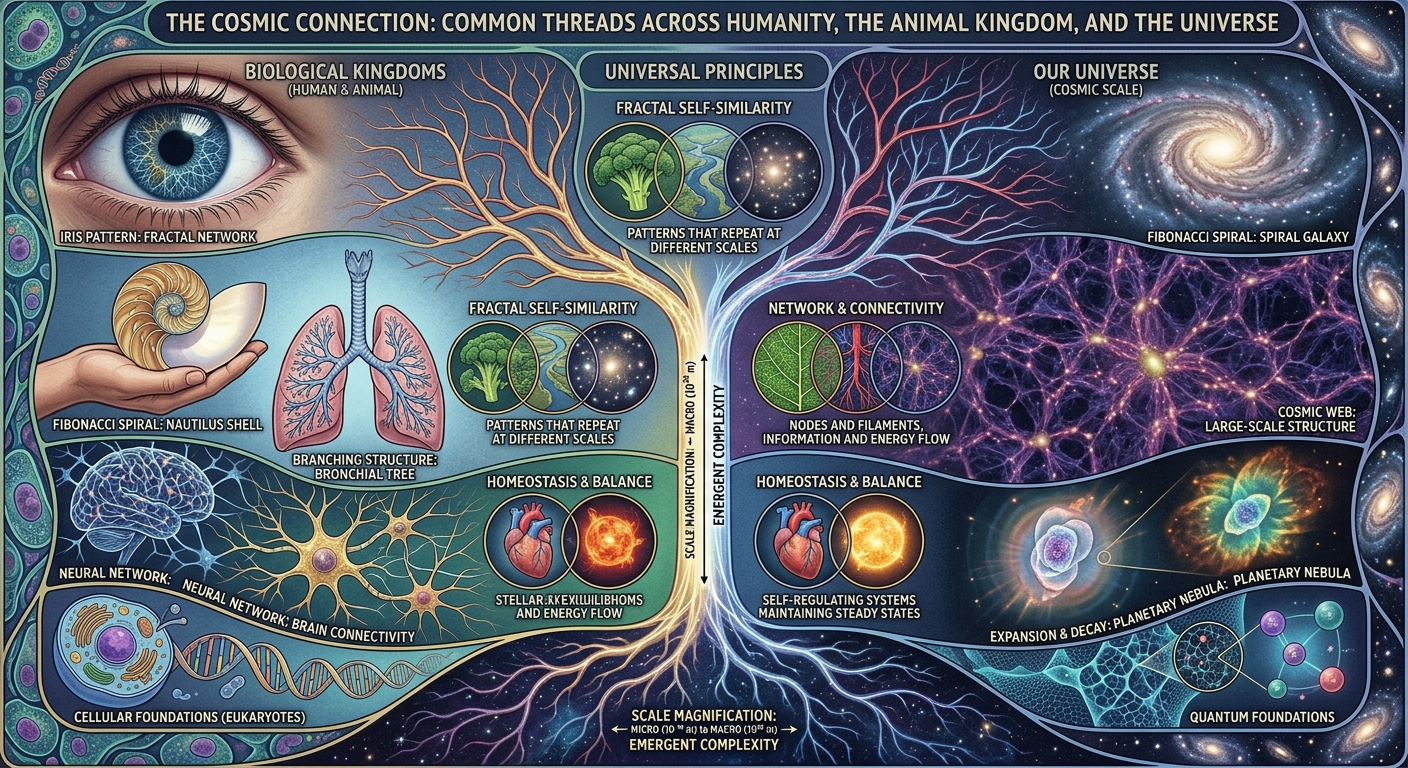
One of the most fascinating ways to understand nature is to study architecture—not architecture in the narrow sense of buildings, but the way complex systems are organized, connected, regulated, and transformed.
The human body, other animals, ecosystems, planets, stars, galaxies, and the observable universe are enormously different physical systems. Yet they sometimes display similar organizational principles: networks, boundaries, hierarchies, flows, feedback loops, specialization, communication, energy transfer, storage, repair, and adaptation.
These similarities do not mean that the universe is literally a giant human body or that galaxies are organisms. Rather, they show that very different systems can arrive at comparable structural solutions because they operate under constraints imposed by physics, information, energy, geometry, and evolution.
1. The Three Architectural Levels
We can begin with three enormous domains:
| Level | Examples | Main organizing principle |
|---|---|---|
| Human | Brain, heart, lungs, blood vessels, organs | Biological organization |
| Animal kingdom | Insects, birds, fish, mammals, reptiles | Evolutionary adaptation |
| Universe | Planets, stars, galaxies, galaxy clusters | Physical laws and cosmic evolution |
A useful conceptual hierarchy is:
Particles → atoms → molecules → cells → tissues → organs → organisms → populations → ecosystems → planets → planetary systems → galaxies → galaxy clusters → cosmic web
At every level, new properties emerge from interactions between components.
2. Architecture Means More Than Shape
When comparing humans, animals, and the universe, architecture should be divided into several dimensions.
2.1 Structural architecture
This concerns what is connected to what.
Examples:
- neurons connect to other neurons;
- blood vessels connect organs;
- roots connect plants to soil;
- food webs connect organisms;
- gravitational structures connect stars into galaxies;
- galaxies participate in the cosmic web.
2.2 Functional architecture
This concerns what each component does.
A heart pumps blood.
A lung exchanges gases.
A neuron transmits information.
A star produces energy through nuclear fusion.
A galaxy organizes enormous populations of stars, gas, dust, and dark matter through gravity.
The functions are completely different, but the principle of specialized components contributing to a larger system is comparable.
2.3 Information architecture
Complex systems need ways to store, transmit, process, and respond to information.
In animals:
sensory input → nervous system → processing → response
In ecosystems:
environmental change → organism sensing → behavioral/physiological response
In human societies:
data → communication → decision → action
At cosmic scales, however, we should be careful: there is no established evidence that galaxies or the universe process information in the biological sense.
3. The Human Body as an Engineered System
The human body is one of nature’s most complex examples of integrated architecture.
Consider its major subsystems:
Structural system
- skeleton
- connective tissues
- muscles
Transport system
- heart
- arteries
- veins
- capillaries
- blood
Energy system
- digestive system
- liver
- mitochondria
- metabolic pathways
Communication system
- brain
- spinal cord
- peripheral nerves
- hormones
Exchange system
- lungs
- respiratory tract
Protection system
- skin
- immune system
- physical barriers
Waste-management system
- kidneys
- liver
- lungs
- digestive tract
The remarkable feature is integration.
The heart cannot operate independently of oxygen delivery.
The brain depends on energy supplied through circulation.
Muscles depend on oxygen, nutrients, nerves, and circulation.
Thus:
Subsystem + subsystem + communication + energy + regulation = organism
4. Architecture Across the Animal Kingdom
The animal kingdom demonstrates another major principle:
Different environments produce different architectural solutions to similar problems.
Every animal must solve problems such as:
- obtaining energy;
- exchanging gases;
- maintaining internal conditions;
- detecting environmental changes;
- reproducing;
- avoiding danger;
- moving or remaining appropriately positioned;
- repairing damage.
But solutions differ dramatically.
Fish
Fish use:
gills + circulatory system + fins + sensory systems
to operate efficiently in aquatic environments.
Birds
Bird architecture includes:
lungs + air sacs + lightweight skeleton + wings + powerful muscles
This supports flight and high metabolic activity.
Insects
An insect has an extraordinary modular architecture:
head + thorax + abdomen
with specialized appendages and a nervous system distributed through the body.
Mammals
Mammalian architecture emphasizes:
lungs + four-chambered heart + specialized organs + highly developed nervous system + temperature regulation
The lesson is important:
Architecture follows constraints.
5. Networks: One of the Strongest Similarities
Networks are among the most important structural patterns found across nature.
Human network
The circulatory system:
Heart → arteries → arterioles → capillaries → venules → veins → heart
Nervous network
Sensory receptors → neurons → spinal cord/brain → motor pathways → muscles
Animal social network
individual → group → colony/herd/flock → population
Ecosystem network
Sun → plants → herbivores → predators → decomposers
Cosmic network
galaxies → galaxy groups → clusters → superclusters → cosmic web
The similarity is therefore not that these networks perform the same function.
The deeper similarity is:
Complex systems frequently organize themselves through interconnected nodes and pathways.
6. The Cosmic Web
At the largest observable scales, matter is distributed in an enormous structure called the cosmic web.
It contains:
- galaxies;
- galaxy groups;
- galaxy clusters;
- filaments;
- enormous low-density regions called voids.
Gravity plays a fundamental role in shaping this structure.
The cosmic web can visually resemble other network systems, including:
- neural networks;
- river systems;
- fungal networks;
- blood-vessel networks.
But visual resemblance alone does not establish a common physical mechanism.
That distinction is crucial.
7. Branching Architecture
Branching occurs repeatedly in biology.
Examples include:
Human body
aorta → arteries → arterioles → capillaries
Lungs
trachea → bronchi → bronchioles → alveoli
Nervous system
neurons → axons → branches → synaptic connections
Plants
trunk → branches → twigs → leaves → veins
Rivers
river → tributaries → smaller streams
Cosmic structures
Matter can become organized into large-scale filamentary structures under gravity.
Branching is useful because it can connect a central region with many distributed regions.
However, each system has different governing mechanisms.
8. Transport Architecture
Another powerful comparison is transport.
Human organisms need to move:
- oxygen;
- nutrients;
- hormones;
- heat;
- waste products.
Animals have evolved many transport architectures.
Examples:
blood vessels → transport materials
respiratory systems → exchange gases
digestive systems → acquire nutrients
Nature repeatedly solves the general engineering problem:
How can material or energy move efficiently between separated regions?
At planetary and cosmic scales, transport also occurs, but through entirely different mechanisms.
Examples include:
- atmospheric circulation;
- ocean currents;
- stellar radiation;
- movement of gas within galaxies;
- gravitational accretion.
9. Energy Architecture
Energy is fundamental across all three domains.
Human
Food contains chemical energy.
The simplified chain is:
Food → digestion → nutrients → cellular metabolism → ATP → biological work
Animals
Different species obtain energy through different strategies:
plants → herbivores → carnivores → decomposers
Earth
The Sun provides most of the energy driving Earth’s surface climate and ecosystems.
Sun → atmosphere/ocean → plants → food webs
Stars
Stars derive their enormous energy output primarily from nuclear fusion.
gravity → compression → high temperature/density → nuclear fusion → radiation
Thus, although the mechanisms differ, complex systems require energy flows to maintain their organization.
10. Boundaries and Compartments
Complex systems often separate internal environments from external environments.
Human
The skin separates:
internal body ↔ external environment
Cell
The cell membrane separates:
cytoplasm ↔ extracellular environment
Animal
A shell, skin, exoskeleton, or other structure can provide protection.
Planet
Earth has multiple interacting boundaries and layers:
core → mantle → crust → oceans → atmosphere → space
Galaxy
A galaxy is not a solid container, but it has a gravitationally organized region containing stars, gas, dust, dark matter, and other components.
The architectural principle is:
Boundaries allow systems to maintain different internal conditions while interacting with their surroundings.
11. Internal Regulation: Homeostasis
One of biology’s most important architectural principles is homeostasis.
The human body continually regulates:
- temperature;
- blood chemistry;
- glucose;
- water balance;
- oxygen and carbon dioxide;
- blood pressure;
- ion concentrations.
A simplified feedback system is:
change → detection → control → correction
For example:
temperature changes → sensors detect change → nervous/endocrine responses → physiological adjustment
This is a feedback loop.
12. Feedback Across Nature
Feedback exists throughout many natural systems.
Biological feedback
Hormonal regulation.
Ecological feedback
Predator populations can influence prey populations, which can subsequently influence predator populations.
Climate feedback
Changes in Earth’s climate can trigger processes that amplify or moderate those changes.
Stellar feedback
Stars influence their surrounding environments through radiation and material expelled during stellar evolution.
The word “feedback” therefore describes a general systems concept, but the underlying mechanisms differ.
13. Specialization
Complex systems often divide tasks among specialized components.
Human
| Component | Main role |
|---|---|
| Heart | Circulation |
| Lungs | Gas exchange |
| Brain | Information processing |
| Kidneys | Filtration/regulation |
| Liver | Metabolism |
| Muscles | Movement |
Insect colony
Different individuals can perform different roles, such as:
- reproduction;
- foraging;
- defense;
- brood care.
Ecosystem
Different species occupy different ecological niches.
Universe
Stars and galaxies are not “organs,” but cosmic structures have different physical characteristics and evolutionary histories.
This illustrates functional differentiation rather than literal biological equivalence.
14. Hierarchical Architecture
Hierarchy is another universal-looking organizational pattern.
Consider:
molecules
↓
cells
↓
tissues
↓
organs
↓
organ systems
↓
organism
↓
population
↓
ecosystem
↓
biosphere
A cosmic hierarchy can be represented approximately as:
particles
↓
atoms
↓
stars/planets
↓
galaxies
↓
galaxy groups
↓
galaxy clusters
↓
large-scale cosmic structure
These hierarchies are not identical, but both demonstrate how larger structures emerge from interactions among smaller components.
15. Emergence
One of the most important ideas in this entire subject is emergence.
A system can possess properties that individual components do not possess by themselves.
For example:
A single neuron is not a human mind.
A single heart cell is not a complete circulatory system.
A single ant cannot reproduce the full behavior of an ant colony.
A single star is not a galaxy.
A single galaxy is not the cosmic web.
Therefore:
components + interactions + organization → emergent properties
This is one of the deepest connections between biology and complex physical systems.
16. The Brain and the Cosmic Web: A Careful Comparison
Images of the human brain and cosmic web sometimes look surprisingly similar.
But appearance can be misleading.
The brain’s network is created through biological development and neural connectivity.
The cosmic web emerges primarily from gravitational evolution of matter over cosmic time.
So the correct conclusion is not:
“The universe is a brain.”
Instead:
“Different complex systems can produce visually similar network-like structures.”
That is a much more scientifically defensible observation.
17. Fractals and Self-Similarity
Nature frequently contains structures that appear similar at different scales.
Examples include:
- tree branches;
- blood vessels;
- lung structures;
- river networks;
- lightning;
- some mathematical fractals.
Self-similarity can emerge because the same mathematical or physical constraints repeatedly operate across scales.
However, not everything in nature is a perfect fractal.
Real biological and cosmic systems have characteristic scales and limits.
18. Circulation and Flow
Flow is another major architectural principle.
Human
blood circulation
Lungs
airflow
Digestive system
food movement
Plants
water and nutrient transport
Oceans
currents
Atmosphere
winds
Stars
movement of plasma and energy
Galaxies
orbital motion and gas dynamics
Flow enables systems to move:
energy + matter + information
from one location to another.
19. Storage Architecture
Complex systems also require storage.
Human
- fat stores energy;
- bones store minerals;
- cells maintain chemical gradients;
- DNA stores biological information.
Animals
Many species store food or energy.
Ecosystems
Biomass represents stored chemical energy.
Earth
Oceans, soils, forests, ice, rocks, and atmosphere store materials and energy.
Universe
Matter and energy are distributed across different cosmic structures and fields.
The mechanisms differ, but storage and transfer are recurring system requirements.
20. Communication Architecture
Communication allows components to coordinate.
Human body
nervous signals + hormones
Animals
Animals communicate through:
- sound;
- vision;
- chemical signals;
- touch;
- electrical signals in some species.
Social organisms
Communication can coordinate:
food gathering → defense → reproduction → group behavior
Human civilization
Communication expands enormously through:
speech → writing → printing → telegraph → telephone → radio → television → Internet → satellite networks → AI systems
The universe itself should not be described as having biological communication unless a specific physical mechanism supports that claim.
21. Repair and Resilience
Living systems are constantly exposed to damage.
Humans possess:
- blood clotting;
- immune defenses;
- cellular repair;
- tissue regeneration.
Animals have evolved numerous repair mechanisms.
Ecosystems can sometimes recover after disturbances.
Engineered societies also develop:
- redundancy;
- emergency systems;
- replacement components;
- disaster recovery.
This gives us an important systems-engineering principle:
Resilient architecture does not assume that failure will never occur; it prepares for failure.
22. Adaptation
Adaptation distinguishes biological architecture from cosmic architecture.
Animals evolve through processes including:
variation → inheritance → selection → population change
Over many generations, this can produce highly specialized anatomical structures.
Examples include:
- bird wings;
- fish fins;
- mammalian teeth;
- insect mouthparts;
- camouflage;
- specialized sensory organs.
The universe does not evolve through biological natural selection.
Cosmic evolution refers to changes governed by:
- gravity;
- nuclear physics;
- thermodynamics;
- electromagnetism;
- cosmic expansion;
- chemical evolution;
- stellar evolution.
Thus the same word—evolution—can describe change over time while referring to very different mechanisms.
23. The Ecosystem as an Intermediate Architecture
The ecosystem is especially useful because it sits between individual organisms and planetary systems.
A simplified architecture is:
Sun
↓
Plants/algae
↓
Herbivores
↓
Predators
↓
Decomposers
↓
Nutrients
↓
Plants
This forms a cycling system.
Matter moves through the system repeatedly, while energy flows through it and ultimately dissipates as heat.
This makes ecosystems excellent examples of open, interconnected systems.
24. A Unified Systems Model
We can create a general architecture applicable to humans, animals, ecosystems, and physical systems:
Layer 1 — Components
What are the basic units?
Layer 2 — Connections
How are the units linked?
Layer 3 — Energy
Where does energy originate?
Layer 4 — Matter
How does matter move?
Layer 5 — Information
How is information represented or transmitted?
Layer 6 — Regulation
How is system behavior controlled?
Layer 7 — Feedback
How does the system respond to changes?
Layer 8 — Adaptation
Can the system change over time?
Layer 9 — Emergence
What new properties appear at higher levels?
Layer 10 — Environment
How does the system interact with its surroundings?
This becomes a powerful framework for studying nature.
25. Comparative Architecture Matrix
| Feature | Human | Animals | Ecosystems | Universe |
|---|---|---|---|---|
| Components | Cells/organs | Cells/organs | Organisms | Matter/structures |
| Networks | Nervous/circulatory | Nervous/circulatory/social | Food webs | Cosmic web |
| Energy | Metabolism | Metabolism | Sun/chemical energy | Nuclear/gravitational/radiative |
| Transport | Blood/air | Blood/hemolymph/air | Nutrient cycles | Gas/matter/radiation |
| Boundaries | Skin/cell membranes | Skin/shell/exoskeleton | Habitat boundaries | Gravitational/physical structures |
| Regulation | Homeostasis | Homeostasis | Ecological feedback | Physical laws |
| Communication | Nerves/hormones | Signals/nervous systems | Chemical/ecological interactions | Physical interactions |
| Specialization | Organs | Organs/body parts | Species/niches | Different cosmic structures |
| Evolution | Biological | Biological | Ecological evolution | Cosmic evolution |
| Repair | Biological repair | Biological repair | Ecological recovery | Physical transformation |
| Emergence | Mind/body behavior | Group behavior | Ecosystem properties | Large-scale structure |
26. What We Should Not Conclude
It is tempting to make dramatic statements such as:
“The galaxy is a cell.”
or:
“The universe is a giant organism.”
These are philosophical metaphors rather than established scientific conclusions.
A rigorous approach distinguishes between:
Structural analogy
Two systems have comparable organizational patterns.
Functional analogy
Two systems perform similar functions.
Mechanistic identity
Two systems operate through the same physical mechanism.
Humans, animals, and the universe frequently demonstrate structural analogies, but that does not mean their underlying mechanisms are identical.
27. A Powerful Concept: Systems Within Systems
Perhaps the deepest architectural lesson is that nature contains nested systems.
A human exists within:
cell → tissue → organ → organism → family/group → society → ecosystem → biosphere → Earth → Solar System → Milky Way → universe
An animal follows a similar nested pathway.
The important concept is scale.
A human is simultaneously:
- a biological organism;
- a member of a population;
- a participant in an ecosystem;
- a component of Earth’s biosphere;
- a physical object within the Solar System and universe.
Thus, every object can be studied at multiple organizational levels.
28. The Universe as a Physical System
The universe can be studied as an enormous physical system containing:
space + time + matter + radiation + fields + physical interactions
Its evolution is governed by fundamental physical laws.
At large scales, gravity is especially important for structure formation.
At smaller scales, quantum mechanics, electromagnetism, nuclear interactions, and thermodynamics become essential.
Unlike an organism, the universe does not have scientifically established:
- organs;
- nervous system;
- biological metabolism;
- biological reproduction;
- biological consciousness.
Therefore, comparisons must remain conceptual rather than literal.
29. The Architectural Principle of Complexity
Across nature, complexity often arises through several recurring ingredients:
simple components
interactions
energy
constraints
feedback
time
=
complex organization
This formula is conceptual rather than a mathematical law, but it provides a useful framework for studying complexity.
30. Tutorial: How to Analyze Any Natural System
You can use the following ten-question method.
Question 1: What are the components?
Identify the smallest important units.
Question 2: How are they connected?
Draw the network.
Question 3: What flows through the system?
Identify:
- energy;
- matter;
- information.
Question 4: What provides energy?
Find the primary energy source.
Question 5: What controls the system?
Identify regulatory mechanisms.
Question 6: What feedback exists?
Look for positive and negative feedback.
Question 7: What are the boundaries?
Determine what belongs inside and outside the system.
Question 8: What happens when something fails?
Study redundancy and resilience.
Question 9: What changes over time?
Separate biological evolution from physical or geological evolution.
Question 10: What emerges?
Ask what properties exist at the system level that individual components do not possess.
31. From Human Architecture to Cosmic Architecture
A fascinating conceptual ladder is:
Cell
↓
Organ
↓
Organism
↓
Population
↓
Ecosystem
↓
Biosphere
↓
Planet
↓
Solar system
↓
Galaxy
↓
Cosmic web
Each level contains structures and interactions that cannot be understood completely by examining only one component.
This is the fundamental lesson of systems thinking.
32. Implications for Engineering and Technology
Studying nature’s architecture has enormous technological value.
Humans have repeatedly learned from biological systems.
Examples include:
- aircraft inspired partly by biological flight;
- robotics inspired by animal locomotion;
- neural networks inspired by aspects of biological nervous systems;
- biomaterials inspired by biological structures;
- swarm robotics inspired by insects;
- distributed computing inspired by networks and collective systems;
- ecological engineering inspired by natural cycles.
This approach is called biomimicry or bio-inspired engineering.
The next frontier is broader:
Learning not only from individual organisms, but from architectures operating across multiple scales.
33. A Proposed Universal Architecture Framework
A useful educational model is:
1. Structure
What exists?
2. Network
What connects it?
3. Energy
What powers it?
4. Matter
What moves through it?
5. Information
What signals change its behavior?
6. Regulation
What keeps it within functional limits?
7. Feedback
How does it respond to change?
8. Adaptation
How does it change over generations or time?
9. Emergence
What new properties appear?
10. Scale
How does its organization change when viewed from microscopic to macroscopic levels?
This framework can be used to study everything from a cell to a galaxy.
Conclusion
The human body, the animal kingdom, ecosystems, Earth, and the universe are not literally the same type of system. Their governing mechanisms are profoundly different.
Nevertheless, they can exhibit recurring architectural patterns:
networks, branching, hierarchy, specialization, boundaries, flows, feedback, storage, regulation, emergence, and interaction across scales.
The human body demonstrates these principles through biological organization. Animals demonstrate how evolution produces different solutions to environmental challenges. Ecosystems demonstrate networks of organisms, energy flows, and material cycles. The universe demonstrates how physical laws can generate enormous structures from comparatively simple fundamental ingredients.
The most important scientific lesson is therefore not that “the universe looks like a human body.”
It is this:
Complexity can repeatedly produce recognizable forms of organization because systems operating under constraints often need to solve comparable problems of connection, transport, energy management, stability, and interaction—even when their underlying mechanisms are completely different.
Understanding these architectural similarities provides a bridge between biology, zoology, ecology, physics, astronomy, mathematics, engineering, computer science, and systems theory. It gives us a powerful way to move from studying isolated objects toward understanding nature as a hierarchy of interacting systems.


Be First to Comment