
Abstract
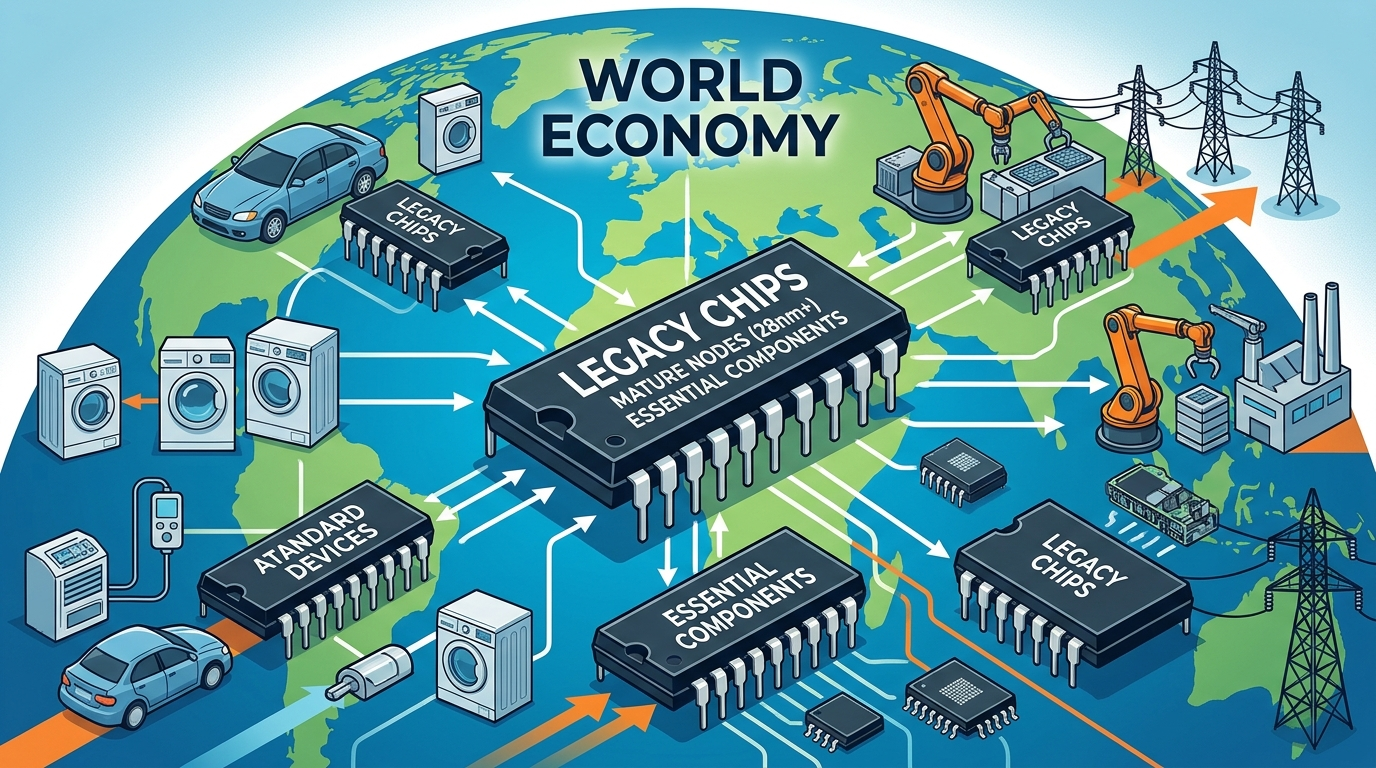
When the semiconductor industry is discussed, public attention often focuses on the smallest and most advanced chips—such as processors designed for artificial intelligence, smartphones, supercomputers and high-performance computing. Yet a large part of the world’s economy depends on another class of semiconductor: the legacy chip, commonly called a mature-node semiconductor.
Legacy chips are not necessarily technologically obsolete. They are semiconductor devices manufactured using established production processes, often including technologies at approximately 28 nm and above, although the exact definition varies by application and industry. They include microcontrollers, analog chips, power-management devices, sensors, connectivity chips, display drivers, interface controllers and many other integrated circuits.
Their importance is enormous because modern products do not normally depend on one sophisticated processor alone. A vehicle, factory, medical device, telecommunications system, power grid, household appliance or industrial machine may contain numerous mature-node chips performing specialized functions.
The importance of these chips became particularly visible during the global semiconductor shortages associated with the COVID-19 pandemic. Shortages of relatively inexpensive components could stop the production of much more expensive products. Research by the Semiconductor Industry Association has estimated that mature-node semiconductors represented around 60% of global semiconductor production capacity at the time of its 2025 analysis, while mature-node semiconductor-enabled activities represented a much larger economic footprint than the chip industry’s direct sales.
The central argument of this thesis is therefore simple:
The economic value of a semiconductor cannot be measured only by its price, transistor count or manufacturing node. A small, inexpensive legacy chip can be economically critical when millions of products depend upon it.
1. Introduction
The modern world is a semiconductor civilization.
Computers, smartphones, automobiles, aircraft, telecommunications networks, industrial robots, medical equipment, banking infrastructure, satellites, energy systems and household appliances all depend upon semiconductor devices.
There is a tendency to divide the semiconductor world into “old chips” and “new chips.” This description can be misleading.
A 180 nm chip may be technologically old compared with a leading-edge processor, but it can be extremely appropriate for a temperature sensor, industrial controller or power-management application. In many cases, manufacturers deliberately continue using established technologies because they offer reliability, lower production costs, mature manufacturing processes, long product lifetimes and predictable performance.
The OECD describes semiconductors as essential components of modern economies and emphasizes that the semiconductor value chain is highly segmented and geographically concentrated.
Consequently, the legacy chip should not be viewed simply as yesterday’s technology.
It should be viewed as industrial infrastructure.
2. What Is a Legacy Chip?
A legacy chip is generally a semiconductor manufactured using an established or mature process technology rather than the newest leading-edge process.
There is no single universal definition of “legacy.”
Depending on the organization and application, mature or legacy processes may include technologies such as:
- 350 nm
- 250 nm
- 180 nm
- 130 nm
- 90 nm
- 65 nm
- 45 nm
- 40 nm
- 28 nm
Some applications also continue to use older technologies below these levels.
The important distinction is that process-node size is not the same thing as usefulness.
A leading-edge processor may contain billions of transistors and deliver extraordinary computational performance, while a mature-node microcontroller may perform one simple task for many years with exceptional reliability.
For example, a legacy chip might:
- measure temperature;
- control a motor;
- regulate voltage;
- manage a battery;
- operate an industrial machine;
- control vehicle systems;
- process signals from sensors;
- drive a display;
- control lighting;
- manage communications;
- interface with other electronic components.
The OECD’s semiconductor taxonomy distinguishes among logic, memory, analog and other semiconductor categories, illustrating why semiconductor technology cannot be understood purely through transistor size.
3. Legacy Does Not Mean Obsolete
This distinction is fundamental.
A technology can be old but still economically optimal.
Consider a simple example.
Suppose an industrial machine requires a microcontroller that:
- operates at a modest clock frequency;
- consumes little power;
- has stable software;
- must remain available for 15–20 years;
- operates in a harsh environment;
- requires certification;
- is manufactured in very large quantities.
Replacing that chip with a cutting-edge processor may provide little economic benefit.
The manufacturer could instead prefer a mature semiconductor because:
- the design is proven;
- the manufacturing process is stable;
- the software is established;
- qualification has already been completed;
- supply can be maintained for a long period;
- the chip is inexpensive;
- the system does not require advanced computational performance.
Therefore:
Technological age and economic usefulness are not the same thing.
4. The Semiconductor Pyramid
The global chip ecosystem can be understood as a technological pyramid.
Layer 1 — Leading-edge computing
Examples include:
- artificial-intelligence accelerators;
- high-performance CPUs;
- advanced GPUs;
- advanced smartphone processors;
- high-performance data-center processors.
These increasingly depend on extremely advanced manufacturing processes.
Layer 2 — Advanced and mainstream chips
These include:
- application processors;
- networking processors;
- communications chips;
- advanced automotive electronics;
- embedded computing.
Layer 3 — Mature-node chips
These include:
- microcontrollers;
- analog circuits;
- power-management ICs;
- display drivers;
- sensors;
- interface chips;
- automotive controllers;
- industrial controllers.
Layer 4 — Discrete and specialized semiconductors
Examples include:
- power transistors;
- diodes;
- voltage regulators;
- sensors;
- switching devices.
The world economy requires all four layers.
A modern economy cannot function simply by producing advanced AI processors.
5. The Hidden Economic Multiplier
One of the most important characteristics of legacy chips is their economic multiplier effect.
The chip itself may have a relatively low selling price.
However, the product containing the chip may be worth:
- thousands of dollars;
- tens of thousands of dollars;
- millions of dollars;
- or even much more when an entire industrial system depends upon it.
This creates an important economic relationship:
Chip value ≠ economic value enabled by the chip.
Research cited by the Semiconductor Industry Association estimated that mature-node semiconductors supported approximately $10.8 trillion of economic activity in the United States, equivalent to about 26% of U.S. gross economic output in its analysis.
This illustrates the difference between the value of semiconductor sales and the value of the industries that depend upon semiconductors.
6. Legacy Chips and the Automobile Industry
The automobile industry is one of the clearest examples of the importance of mature semiconductors.
A modern vehicle can contain hundreds or even thousands of semiconductor devices.
The OECD notes that a modern car can contain up to approximately 3,000 semiconductor chips, controlling functions ranging from battery management and fuel injection to infotainment.
Many of these functions do not require the world’s most advanced processor.
Instead, they require reliable:
- microcontrollers;
- power devices;
- sensors;
- analog chips;
- communication controllers;
- motor controllers;
- battery-management devices.
This creates a paradox:
The world’s most advanced automobile may depend upon semiconductor technologies that are decades old.
The COVID-era semiconductor shortage demonstrated this vulnerability. Automotive manufacturers experienced production interruptions because the absence of relatively small semiconductor components could prevent completion of entire vehicles.
7. Legacy Chips and Industrial Automation
Factories depend heavily on mature semiconductors.
Industrial equipment frequently operates for decades.
Examples include:
- programmable logic controllers;
- motor drives;
- robotic systems;
- sensors;
- industrial communication systems;
- factory-control systems;
- measurement equipment;
- power-control systems.
Industrial customers generally value reliability more than extreme transistor density.
A factory operator may prefer a proven component that has operated reliably for many years rather than introduce unnecessary technological change.
Therefore mature-node manufacturing supports the concept of industrial continuity.
8. Legacy Chips and Telecommunications
Telecommunications infrastructure is another major consumer.
A telecommunications network consists of thousands or millions of electronic components.
Legacy and mature semiconductors can be found in:
- base stations;
- routers;
- switches;
- optical equipment;
- power supplies;
- network controllers;
- timing systems;
- radio equipment;
- signal-processing systems.
The newest telecommunications technology may receive the greatest public attention, but the infrastructure supporting it contains many specialized components that do not need the smallest possible transistor dimensions.
9. Legacy Chips and Electricity Grids
The electrical grid is increasingly computerized.
Modern electricity systems require:
- sensors;
- measurement devices;
- control systems;
- protection equipment;
- power electronics;
- communication systems;
- industrial controllers.
Mature semiconductor technology is particularly important for power-management and control functions.
This means that semiconductors are becoming part of the physical infrastructure of electricity itself.
A semiconductor shortage can therefore become more than an electronics problem.
It can become an infrastructure problem.
10. Legacy Chips and Renewable Energy
The global transition toward renewable energy increases semiconductor requirements.
Solar systems require electronic control and power-management components.
Wind turbines require:
- sensors;
- controllers;
- power electronics;
- communications systems.
Battery-storage systems require:
- battery-management systems;
- sensors;
- power controllers;
- monitoring electronics.
Electric vehicles require sophisticated power-management and control systems.
Consequently, the transition toward electrification does not eliminate the importance of mature chips.
It increases it.
11. Legacy Chips and Medical Technology
Medical devices require enormous numbers of specialized semiconductor components.
Examples include:
- patient monitors;
- imaging equipment;
- laboratory instruments;
- diagnostic machines;
- electronic thermometers;
- medical pumps;
- hearing devices;
- hospital equipment.
Many medical devices must remain reliable for years.
Manufacturers therefore place tremendous value on stable and well-characterized components.
This is one reason semiconductor supply-chain resilience is important for healthcare.
12. Legacy Chips and Agriculture
Modern agriculture is becoming increasingly digital.
Semiconductors are used in:
- irrigation systems;
- tractors;
- agricultural sensors;
- weather stations;
- automated feeding systems;
- greenhouse controls;
- GPS-related equipment;
- water-management systems;
- farm monitoring.
This creates an important connection:
Semiconductors → automation → agricultural productivity → food production → economic development.
For developing economies, this relationship is especially important because affordable electronics can enable farmers to increase productivity without requiring the most expensive computing technologies.
13. Legacy Chips and Consumer Electronics
The average household contains a huge number of semiconductor devices.
Examples include:
- televisions;
- refrigerators;
- washing machines;
- microwave ovens;
- air conditioners;
- printers;
- routers;
- cameras;
- toys;
- security systems;
- lighting equipment.
Many of these products do not require leading-edge processors.
Instead, they require inexpensive, reliable microcontrollers, sensors and control electronics.
This explains why older semiconductor manufacturing processes continue to have enormous commercial value.
14. The Economics of Scale
One of the greatest strengths of mature-node semiconductor manufacturing is scale.
A mature process may have:
- established equipment;
- experienced engineers;
- mature process recipes;
- proven designs;
- established suppliers;
- high manufacturing yields;
- long qualification histories.
Because the technology has existed for many years, manufacturers can produce enormous volumes.
The resulting economics can be highly attractive.
A semiconductor company does not always need to sell the most technologically advanced chip.
It can instead make a very large number of specialized chips at relatively low cost.
This is the economic principle of:
high volume × low unit price = enormous aggregate value.
15. Why Companies Continue Producing Legacy Chips
There are several reasons.
15.1 Reliability
Older manufacturing processes have been extensively tested.
15.2 Lower Cost
Mature manufacturing generally does not require the extraordinary capital expenditure associated with the newest fabrication technologies.
15.3 Long Product Lifetimes
Industrial, automotive and infrastructure products may remain in service for many years.
15.4 Qualification
Automotive, aerospace, medical and industrial products frequently require extensive testing and certification.
Changing a semiconductor can therefore require substantial redesign and requalification.
15.5 Availability of Manufacturing Capacity
Mature-node fabs remain an important part of global production.
The OECD reports that mature logic production is widespread and that around 75% of fabs in its dataset produce mature logic chips in combination with another semiconductor type.
16. Legacy Chips and Supply-Chain Security
The global semiconductor supply chain is geographically distributed.
One country may specialize in:
- semiconductor design;
another in:
- manufacturing equipment;
another in:
- wafers;
another in:
- fabrication;
another in:
- packaging;
another in:
- testing;
and another in:
- final electronics assembly.
The result is an extraordinary international network.
The OECD emphasizes that semiconductor production is characterized by complex, geographically distributed value chains and concentration of critical capabilities in particular regions.
This creates vulnerability.
A disruption at one stage can affect companies thousands of kilometres away.
17. The COVID-19 Semiconductor Crisis
The semiconductor shortages during the COVID-19 period provided a major economic lesson.
When the pandemic disrupted manufacturing and consumer behavior changed, demand for electronics increased while automotive and other industries experienced major supply problems.
The semiconductor supply chain could not instantly adjust.
A chip factory cannot simply change production overnight.
Manufacturing facilities require:
- specialized equipment;
- qualified processes;
- trained personnel;
- cleanrooms;
- materials;
- testing;
- packaging;
- logistics;
- customer qualification.
The OECD found that semiconductor shortages produced significant ripple effects across downstream industries, demonstrating the systemic economic consequences of semiconductor disruptions.
18. The Strategic Importance of Legacy Chips
Governments increasingly recognize that semiconductor security is not only about leading-edge processors.
It is also about mature-node production.
The United States, European countries, China, Japan, South Korea, Taiwan and other economies have pursued strategies designed to strengthen semiconductor manufacturing and supply-chain resilience.
Recent U.S. semiconductor investments, for example, include projects specifically targeting mature-node manufacturing for automotive, industrial, defense and aerospace applications.
This demonstrates an important shift in thinking:
A nation can be technologically advanced and still remain vulnerable if it cannot reliably obtain mature semiconductor components.
19. Legacy Chips and National Economic Security
Semiconductors increasingly have the characteristics of strategic infrastructure.
They affect:
- manufacturing;
- transportation;
- communications;
- electricity;
- healthcare;
- defense;
- finance;
- agriculture;
- logistics;
- information technology.
Consequently, semiconductor shortages can become economic-security problems.
The OECD describes semiconductors as vital to economic growth and security while highlighting the concentration and interdependence of the global semiconductor value chain.
20. The Relationship Between Advanced and Legacy Chips
It is incorrect to think of advanced chips and legacy chips as competitors.
They are complementary.
A modern electric vehicle, for example, might contain:
Advanced computing
→ high-performance processors
Mature computing
→ microcontrollers
Analog electronics
→ sensor interfaces
Power semiconductors
→ motor and battery control
Communication chips
→ networking between systems
Therefore a sophisticated technological product is usually a semiconductor ecosystem, not a single chip.
21. Legacy Chips and Artificial Intelligence
Artificial intelligence has created enormous demand for advanced processors.
However, AI infrastructure also requires mature semiconductor technologies.
Data centers require:
- power-management electronics;
- networking components;
- sensors;
- monitoring systems;
- cooling controls;
- power-conversion equipment;
- storage systems.
Thus even an AI data center is built from multiple generations of semiconductor technology.
The AI revolution therefore does not eliminate legacy chips.
Instead, it creates another layer of demand for the broader semiconductor ecosystem.
22. The Economic Geography of Legacy Chips
Semiconductor manufacturing has become geographically concentrated.
The OECD’s recent semiconductor analysis shows significant regional specialization across different semiconductor categories and manufacturing technologies.
This creates both opportunities and risks.
Opportunities
Countries can develop:
- fabrication plants;
- packaging facilities;
- testing industries;
- semiconductor design companies;
- equipment industries;
- materials industries;
- engineering education;
- research institutions.
Risks
Countries may become excessively dependent upon:
- imported chips;
- foreign fabrication;
- foreign equipment;
- foreign materials;
- foreign intellectual property.
Therefore semiconductor policy has become part of industrial policy.
23. Africa and the Legacy-Chip Opportunity
Africa is a major consumer of electronic technology but has comparatively limited semiconductor manufacturing capacity.
This does not mean Africa has no role to play.
The continent could develop capabilities in areas such as:
- electronics assembly;
- semiconductor testing;
- packaging;
- embedded systems;
- PCB manufacturing;
- repair and refurbishment;
- industrial electronics;
- IoT systems;
- agricultural electronics;
- technical education;
- semiconductor design;
- specialized applications.
The greatest opportunity may not initially be building the world’s most advanced fabrication plants.
Instead, African economies could develop regional semiconductor and electronics ecosystems around practical industrial requirements.
For countries such as South Africa, this could connect semiconductor technology with:
- mining;
- renewable energy;
- automotive manufacturing;
- telecommunications;
- agriculture;
- logistics;
- industrial automation;
- scientific research.
24. Legacy Chips and Employment
The semiconductor economy creates employment across an enormous chain.
Jobs include:
- electrical engineers;
- semiconductor engineers;
- mechanical engineers;
- chemical engineers;
- software engineers;
- technicians;
- equipment operators;
- quality-control specialists;
- logistics workers;
- researchers;
- designers;
- sales professionals;
- maintenance specialists.
The economic impact therefore extends far beyond chip factories.
A semiconductor plant can create an industrial ecosystem involving universities, suppliers, logistics companies, construction companies and downstream manufacturers.
25. Legacy Chips and Innovation
Another misconception is that mature-node technology is incompatible with innovation.
In reality, innovation can occur at the system level.
Engineers can create highly innovative products using mature semiconductor technologies.
Examples include:
- smart agriculture;
- industrial IoT;
- environmental sensors;
- energy monitoring;
- medical monitoring;
- intelligent transport;
- water-management systems;
- mining automation.
The innovation may come from combining:
sensor + microcontroller + communication + software + cloud + AI
rather than from manufacturing a new transistor node.
26. The Economics of the “Good Enough” Chip
One of the most important economic concepts surrounding legacy semiconductors is fitness for purpose.
If a 180 nm microcontroller performs its required function reliably, replacing it with a much more advanced processor may not create sufficient economic value.
This is analogous to many other industries.
A modern economy does not replace every road because a new road technology has been invented.
It does not replace every electrical motor because a newer motor exists.
Likewise, it does not need to replace every semiconductor simply because a smaller transistor has become available.
Technology evolves through layers.
27. Legacy Chips and Circular Economy
The continued production of mature chips also creates environmental questions.
Older manufacturing technologies can have long product lifetimes, which may reduce the need for premature redesign.
However, the enormous volume of inexpensive electronic devices contributes to electronic waste.
A recent 2026 research paper highlights how extremely inexpensive microchips have become deeply embedded in everyday disposable products and emphasizes the environmental implications of their enormous volume.
Therefore the future semiconductor economy must consider:
- repairability;
- recycling;
- component reuse;
- longer product lifetimes;
- responsible manufacturing;
- energy consumption;
- material recovery.
28. Legacy Chips and Technological Sovereignty
Technological sovereignty means having sufficient domestic or regional capabilities to maintain essential systems.
A country does not necessarily need to manufacture every semiconductor domestically.
However, it should understand which components are strategically important and where vulnerabilities exist.
Possible strategies include:
- diversified international sourcing;
- strategic inventories;
- domestic manufacturing of critical components;
- regional manufacturing partnerships;
- local packaging and testing;
- semiconductor research;
- workforce development;
- improved supply-chain visibility.
The OECD specifically emphasizes diversification, information sharing and international cooperation as approaches to semiconductor supply-chain resilience.
29. Legacy Chips as Industrial Infrastructure
The strongest conclusion of this thesis is that mature semiconductors should be considered a form of industrial infrastructure.
Infrastructure normally includes:
- roads;
- ports;
- electricity;
- telecommunications;
- water systems.
But modern industrial infrastructure also requires electronic control.
Therefore:
No semiconductor → no modern electronic control.
And:
No electronic control → reduced industrial productivity.
This makes the semiconductor supply chain part of the underlying infrastructure of the global economy.
30. The Future of Legacy Chips
Legacy chips are unlikely to disappear simply because smaller process nodes continue to emerge.
Instead, several semiconductor generations will coexist.
The future will probably contain:
- leading-edge AI processors;
- advanced CPUs and GPUs;
- mature-node microcontrollers;
- analog chips;
- power semiconductors;
- sensors;
- specialty memory;
- communications chips;
- discrete devices.
The semiconductor industry will therefore remain a multi-generational technological ecosystem.
The latest chip does not automatically replace every previous generation.
31. Strategic Lessons for the World Economy
Several lessons can be drawn.
Lesson 1: Small components can have enormous economic consequences.
A cheap semiconductor can stop production of a very expensive product.
Lesson 2: Mature technology can remain strategically important.
Age does not automatically mean irrelevance.
Lesson 3: Semiconductor supply chains must be diversified.
Excessive dependence on a small number of regions creates systemic risks.
Lesson 4: Manufacturing capability matters.
Design alone does not guarantee semiconductor security.
Lesson 5: Skills are strategic assets.
Countries require engineers, technicians, researchers and manufacturing specialists.
Lesson 6: Semiconductor policy is industrial policy.
Chip availability influences manufacturing, transportation, energy and communications.
Lesson 7: Advanced and legacy technologies must coexist.
The global economy requires both.
32. A Conceptual Economic Model
The economic importance of a legacy semiconductor can be expressed conceptually as:
Economic impact = chip value × production volume × number of dependent products × downstream economic activity
This is not a formal economic equation, but it illustrates the central principle.
A chip worth only a few dollars can become economically significant when:
- hundreds of millions are produced;
- thousands of products depend upon it;
- factories cannot operate without it;
- replacement requires redesign;
- supply interruptions create production losses.
Consequently, criticality is determined by dependency, not merely price.
33. Legacy Chips and the Global Technology Chain
The complete semiconductor ecosystem can be represented as:
Raw materials
↓
Silicon wafers and specialty materials
↓
Chip design
↓
EDA and intellectual property
↓
Wafer fabrication
↓
Packaging
↓
Testing
↓
Electronic products
↓
Industrial systems
↓
Consumers and businesses
↓
Economic activity
A failure anywhere in this chain can affect the final economy.
This is why the semiconductor industry is increasingly regarded as a strategic global value chain rather than simply another manufacturing sector.
34. Conclusion
The legacy semiconductor is one of the least visible but most important technologies in the modern world economy.
The public imagination often associates semiconductor leadership with the smallest transistor dimensions, artificial intelligence processors and high-performance computing. Those technologies are extremely important, but they represent only one part of the semiconductor ecosystem.
Behind them stands an enormous foundation of mature technologies.
Legacy chips control machines.
They regulate electricity.
They monitor batteries.
They operate vehicles.
They manage telecommunications equipment.
They control industrial factories.
They support medical devices.
They operate household appliances.
They enable agricultural automation.
They contribute to renewable-energy systems.
They connect sensors to computers.
They make physical infrastructure intelligent.
The semiconductor industry itself has become an essential component of economic infrastructure. OECD research emphasizes that semiconductors are embedded across modern products and that disruptions can propagate through international value chains.
The economic significance of legacy chips can therefore be summarized in one principle:
The most economically important technology is not always the most technologically advanced technology.
A mature chip may be decades old, but if millions of vehicles, machines, appliances, hospitals, factories and infrastructure systems depend upon it, that chip remains economically vital.
The future semiconductor economy will therefore not be a simple march from “old” chips to “new” chips.
It will be a layered civilization in which advanced processors, mature-node chips, analog electronics, sensors and power semiconductors work together.
The true legacy of legacy chips is consequently not that they belong to the past.
Their legacy is that they form one of the foundations upon which the present—and much of the future—digital economy is built.
Final Summary
| Area | Importance of Legacy Chips |
|---|---|
| Automobiles | Engine, safety, battery and control systems |
| Electric vehicles | Battery management, motor control and power systems |
| Industry | Automation, machinery and process control |
| Telecommunications | Network equipment and infrastructure |
| Energy | Grid control, power management and renewable systems |
| Healthcare | Medical instruments and monitoring equipment |
| Agriculture | Sensors, irrigation and automation |
| Consumer electronics | Appliances, displays and controllers |
| AI infrastructure | Power, networking, monitoring and supporting electronics |
| Defence and aerospace | Long-life, reliable specialized electronics |
| Employment | Engineering, manufacturing, testing and logistics |
| National security | Supply-chain resilience and strategic capability |
| Economic growth | Enables production across many downstream sectors |
| Africa | Opportunity in electronics, packaging, testing, design and industrial applications |
Final thesis statement:
Legacy chips are not merely remnants of an earlier semiconductor era. They are durable technological building blocks that connect the physical economy to the digital economy, and their availability, affordability and reliability are fundamental to global production, employment, infrastructure, technological development and economic security.




Be First to Comment