
Abstract
Matter, in all its observable and theoretical forms, is constructed from atoms and subatomic particles. Despite their microscopic size, atoms—and the electrons, protons, and neutrons that compose them—govern the entire structure and behavior of the universe. This thesis offers a comprehensive anatomical and conceptual analysis of these fundamental entities, explaining their structure, functions, interactions, distinctions, and their roles in chemistry, physics, and cosmology.
1. Introduction
Atoms are the foundational units of matter. Every solid, liquid, gas, plasma, and chemical compound in existence originates from the atomic structure. While ancient philosophers conceptualized indivisible “atoms,” modern science has revealed a complex internal architecture composed of three primary subatomic particles:
- Protons
- Neutrons
- Electrons
These components are not merely tiny building blocks but are dynamic entities governed by quantum mechanics and electromagnetic forces. Understanding their distinctions is essential to grasp chemical reactions, electricity, molecular bonding, nuclear energy, radiation, and the origins of the universe.
2. What is an Atom?
An atom is the smallest unit of an element that still retains its chemical identity. It consists of:
- Nucleus – located at the center
- Electron Cloud – a surrounding region where electrons move in defined energy levels (orbitals)
Key Characteristics of Atoms
- Diameter is approximately 0.1 nanometers (10⁻¹⁰ meters).
- Over 99.9% of the atom’s mass is located in the nucleus.
- The nucleus is extremely dense—if an atom were the size of a stadium, the nucleus would be the size of a pea, yet contain almost all the mass.
Atoms differ from one another by:
- Atomic number (number of protons)
- Atomic mass (protons + neutrons)
- Electron arrangement
These differences create the 118 elements in the periodic table.
3. Protons: The Identity-Defining Particles
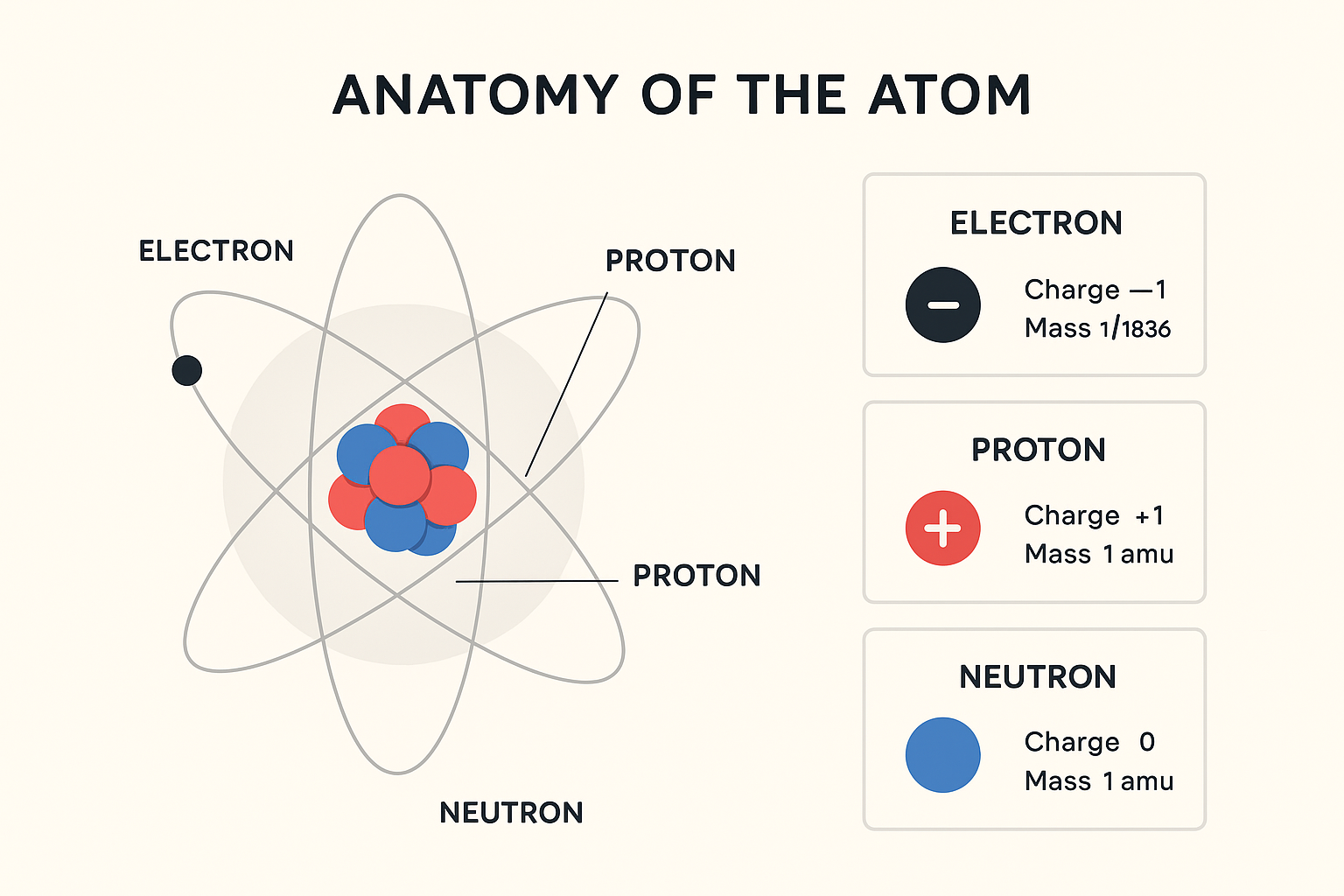
A proton is a positively charged particle found in the nucleus.
Properties
- Charge: +1 (positive)
- Mass: 1 atomic mass unit (amu)
- Location: Nucleus
- Composition: Made of 3 quarks (2 up quarks + 1 down quark)
Functions
- Defines the element
- Hydrogen has 1 proton.
- Carbon has 6 protons.
- Gold has 79 protons.
Changing the number of protons changes the element entirely.
- Attracts electrons
The positive charge of protons pulls in negatively charged electrons and stabilizes the atom. - Contributes to atomic mass
Protons form half of the mass of most atoms.
Distinguishing Feature
The proton is the identity of the atom. Lose or gain a proton = a completely new element.
4. Neutrons: The Mass Builders and Nuclear Stabilizers
A neutron is a neutral (no charge) particle found in the nucleus.
Properties
- Charge: 0 (neutral)
- Mass: 1 amu (slightly heavier than protons)
- Location: Nucleus
- Composition: 3 quarks (1 up quark + 2 down quarks)
Functions
- Provides atomic mass
Like protons, neutrons contribute significantly to atom’s mass. - Stabilizes the nucleus
The nucleus contains protons that repel each other (positive repulsion).
Neutrons act as “nuclear glue” to prevent the nucleus from breaking apart. - Forms isotopes
Atoms of the same element with different numbers of neutrons are called isotopes.
Example:- Carbon-12 (6 neutrons)
- Carbon-14 (8 neutrons)
- Essential for nuclear reactions
Free neutrons cause:- Nuclear fission (splitting)
- Radioactive decay
- Chain reactions in nuclear reactors
Distinguishing Feature
Neutrons decide the stability and radioactivity of the atom, and vary without changing the element’s identity.
5. Electrons: The Drivers of Chemistry and Electricity
An electron is a negatively charged particle that orbits the nucleus in energy levels.
Properties
- Charge: –1 (negative)
- Mass: extremely small (1/1836 of a proton)
- Location: Electron cloud around nucleus
- Nature: Quantum particle and wave simultaneously
Functions
- Chemical bonding
Electrons are responsible for forming:- Ionic bonds
- Covalent bonds
- Metallic bonds
- Electricity
Electric current is the movement of electrons through a conductor. - Reactivity and behavior of elements
Elements with similar electron arrangements behave similarly. - Determines ion formation
- Losing electrons → Positive ion (cation)
- Gaining electrons → Negative ion (anion)
- Absorption and emission of energy
Electrons jump between energy levels, emitting:- Light
- Heat
- X-rays
- Color from stars and elements
Distinguishing Feature
Electrons govern chemical properties, electricity, and almost all visible interactions between matter.
6. Distinctions Between Protons, Neutrons, and Electrons
| Feature | Proton | Neutron | Electron |
|---|---|---|---|
| Charge | +1 | 0 | –1 |
| Mass | 1 amu | 1 amu | 1/1836 amu |
| Location | Nucleus | Nucleus | Electron cloud |
| Defines | Element identity | Isotopes & stability | Chemical behavior |
| Interactions | Electromagnetic, strong nuclear | Strong nuclear | Electromagnetic |
| Role | Attract electrons, define element | Stabilize nucleus | Bonding, electricity |
7. The Structure of the Atom as a Whole
An atom functions through the interactions of its subatomic particles:
Nucleus
- Contains protons and neutrons.
- Held together by the strong nuclear force.
- High mass, tiny volume.
Electron Cloud
- Electrons exist in orbital shells (s, p, d, f).
- Defines atom size and chemical behavior.
- Mostly empty space.
Forces Involved
- Electromagnetic force → attracts electrons to protons.
- Strong nuclear force → binds protons and neutrons.
- Weak nuclear force → responsible for radioactive decay.
- Gravity → negligible at atomic scale.
8. Quantum Mechanics and the Atom
Electrons do not behave like classical particles but exist in probability clouds.
Key quantum principles:
- Heisenberg uncertainty principle
Cannot know position and momentum simultaneously. - Quantized energy levels
Electrons exist in fixed shells. - Wave-particle duality
Electrons behave as particles and waves. - Pauli exclusion principle
No two electrons in an atom can share the same quantum state.
These rules define the modern model of the atom.
9. Importance of Atoms and Subatomic Particles
Understanding atoms is essential because they:
In Chemistry
- Determine reactions, bonding, periodic trends, and molecular structure.
In Physics
- Explain energy, light emission, electricity, magnetism.
In Nuclear Science
- Basis for nuclear fission and fusion.
- Used in power plants, weapons, medical imaging, and cancer treatment.
In Cosmology
- Atoms formed after the Big Bang.
- Fusion inside stars creates heavier atoms.
Atoms are literally the building blocks of the universe.
10. Conclusion
The distinctions between atoms, electrons, protons, and neutrons define the architecture of matter.
- Protons give identity.
- Neutrons give stability.
- Electrons give reactivity and structure.
Together, they produce the complex diversity of elements, compounds, and materials that make up the physical universe.
A deep understanding of these subatomic particles reveals how matter forms, transforms, and interacts—from the smallest molecules to the largest stars.




Be First to Comment