
A Comprehensive Scientific Thesis on Maternal Genetic Inheritance, Mitochondrial DNA, Fertilization, Epigenetics, Development, and Human Evolution
Abstract
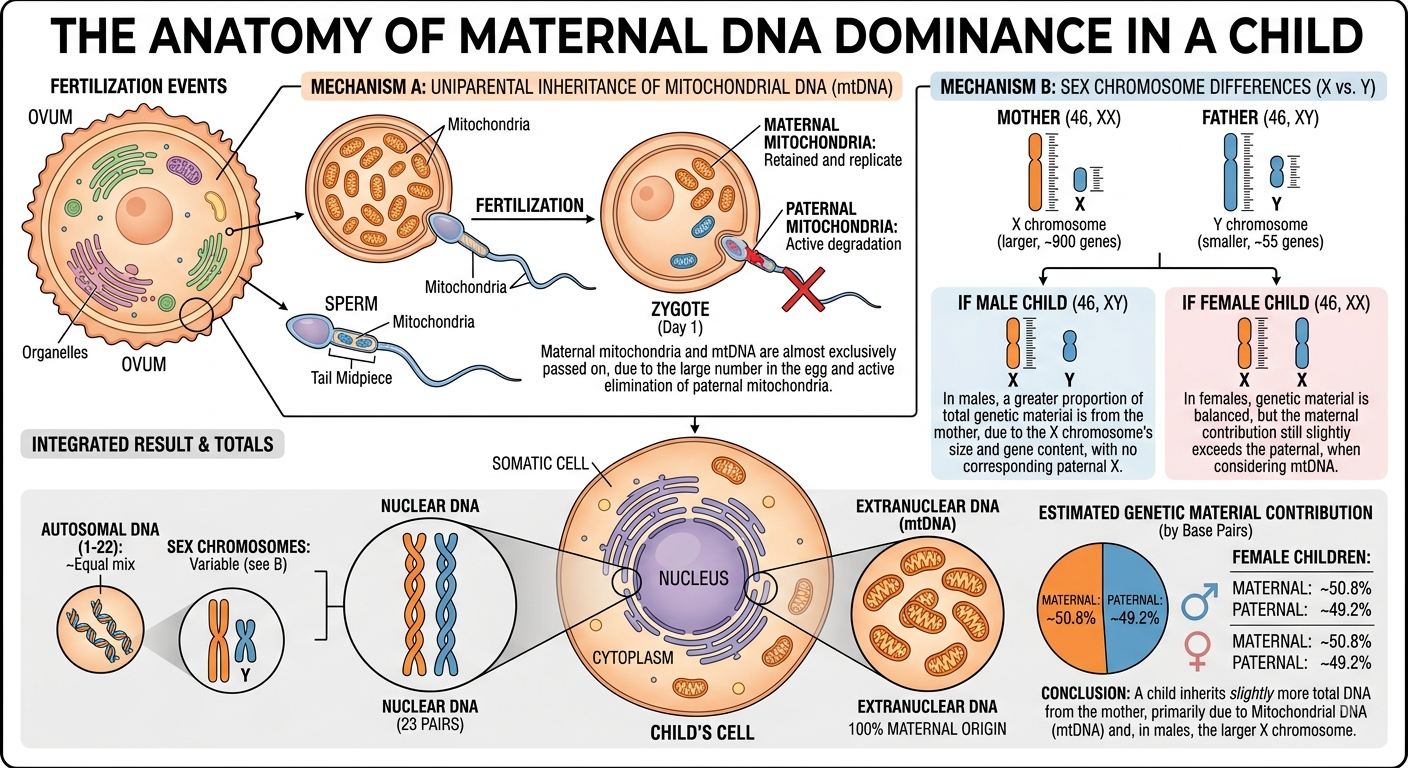
The inheritance of human DNA is a remarkably balanced process in which a child normally receives approximately one half of their nuclear genome from the mother and one half from the father. Yet an important exception exists: mitochondrial DNA (mtDNA) is generally inherited through the maternal line. This distinctive pattern has sometimes been described as the “dominance” of female or maternal DNA, although scientifically it is more accurate to distinguish maternal inheritance of mitochondrial DNA from maternal dominance of the entire genome.
This thesis investigates the biological architecture responsible for maternal mitochondrial inheritance and examines the broader relationship between maternal and paternal genetic contributions. It follows the process from the structure of the egg and sperm through fertilization, embryonic development, mitochondrial transmission, nuclear chromosomes, sex chromosomes, genomic imprinting, epigenetic regulation, mitochondrial energetics, inheritance patterns, disease, ancestry, evolution, and modern genomic science.
The central finding is that maternal genetic influence has several distinct biological dimensions. First, the mother contributes approximately half of the child’s nuclear chromosomes. Second, the egg supplies the cytoplasm, organelles, molecular machinery, and mitochondria required for the earliest stages of embryonic development. Third, mitochondrial DNA is ordinarily transmitted maternally because the mitochondria retained in the embryo originate from the egg. Finally, maternal and paternal genomes can differ in their regulatory histories because of mechanisms such as genomic imprinting.
The resulting picture is therefore not one of simple female genetic dominance. Rather, human inheritance is a highly integrated system in which maternal and paternal nuclear genomes combine, while mitochondrial inheritance follows a predominantly maternal lineage.
1. Introduction
Every human begins as a single cell produced by the fusion of an egg and a sperm. This event combines genetic material from two individuals and establishes the genome of a new organism.
The apparent simplicity of this process hides an extraordinary biological asymmetry.
The sperm contributes a highly compact package of nuclear genetic material. The egg contributes nuclear DNA as well as a large cellular environment containing cytoplasm, mitochondria, proteins, RNAs, nutrients, membranes, molecular machinery, and other components required for early development.
This difference is particularly important for mitochondrial inheritance.
Human cells contain mitochondria, specialized organelles involved in cellular energy metabolism. Mitochondria possess their own small circular genome. Unlike nuclear chromosomes, mitochondrial DNA is generally inherited from the mother. The National Human Genome Research Institute describes mitochondrial DNA as a chromosome located within mitochondria and notes that offspring generally inherit mitochondria, and therefore mtDNA, from their mother.
This creates an unusual genetic pathway:
Mother → mitochondria → mitochondrial DNA → child → subsequent maternal lineage
The paternal nuclear genome remains essential, however. The child’s chromosomes are not predominantly maternal. In normal sexual reproduction, one copy of each nuclear chromosome comes from the mother and the other from the father.
Consequently, the scientifically important question is not:
“Why does the child receive more DNA from the mother?”
but rather:
“Why does mitochondrial DNA follow a predominantly maternal inheritance pathway, and how does this coexist with approximately equal nuclear inheritance from both parents?”
2. The Human Genome: Two Major Genetic Compartments
Human genetic information is distributed principally between:
- Nuclear DNA
- Mitochondrial DNA
These two systems differ in structure, location, inheritance, and biological function.
2.1 Nuclear DNA
Nuclear DNA is packaged into chromosomes inside the cell nucleus.
Humans normally possess 23 chromosome pairs:
- 22 pairs of autosomes
- 1 pair of sex chromosomes
One chromosome of each pair normally comes from the mother and the other from the father.
Therefore:
Maternal nuclear contribution ≈ 50%
Paternal nuclear contribution ≈ 50%
This is the fundamental genetic basis of biparental inheritance.
2.2 Mitochondrial DNA
Mitochondria possess their own small circular chromosome.
Unlike nuclear chromosomes, mitochondrial DNA is generally transmitted through the maternal line.
Thus:
Nuclear DNA → biparental
Mitochondrial DNA → predominantly maternal
This distinction is the foundation of maternal mitochondrial inheritance.
3. The Egg and the Sperm Are Biologically Different Cells
Understanding maternal mitochondrial inheritance requires examining the two gametes.
3.1 The egg
The human egg is a comparatively large cell containing:
- nuclear DNA
- cytoplasm
- mitochondria
- proteins
- messenger RNAs
- ribosomes
- membranes
- metabolic molecules
- developmental factors
The egg therefore provides much more than chromosomes.
It provides the initial cellular environment in which embryonic development begins.
3.2 The sperm
The sperm is highly specialized for delivering paternal nuclear genetic material.
Its head contains the nucleus containing paternal DNA. Its midpiece contains mitochondria that provide energy for sperm movement. However, these paternal mitochondria are generally not retained as the embryo develops.
This produces a fundamental asymmetry:
Sperm → primarily delivers paternal nuclear genome
Egg → delivers maternal nuclear genome + cellular machinery + mitochondria
This asymmetry is one of the principal reasons mitochondrial inheritance becomes maternal.
4. Fertilization: The Moment Two Genomes Become One
Fertilization brings the maternal and paternal nuclear genomes together.
The sperm enters the egg and contributes its nuclear genetic material.
The egg contributes:
- its nuclear genome
- cytoplasm
- mitochondria
- molecular machinery
- developmental resources
The resulting embryo therefore possesses a nuclear genome derived from both parents but mitochondrial machinery originating primarily from the maternal gamete.
The process can be represented as:
Maternal egg
↓
Maternal nucleus + cytoplasm + mitochondria
Paternal sperm
↓
Paternal nucleus
↓
Fertilized embryo
↓
Biparental nuclear genome + predominantly maternal mitochondrial genome
5. Why Mitochondrial DNA Is Normally Maternal
The central mechanism is straightforward.
The egg contributes mitochondria to the developing embryo, whereas sperm mitochondria normally do not become the persistent mitochondrial population of the embryo. The NHGRI explains that only egg cells retain their mitochondria during fertilization, resulting in maternal inheritance of mitochondrial DNA.
MedlinePlus likewise identifies mitochondrial inheritance as a form of maternal inheritance because only egg cells contribute mitochondria to the developing embryo.
Therefore:
Mother → mtDNA → child
while ordinarily:
Father → nuclear DNA → child
rather than:
Father → mtDNA → child
This is not because maternal DNA is biologically “stronger.” It is because the reproductive architecture establishes different transmission pathways for nuclear and mitochondrial genomes.
6. The Mitochondrial Bottleneck
Maternal mitochondrial inheritance becomes even more interesting because an egg contains many mitochondria and mitochondrial DNA molecules.
During the formation of eggs and subsequent development, the distribution of mtDNA variants can change substantially.
This phenomenon contributes to the concept of the mitochondrial genetic bottleneck.
A mother can carry a mixture of mitochondrial DNA variants, and different eggs may receive different proportions of these variants.
This is related to heteroplasmy, the presence of more than one mitochondrial DNA population within cells.
The consequence is that mitochondrial inheritance is not necessarily a simple identical-copy process.
Instead:
Maternal mtDNA population
↓
Different mitochondrial proportions among eggs
↓
Different embryos
↓
Potentially different mitochondrial genetic profiles
This helps explain why mitochondrial disorders can vary substantially between relatives.
7. Maternal Inheritance Does Not Mean Maternal Dominance of All Traits
A major misconception must be avoided.
The fact that mitochondrial DNA is maternally inherited does not mean that most human traits are genetically controlled by the mother.
Most human genes are located in nuclear chromosomes, and those genes are inherited from both parents.
For example, genes influencing:
- metabolism
- development
- immune function
- neurological processes
- growth
- pigmentation
- cardiovascular biology
- cellular signaling
are distributed throughout the nuclear genome.
Consequently, both parents make extensive genetic contributions.
The proper distinction is:
| Genetic component | Typical inheritance |
|---|---|
| Autosomes | Mother + father |
| X chromosome | Mother and/or father depending on child’s sex |
| Y chromosome | Father → son |
| Mitochondrial DNA | Mother → children |
| Genomic imprinting | Parent-of-origin effects |
| Epigenetic regulation | Influenced by developmental and parental processes |
8. The X and Y Chromosomes
Sex chromosomes introduce another interesting asymmetry.
Egg cells normally carry an X chromosome.
Sperm cells carry either:
- X
- Y
Consequently:
X sperm + X egg → XX
Y sperm + X egg → XY
Thus the paternal gamete determines whether the embryo receives an X or Y chromosome under the conventional XX/XY system.
This provides an important counterbalance to maternal mitochondrial inheritance.
The mother supplies mitochondrial DNA to all children, while a father can transmit his Y chromosome specifically to sons.
Therefore human inheritance contains several different lineage systems rather than one universal maternal or paternal dominance system.
9. Genomic Imprinting
Another layer of complexity is genomic imprinting.
Genomic imprinting occurs when the expression of a gene depends on whether the relevant copy was inherited from the mother or father.
The DNA sequence itself does not necessarily differ. Instead, epigenetic chemical marks can influence whether a gene is expressed or silenced.
This means:
Maternal allele ≠ necessarily paternal allele in functional expression
even when both are present.
Parent-of-origin effects therefore add another dimension to inheritance.
They demonstrate that genetics is not simply about receiving DNA sequences. It is also about how those sequences are regulated.
10. Maternal Cytoplasm and Early Embryonic Development
The egg’s importance extends beyond mitochondrial DNA.
Immediately after fertilization, the early embryo relies heavily on molecular resources that were already present in the egg.
These include:
- maternal RNAs
- proteins
- ribosomes
- metabolic molecules
- mitochondria
- regulatory factors
This produces a temporary developmental asymmetry.
The paternal genome enters the embryo at fertilization, but the egg supplies much of the initial cellular environment in which that genome operates.
Therefore:
Maternal contribution = genome + cellular environment
Paternal contribution = primarily genome
This does not make the maternal genome inherently dominant. It reflects the fundamentally different physical structures of the egg and sperm.
11. Mitochondria and Cellular Energy
Mitochondria are central to understanding why maternal inheritance is biologically important.
Mitochondria generate much of the chemical energy required by cells, storing energy in ATP.
Mitochondria participate in:
- oxidative phosphorylation
- ATP production
- metabolic regulation
- cellular signaling
- programmed cell death
- regulation of cellular redox state
The developing embryo therefore inherits not simply an mtDNA sequence but a population of mitochondria that immediately participates in cellular metabolism.
This creates a fascinating connection between:
maternal inheritance
↓
mitochondrial genome
↓
mitochondrial function
↓
cellular energy metabolism
↓
embryonic development
12. Why Paternal Mitochondria Are Usually Excluded
The precise cellular mechanisms responsible for eliminating paternal mitochondria involve processes associated with selective degradation and maternal inheritance mechanisms.
The general biological outcome is clear:
Paternal mitochondria normally do not contribute to the long-term mitochondrial population of the embryo.
This prevents the normal inheritance pattern from becoming a mixture of maternal and paternal mitochondrial genomes.
The resulting system allows mtDNA to follow a predominantly maternal lineage across generations.
13. Maternal Mitochondrial Lineages
Because mtDNA is generally transmitted from mothers to their children, mitochondrial DNA can be used to trace maternal ancestry.
A person receives mtDNA from their mother.
That mother’s mtDNA came from her mother.
That grandmother’s mtDNA came from her mother.
The lineage can therefore be represented as:
Mother
↓
Maternal grandmother
↓
Maternal great-grandmother
↓
Earlier maternal ancestors
↓
Ancient maternal population
Modern mitochondrial DNA analysis can therefore provide information about maternal ancestry. MedlinePlus notes that mitochondrial DNA testing provides information about the female ancestral line.
14. Maternal Inheritance and Disease
Maternal inheritance becomes medically significant when pathogenic variants occur in mitochondrial DNA.
Mitochondrial disorders can result from variants in:
- mitochondrial DNA
- nuclear DNA
These are fundamentally different inheritance systems.
When the relevant pathogenic variant is located in mtDNA, maternal inheritance can occur.
MedlinePlus describes mitochondrial inheritance as a pattern in which mtDNA variants can be transmitted from mothers to both sons and daughters, while fathers do not ordinarily pass mtDNA-associated disorders to their children.
This illustrates why understanding maternal inheritance is important in human genetics and medicine.
15. Mitochondrial DNA and Heteroplasmy
A particularly important concept is heteroplasmy.
Cells may contain a mixture of mitochondrial genomes.
For example:
Normal mtDNA + variant mtDNA
may coexist within the same cell.
The proportion of altered mitochondrial genomes can influence cellular consequences in certain mitochondrial diseases.
MedlinePlus describes heteroplasmy as a mixture of mitochondria containing mutated and unmutated DNA and notes that disease severity can be associated with the proportion of mitochondria carrying a particular mutation.
Thus mitochondrial inheritance involves not only:
Which mtDNA sequence is inherited?
but also:
How many copies of different mtDNA variants are inherited?
16. Maternal DNA and the Architecture of Human Development
The maternal contribution can therefore be divided into several layers.
Layer 1 — Nuclear genetics
Approximately half of the child’s nuclear genome originates from the mother.
Layer 2 — Mitochondrial genetics
Mitochondrial DNA is normally inherited from the mother.
Layer 3 — Cellular infrastructure
The egg supplies mitochondria and extensive cytoplasmic machinery.
Layer 4 — Early developmental regulation
Maternal molecules help support development before the embryonic genome becomes fully operational.
Layer 5 — Epigenetic inheritance
Parent-of-origin effects can influence gene expression through mechanisms such as imprinting.
These layers create the appearance of strong maternal influence without requiring the scientifically incorrect conclusion that the mother contributes most of the child’s DNA.
17. Evolutionary Explanation
Maternal mitochondrial inheritance is also an evolutionary phenomenon.
Mitochondria originated through an ancient symbiotic relationship between ancestral eukaryotic cells and bacteria-like organisms.
Over evolutionary time, mitochondria retained a small genome while most ancestral mitochondrial genes became integrated into the nuclear genome.
Modern mitochondria therefore represent a remarkable combination of:
Ancient evolutionary history + cellular energy production + independent genetic material
Their maternal inheritance creates a relatively continuous maternal lineage that can persist over many generations.
18. The Endosymbiotic Perspective
The endosymbiotic theory provides a deeper explanation for why mitochondria possess their own DNA.
According to the widely accepted evolutionary model, mitochondria originated from an ancient symbiotic association between an ancestral host cell and an aerobic bacterium.
The former bacterium eventually became a permanent cellular organelle.
This explains several unusual mitochondrial characteristics:
- mitochondrial DNA
- double membranes
- bacterial-like molecular characteristics
- independent replication
- specialized energy metabolism
The maternal inheritance of mtDNA therefore represents the inheritance of a tiny evolutionary genome embedded within human cells.
19. Maternal Versus Paternal Genetic Legacy
Human heredity contains multiple overlapping lineages.
Maternal autosomal lineage
Mother → approximately half of nuclear DNA
Paternal autosomal lineage
Father → approximately half of nuclear DNA
Maternal mitochondrial lineage
Mother → mtDNA
Paternal Y-chromosomal lineage
Father → Y chromosome in sons
This produces a fascinating genetic map:
Mother
- autosomal DNA
- X chromosome
- mitochondrial DNA
Father
- autosomal DNA
- X or Y chromosome
The child therefore represents a genetic intersection of multiple inheritance systems.
20. Why the Term “Dominance” Can Be Misleading
The word dominance has a specific meaning in genetics.
A dominant allele is one whose effect can be expressed when only one copy is present under the relevant genetic circumstances.
Therefore:
Maternal inheritance ≠ genetic dominance
and:
Maternal inheritance ≠ maternal superiority
and:
Maternal mitochondrial transmission ≠ inheritance of most nuclear DNA from the mother
The scientifically precise concept is:
Maternal mitochondrial inheritance occurs because the embryo normally receives its persistent mitochondria from the egg.
This distinction should be central to any rigorous treatment of the subject.
21. A Systems-Level Model of Maternal Genetic Influence
The complete system can be represented as follows:
Mother
↓
Egg formation
↓
Maternal nuclear genome
+
Maternal mitochondria
+
Maternal cytoplasm
+
Maternal developmental molecules
↓
Fertilization
Father
↓
Paternal nuclear genome
↓
Embryo
↓
Biparental nuclear genome
Predominantly maternal mitochondrial genome
↓
Cell division
↓
Organ development
↓
Mature human organism
This model explains how maternal inheritance can be biologically distinctive without being equivalent to overall maternal genetic dominance.
22. Scientific Implications
Understanding maternal mitochondrial inheritance has implications for:
- human genetics
- reproductive biology
- developmental biology
- evolutionary biology
- mitochondrial medicine
- genetic counseling
- ancestry analysis
- population genetics
- molecular anthropology
- precision medicine
It also illustrates an important principle of modern biology:
Inheritance is multidimensional.
Genes are inherited, but so are cellular structures, molecular environments, regulatory states, and organelles.
23. Technological Implications
Modern DNA sequencing makes it possible to distinguish:
- nuclear DNA
- mitochondrial DNA
- mitochondrial variants
- heteroplasmy
- maternal lineages
- population-level genetic patterns
High-throughput sequencing and computational genomics have transformed mitochondrial research.
Researchers can compare mitochondrial genomes across individuals and populations to investigate:
- evolutionary history
- migration
- population structure
- inherited mitochondrial disorders
- ancient human ancestry
Mitochondrial DNA has therefore become both a biological inheritance system and an important scientific data source.
24. Maternal DNA and Human Ancestry
Mitochondrial DNA provides a particularly useful record of maternal ancestry because its transmission pattern differs from autosomal inheritance.
Autosomal DNA becomes increasingly mixed through generations.
Mitochondrial DNA, by contrast, tends to preserve a more direct maternal lineage.
This makes mtDNA valuable for studying:
mother → daughter/son → maternal descendants
across many generations.
It does not provide a complete picture of a person’s ancestry, however. It represents only one lineage among the enormous number of ancestral lines contributing to a person’s overall genome.
25. A More Accurate Definition of Maternal Genetic Influence
The phrase “maternal DNA dominance” should therefore be reformulated scientifically.
A more accurate definition is:
Maternal genetic influence in human inheritance consists of approximately half of the nuclear genome together with predominantly maternal mitochondrial inheritance and a substantial maternal contribution to the cellular environment of the newly fertilized embryo.
This definition captures the biological reality without incorrectly suggesting that the mother supplies most of the child’s DNA.
26. The Central Scientific Paradox
The fascinating paradox is:
The child receives approximately half of the nuclear genome from each parent, yet mitochondrial DNA follows a maternal lineage.
This demonstrates that “DNA inheritance” is not a single process.
It consists of different genetic compartments with different transmission mechanisms.
The human organism therefore carries:
Biparental nuclear inheritance
alongside
Predominantly maternal mitochondrial inheritance.
27. Conclusion
The anatomy of maternal DNA inheritance reveals one of the most remarkable organizational principles in human biology.
The mother does not normally contribute most of a child’s nuclear DNA. Instead, the nuclear genome is constructed through approximately equal contributions from the maternal and paternal gametes.
What makes maternal inheritance distinctive is the mitochondrial system.
The egg supplies the mitochondria that become the embryo’s mitochondrial population, while paternal mitochondria are normally excluded from long-term inheritance. Consequently, mitochondrial DNA follows a predominantly maternal lineage.
This maternal mitochondrial pathway connects reproduction with:
- cellular energy production
- embryonic development
- mitochondrial disease
- genetics
- evolution
- ancestry
- population biology
- molecular medicine
At the same time, genomic imprinting demonstrates that parent-of-origin effects can influence gene expression beyond the simple question of which DNA sequence was inherited.
The most accurate conclusion is therefore not that female DNA dominates the child’s genome, but that human inheritance contains a remarkable maternal mitochondrial pathway embedded within an otherwise predominantly biparental nuclear genome.
The resulting biological architecture can be summarized in one equation-like concept:
Human inheritance = biparental nuclear genome + predominantly maternal mitochondrial genome + parent-of-origin regulation + developmental cellular environment
This framework provides a scientifically rigorous foundation for understanding why maternal inheritance is so distinctive while preserving the equally fundamental contribution of paternal DNA.

Be First to Comment