
A Comprehensive Scientific and Technological Thesis
Abstract
Mitochondria are highly specialized cellular organelles that occupy a central position in human biology. Traditionally described as the “powerhouses of the cell,” they are responsible for much more than the production of adenosine triphosphate (ATP). Mitochondria integrate nutrient metabolism, oxygen consumption, oxidative phosphorylation, calcium handling, redox signaling, biosynthesis, cellular stress responses, programmed cell death, and communication between cellular compartments.
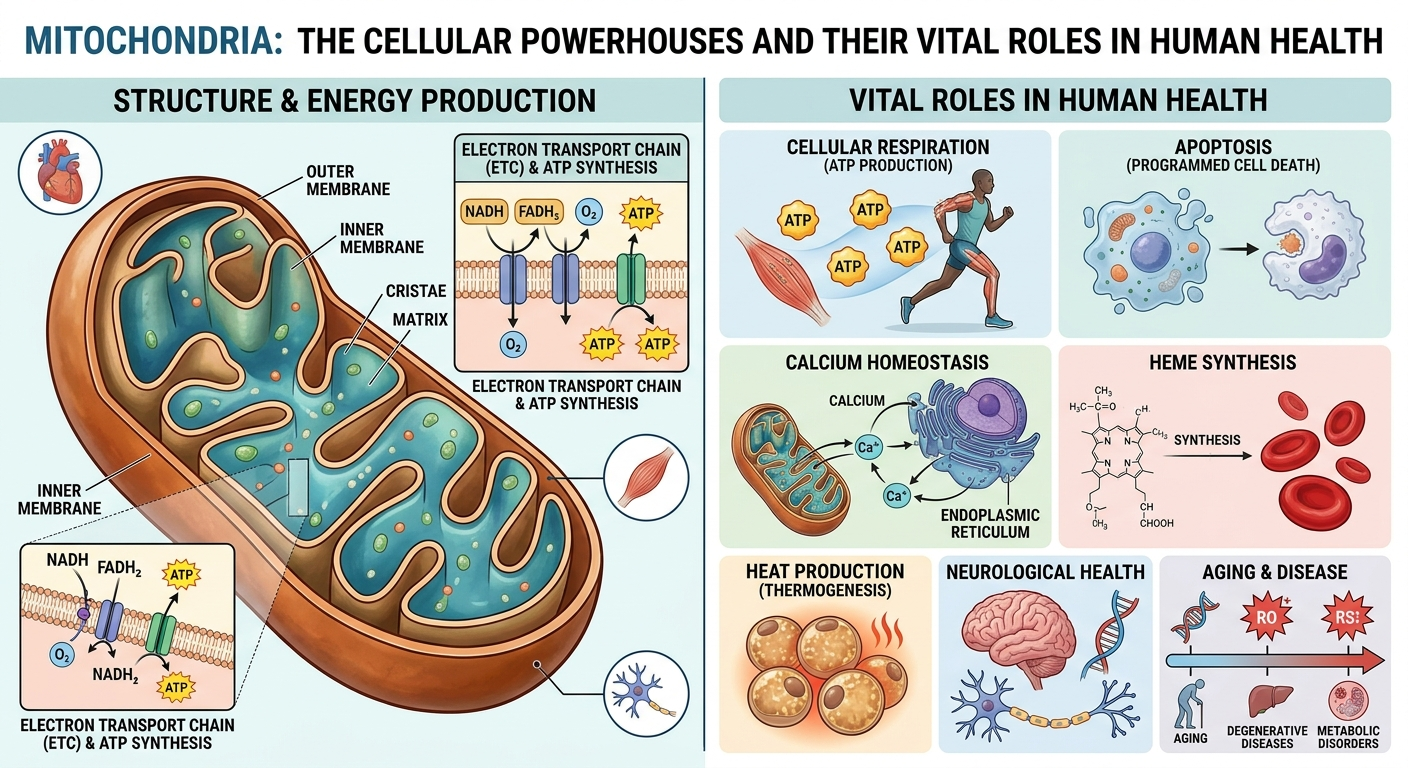
Their importance arises from their remarkable molecular architecture. A mitochondrion contains an outer membrane, intermembrane space, highly specialized inner membrane, cristae, and matrix. The inner membrane houses the respiratory-chain machinery that converts the energy contained in electrons into an electrochemical proton gradient. ATP synthase subsequently uses this gradient to synthesize ATP. This process, oxidative phosphorylation, provides a major fraction of the energy used by aerobic human cells.
Mitochondria also possess their own genome, mitochondrial DNA (mtDNA), while most mitochondrial proteins are encoded by nuclear DNA and imported into the organelle. This unusual genetic arrangement reflects their evolutionary history as descendants of ancient bacterial endosymbionts. Current evolutionary models place mitochondrial origins within an ancient symbiotic relationship involving an alphaproteobacterial lineage and an ancestral host cell.
This thesis examines mitochondria from molecular architecture and evolutionary origin through energy metabolism, electron transport, ATP synthesis, signaling, quality control, aging, disease, biotechnology, and future mitochondrial medicine.
1. Introduction
Every human cell requires energy.
Cells continually perform work:
- maintaining ion gradients;
- synthesizing proteins;
- copying DNA;
- transporting molecules;
- contracting muscles;
- transmitting nerve signals;
- maintaining membranes;
- repairing cellular damage;
- controlling intracellular chemistry; and
- regulating growth and survival.
ATP provides a major universal energy currency for this work.
Mitochondria are central to the production and regulation of this energy. They oxidize products derived from carbohydrates, fats and proteins and transfer the resulting electrons through a series of molecular complexes. The energy released is converted into an electrochemical gradient and subsequently into ATP.
However, describing mitochondria only as energy generators is incomplete.
Modern mitochondrial biology recognizes them as dynamic metabolic and signaling systems. Their functions include lipid metabolism, ion homeostasis, biosynthesis, cellular signaling, quality control and regulation of cell death.
A useful conceptual model is therefore:
Mitochondria = energy conversion + metabolism + signaling + quality control + cellular adaptation
2. Evolutionary Origin of Mitochondria
2.1 The Endosymbiotic Principle
One of the most important ideas in cell biology is that mitochondria originated from an ancient endosymbiotic event.
The broad model proposes that an ancestral host cell established a long-term association with a bacterium related to modern alphaproteobacteria. Over evolutionary time, the bacterial partner became integrated into the host and eventually evolved into the mitochondrion.
This process was extraordinarily consequential because it created a new cellular organization capable of exploiting oxygen-dependent metabolism within a specialized intracellular compartment.
2.2 Evidence for Bacterial Ancestry
Several mitochondrial characteristics are consistent with bacterial ancestry:
- mitochondrial DNA;
- bacterial-like ribosomes;
- double-membrane organization;
- bacterial-like molecular machinery;
- division by mechanisms related to bacterial fission;
- evolutionary relationships between mitochondrial genes and bacterial genes.
Mitochondrial evolution also involved extensive transfer of genes from the ancestral endosymbiont to the nuclear genome. Consequently, modern mitochondria are genetically dependent on both mitochondrial and nuclear genomes.
2.3 Evolutionary Integration
The modern mitochondrion is therefore neither simply a bacterium nor simply an ordinary cellular compartment.
It is an integrated evolutionary system:
Ancient bacterium → endosymbiosis → gene transfer → cellular integration → modern mitochondrion
Recent evolutionary research continues to refine the timing and circumstances of this event. Some analyses suggest that mitochondrial acquisition occurred relatively early in eukaryotic evolution and probably after the Great Oxidation Event, although the precise sequence remains an active research question.
3. Molecular Architecture of the Mitochondrion
A mitochondrion is organized into several distinct compartments:
- Outer mitochondrial membrane
- Intermembrane space
- Inner mitochondrial membrane
- Cristae
- Mitochondrial matrix
This compartmentalization is fundamental to mitochondrial function.
3.1 Outer Membrane
The outer membrane forms the external boundary.
It contains proteins such as porins that permit relatively small molecules and ions to pass through. The outer membrane therefore differs greatly from the highly selective inner mitochondrial membrane.
It also participates in:
- protein import;
- lipid exchange;
- signaling;
- mitochondrial dynamics; and
- apoptosis.
3.2 Intermembrane Space
Between the two membranes lies the intermembrane space.
During respiration, protons are pumped from the matrix toward this compartment, creating part of the electrochemical gradient required for ATP synthesis.
3.3 Inner Mitochondrial Membrane
The inner membrane is the principal bioenergetic membrane.
It contains:
- respiratory Complex I;
- Complex II;
- Complex III;
- Complex IV;
- ATP synthase;
- transport proteins;
- lipid-metabolism machinery;
- specialized protein assemblies.
The membrane is highly protein-rich and normally restricts the movement of ions. This impermeability is essential because the respiratory chain must establish and preserve a proton gradient across it.
3.4 Cristae
The inner membrane folds inward to create structures called cristae.
Cristae dramatically increase the membrane area available for respiratory and ATP-producing machinery. Their architecture is not merely structural; it influences mitochondrial bioenergetics and cellular physiology.
Modern research has identified specialized molecular systems, including MICOS, that organize cristae structure and maintain functional compartments within the inner membrane.
3.5 Matrix
The matrix is the innermost aqueous compartment.
It contains enzymes responsible for important metabolic reactions, including:
- pyruvate processing;
- the citric acid cycle;
- fatty-acid oxidation;
- portions of amino-acid metabolism;
- mitochondrial DNA replication and transcription;
- mitochondrial protein synthesis.
4. Mitochondrial DNA
Mitochondria are unusual because they contain their own DNA.
Human mtDNA encodes a small number of essential components of the respiratory system, while most mitochondrial proteins are encoded by nuclear DNA. The nuclear genome therefore provides the overwhelming majority of the mitochondrial proteome.
This creates a remarkable two-genome system:
Nuclear DNA → most mitochondrial proteins
Mitochondrial DNA → selected mitochondrial RNAs and respiratory proteins
The two genetic systems must operate together for normal mitochondrial function.
5. Nutrients as Sources of Mitochondrial Energy
Human cells obtain chemical energy from several classes of nutrients.
Carbohydrates
Carbohydrates are broken down through glycolysis to produce pyruvate. Pyruvate can enter mitochondrial metabolism and ultimately contribute carbon to the citric acid cycle.
Fatty acids
Fatty acids undergo β-oxidation, generating acetyl-CoA together with reduced electron carriers.
Amino acids
Amino acids can be converted into metabolic intermediates that enter pathways such as the citric acid cycle.
The mitochondrion therefore sits at a major intersection of carbohydrate, lipid and protein metabolism.
6. From Glucose to Acetyl-CoA
Glucose is initially metabolized through glycolysis in the cytosol.
The simplified pathway is:
Glucose → glycolysis → pyruvate → acetyl-CoA → citric acid cycle
Pyruvate is transported into mitochondria and converted to acetyl-CoA by the pyruvate dehydrogenase complex.
Acetyl-CoA then enters the citric acid cycle.
This creates a biochemical bridge between carbohydrate metabolism and mitochondrial respiration.
7. The Citric Acid Cycle
The citric acid cycle, also called the tricarboxylic acid or Krebs cycle, occurs primarily in the mitochondrial matrix.
Its major function is not simply ATP production directly. Instead, it generates reduced electron carriers, particularly:
- NADH;
- FADH₂.
These molecules carry high-energy electrons toward the respiratory chain.
The simplified sequence is:
Acetyl-CoA → citrate → isocitrate → α-ketoglutarate → succinyl-CoA → succinate → fumarate → malate → oxaloacetate
The regenerated oxaloacetate allows the cycle to continue.
Thus:
Citric acid cycle = electron-carrier generation
while:
Electron transport + proton gradient + ATP synthase = major oxidative ATP-production system
8. β-Oxidation and Fatty-Acid Metabolism
Mitochondria are major sites of fatty-acid oxidation.
Fatty acids are progressively shortened through β-oxidation.
The products include:
- acetyl-CoA;
- NADH;
- FADH₂.
Acetyl-CoA enters the citric acid cycle while NADH and FADH₂ contribute electrons to the respiratory system.
This allows stored chemical energy in lipids to be transformed into usable cellular energy.
9. The Electron Transport Chain
The electron transport chain is embedded within the inner mitochondrial membrane.
Its principal components are:
Complex I
Complex II
Coenzyme Q
Complex III
Cytochrome c
Complex IV
Electrons ultimately reach molecular oxygen, which serves as the terminal electron acceptor and is reduced to water.
The electron-transfer pathway can therefore be simplified as:
NADH/FADH₂ → respiratory chain → O₂ → H₂O
At the same time, energy released during electron transfer drives proton movement across the inner membrane.
10. Complex I
Complex I accepts electrons from NADH.
It transfers those electrons toward ubiquinone while contributing to proton translocation across the inner mitochondrial membrane.
This makes Complex I an important connection between NADH-producing metabolic pathways and oxidative phosphorylation.
11. Complex II
Complex II is unusual because it participates in both the citric acid cycle and respiratory electron transfer.
Succinate is oxidized to fumarate while electrons are transferred toward ubiquinone.
Unlike Complex I, Complex II does not itself pump protons across the inner membrane.
12. Coenzyme Q
Coenzyme Q, also called ubiquinone, is a mobile electron carrier within the inner membrane.
It receives electrons from several pathways and transfers them toward Complex III.
It therefore functions as an important molecular connection point within the respiratory network.
13. Complex III and Cytochrome c
Complex III transfers electrons from reduced coenzyme Q to cytochrome c.
Cytochrome c is a mobile electron carrier associated with the intermembrane-space side of the inner membrane.
Electrons are subsequently delivered to Complex IV.
Respiratory complexes can also associate into larger assemblies known as respiratory supercomplexes or respirasomes.
14. Complex IV and Oxygen
Complex IV, cytochrome c oxidase, receives electrons and ultimately transfers them to molecular oxygen.
The final chemical reaction produces water.
This makes oxygen essential to aerobic oxidative phosphorylation:
Electrons + O₂ + H⁺ → H₂O
Without oxygen serving as the terminal electron acceptor, normal high-capacity oxidative phosphorylation cannot continue.
15. The Proton Gradient
The respiratory chain does more than move electrons.
It uses their energy to pump protons from the matrix toward the intermembrane space.
The result is an electrochemical gradient.
Two components are particularly important:
- A chemical gradient based on proton concentration.
- An electrical gradient created by charge separation across the membrane.
Together these form the proton-motive force.
The mitochondrial inner membrane therefore acts somewhat like a microscopic energy-storage barrier.
16. ATP Synthase
ATP synthase converts the energy stored in the proton-motive force into ATP.
Protons flow back through the ATP synthase molecular machine.
Their movement drives conformational and rotational changes within the enzyme, ultimately enabling:
ADP + Pi → ATP
This is a remarkable example of molecular-scale energy conversion.
ATP synthase is therefore comparable to a molecular rotary engine whose energy source is the proton gradient.
17. Oxidative Phosphorylation
The complete process can be summarized:
Nutrients
↓
Metabolic oxidation
↓
NADH + FADH₂
↓
Electron transport
↓
Proton pumping
↓
Proton-motive force
↓
ATP synthase
↓
ATP
This coupling between electron transport and phosphorylation is called oxidative phosphorylation.
It is responsible for most ATP generation in many aerobic cells.
18. ATP as Cellular Energy Currency
ATP is continuously produced and consumed.
Cells use ATP to power:
- ion pumps;
- muscle contraction;
- molecular transport;
- biosynthesis;
- cellular movement;
- protein modification;
- DNA and RNA-related processes;
- maintenance of membrane potentials.
ATP should therefore be regarded as a rapidly recycled energy-transfer molecule rather than a permanent energy store.
19. Mitochondria and Cellular Metabolism
Mitochondria form a metabolic hub connecting numerous pathways.
They participate in:
- carbohydrate metabolism;
- lipid metabolism;
- amino-acid metabolism;
- nucleotide-related processes;
- iron and metal cofactor metabolism;
- biosynthesis;
- energy sensing.
Their architecture allows different reactions to occur in specialized compartments.
Modern research therefore increasingly views mitochondrial compartmentalization as a fundamental component of metabolic regulation.
20. Mitochondria and Calcium
Mitochondria participate in cellular calcium regulation.
Calcium influences mitochondrial metabolism, while mitochondria can buffer and process calcium signals.
Mitochondria also communicate closely with the endoplasmic reticulum, creating specialized contact regions where calcium and lipid metabolism can be coordinated.
However, excessive mitochondrial calcium loading can disrupt mitochondrial function and contribute to cellular injury.
21. Mitochondrial Reactive Oxygen Species
Electron transport is not perfectly efficient.
Some electrons can interact with oxygen and generate reactive oxygen species (ROS).
Important ROS include:
- superoxide;
- hydrogen peroxide;
- other reactive oxidant species.
ROS have two contrasting biological roles.
At controlled concentrations they can participate in cellular signaling.
At excessive levels they can damage:
- proteins;
- lipids;
- DNA;
- mitochondrial membranes;
- cellular structures.
Therefore:
ROS ≠ automatically harmful
Rather:
ROS balance = signaling + protection against excessive oxidative damage
This distinction is essential for understanding modern mitochondrial biology.
22. Mitochondrial Quality Control
Mitochondria are continuously monitored and remodeled.
Quality-control mechanisms include:
- protein repair;
- protein degradation;
- mitochondrial fusion;
- mitochondrial fission;
- mitophagy;
- replacement of damaged components.
These mechanisms prevent defective mitochondria from accumulating indefinitely.
23. Fusion and Fission
Mitochondria are dynamic structures rather than fixed objects.
They can:
Fuse → exchange contents and maintain network connectivity
and
Divide → redistribute mitochondria and isolate damaged components
This dynamic behavior allows the mitochondrial network to adapt to changing cellular conditions.
24. Mitophagy
Mitophagy is the selective removal of mitochondria through autophagic processes.
It represents an important mitochondrial quality-control mechanism.
The general principle is:
Damage detection → mitochondrial selection → isolation → degradation → recycling
This prevents severely dysfunctional mitochondria from remaining indefinitely within the cellular network.
25. Mitochondria and Programmed Cell Death
Mitochondria participate in apoptosis, one of the principal regulated forms of cell death.
Changes in mitochondrial membrane integrity can influence the release of signaling molecules that activate downstream apoptotic pathways.
This gives mitochondria a dual role:
maintaining cellular life through metabolism
and
participating in controlled cellular elimination when appropriate
26. Mitochondria and the Brain
The brain has extremely high energy requirements.
Neurons continuously maintain electrical gradients and support:
- synaptic signaling;
- neurotransmitter cycling;
- membrane potentials;
- intracellular transport;
- information processing.
Mitochondrial ATP production is therefore fundamental to neuronal function.
Mitochondria also have to be transported to regions of neurons where energy demand is high.
27. Mitochondria and Skeletal Muscle
Muscle contraction requires substantial ATP.
Mitochondria supply ATP for repeated cycles of contraction and relaxation.
Training and physiological demand can influence mitochondrial abundance, organization and metabolic capacity.
This illustrates a central principle:
Energy demand influences mitochondrial adaptation.
28. Mitochondria and the Heart
The heart contracts continuously throughout life.
Cardiac muscle therefore possesses a very high requirement for aerobic energy production.
Mitochondrial metabolism supplies much of the ATP required for cardiac contraction.
Disruption of mitochondrial energy production can consequently have major effects on cardiovascular physiology.
29. Mitochondria and the Liver
The liver is a major metabolic organ and mitochondria participate in:
- fatty-acid oxidation;
- carbohydrate metabolism;
- amino-acid metabolism;
- biosynthesis;
- metabolic adaptation.
The liver demonstrates that mitochondria are not simply energy generators but components of systemic metabolic regulation.
30. Mitochondrial Genetics and Disease
Mitochondrial disease can result from pathogenic variants in either:
- mitochondrial DNA; or
- nuclear DNA encoding mitochondrial proteins.
This makes mitochondrial genetics unusually complex.
Because different tissues have different energy demands, mitochondrial disorders can affect organs such as the:
- brain;
- muscles;
- heart;
- liver;
- kidneys;
- endocrine system.
31. Heteroplasmy
A cell can contain mixtures of normal and altered mitochondrial genomes.
This phenomenon is known as heteroplasmy.
The proportion and distribution of different mtDNA variants can influence whether mitochondrial dysfunction becomes biologically significant.
This contributes to the complexity of mitochondrial inheritance and disease expression.
32. Mitochondria and Aging
Mitochondrial biology is deeply connected with aging research.
Potential age-associated changes include:
- altered respiratory function;
- accumulation of mtDNA damage;
- changes in mitochondrial dynamics;
- impaired quality control;
- altered metabolic signaling;
- changes in redox regulation;
- reduced ability to adapt to stress.
However, aging is not caused by a single mitochondrial mechanism.
Modern research increasingly views mitochondrial aging as part of a network involving metabolism, cellular stress responses, inflammation, DNA maintenance, protein quality control and tissue-level regulation.
33. Mitochondrial Dysfunction and Disease
Mitochondrial dysfunction has been associated with many disease processes.
These include:
- primary mitochondrial disorders;
- metabolic disorders;
- cardiovascular diseases;
- neurological disorders;
- neurodegenerative diseases;
- some cancers;
- age-associated conditions.
The scientific relationship is complex.
Mitochondrial dysfunction may sometimes be a primary driver, while in other situations it may be a consequence or amplifier of disease.
34. Mitochondria and Cancer Biology
Cancer cells undergo major changes in metabolism.
Although the historical view emphasized a shift toward glycolysis, modern cancer biology shows that mitochondria remain important in many cancers.
Mitochondria can contribute to:
- biosynthesis;
- redox regulation;
- signaling;
- metabolic flexibility;
- cell survival.
Thus, cancer metabolism cannot be understood solely as a choice between glycolysis and mitochondrial respiration.
35. Mitochondria as Signaling Organelles
Mitochondria communicate with the rest of the cell through metabolic and molecular signals.
They interact with:
- nucleus;
- endoplasmic reticulum;
- lysosomes;
- peroxisomes;
- cytoskeleton;
- cellular immune pathways.
This produces a distributed regulatory system:
Nucleus ↔ mitochondria ↔ other organelles
The mitochondrion is therefore an information-processing component of cellular metabolism as well as an energy-conversion system.
36. Mitochondrial-Nuclear Communication
Mitochondrial function depends on coordinated activity between two genomes.
The nucleus regulates the production of thousands of mitochondrial proteins.
Mitochondria, meanwhile, generate metabolic and stress signals that can influence nuclear gene expression.
This two-way communication is sometimes described as:
Anterograde signaling: nucleus → mitochondria
Retrograde signaling: mitochondria → nucleus
This feedback system enables cells to adjust mitochondrial capacity according to physiological conditions.
37. Mitochondrial Biogenesis
Mitochondrial biogenesis is the process through which cells increase mitochondrial content and capacity.
It requires coordination of:
- nuclear gene expression;
- mitochondrial gene expression;
- protein synthesis;
- protein import;
- membrane construction;
- mtDNA replication;
- respiratory-complex assembly.
Mitochondrial biogenesis is therefore a highly coordinated cellular engineering process.
38. Mitochondrial Protein Import
Most mitochondrial proteins are synthesized outside the mitochondrion.
They must be accurately delivered into the organelle.
Specialized protein-import systems recognize targeting signals and transport proteins across mitochondrial membranes.
This creates an extraordinary logistical system:
Nuclear genome → cytoplasmic protein synthesis → targeting → mitochondrial import → correct compartment → functional assembly
39. Respiratory Supercomplexes
Respiratory complexes do not necessarily function only as completely isolated entities.
Complexes I, III and IV can form higher-order assemblies called respiratory supercomplexes or respirasomes.
This suggests that mitochondrial respiration involves not only individual molecular machines but also organized molecular networks.
The architecture of these assemblies remains an active area of structural and biochemical research.
40. Cristae as Bioenergetic Architecture
The cristae demonstrate an important principle of biological engineering:
Structure influences function.
By folding the inner membrane, mitochondria create large surfaces on which respiratory complexes and ATP synthase operate.
Modern research shows that cristae architecture is actively organized and remodeled rather than being merely passive membrane folding.
41. Mitochondria as Cellular Energy-Conversion Machines
Mitochondrial respiration can be understood as a sequence of energy transformations:
Chemical energy in nutrients
↓
Energy in reduced electron carriers
↓
Electron-transfer energy
↓
Electrochemical proton gradient
↓
Mechanical/conformational energy in ATP synthase
↓
Chemical energy stored in ATP
↓
Cellular work
This makes mitochondria one of biology’s most sophisticated natural energy-conversion systems.
42. Mitochondrial Technology and Scientific Measurement
Modern mitochondrial research depends on advanced technologies.
These include:
- electron microscopy;
- cryo-electron microscopy;
- fluorescence microscopy;
- respirometry;
- metabolomics;
- proteomics;
- mitochondrial genomics;
- single-cell analysis;
- mass spectrometry;
- structural biology;
- computational modeling;
- artificial intelligence.
Cryo-electron microscopy and other structural techniques have made it increasingly possible to study respiratory complexes and their assemblies at molecular resolution.
43. Mitochondrial Research and Artificial Intelligence
Artificial intelligence can increasingly assist mitochondrial research by analyzing:
- genomic data;
- protein structures;
- microscopy images;
- metabolic networks;
- clinical datasets;
- molecular interactions.
AI does not replace biological experimentation. Instead, it can help researchers identify patterns and generate hypotheses that can subsequently be tested experimentally.
A future research pipeline could be:
Mitochondrial data → AI analysis → biological hypothesis → laboratory experiment → validation → clinical research
44. Mitochondrial Medicine
Mitochondrial medicine is investigating approaches aimed at diagnosing, understanding and potentially treating mitochondrial disorders.
Research areas include:
- genetic diagnosis;
- mitochondrial biomarkers;
- metabolic interventions;
- gene-based approaches;
- mitochondrial replacement strategies;
- targeted molecular therapies;
- precision medicine.
Mitochondrial transfer is also being investigated as a biological phenomenon. Research indicates that mitochondria can, under certain circumstances, move between cells, creating another dimension of mitochondrial biology beyond inheritance within individual cells.
45. The Mitochondrial Network
Mitochondria should not always be conceptualized as isolated bean-shaped organelles.
Within many cells they form interconnected and continuously remodeled networks.
The network can:
- redistribute energy-producing capacity;
- exchange mitochondrial components;
- respond to cellular stress;
- isolate damaged regions;
- coordinate metabolic activity.
Thus:
Mitochondrial biology = individual organelles + network behavior
46. Mitochondrial Homeostasis
A healthy mitochondrial system requires balance between:
Production
Energy conversion
Repair
Fusion
Fission
Quality control
Removal
Replacement
This can be represented as:
Mitochondrial homeostasis
= biogenesis + maintenance + adaptation − accumulated damage
This is a conceptual framework rather than a literal mathematical equation, but it captures the dynamic nature of mitochondrial health.
47. The Integrated Human Energy System
Mitochondria cannot be separated from the rest of human physiology.
The integrated system can be represented as:
Food
↓
Digestion
↓
Nutrients
↓
Cellular uptake
↓
Metabolic pathways
↓
Mitochondrial oxidation
↓
Electron transport
↓
Proton gradient
↓
ATP
↓
Cellular work
↓
Tissue function
↓
Organ function
↓
Human physiology
Mitochondria therefore connect molecular chemistry to the functioning of the entire human organism.
48. Why the “Powerhouse” Description Is Incomplete
The phrase “powerhouse of the cell” is useful for introducing mitochondrial ATP production, but it does not capture the full biology.
Mitochondria are simultaneously:
- energy converters;
- metabolic hubs;
- signaling platforms;
- calcium regulators;
- biosynthetic centers;
- redox regulators;
- quality-control systems;
- participants in programmed cell death;
- genetic organelles;
- dynamic cellular networks.
The modern mitochondrion is therefore better described as a multifunctional metabolic and signaling organelle.
49. Central Scientific Model
The entire thesis can be condensed into one integrated framework:
NUTRIENTS
↓
CARBOHYDRATE / FAT / PROTEIN METABOLISM
↓
ACETYL-CoA + REDUCED ELECTRON CARRIERS
↓
CITRIC ACID CYCLE
↓
NADH + FADH₂
↓
ELECTRON TRANSPORT CHAIN
↓
PROTON-MOTIVE FORCE
↓
ATP SYNTHASE
↓
ATP
↓
CELLULAR WORK
At the same time:
Mitochondria
↔ Calcium
↔ ROS / redox signaling
↔ Nucleus
↔ Endoplasmic reticulum
↔ Metabolism
↔ Autophagy / mitophagy
↔ Cell survival and death
This is the central systems-biology perspective of mitochondrial function.
50. Conclusion
Mitochondria represent one of the most remarkable examples of biological engineering.
Their evolutionary history began with an ancient endosymbiotic relationship that permanently transformed eukaryotic cellular organization. Their modern structure contains multiple specialized compartments, each contributing to a coordinated biochemical system.
Their most famous function—ATP production—is itself an extraordinary molecular process. Nutrient-derived electrons enter the respiratory chain, electron transfer powers proton movement, the resulting electrochemical gradient stores usable energy, and ATP synthase converts that gradient into ATP.
Yet ATP production is only one part of mitochondrial biology.
Mitochondria regulate metabolism, calcium, redox signaling, cellular communication, quality control, programmed cell death and adaptation. Their physical architecture—including cristae and membrane organization—is tightly connected to their biochemical function.
Their genetic duality is equally remarkable. Mitochondria retain their own genome while depending heavily on proteins encoded by the nuclear genome. This creates an integrated two-genome biological system.
The health of the mitochondrial network consequently influences the health of individual cells, tissues and organs. Conversely, cellular conditions influence mitochondrial structure, metabolism and behavior.
The deepest lesson of mitochondrial biology is therefore that energy, information, structure and life are interconnected.
Mitochondria transform chemical energy into biological work, but they also sense the metabolic state of the cell, communicate with other organelles, respond to stress, regulate survival and participate in the long-term adaptation of tissues.
The mitochondrion is consequently not merely the “powerhouse of the cell.”
It is better understood as a dynamic cellular energy-conversion, metabolic, signaling and quality-control system—one of the fundamental molecular machines upon which complex human life depends.
Key Scientific Relationship
Evolution
→ Endosymbiosis
→ Mitochondrial genome
→ Double-membrane architecture
→ Cristae
→ Respiratory complexes
→ Electron transport
→ Proton gradient
→ ATP synthase
→ ATP
→ Cellular work
→ Metabolic signaling
→ Cellular adaptation
→ Tissue function
→ Human health
This sequence provides a unified scientific framework connecting the evolutionary history, molecular architecture, bioenergetics, metabolism, cellular signaling, aging, disease and technological investigation of mitochondria.



Be First to Comment