
COMPREHENSIVE SCIENTIFIC THESIS
Institute of Medical Informatics
Graphical Abstract Maker | AI Generator, Free
The Visual Story: using computer vision AI to narrate factory floor efficiency.
12
Scientific and technological research
Foundational to advanced understanding
Abstract
Artificial Intelligence (AI) and Machine Learning (ML) represent two of the most significant technological developments in human history. They are transforming how human beings collect information, understand the natural world, conduct scientific research, manufacture products, manage businesses, operate financial systems, develop medicines and solve complex economic problems.
At their foundation, AI and ML combine mathematics, statistics, computer science, computational logic, probability, information theory, neuroscience and engineering.
Artificial Intelligence is the broader scientific discipline concerned with developing computer systems capable of performing tasks that normally require aspects of human intelligence.
Machine Learning is a major branch of Artificial Intelligence that enables computer systems to identify patterns in data and improve their performance through experience rather than relying exclusively on manually programmed instructions.
The fundamental distinction is:
- Artificial Intelligence: The broader science of creating intelligent computational systems.
- Machine Learning: A method of enabling computers to learn patterns from data.
- Deep Learning: A specialised branch of machine learning using multilayer artificial neural networks.
- Generative AI: AI systems that generate new content, including text, images, audio, video and computer code.
Understanding these technologies requires studying their historical origins, mathematical foundations, computational architecture, training mechanisms, applications, limitations and future economic significance.
CHAPTER 1: Understanding the meaning of Artificial Intelligence
1.1 What is Artificial Intelligence?
Artificial Intelligence is the scientific and engineering discipline concerned with designing computer systems capable of performing tasks associated with intelligent behaviour.
These tasks include:
- Learning from information.
- Recognising patterns.
- Understanding language.
- Solving mathematical problems.
- Recognising objects and images.
- Making predictions.
- Planning activities.
- Evaluating alternative decisions.
- Interacting with human beings.
- Generating new information.
For example, consider a human being learning to recognise different types of birds.
A person observes thousands of birds and gradually learns to distinguish them through characteristics such as:
- Size.
- Shape.
- Colour.
- Wings.
- Beak structure.
- Behaviour.
- Sound.
An AI system can perform a comparable classification task by analysing large collections of labelled images and learning statistical patterns that distinguish one bird from another.
However, the computational process is fundamentally different from human biological intelligence.
A computer does not need to possess human consciousness to recognise patterns or perform intelligent tasks.
1.2 The fundamental purpose of AI
The objective of AI is to develop computational systems that can:
- Interpret information.
- Learn from available evidence.
- Identify relationships.
- Predict possible outcomes.
- Select appropriate actions.
- Improve performance against defined objectives.
An important distinction is that intelligence in an AI system is task-dependent.
A system might outperform a human in analysing millions of financial transactions but remain incapable of understanding an ordinary physical environment without additional sensors and capabilities.
CHAPTER 2: Historical evolution of Artificial Intelligence
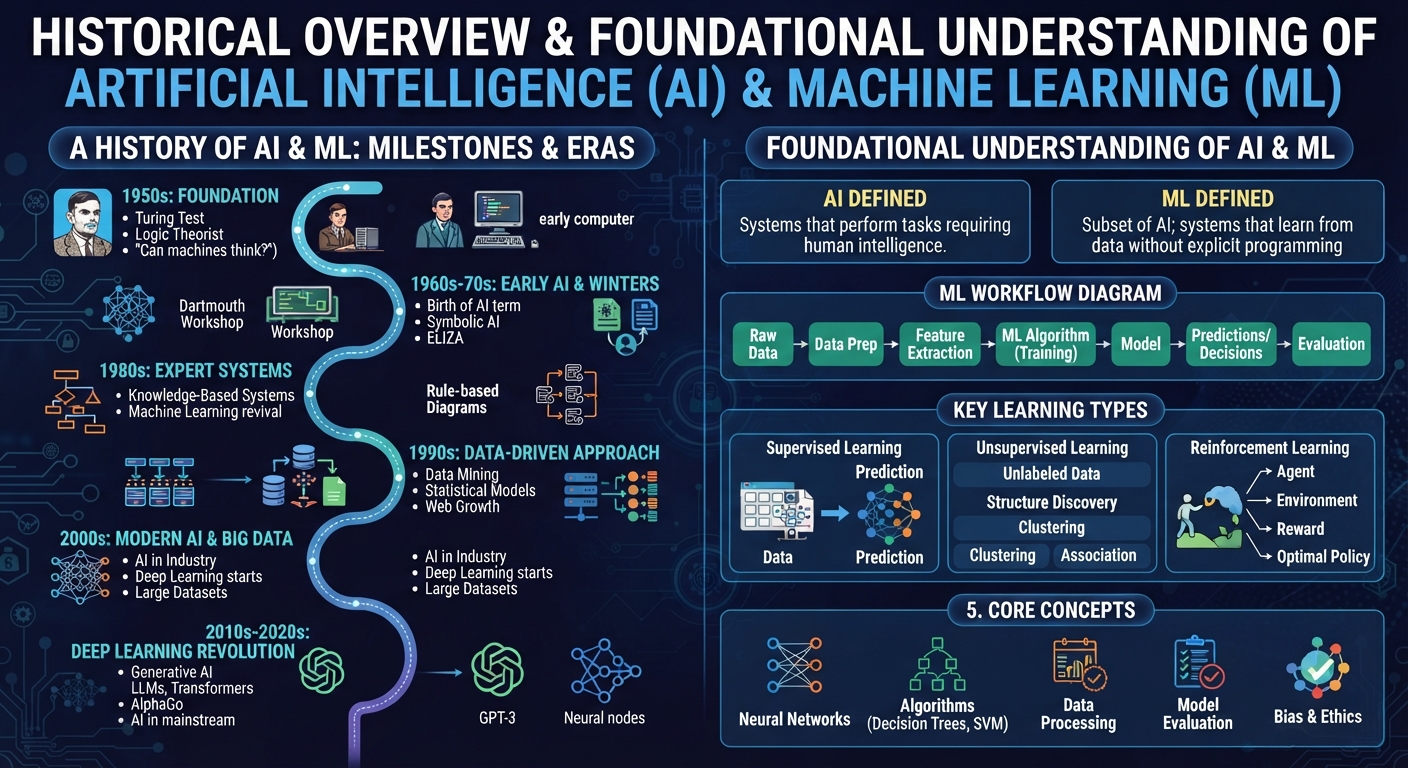
Artificial Intelligence did not emerge overnight. Its foundations developed through thousands of years of mathematics, philosophy, logic, mechanical invention and scientific discovery.
Philosophical Treasures | Faculty of Philosophy
The World War II codebreakers of Bletchley Park
75 years ago, the world’s first modern computer made its public debut
7
2.1 Ancient foundations: 600 BCE–1500 CE
Long before electronic computers existed, philosophers and mathematicians investigated whether human reasoning could be represented through logical rules.
Important intellectual foundations included:
| Historical figure | Contribution | Importance to AI |
|---|---|---|
| Aristotle (384–322 BCE) | Formal logic | Structured reasoning |
| Euclid (c. 300 BCE) | Mathematical proofs | Formal mathematical systems |
| Al-Khwarizmi (c. 780–850 CE) | Algebra and algorithms | Foundations of computational procedures |
| Ibn al-Haytham (965–1040) | Experimental scientific methodology and optics | Observation and evidence-based investigation |
| Leonardo da Vinci (1452–1519) | Mechanical engineering designs | Early inspiration for intelligent machines |
The development of algorithms is particularly important.
An algorithm is a sequence of precisely defined instructions for solving a problem.
Modern AI depends on algorithms to process information, calculate probabilities, optimise models and make predictions.
2.2 The mathematical and mechanical foundations: 1600–1900
The analytical engine designed by Charles Babbage was never built in… | Download Scientific Diagram
7
Several discoveries established the foundations of modern computing.
Blaise Pascal (1623–1662)
Developed the Pascaline, a mechanical calculating machine capable of performing arithmetic operations.
Gottfried Wilhelm Leibniz (1646–1716)
Advanced mathematical logic and developed mechanical calculating machinery.
George Boole (1815–1864)
Developed Boolean algebra, a mathematical system that represents logical relationships using operations such as AND, OR and NOT.
Boolean algebra became fundamental to digital electronics and computer logic.
Charles Babbage (1791–1871)
Designed the Difference Engine and Analytical Engine, establishing important concepts associated with programmable computing.
Ada Lovelace (1815–1852)
Recognised that a programmable machine could manipulate symbols and potentially perform operations beyond ordinary numerical calculations. Her notes included an algorithm intended for Babbage’s Analytical Engine.
These developments established an essential principle:
Human reasoning and mathematical procedures can be represented using formal systems that machines can execute.
2.3 The birth of modern computing and theoretical AI: 1930–1955
Computable90 — The National Museum of Computing
Chapter I. From Military to Civil Computing
8
Three developments were particularly important.
1. Alan Turing and computational theory
In 1936, Alan Turing published work establishing the theoretical foundations of computation through the Turing machine.
This abstract mathematical machine demonstrated how a general-purpose computational process could be represented.
In 1950, Turing published Computing Machinery and Intelligence, asking the famous question:
“Can machines think?”
He introduced what became known as the imitation game, later called the Turing Test.
2. McCulloch and Pitts, 1943
PPT – 神经信息学 Neuroinformatics PowerPoint Presentation, free download – ID:6919774
Warren McCulloch and Walter Pitts proposed a mathematical model of an artificial neuron.
Their work demonstrated how simplified neuron-like units could represent logical operations.
This became one of the conceptual foundations of artificial neural networks.
3. Early electronic computers
Machines such as ENIAC demonstrated that electronic devices could execute mathematical operations at speeds far beyond ordinary manual calculation.
These developments created the technological environment in which modern AI could emerge.
2.4 The official birth of Artificial Intelligence: 1956
Historic milestone
The 1956 Dartmouth Summer Research Project on Artificial Intelligence is widely recognised as the formal beginning of AI as an organised research field.
The project was associated with researchers including:
- John McCarthy.
- Marvin Minsky.
- Claude Shannon.
- Nathaniel Rochester.
John McCarthy helped establish the term Artificial Intelligence.
Researchers began investigating whether learning, reasoning, language understanding and problem-solving could be described precisely enough for machines to simulate aspects of them.
This marked a major transition from theoretical speculation towards an organised scientific discipline.
2.5 The development of early AI: 1957–1970
Data jabberwocky: Perceptron Model
Eliza, the first chatbot ever (1966) | Patreon
Fifty years of Shakey, the “world’s first electronic person”
9
Important developments included:
1957–1958: The Perceptron
Frank Rosenblatt developed the perceptron, an early trainable artificial neural network.
It could learn to distinguish between certain categories using weighted inputs.
1959: Arthur Samuel and machine learning
Arthur Samuel advanced computer programs that could improve their performance through experience.
His work on checkers became an important early demonstration of machine learning.
1960s: Natural language experiments
Joseph Weizenbaum developed ELIZA, an early conversational computer program that simulated aspects of human conversation.
1966–1972: Robotics research
Shakey, developed at Stanford Research Institute, demonstrated how a robot could combine perception, planning and physical movement.
These developments helped establish the early foundations of machine learning, conversational computing and robotics.
2.6 Expert systems and AI winters: 1970–1993
During this period, researchers developed expert systems.
An expert system uses a collection of predefined rules and a knowledge base to solve specialised problems.
For example:
IF a machine shows certain symptoms,
AND its temperature is unusually high,
THEN investigate possible cooling-system failure.
One important system was MYCIN, developed at Stanford for research into medical diagnosis and antibiotic recommendations.
However, early AI encountered serious difficulties:
- Limited computer processing capacity.
- Insufficient training data.
- Expensive computing infrastructure.
- Difficulty representing everyday human knowledge.
- Unrealistic expectations.
- Poor performance outside narrowly defined tasks.
These difficulties contributed to two major periods of reduced AI funding and enthusiasm, commonly called the AI winters.
2.7 The machine learning revolution: 1980–2010
PPT – Deep Learning – Evolution and Future Trends PowerPoint Presentation – ID:7865889
Chess Grandmaster Beaten by AI Predicts It Will ‘Destroy’ Most Jobs – Business Insider
PPT – CSCE 643: Introduction to Computer Vision PowerPoint Presentation – ID:1124766
8
Several discoveries changed the direction of AI research.
1986: Backpropagation
David Rumelhart, Geoffrey Hinton and Ronald Williams published influential research demonstrating the effectiveness of backpropagation for training multilayer neural networks.
Backpropagation calculates how much each internal parameter contributes to a model’s error and uses that information to improve the parameters.
1997: Deep Blue
IBM’s Deep Blue defeated world chess champion Garry Kasparov in a match.
This demonstrated the extraordinary capabilities of specialised computational search and evaluation systems.
2000s: Growing computational resources
Three developments increasingly supported machine learning:
- Larger digital datasets.
- More powerful processors and graphics processing units.
- Improved statistical learning algorithms.
These developments prepared the foundation for modern deep learning.
2.8 The deep learning revolution: 2012–2017
2012: AlexNet Wins the ImageNet Challenge – AskPromotheus.ai
Cái cách mà AlphaGo chiến thắng khiến chúng ta phải tâm phục khẩu phục
The Current Research Status of AI-Based Network Security Situational Awareness | MDPI
5
2012: AlexNet
A deep convolutional neural network called AlexNet achieved a landmark result in the ImageNet image-recognition competition.
It demonstrated the effectiveness of deep neural networks trained using large datasets and GPUs.
2016: AlphaGo
DeepMind’s AlphaGo defeated leading Go player Lee Sedol.
The system combined deep neural networks with search and reinforcement learning techniques.
2017: The Transformer architecture
Researchers at Google published the paper Attention Is All You Need.
The Transformer architecture introduced a powerful attention-based approach to processing sequences.
It became the foundation for many modern large language models.
2.9 The generative AI revolution: 2018–2026
Top 13 Machine Learning Trends CTOs Need to Know in 2026
Why Your Business Needs Human Expertise in AI Era — Countsy
8
Important developments include:
| Year | Development | Significance |
|---|---|---|
| 2018 | BERT | Advanced language representation |
| 2020 | GPT-3 | Large-scale language generation |
| 2021 | AlphaFold 2 | Major advance in protein-structure prediction |
| 2022 | ChatGPT | Conversational generative AI became widely accessible |
| 2023 | GPT-4 | Advanced multimodal and reasoning capabilities |
| 2024 | Increasing multimodal AI systems | Integration of text, images, audio and other inputs |
| 2025–2026 | Rapid development of reasoning and agentic systems | Greater emphasis on complex tasks, tool use and workflow automation |
The historical progression illustrates how AI developed from mathematical logic and mechanical calculation into systems capable of processing enormous quantities of information and generating sophisticated outputs.
CHAPTER 3: Understanding Machine Learning
3.1 What is Machine Learning?
Machine Learning is a branch of AI concerned with developing algorithms that identify patterns in data and use those patterns to make predictions, classifications or decisions.
Traditional programming generally follows this structure:
Traditional programming
Data + Human-written rules
Computer executes instructions
Output
Machine learning works differently:
Machine learning
Training data + Learning algorithm
Trained mathematical model
Predictions or classifications on new data
For example, instead of writing thousands of individual rules describing what makes an email spam, a machine learning system can study examples of spam and legitimate messages and learn statistical patterns that distinguish them.
3.2 The four fundamental stages of machine learning
Machine Learning Unlocks Potential of Mud Logs, LWD in the Gulf of Thailand
Stage 1: Data collection
The system receives information from sources such as:
- Databases.
- Websites.
- Sensors.
- Images.
- Documents.
- Financial transactions.
- Scientific measurements.
Stage 2: Data preparation
Information is cleaned, organised and transformed into a format suitable for computational analysis.
Stage 3: Model training
An algorithm processes the training information and adjusts its internal mathematical parameters to reduce prediction errors or optimise another learning objective.
Stage 4: Evaluation and deployment
The trained model is tested using information that was not used to train it.
If its performance is sufficiently reliable for the intended application, it can be deployed to make predictions on new information.
CHAPTER 4: The four major types of Machine Learning
Machine learning is generally organised into several learning approaches.
4.1 Supervised learning
How AI Learns: Supervised, Unsupervised & More | Medium
Supervised learning trains a model using examples that contain both inputs and known answers.
For example, suppose a bank has historical transaction records labelled as legitimate or fraudulent.
The system studies these examples to learn patterns associated with each category.
Common applications:
- Fraud detection.
- Credit-risk assessment.
- Medical image classification.
- House-price prediction.
- Weather forecasting.
- Customer demand prediction.
Two major supervised learning problems are:
Classification: Predicting a category.
Example: Is a transaction legitimate or suspicious?
Regression: Predicting a numerical value.
Example: What is the expected demand for electricity tomorrow?
4.2 Unsupervised learning
How to Pick The Right Data Visualization Tools | by Mahmudur R Manna | Medium
Unsupervised learning identifies structures and relationships in data without relying on predefined answer labels.
For example, a retailer might possess millions of purchasing records.
A clustering algorithm could identify groups of customers with similar purchasing patterns.
Applications include:
- Customer segmentation.
- Identifying unusual transactions.
- Grouping scientific observations.
- Discovering patterns in biological data.
- Analysing economic behaviour.
Common techniques include K-means clustering, hierarchical clustering and principal component analysis.
4.3 Reinforcement learning
Reinforcement learning involves an agent interacting with an environment and learning through feedback.
The system receives rewards or penalties based on its actions.
For example, an AI agent learning to navigate a simulated environment might receive:
- A positive reward for reaching its destination.
- A penalty for taking an inefficient route.
- A penalty for violating a defined constraint.
The objective is to develop a strategy that maximises long-term reward.
Applications include:
- Robotics research.
- Game-playing systems.
- Resource allocation.
- Industrial optimisation.
- Traffic-signal optimisation.
4.4 Self-supervised learning
Self-supervised learning enables systems to generate learning targets from the structure of their own training data.
For example, a language model might receive a sentence with certain words hidden and learn to predict the missing words.
It does not require a human to label every individual training example.
This approach is particularly important in modern language models because enormous quantities of text are available without manually created labels.
Comparison of learning approaches
| Learning approach | Learning information | Main objective |
|---|---|---|
| Supervised | Labelled examples | Predict known categories or values |
| Unsupervised | Unlabelled data | Discover hidden patterns |
| Reinforcement | Rewards and feedback | Learn effective actions |
| Self-supervised | Targets derived from data | Learn useful representations |
CHAPTER 5: The relationship between AI, ML, Deep Learning and Generative AI
This is one of the most important foundations to understand because these terms are frequently confused.
Machine Learning Concepts Explained Simply.
The relationship can be represented as follows:
ARTIFICIAL INTELLIGENCE
The broad scientific discipline
MACHINE LEARNING
Learning from data and experience
DEEP LEARNING
Learning using multilayer neural networks
GENERATIVE DEEP LEARNING
Generating new content and information
One qualification: Generative AI is not exclusively deep learning in principle, although today’s most influential generative AI systems predominantly use deep learning.
5.1 Artificial Intelligence
AI includes different approaches:
- Rule-based reasoning.
- Knowledge representation.
- Expert systems.
- Search algorithms.
- Planning systems.
- Machine learning.
- Robotics.
Not all AI systems learn from data.
5.2 Machine Learning
ML uses statistical and computational techniques to discover patterns in information.
5.3 Deep Learning
Deep learning uses artificial neural networks containing multiple computational layers.
It is particularly effective in processing:
- Images.
- Speech.
- Natural language.
- Video.
- Complex scientific data.
5.4 Generative AI
Generative AI creates new outputs based on patterns learned during training.
Examples include:
- Text generation.
- Image generation.
- Music and audio generation.
- Video generation.
- Computer programming assistance.
- Scientific structure prediction.
CHAPTER 6: The mathematical foundations of AI and Machine Learning
How AI Mathematics Shapes the Future | Engineering UPdates posted on the topic | LinkedIn
Artificial Intelligence is not simply computer programming. Its deeper foundations are mathematical.
Five major mathematical disciplines support modern AI.
6.1 Linear algebra
Linear algebra studies vectors, matrices and transformations.
It is essential because AI systems process information through large mathematical structures.
A vector can represent a collection of numerical measurements.
For example:
\[ X = [25, 40, 65] \]
These three numbers might represent measurements of a product, such as weight, length and price, after suitable numerical encoding.
A matrix is a rectangular arrangement of numbers.
\[ A = \begin{bmatrix} 1 & 2\\ 3 & 4 \end{bmatrix} \]
Matrices enable computers to process large quantities of information efficiently.
Neural networks repeatedly perform matrix multiplications and other mathematical operations.
6.2 Calculus
Calculus studies change, rates of change and optimisation.
Machine learning uses calculus to determine how model parameters should change to improve performance.
An important mathematical concept is the derivative.
\[ \frac{dy}{dx} \]
This represents the rate at which one quantity changes relative to another.
During neural-network training, derivatives help determine how changing a model parameter affects its error.
6.3 Probability theory
Probability measures the likelihood of events.
For example:
\[ P(A)=0.8 \]
This represents an 80% probability under the defined probability model.
AI systems use probability to:
- Estimate outcomes.
- Classify information.
- Evaluate uncertainty.
- Recognise patterns.
- Make predictions.
An important distinction is that a model’s probability estimate is not automatically a guarantee that its prediction is correct.
6.4 Statistics
Statistics enables AI researchers to understand data and determine whether patterns are meaningful.
Important statistical concepts include:
- Mean.
- Median.
- Variance.
- Standard deviation.
- Correlation.
- Regression.
- Sampling.
- Statistical distributions.
- Hypothesis testing.
For example, a machine learning system predicting electricity demand must analyse historical consumption, temperature, seasonality and other relevant variables.
Statistics helps establish which relationships are meaningful and how reliable the predictions might be.
6.5 Optimisation
Optimisation is the mathematical process of finding the best solution according to a defined objective.
Machine learning uses optimisation algorithms to adjust model parameters.
A simplified objective is:
\[ \theta^*=\arg\min_{\theta}L(\theta) \]
Where:
- \(\theta\) = model parameters.
- \(L\) = loss function.
- \(\theta^*\) = parameter values that minimise the loss.
In simple language, the model repeatedly adjusts its internal mathematical settings to reduce the difference between its predictions and the desired outcomes.
6.6 Information theory
Information theory, developed through the pioneering work of Claude Shannon, studies the mathematical representation, measurement and transmission of information.
It contributes to AI through concepts such as:
- Entropy.
- Information gain.
- Compression.
- Information loss.
- Communication efficiency.
Entropy can be represented as:
\[ H(X)=-\sum_i p(x_i)\log_2p(x_i) \]
This equation measures uncertainty in a probability distribution.
Information theory is particularly useful in decision trees, data compression, communication systems and machine learning.
CHAPTER 7: The architecture of an Artificial Intelligence system
This chapter examines how the different technological components connect to form an operational AI system.
Artificial Intelligence: How It’s Built, Works, and Used
An AI system is not just an algorithm. It is an interconnected technological ecosystem.
7.1 The seven foundational architectural layers
Layer 1
Data acquisition
Sensors, databases, documents, images, transactions and digital platforms.
Layer 2
Data storage and infrastructure
Cloud storage, data warehouses, databases and distributed computing.
Layer 3
Data preparation
Cleaning, validation, transformation and feature engineering.
Layer 4
Algorithms and model development
Statistical methods, neural networks and machine learning architectures.
Layer 5
Training and computational processing
CPUs, GPUs, accelerators, memory and optimisation software.
Layer 6
Inference and deployment
Predictions, generated outputs, applications and automated workflows.
Layer 7
Governance and monitoring
Security, accuracy, reliability, privacy, auditing and human oversight.
7.2 Data acquisition
AI depends on information.
Data can originate from:
- Financial institutions.
- Agricultural sensors.
- Satellite systems.
- Medical laboratories.
- Manufacturing equipment.
- Telecommunications networks.
- Government databases.
- Internet platforms.
The quality of this information has a major influence on the performance of the resulting AI model.
7.3 Data storage
Collected information must be stored and managed.
Important technologies include:
- Relational databases.
- NoSQL databases.
- Data lakes.
- Data warehouses.
- Distributed storage.
- Cloud infrastructure.
For example, an agricultural AI platform might store rainfall records, soil measurements, crop images, temperature readings and production records.
7.4 Data preparation
Raw data is rarely ready for machine learning.
It may contain:
- Missing values.
- Duplicate records.
- Incorrect measurements.
- Inconsistent formats.
- Outdated information.
- Unrepresentative observations.
Data preparation helps improve the quality and usefulness of the information.
7.5 Algorithms and models
An algorithm describes the computational procedure.
A model is the mathematical structure that has been fitted or trained using data.
For example:
- Linear regression.
- Decision trees.
- Random forests.
- Support vector machines.
- Neural networks.
- Transformers.
7.6 Computational hardware
Modern AI depends heavily on specialised computational hardware.
NVIDIA A40 Ampere – 48 GB GDDR6 – Dual Slot – PCIe 4.0 Graphic Card – 900-2G133-0000-000 | Exxact
AI Cluster Solutions for Scalable Compute | Hypertec
Die Zukunft der Mikrochips: Wie klein geht es noch? – SZ.de
9
Important hardware components include:
| Hardware | Function |
|---|---|
| CPU | General-purpose computation and system control |
| GPU | Parallel mathematical computation |
| TPU | Specialised tensor processing |
| RAM | Temporary working memory |
| Storage | Persistent information storage |
| Network equipment | Communication between computers |
| Cooling systems | Managing computational heat |
GPUs are particularly important because neural networks perform enormous numbers of mathematical operations that can be processed in parallel.
7.7 Deployment and monitoring
A trained model must be connected to an application or operating environment.
For example, an agricultural AI model might receive current weather information and produce crop-disease risk predictions.
After deployment, the system must be monitored because real-world data changes over time.
This phenomenon is called data drift or model drift, depending on the type of change.
CHAPTER 8: Artificial Neural Networks — the computational brain of Deep Learning
机器学习基础入门(第七篇):神经网络训练优化与常见问题解析-腾讯云开发者社区-腾讯云
Artificial neural networks are computational structures inspired in a simplified way by biological nervous systems.
They are not biological brains. They are mathematical systems made from interconnected computational units.
8.1 The structure of an artificial neuron
A simplified artificial neuron receives inputs, multiplies them by weights, adds a bias and passes the result through an activation function.
Its mathematical representation is:
\[ z=\sum_{i=1}^{n}w_ix_i+b \]
\[ y=f(z) \]
Where:
- \(x_i\) = input values.
- \(w_i\) = weights.
- \(b\) = bias.
- \(f\) = activation function.
- \(y\) = neuron output.
Consider a simple example.
An AI model receives three measurements:
- Temperature.
- Humidity.
- Rainfall.
Each measurement is assigned a mathematical weight.
The neuron combines the information and produces an output.
That output may then be passed to another computational layer.
8.2 The three major neural-network components
1. Input layer
Receives numerical representations of information.
2. Hidden layers
Process information through weighted mathematical operations and activation functions.
3. Output layer
Produces a prediction, classification or other computational result.
A deep neural network contains multiple hidden layers.
These layers can learn increasingly complex representations of information.
For example, in image recognition:
- Early layers may detect edges.
- Later layers may identify shapes.
- Deeper layers may recognise complex objects.
- The output layer may classify the image.
8.3 What is a neural-network weight?
Weights determine the influence of different inputs on a computational result.
During training, the system adjusts these weights to improve performance.
A neural network with millions or billions of parameters can represent highly complex statistical relationships.
However, having more parameters does not automatically make a model better. Data quality, architecture, training, evaluation and computational efficiency also matter.
8.4 Activation functions
Activation functions introduce nonlinear behaviour into neural networks.
Without suitable nonlinear activation functions, stacking multiple ordinary linear transformations would still amount to a single linear transformation.
Common activation functions include:
| Function | Purpose |
|---|---|
| ReLU | Commonly used in hidden layers |
| Sigmoid | Produces outputs between 0 and 1 |
| Tanh | Produces outputs between -1 and 1 |
| Softmax | Converts scores into a probability distribution |
8.5 Backpropagation: how a neural network learns
Backpropagation is a mathematical procedure that calculates how changes in neural-network parameters affect the loss.
The basic process is:
- The model receives training information.
- It generates a prediction.
- The prediction is compared with the target.
- A loss value is calculated.
- Backpropagation calculates gradients.
- An optimisation algorithm updates the parameters.
- The process repeats.
This repeated process is called training.
Forward/Backward Flow Field. Forward/Backward Flow Field | by Abhishek Kumar Pandey | Medium
CHAPTER 9: How AI learns — the complete training process
Training is one of the most important operations in machine learning.
A model is not automatically intelligent simply because it has been programmed.
It must be developed, trained, evaluated and tested against clearly defined objectives.
9.1 Training data
Training data is the information used to develop a model.
For example, to build a system that recognises different agricultural crop diseases, researchers might use thousands of appropriately labelled crop images.
Each example contains information that helps the system identify relevant patterns.
9.2 Training, validation and testing
A dataset is commonly divided into three parts.
| Dataset | Function |
|---|---|
| Training set | Used to adjust model parameters |
| Validation set | Used to compare models and tune settings |
| Test set | Used to estimate performance on unseen data |
This separation helps prevent researchers from mistakenly believing that a model performs well simply because it memorised its training examples.
9.3 Loss functions
A loss function measures the error associated with a model’s predictions.
For a simple regression problem, mean squared error is:
\[ MSE=\frac{1}{n}\sum_{i=1}^{n}(y_i-\hat y_i)^2 \]
Where:
- \(y_i\) = actual value.
- \(\hat y_i\) = predicted value.
- \(n\) = number of observations.
The objective is generally to minimise this error during training.
Different tasks require different loss functions.
9.4 Gradient descent
Gradient descent is an optimisation technique that updates parameters in a direction that reduces the loss.
A simplified update equation is:
\[ \theta_{new}=\theta_{old}-\eta\nabla L(\theta) \]
Where:
- \(\theta\) = model parameters.
- \(\eta\) = learning rate.
- \(\nabla L\) = gradient of the loss.
The learning rate determines the size of each parameter update.
If it is too large, training may become unstable. If it is too small, training may take unnecessarily long.
9.5 Epochs, batches and iterations
These three concepts are essential to understanding AI training.
- Epoch: One complete pass through the training dataset.
- Batch: A subset of training examples processed together.
- Iteration: One parameter-update step, typically associated with processing a batch.
For example, if a dataset contains 10,000 examples and a batch contains 100 examples, one epoch requires 100 batches.
The model learns through repeated processing and parameter adjustment.
9.6 Overfitting and underfitting
Machine Learning 101 — Jeff Winter
Overfitting happens when a model learns the training examples too specifically and performs poorly on new information.
Underfitting happens when a model is too simple or insufficiently trained to capture the important patterns.
Good generalisation occurs when the model performs reliably on previously unseen information from the intended application environment.
This is one of the central scientific challenges of machine learning.
CHAPTER 10: The architecture of modern Large Language Models
Large Language Models, commonly called LLMs, are among the most influential developments in modern AI.
Large Language Model and Transformer Architecture in simple English
10.1 What is an LLM?
A Large Language Model is a machine learning model trained on large collections of language data to learn statistical relationships between tokens and generate language.
Examples of prominent model families include:
- GPT.
- Gemini.
- Claude.
- Llama.
- Mistral.
10.2 What are tokens?
A token is a unit of information processed by a language model.
A token may represent:
- A complete word.
- Part of a word.
- A punctuation mark.
- A number.
- A combination of characters.
For example, the sentence:
“Artificial intelligence transforms modern industry.”
is divided into tokens according to the model’s tokenisation system.
Tokens are not always equivalent to words.
10.3 Embeddings
Before language models process tokens through their neural networks, tokens are represented numerically.
These numerical representations are called embeddings.
An embedding is a vector that represents information in a mathematical space.
Tokens with similar usage or meaning can develop related statistical representations.
Embeddings help models process relationships between language elements.
10.4 The Transformer architecture
The Transformer is a neural-network architecture introduced in 2017.
Its most important innovation was the attention mechanism.
Attention allows a model to calculate relationships between different parts of an input sequence.
For example, consider:
“The farmer placed the seeds in the soil because it was fertile.”
A language model must interpret the relationships between words to understand the sentence.
Attention mechanisms help it determine which parts of the surrounding context are relevant when processing particular tokens.
10.5 Self-attention
A simplified attention equation is:
\[ Attention(Q,K,V)= Softmax\left(\frac{QK^T}{\sqrt{d_k}}\right)V \]
Where:
- \(Q\) = Query.
- \(K\) = Key.
- \(V\) = Value.
- \(d_k\) = dimensionality of the key vectors.
The attention mechanism calculates relationships between representations and combines information according to their relevance.
This allows Transformers to process complex contextual relationships.
10.6 How an LLM generates an answer
A simplified generation process:
1. User input
A question, instruction or document.
2. Tokenisation
The input is divided into tokens.
3. Embedding and Transformer processing
Numerical representations and contextual relationships are processed.
4. Probability distribution
The model calculates possible next tokens.
5. Token generation
Tokens are selected and generated sequentially.
6. Final response
The generated tokens are converted into readable output.
An important scientific distinction: an LLM generates language through learned computational patterns. Fluent language does not guarantee factual correctness or genuine understanding in the human sense.
CHAPTER 11: The relationship between human intelligence and artificial intelligence
Understanding AI becomes easier when comparing it with the biological nervous system.
The human brain and artificial neural networks both involve interconnected processing units, but their physical structures and operating mechanisms are very different.
| Human intelligence | Artificial intelligence |
|---|---|
| Biological neurons | Mathematical computational units |
| Synaptic connections | Numerical weights |
| Electrical and chemical signalling | Electronic signal processing |
| Biological learning | Algorithmic training |
| Biological memory | Digital and model-based representations |
| Sensory perception | Cameras, microphones and other sensors |
| Biological reasoning | Computational inference and reasoning procedures |
| Conscious experience | No established equivalent in present-day AI |
11.1 Biological neurons versus artificial neurons
A biological neuron contains several important structures:
- Dendrites.
- Cell body.
- Axon.
- Synapses.
- Cell membrane.
Biological neurons communicate through electrical and chemical signalling.
Artificial neurons, by comparison, perform mathematical operations on numerical inputs.
There is an important difference: the artificial neuron is a simplified mathematical abstraction inspired partly by biological systems, not a complete reproduction of a living neuron.
11.2 Learning mechanisms
Human beings learn through a combination of:
- Sensory experience.
- Biological memory.
- Language.
- Observation.
- Physical interaction.
- Social learning.
- Reasoning.
- Emotional and motivational processes.
Machine learning systems acquire patterns through mathematical optimisation and other computational learning procedures.
11.3 Can AI become more intelligent than humans?
AI already exceeds human performance in certain narrowly defined computational tasks.
Examples include:
- Processing enormous datasets.
- Performing certain mathematical calculations.
- Recognising some patterns in specialised datasets.
- Searching large computational spaces.
- Executing repetitive information-processing operations.
However, this does not establish that AI possesses general human intelligence.
Human intelligence encompasses a much wider combination of biological, physical, social, emotional and cognitive capabilities.
Artificial General Intelligence (AGI) is a proposed capability level involving broadly general-purpose intelligence across different domains. There is no universally accepted scientific test establishing that current AI systems have achieved AGI.
CHAPTER 12: The practical applications of AI and Machine Learning across the modern economy
Artificial Intelligence is becoming an important component of economic infrastructure.
Its significance extends far beyond chatbots and computer programming.
24 Applications of Artificial Intelligence (AI) in 2026 | VOSU.AI
12.1 AI in agriculture
La comida en México depende de pequeños agricultores que ya siembran con IA, drones y WhatsApp
AI can help transform agriculture from traditional observation-based farming towards data-driven agricultural management.
Applications include:
- Crop disease recognition.
- Soil-condition analysis.
- Irrigation optimisation.
- Weather forecasting.
- Agricultural production forecasting.
- Livestock monitoring.
- Farm logistics.
- Agricultural market analysis.
Practical example: South African agriculture
Imagine an agricultural platform combining:
- Borehole water measurements.
- Soil moisture sensors.
- Temperature records.
- Rainfall information.
- Satellite imagery.
- Crop health photographs.
An ML model could analyse these data sources and estimate irrigation requirements or identify possible crop stress.
This could help farmers improve resource management and agricultural productivity.
12.2 AI in banking and financial services
AI has significant applications in financial infrastructure.
Examples include:
- Fraud detection.
- Transaction monitoring.
- Credit-risk modelling.
- Customer-service automation.
- Financial forecasting.
- Anti-money-laundering monitoring.
- Cybersecurity.
- Operational risk analysis.
For example, a machine learning system can analyse patterns in transaction amounts, timing, locations and other relevant variables to identify unusual activity.
However, financial institutions must manage privacy, model bias, false positives and regulatory obligations.
12.3 AI in healthcare and biotechnology
AI supports scientific and medical research through:
- Medical image analysis.
- Drug discovery research.
- Protein structure prediction.
- Genomic analysis.
- Laboratory automation.
- Clinical research.
- Hospital resource planning.
- Medical information management.
One major milestone was AlphaFold 2.
Its ability to predict protein structures from amino acid sequences represented an important advance in computational structural biology.
12.4 AI in manufacturing
Manufacturing is moving towards intelligent production systems.
AI can support:
- Predictive maintenance.
- Quality inspection.
- Production scheduling.
- Industrial robotics.
- Energy optimisation.
- Supply-chain forecasting.
- Equipment performance monitoring.
For example, a machine learning model can analyse vibration and temperature measurements from industrial equipment to identify patterns associated with developing mechanical faults.
This enables maintenance teams to investigate problems before equipment failure.
12.5 AI in transport and logistics
Applications include:
- Route optimisation.
- Delivery scheduling.
- Warehouse automation.
- Demand prediction.
- Vehicle maintenance forecasting.
- Traffic-flow management.
- Supply-chain visibility.
A logistics company could combine GPS information, traffic patterns, delivery schedules and fuel-consumption records to improve fleet management.
12.6 AI in education
AI Enters Classrooms: The Growing Need for AI Training – AI CERTs News
AI can support educational development through:
- Personalised learning.
- Interactive tutorials.
- Language learning.
- Mathematical assistance.
- Scientific simulations.
- Learning progress analysis.
- Educational content development.
An AI educational platform could identify which mathematical concepts a learner has understood and which concepts require further explanation.
It can then adapt the sequence and difficulty of educational material.
12.7 AI in telecommunications
AI can assist telecommunications operators with:
- Network traffic prediction.
- Network optimisation.
- Fault detection.
- Spectrum management.
- Customer support.
- Cybersecurity.
- Infrastructure maintenance.
As telecommunications networks develop towards advanced 5G and future 6G systems, AI-assisted network management is becoming increasingly important.
12.8 AI in mining and mineral exploration
Sandvik and Exyn set to jointly explore new horizons of mine autonomy
Applications include:
- Geological data analysis.
- Mineral exploration.
- Equipment maintenance.
- Environmental monitoring.
- Production planning.
- Operational safety monitoring.
- Energy management.
This is particularly relevant to mineral-producing economies such as South Africa.
12.9 AI in government and public infrastructure
AI can support:
- Transport planning.
- Water-demand forecasting.
- Electricity-demand forecasting.
- Public-service administration.
- Infrastructure maintenance.
- Agricultural planning.
- Disaster prediction and preparedness.
- Public-sector data analysis.
However, government AI systems require transparency, public accountability, privacy protection and careful oversight.
CHAPTER 13: The economic architecture of Artificial Intelligence
AI is not only a computer science development. It is becoming a major economic production technology.
Why Sanil Electric’s Stock Soared 100% Amid AI Investment Boom | Aju Press
13.1 AI as an economic productivity engine
Traditional economic production depends on several important factors:
- Human capital.
- Physical capital.
- Natural resources.
- Technology.
- Infrastructure.
- Organisational knowledge.
AI introduces additional computational capabilities into these production systems.
It can help businesses process information faster, improve forecasting, automate selected operations and develop new products and services.
13.2 The AI value chain
The AI economy is supported by an interconnected supply chain.
1. Semiconductor industry
Processors, GPUs, memory and specialised chips.
2. Computing infrastructure
Data centres, electricity, cooling and networking.
3. Data infrastructure
Data collection, storage, governance and processing.
4. AI model development
Algorithms, training and deployment.
5. Applications and services
Banking, agriculture, healthcare, education and industry.
6. Economic and social value
Productivity, innovation, employment transformation and new markets.
13.3 AI and human capital development
AI does not eliminate the importance of human knowledge.
Instead, it increases the importance of developing people who understand:
- Mathematics.
- Statistics.
- Computer science.
- Data engineering.
- Software development.
- Scientific methodology.
- Business economics.
- Critical thinking.
- Innovation management.
A country that develops these capabilities can participate more effectively in the AI economy.
13.4 AI and the transformation of employment
AI may automate certain tasks while creating new activities and occupations.
Examples of emerging and expanding professional fields include:
- Machine learning engineering.
- AI research.
- Data engineering.
- AI infrastructure engineering.
- Robotics engineering.
- AI cybersecurity.
- Model evaluation.
- AI governance.
- AI product development.
The important economic question is not simply how many jobs AI will replace.
It is also how education, industrial development, business creation and workforce skills will adapt to the changing structure of production.
CHAPTER 14: Limitations, risks and scientific challenges of AI
Artificial Intelligence has enormous capabilities, but it also has important limitations.
Understanding these limitations is essential to building reliable systems.
14.1 Data quality
Poor-quality information can produce poor-quality predictions.
If a model is trained using incomplete, inaccurate or unrepresentative data, its performance may be unreliable.
14.2 Algorithmic bias
A model can reproduce unfair patterns present in its training data.
For example, an employment-screening system trained using historically biased recruitment information might produce discriminatory recommendations.
14.3 Hallucinations
Generative AI systems can produce convincing statements that are factually incorrect.
This is commonly called hallucination.
For this reason, important outputs should be verified using trustworthy evidence.
14.4 Privacy and cybersecurity
AI systems may process sensitive information.
Important security challenges include:
- Unauthorised data access.
- Data leakage.
- Model manipulation.
- Malicious inputs.
- Insecure integrations.
- Misuse of personal information.
14.5 Computational costs
Large-scale AI requires significant resources.
These include:
- Electricity.
- Cooling infrastructure.
- Semiconductor equipment.
- High-speed networks.
- Data storage.
- Skilled engineering personnel.
14.6 Explainability
Some complex AI systems are difficult to interpret.
Researchers and organisations need methods to understand why models produce particular outputs, especially in high-impact applications.
14.7 Dependence on AI
People and organisations should not surrender important decisions entirely to automated systems.
Human judgement, independent verification and accountability remain essential.
CHAPTER 15: The future development of Artificial Intelligence, 2026–2050
The future of AI will likely involve increasing integration with other scientific and technological disciplines.
The following developments are areas of active research and technological development, not guaranteed predictions.
15.1 Multimodal AI
Multimodal AI processes different types of information within connected systems.
These may include:
- Text.
- Images.
- Audio.
- Video.
- Sensor readings.
- Spatial information.
A multimodal system could analyse a photograph, interpret accompanying instructions and produce a structured report.
15.2 AI agents
AI agents are systems designed to perform tasks through combinations of reasoning, planning, tool use and interaction with external software.
For example, an agricultural management agent might:
- Receive farm information.
- Analyse crop conditions.
- Examine weather forecasts.
- Identify possible problems.
- Prepare recommendations.
- Request human approval for consequential actions.
An agent’s autonomy must be limited by appropriate permissions and safeguards.
15.3 Robotics and physical AI
Fraunhofer Launches First Independent Benchmark for Industrial Humanoids | AI2Work
Combining AI with robotics gives computational systems the ability to interact with physical environments.
Future research areas include:
- Industrial robots.
- Agricultural robots.
- Warehouse robots.
- Medical-assistance robotics.
- Autonomous inspection systems.
- Disaster-response robotics.
15.4 AI and biotechnology
AI could accelerate scientific research in:
- Drug discovery.
- Protein engineering.
- Genomics.
- Molecular biology.
- Materials science.
- Laboratory experimentation.
The combination of AI and biological research may produce important advances in medicine, agriculture and biotechnology.
15.5 AI and scientific discovery
AI can help researchers identify patterns that are difficult to discover through traditional manual analysis.
Potential applications include:
- Climate modelling.
- Astronomy.
- Particle physics.
- Materials discovery.
- Mathematical research.
- Drug development.
- Environmental science.
AI should be understood as a scientific instrument that can assist researchers, not a replacement for experimental validation.
15.6 AI and quantum computing
Google reaches quantum computing milestone with 53-qubit Sycamore chip – SiliconANGLE
Quantum computing uses principles of quantum mechanics to process information.
It is different from conventional computing and may offer advantages for certain specialised computational problems.
Researchers are investigating possible relationships between quantum computing and machine learning.
However, practical quantum advantage for broad AI applications has not been established. Conventional GPUs and specialised AI accelerators remain the principal hardware foundations of today’s large-scale AI.
15.7 The future of human-AI collaboration
One of the most significant developments may be the integration of AI into everyday professional activities.
Instead of treating AI merely as a question-and-answer system, organisations may increasingly use it as a computational assistant for:
- Research.
- Data analysis.
- Business planning.
- Engineering.
- Scientific modelling.
- Quality control.
- Innovation development.
The central objective should be to increase human problem-solving capabilities while maintaining human responsibility.
CHAPTER 16: The scientific disciplines that make Artificial Intelligence possible
AI is an interdisciplinary science. Its development depends on the combined contribution of numerous academic and technological disciplines.
The following table provides a foundation for understanding the complete scientific ecosystem.
| Scientific discipline | Contribution to AI |
|---|---|
| Mathematics | Computational models and equations |
| Statistics | Data analysis and prediction |
| Physics | Semiconductor and computational technologies |
| Computer science | Algorithms and software |
| Neuroscience | Inspiration for neural-network models |
| Cognitive science | Research into learning and reasoning |
| Linguistics | Natural language processing |
| Information theory | Information measurement and encoding |
| Control engineering | Automated systems and robotics |
| Economics | Decision theory and resource optimisation |
| Biology | Computational analysis of living systems |
| Cybersecurity | Protection of AI infrastructure |
16.1 Why mathematics is particularly important
Mathematics provides the language through which AI systems represent and process information.
Without mathematics, modern machine learning would not have its underlying computational foundations.
The five particularly important mathematical subjects to study are:
- Algebra.
- Linear algebra.
- Calculus.
- Probability and statistics.
- Optimisation.
16.2 Why physics is important
Physics contributes to the physical infrastructure on which AI operates.
Consider the following connections:
- Semiconductor physics makes modern processors possible.
- Electromagnetism supports electronic circuits and communications.
- Thermodynamics explains heat generated by computing equipment.
- Optics supports cameras and optical communication.
- Quantum mechanics explains the behaviour of semiconductor materials.
This demonstrates that AI is not just a software industry. It depends on an extensive physical and scientific infrastructure.
CHAPTER 17: Building an AI and Machine Learning development ecosystem
To understand AI professionally, it is useful to study the actual tools, programming languages and development platforms used by researchers and engineers.
17.1 Programming languages
Python
Important starting language
Widely used for machine learning, data science, neural networks and AI application development.
Expertise | AHEAD — IIT Roorkee
R
Statistical computing, research and data analysis.
POLYTRON Logo PNG, AI, EPS, CDR, PDF, SVG – iconLogoVector
C++
High-performance computing, robotics and performance-critical software.
JavaScript color icon in PNG, SVG
JavaScript
AI-powered websites and interactive applications.
17.2 Important AI development frameworks
Pytorch Logo Png | Pytorch Logo Vector – freepng
PyTorch
A widely used framework for developing and training neural networks.
AI Hosting for Every Budget | H100, A100, RTX Servers
TensorFlow
An ecosystem for machine learning and deploying AI applications.
scikit-learn – AI Tool Review | LinkGo
Scikit-learn
Provides classical machine learning algorithms, data preparation and evaluation tools.
MTEB Leaderboard – a Hugging Face Space by mteb
Hugging Face
A platform for discovering and working with AI models, datasets and development tools.
17.3 Important AI research and learning institutions
These organisations have contributed significantly to the development of modern AI.
- MIT — Research and education.
- Stanford University — Research and education.
- Carnegie Mellon University — Research and education.
- Google DeepMind — AI research.
- OpenAI — AI research and development.
- Allen Institute for AI — AI research.
CHAPTER 18: A practical learning curriculum — from beginner to AI researcher
A comprehensive understanding of AI requires a structured educational pathway.
The following curriculum moves from mathematical foundations towards advanced AI engineering.
AI and Machine Learning master curriculum
Suggested 12-stage learning framework
- Stage 1 — Mathematical foundationsAlgebra, equations, functions and mathematical logic.
- Stage 2 — Statistics and probabilityDistributions, averages, variance, probability and correlation.
- Stage 3 — Computer scienceAlgorithms, data structures and computational thinking.
- Stage 4 — Python programmingVariables, functions, loops, data structures and libraries.
- Stage 5 — Data scienceData collection, cleaning, visualisation and statistical analysis.
- Stage 6 — Classical machine learningRegression, classification, clustering and model evaluation.
- Stage 7 — Neural networksNeurons, weights, activation functions and backpropagation.
- Stage 8 — Deep learningCNNs, recurrent networks and advanced neural architectures.
- Stage 9 — Natural language processingLanguage modelling, tokenisation, embeddings and Transformers.
- Stage 10 — Generative AILarge language models, multimodal systems and model adaptation.
- Stage 11 — AI engineeringAPIs, cloud infrastructure, deployment, monitoring and cybersecurity.
- Stage 12 — Research and innovationIndependent experiments, scientific validation and development of original applications.
18.1 Practical projects for developing foundational knowledge
Theory becomes more meaningful when connected to real projects.
Here are six educational projects:
| Project | Main AI discipline |
|---|---|
| Predict electricity consumption | Regression |
| Classify agricultural crop images | Computer vision |
| Identify unusual financial transactions in a simulated dataset | Anomaly detection |
| Forecast product demand | Time-series analysis |
| Develop a question-answering educational application | Natural language processing |
| Build a simulated autonomous delivery system | Reinforcement learning |
These projects provide a progression from basic mathematics to more complex computational engineering.
CHAPTER 19: Essential terminology and scientific glossary
Understanding the vocabulary of AI is important because these concepts appear repeatedly in academic research, technology development and industry.
| Term | Foundational meaning |
|---|---|
| Algorithm | Defined computational procedure |
| Dataset | Collection of information |
| Feature | Input variable used by a model |
| Label | Known target associated with an example |
| Model | Mathematical structure trained or fitted using data |
| Parameter | Internal numerical value adjusted during training |
| Hyperparameter | Training or model setting selected externally |
| Neural network | Interconnected mathematical processing units |
| Deep learning | Learning through multilayer neural networks |
| Training | Process of adjusting model parameters |
| Inference | Applying a trained model to new information |
| Loss function | Measures model prediction error or objective |
| Gradient | Direction and rate of change of a function |
| Epoch | One complete pass through training data |
| Token | Unit of information processed by a language model |
| Embedding | Numerical vector representation |
| Transformer | Attention-based neural-network architecture |
| GPU | Graphics processing unit |
| LLM | Large Language Model |
| AGI | Artificial General Intelligence |
| Multimodal AI | AI that processes multiple information types |
| Model drift | Changes that reduce model performance over time |
CHAPTER 20: The fundamental principles that every AI learner should understand
The following 15 principles summarise the scientific foundations of this thesis.
- AI is a scientific and engineering discipline, not simply a computer application.
- Machine Learning is a branch of AI.
- Deep Learning is a specialised branch of Machine Learning.
- Generative AI creates new content using learned computational patterns.
- Data is a fundamental resource for machine learning.
- Mathematics provides the computational language of AI.
- Statistics helps AI systems identify and evaluate patterns.
- Algorithms determine how computational learning procedures operate.
- Neural networks use interconnected mathematical processing units.
- Backpropagation and optimisation enable many neural networks to learn.
- GPUs and specialised processors provide the computational power for large-scale training.
- Transformers and attention mechanisms support many modern language models.
- AI performance depends on data quality, model design and appropriate evaluation.
- AI can transform industrial productivity, scientific research and economic development.
- Human oversight, scientific verification, security and ethical governance are essential.
CHAPTER 21: Selected historical and academic references
For further academic study, the following publications provide important foundations.
| Author / researcher | Publication | Scientific significance |
|---|---|---|
| Alan Turing (1950) | Computing Machinery and Intelligence | Theoretical machine intelligence |
| McCulloch and Pitts (1943) | A Logical Calculus of the Ideas Immanent in Nervous Activity | Mathematical artificial neurons |
| Arthur Samuel (1959) | Some Studies in Machine Learning Using the Game of Checkers | Early machine learning |
| Rumelhart, Hinton and Williams (1986) | Learning Representations by Back-propagating Errors | Neural-network training |
| Judea Pearl (1988) | Probabilistic Reasoning in Intelligent Systems | Probabilistic reasoning |
| Christopher Bishop (2006) | Pattern Recognition and Machine Learning | Statistical learning |
| Ian Goodfellow, Yoshua Bengio and Aaron Courville (2016) | Deep Learning | Deep neural networks |
| Vaswani et al. (2017) | Attention Is All You Need | Transformer architecture |
| Russell and Norvig (2020) | Artificial Intelligence: A Modern Approach, 4th edition | Comprehensive AI foundations |
These publications provide a starting point for tracing the development of AI from its theoretical foundations to modern computational systems.
FINAL CONCLUSION: Artificial Intelligence as a foundation of the future scientific and technological economy
Artificial Intelligence and Machine Learning represent a fundamental transformation in humanity’s ability to process information, discover patterns and develop computational solutions to complex problems.
Their historical development began with ancient mathematical logic, progressed through mechanical calculation and electronic computing, and eventually produced modern machine learning, deep neural networks and generative AI.
The most important lesson is that AI is not an isolated technology.
It is an interconnected scientific ecosystem involving:
- Mathematics provides its theoretical foundation.
- Statistics provides its analytical foundation.
- Computer science provides its computational foundation.
- Physics provides its hardware foundation.
- Data engineering provides its information foundation.
- Machine learning provides its adaptive learning mechanisms.
- Deep learning provides advanced representation capabilities.
- Generative AI provides new forms of computational content production.
- Human intelligence provides scientific direction, creativity, responsibility and judgement.
The greatest economic opportunity is not simply learning how to use Artificial Intelligence. It is learning how to understand its architecture, develop its technologies, apply its scientific principles and create new industries around its capabilities.
For countries such as South Africa, this creates opportunities in agriculture, mining, banking, manufacturing, telecommunications, healthcare, logistics and education.
The future competitiveness of an economy will increasingly depend on its capacity to develop human capital, digital infrastructure, scientific research, computational capabilities and innovative businesses.
The ultimate objective should therefore be to move beyond being consumers of AI technology towards becoming developers, researchers, innovators and builders of intelligent technological systems.
Artificial Intelligence is one of humanity’s most important computational inventions because it extends the ability to transform information into knowledge, knowledge into solutions, and solutions into technological and economic progress.

Be First to Comment