
COMPREHENSIVE THESIS
A multidisciplinary scientific, technological, economic and industrial research thesis
Industry 4.0 — Industrial Iot, Ai & Digital Twin | ABC Trainings
AI Veri Merkezi Yatırımı Gayrimenkulü Dönüştürüyor | Masqot
When Algorithms Meet Biology: Testing AI Agents in Real-World DNA Workflows | Technology
13
Abstract
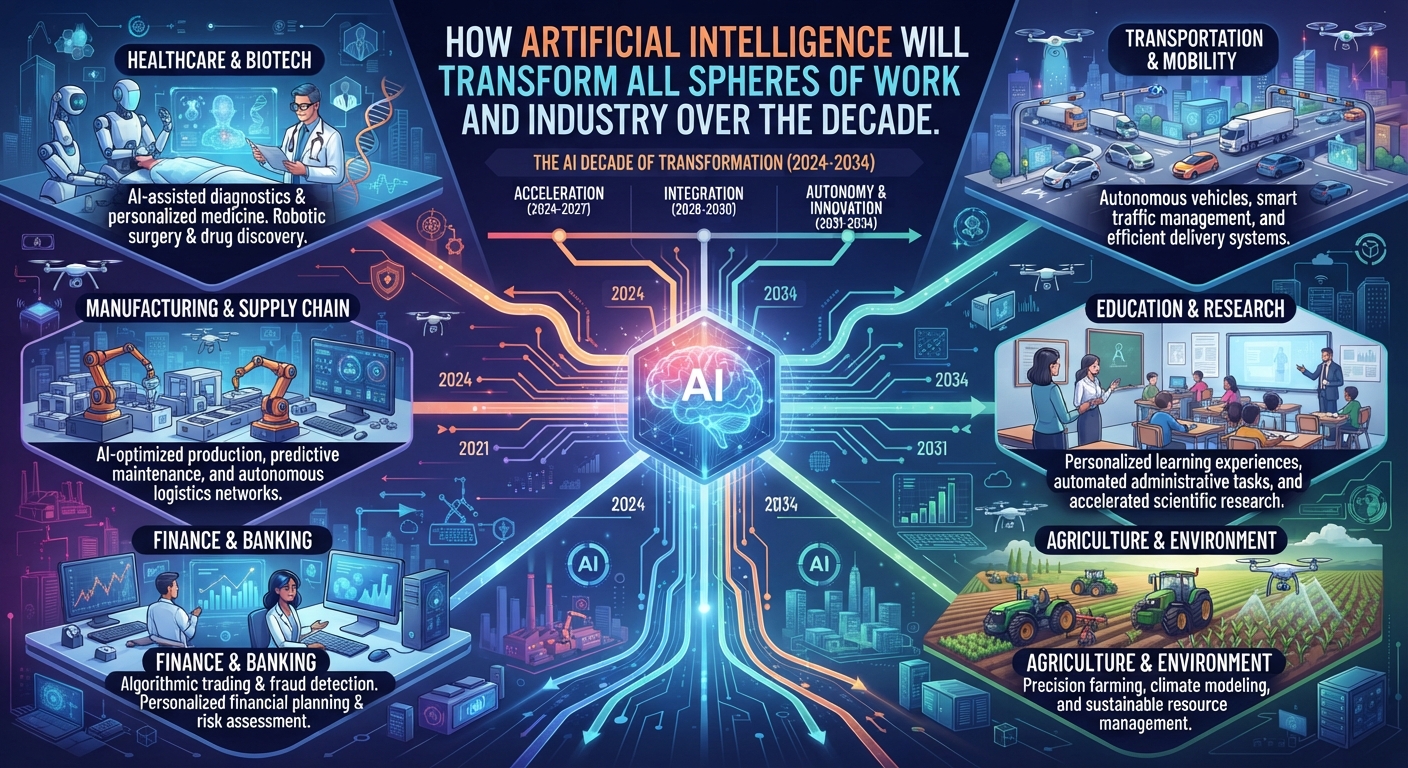
Artificial Intelligence (AI) is emerging as one of the most consequential technological developments in human economic history. Its influence will extend far beyond computers, software and automated machinery. During the decade from 2026 to 2036, AI is likely to reshape how humanity produces goods, delivers services, manages infrastructure, conducts scientific research, educates populations, transports people and commodities, manages financial systems, and organises businesses and governments.
Previous industrial revolutions transformed human physical capabilities through mechanical power, electricity, mass production and computerisation. The emerging AI revolution introduces another dimension: the ability of machines to process information, recognise patterns, generate knowledge-based outputs, support decisions and coordinate complex activities.
The central argument of this thesis is that AI will become a foundational economic and industrial infrastructure, comparable in importance to electricity, telecommunications, computing and the internet.
However, this transformation will not happen uniformly. Some industries will experience rapid automation, others will adopt AI as an assistant to human workers, and entirely new industries will emerge.
The most important development will not simply be the replacement of human labour. It will be the reorganisation of work around human intelligence, artificial intelligence, robotics, digital information and interconnected economic systems.
CHAPTER 1: Understanding the AI Industrial Revolution
1.1 What is Artificial Intelligence?
Artificial Intelligence is a branch of computer science concerned with developing systems capable of performing tasks that normally require aspects of human intelligence.
These include:
- Learning from information.
- Recognising patterns.
- Understanding and generating language.
- Analysing complex datasets.
- Predicting possible outcomes.
- Recognising images, sounds and objects.
- Supporting decisions.
- Planning and solving problems.
- Controlling machines and robotic systems.
AI is not one technology. It is an ecosystem of interconnected technologies.
1.2 The seven foundational layers of AI
Choosing the Right AI Software Development Company
| Layer | Technology | Economic significance |
|---|---|---|
| 1 | Semiconductor chips | Computational processing |
| 2 | Data infrastructure | Information collection and storage |
| 3 | Cloud and computing | Large-scale processing |
| 4 | Machine learning | Pattern recognition and prediction |
| 5 | Deep learning and foundation models | Complex information processing |
| 6 | AI agents and software | Task execution and coordination |
| 7 | Robotics and physical AI | Interaction with the physical economy |
These layers depend on one another.
For example, an intelligent agricultural robot requires semiconductor processors, sensors, software, trained AI models, connectivity, energy and mechanical engineering.
AI therefore cannot be understood as merely a software application. It must be understood as a complete technological infrastructure.
1.3 The historical progression of industrial revolutions
Technology is Driving the Fourth Industrial Revolution
| Industrial revolution | Main technological foundation | Primary transformation |
|---|---|---|
| First | Steam power and mechanical engineering | Human and animal labour supplemented by machines |
| Second | Electricity and mass production | Industrial-scale manufacturing |
| Third | Computers and telecommunications | Digital information and automation |
| Fourth | AI, IoT, robotics and connected systems | Intelligent and interconnected production |
| Emerging fifth phase | Human-AI collaboration and advanced biotechnology | Greater integration of human capabilities and intelligent technologies |
The fourth industrial revolution is already underway. The next decade will deepen the integration of AI into everyday economic activity.
CHAPTER 2: The Transformation of the Global Labour Market
2.1 How AI will change the meaning of work
For centuries, employment has largely been organised around human physical labour, administrative responsibilities, technical knowledge and professional expertise.
AI introduces a new organisational model:
Human intelligence + Artificial intelligence + Automation + Robotics = Intelligent production systems.
Consider a traditional business.
A company might employ:
- Accountants to process financial information.
- Administrators to organise documents.
- Analysts to study business performance.
- Managers to coordinate employees.
- Customer service representatives to answer enquiries.
- Engineers to monitor equipment.
In an AI-enabled organisation, many repetitive information-processing tasks could be supported by intelligent software. Employees would increasingly supervise systems, interpret information, solve unusual problems, maintain relationships and make accountable decisions.
2.2 Three major categories of employment transformation
Automazione Industriale 5.0: come cambiano le fabbriche con AI e robot collaborativi
1. Automation of tasks
Repetitive activities become automated, including routine documentation, data entry, sorting and certain production processes.
Startup CEOs Push Back on AI Job Doom at Web Summit | The Tech Buzz
2. Augmentation of human capabilities
AI assists professionals in research, calculations, diagnosis support, engineering, planning and decision-making.
AI-Controlled World: Synergistic Coexistence | Futuristic Vision | AI Art Generator | Easy-Peasy.AI
3. Creation of new occupations
New work emerges in AI engineering, robotics, data governance, model evaluation, intelligent infrastructure and AI security.
The distinction is important: an occupation consists of many tasks. Automating some tasks does not necessarily eliminate the entire occupation.
The OECD’s 2026 research highlights these three simultaneous effects: task automation, new task creation and productivity improvement. OECD+1
2.3 Which jobs could experience the greatest transformation?
| Employment category | Potential AI influence |
|---|---|
| Data entry | High automation |
| Basic administration | High automation |
| Customer support | AI-assisted service |
| Accounting | Automated processing and analysis |
| Software development | AI-assisted programming |
| Engineering | Simulation and design assistance |
| Medicine | Diagnostic and research support |
| Education | Personalised learning assistance |
| Agriculture | Intelligent monitoring and machinery |
| Construction | Planning, design and site monitoring |
| Scientific research | Data analysis and discovery assistance |
| Management | Forecasting and operational intelligence |
This does not mean all these occupations will disappear. Human responsibility, physical environments, professional judgement, relationships and regulatory requirements will continue to matter.
2.4 The emerging AI workforce
By 2036, demand is likely to increase for several categories of expertise:
- AI systems engineers.
- Data architects.
- Robotics engineers.
- Cybersecurity specialists.
- Semiconductor engineers.
- AI governance professionals.
- Industrial automation specialists.
- Machine-learning researchers.
- Human-machine interaction designers.
- AI-assisted scientific researchers.
- Digital infrastructure engineers.
- AI operations managers.
Equally important will be people who combine traditional professional knowledge with AI literacy.
An agricultural scientist who understands AI, for example, may be able to analyse much larger quantities of soil, weather and crop information than traditional methods permit.
CHAPTER 3: Transformation Across 25 Major Industries
This chapter examines how AI could transform the major productive systems of the global economy.
3.1 Agriculture and food production
Otonom traktörler Türkiye tarlalarında boy gösteriyor
Surveying :: Oz Drone Operations
2026 Hydroponics Trends: AI & Smart Farming Automation | Lyine Group
10
Agriculture is one of the industries where AI could make a substantial contribution to food security, productivity and environmental management.
Major applications:
- Soil analysis and fertility prediction.
- Crop disease identification.
- Irrigation management.
- Weather forecasting.
- Livestock monitoring.
- Automated harvesting.
- Agricultural market forecasting.
- Fertiliser and water optimisation.
- Food supply-chain management.
Future agricultural architecture
Agricultural environment
Soil • Water • Crops • Livestock • Climate
Sensors and data collection
IoT • Satellites • Cameras • Weather stations
Artificial intelligence
Predictive models • Image recognition • Analytics
Agricultural decisions
Irrigation • Disease management • Harvest planning
Food production and distribution
Yield • Quality • Storage • Market access
Economic significance: Farmers could make more informed decisions, reduce avoidable losses and improve the efficiency of available land and water resources.
For South Africa, opportunities include livestock management, maize production, horticulture, poultry, aquaculture and agricultural logistics.
3.2 Manufacturing and industrial production
Automated Manufacturing Companies: 2026 Technology Guide | Automate X
The Future of Smart Manufacturing Digital Twins: Driving Industry 4.0
13
Manufacturing could become one of the most extensively interconnected AI environments.
AI will support:
- Predictive maintenance.
- Automated quality inspection.
- Production scheduling.
- Intelligent inventory control.
- Digital factory simulations.
- Robotic assembly.
- Energy optimisation.
- Industrial safety monitoring.
- Product design and testing.
The future smart factory
Traditional factories generally depend on separate machines and human-controlled production stages.
An intelligent factory will increasingly connect machines, sensors, software, employees, suppliers and production-management systems.
A digital twin can represent a physical production facility virtually, allowing engineers to examine performance and test changes before applying them to actual operations.
Example: A manufacturing company could use AI to identify a developing equipment problem before the equipment stops operating, enabling maintenance to be planned earlier.
3.3 Healthcare and medical sciences
ロシュのAI創薬、ボストン拠点が示すこと 「自律型ラボ」は確認できるのか | 答え | Studio Global AI
KIMS Advances Patient Monitoring With AI – AI CERTs News
11
Healthcare will experience important changes through the combination of AI, molecular biology, medical imaging, robotics and biomedical information.
Applications include:
- Medical image analysis.
- Early disease-risk identification.
- Drug discovery research.
- Hospital resource management.
- Medical record organisation.
- Laboratory data interpretation.
- Personalised treatment research.
- Remote patient monitoring.
- Biomedical research.
- Medical education and simulation.
AI and the human biological system
AI can analyse complex biological datasets involving:
- DNA and genomic sequences.
- Proteins and molecular structures.
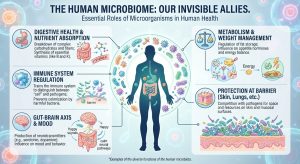
- Human microbiomes.
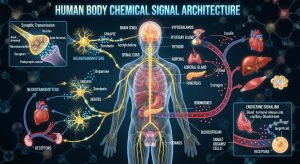
- Cellular communication.
- Immune-system responses.
- Metabolic pathways.
- Medical imaging.
This creates an opportunity to connect molecular biology with computational science.
For example, AI-assisted protein structure analysis can help researchers investigate how proteins interact and how biological processes might be influenced by disease.
However, AI-generated medical predictions must be scientifically validated. Clinical decisions and patient care require appropriately qualified healthcare professionals.
3.4 Banking, finance and accounting
Sanjiv Bajaj: ‘Fortunately, We’ve More Companies Than Family Members’ – Rediff.com Business
Financial institutions manage enormous quantities of information. AI can help analyse financial transactions, customer activity, economic indicators and operational risks.
Transformation areas:
| Financial function | AI application |
|---|---|
| Banking | Intelligent customer services |
| Accounting | Transaction classification |
| Auditing | Anomaly detection |
| Credit analysis | Risk assessment support |
| Treasury | Financial forecasting |
| Insurance | Claims processing |
| Payments | Fraud pattern detection |
| Investment research | Financial data analysis |
| Compliance | Regulatory monitoring |
| Financial planning | Scenario modelling |
An important development will be the integration of AI with digital payments, financial databases, cybersecurity and international financial networks.
Human oversight remains essential because financial systems require accountability, fairness, privacy and regulatory compliance.
3.5 Transportation, logistics and supply chains
BotShare’s Three-Week Sprint to Funding Exposes Robotics Industry’s Distribution Bottleneck
Technology, AI & Digital Policy | Breeze in Busan
9
Transportation is a complex economic network involving roads, railways, airports, shipping ports, warehouses and distribution centres.
AI could coordinate information across these systems.
Its applications include:
- Traffic forecasting.
- Vehicle maintenance prediction.
- Fleet management.
- Warehouse optimisation.
- Freight scheduling.
- Port operations.
- Supply-chain forecasting.
- Route planning.
- Public transport coordination.
- Intelligent inventory management.
Future intelligent logistics architecture
Connected logistics ecosystem
Suppliers
Raw materials and inventory
Manufacturers
Production and distribution
Ports and borders
Cargo and documentation
Transport operators
Road, rail, air and sea
Central AI intelligence platform
Forecasting • Coordination • Analytics • Monitoring
Customers and final markets
Delivery • Availability • Cost • Service quality
This could significantly improve supply-chain visibility and help organisations respond more quickly to disruptions.
3.6 Education and scientific research
AI in Education: Top Trends for October 2025 | AIapps
La inteligencia artificial será clave en el desarrollo farmacéutico a partir de 2026 – Infobae
Honda-supported project builds ‘trust’ between humans and robots | CSUF News
15
Education could move from a largely standardised model towards more personalised learning.
AI educational systems could:
- Explain difficult concepts at different levels.
- Support mathematics and scientific learning.
- Generate simulations.
- Help students practise problem-solving.
- Assist teachers with lesson preparation.
- Analyse learning progress.
- Support scientific experimentation.
- Translate educational material into different languages.
The teacher’s role will remain important in developing critical thinking, discipline, creativity, communication and social understanding.
Scientific research transformation
AI could accelerate research in:
- Physics.
- Chemistry.
- Mathematics.
- Astronomy.
- Biotechnology.
- Materials science.
- Climate science.
- Neuroscience.
- Engineering.
- Computational biology.
The combination of AI and scientific experimentation may shorten the time needed to identify promising research directions.
However, generating a scientific hypothesis is not the same as proving it. Experimental evidence and independent verification remain necessary.
3.7 Mining and mineral processing
Autonomous Mining: Connectivity for Remote Operations.
Mining is particularly important to South Africa’s industrial economy.
AI could assist with:
- Geological data interpretation.
- Mineral exploration.
- Equipment maintenance.
- Ore-grade estimation.
- Processing optimisation.
- Energy consumption analysis.
- Environmental monitoring.
- Production forecasting.
- Worker safety monitoring.
A future intelligent mining operation could connect underground sensors, geological models, machinery, processing facilities and management systems.
The objective would be to improve productivity, operational reliability and environmental performance while maintaining strong human safety oversight.
3.8 Energy and electricity
California is set to become the first US state to manage power outages with AI – Switchgear Magazine
AI could contribute to the development of intelligent electricity systems.
Major applications:
- Electricity demand forecasting.
- Renewable-energy forecasting.
- Grid fault detection.
- Energy storage optimisation.
- Predictive equipment maintenance.
- Smart-meter analytics.
- Industrial energy management.
- Electricity distribution planning.
For South Africa, AI-supported electricity management could help utilities and industrial operators analyse demand, renewable generation, equipment performance and network constraints.
AI cannot create electricity. Its value lies in helping people manage generation, storage and distribution more effectively.
3.9 Construction and civil engineering
AI could transform construction through:
- Computer-assisted architectural design.
- Structural simulations.
- Building Information Modelling (BIM).
- Construction cost forecasting.
- Project scheduling.
- Materials optimisation.
- Infrastructure inspections.
- Equipment monitoring.
- Quality-control systems.
The future construction industry will increasingly combine engineers, architects, data specialists, automated equipment and digital project-management systems.
3.10 Telecommunications and information technology
Brilliantel | Enterprise Telecommunications South Africa | Fibre, SD-WAN & MPLS Solutions
Telecommunications provides the connectivity required by many AI systems.
AI will support:
- Network traffic management.
- Predictive network maintenance.
- Cybersecurity monitoring.
- Spectrum optimisation.
- Customer-service automation.
- Data-centre management.
- Intelligent cloud infrastructure.
- Edge computing.
- Network capacity planning.
The development of advanced mobile networks, fibre infrastructure, satellite communication and edge computing will expand the ability to deploy AI across geographically distributed industries.
3.11 Other industries and their AI transformation
The following industries will also experience important changes.
| Industry | Potential transformation |
|---|---|
| Retail and wholesale | Demand forecasting and inventory management |
| Tourism and hospitality | Personalised customer services and booking management |
| Aviation | Aircraft maintenance and flight operations support |
| Maritime | Port planning and vessel maintenance |
| Real estate | Property analysis and building management |
| Legal services | Document analysis and legal research assistance |
| Insurance | Risk analysis and claims assessment |
| Media and entertainment | Content production and audience analytics |
| Telecommunications | Network optimisation |
| Pharmaceuticals | Drug research and manufacturing quality |
| Water management | Leak detection and demand forecasting |
| Environmental services | Pollution monitoring and climate modelling |
| Public administration | Document processing and service coordination |
| Automotive | Vehicle design and manufacturing automation |
| Aerospace | Engineering simulation and research |
The OECD’s 2026 sectoral research specifically examines AI adoption in agriculture, healthcare, manufacturing and mobility, identifying predictive maintenance, precision farming, medical applications and intelligent transport as important areas of development. OECD+1
CHAPTER 4: The New Architecture of Business and Enterprise
4.1 From traditional organisations to AI-native organisations
A traditional enterprise usually operates through departments with separate information systems.
For example:
- Human resources.
- Finance.
- Procurement.
- Operations.
- Marketing.
- Sales.
- Customer services.
- Research and development.
The future enterprise will increasingly integrate these departments through shared data platforms and AI-supported processes.
Introduktion till affärsprocesslösningar (offentlig förhandsversion) | Microsoft Learn
The intelligent enterprise architecture
| Layer | Function |
|---|---|
| Physical infrastructure | Buildings, machinery and equipment |
| Data infrastructure | Databases and information networks |
| Computing infrastructure | Chips, servers and cloud systems |
| AI intelligence | Machine learning and foundation models |
| Workflow automation | Software agents and process automation |
| Human management | Leadership and accountability |
| Economic output | Products, services and revenue |
4.2 The emergence of AI agents
An AI agent is a software system designed to pursue a defined task or objective using available information and permitted tools.
For example, an enterprise could use separate AI agents to assist with:
- Monitoring inventory.
- Preparing financial reports.
- Analysing customer enquiries.
- Reviewing procurement documents.
- Forecasting demand.
- Tracking project milestones.
These agents may communicate with other software systems and pass information between stages of a business workflow.
However, important decisions involving money, safety, legal obligations and personal information should remain subject to appropriate authorisation and human oversight.
4.3 The future of small and medium-sized businesses
AI could make advanced analytical capabilities more accessible to smaller businesses.
A small enterprise may be able to use AI to assist with:
- Market research.
- Product development.
- Customer service.
- Business administration.
- Financial record organisation.
- Inventory management.
- Digital marketing.
- Competitor analysis.
- Business forecasting.
This could reduce some barriers to entering markets traditionally dominated by larger organisations.
But technology alone does not guarantee success. Businesses still need customers, reliable products, good management, working capital and sound economic decisions.
CHAPTER 5: The Economic Architecture of the AI Revolution
5.1 AI as a new factor of production
Traditional economic theory identifies land, labour, capital and entrepreneurship as important factors of production.
AI introduces a new productive capability: computational intelligence.
It does not replace the traditional factors. Instead, it changes how effectively they can be combined.
Consider:
| Economic factor | Traditional contribution | AI-enhanced contribution |
|---|---|---|
| Land | Natural resources and production space | Geospatial and environmental intelligence |
| Labour | Human physical and intellectual work | Human-AI collaboration |
| Capital | Machinery, buildings and finance | Intelligent capital allocation |
| Entrepreneurship | Innovation and risk-taking | AI-assisted innovation and forecasting |
| Information | Business records and knowledge | Large-scale data analysis |
| Technology | Tools and production machinery | Intelligent automation and robotics |
5.2 A mathematical model of AI-driven productivity
We can represent a simplified production function as:
\[ Y=A K^\alpha L^\beta R^\gamma \]
Where:
- \(Y\) = total economic output.
- \(A\) = overall productivity and technology.
- \(K\) = physical and financial capital.
- \(L\) = human labour.
- \(R\) = AI and intelligent computational resources.
- \(\alpha,\beta,\gamma\) = production contribution parameters.
This is a conceptual extension of a conventional production function, not a universally established measurement model.
The equation demonstrates that AI can become an additional productive input alongside human labour and traditional capital.
For example, a factory with the same number of employees and machines might increase its output if AI improves production scheduling, equipment reliability and quality control.
5.3 The relationship between AI and productivity
Productivity measures how efficiently resources are converted into goods and services.
A basic productivity equation is:
\[ P=\frac{\text{Total Output}}{\text{Total Inputs}} \]
Suppose a manufacturing operation produces 1,000 units using 100 units of labour input.
\[ P=\frac{1000}{100}=10 \]
If AI-supported improvements increase production to 1,300 units without increasing the labour input:
\[ P=\frac{1300}{100}=13 \]
Illustrative 30% productivity increase
This is a mathematical example, not a forecast of what AI will achieve in every factory.
5.4 AI and national economic growth
AI could influence national economic development through five interconnected mechanisms:
- Increasing productivity.
- Reducing certain operating costs.
- Improving scientific research.
- Creating new industries.
- Improving the allocation of economic resources.
The OECD’s 2026 research estimates that AI could add approximately 0.5–1 percentage point to annual labour productivity growth across G7 economies over a ten-year period in its central adoption scenario. These are modelled estimates, not guaranteed outcomes or predictions for every country. OECD
5.5 The emergence of new economic markets
AI will support the development of markets that are still relatively young.
Examples include:
- AI infrastructure services.
- Industrial robotics.
- Data engineering.
- AI consulting.
- Intelligent agricultural systems.
- AI-assisted scientific services.
- Digital twins.
- AI cybersecurity.
- Intelligent logistics.
- Advanced semiconductor manufacturing.
- AI education and training.
A particularly important opportunity will be the development of AI applications for industries that have not yet undergone substantial digital transformation.
CHAPTER 6: The Semiconductor, Data Centre and Computing Revolution
AI’s industrial expansion depends on the physical infrastructure that makes computational intelligence possible.
Silicon wafer for manufacturing semiconductor of integrated circuit.
Microsoft, Amazon, and Google operate half the world’s 600 hyperscale data centers – DCD
7
6.1 The semiconductor foundation
Semiconductor processors perform the mathematical operations required by AI systems.
Important components include:
- CPUs: Central Processing Units.
- GPUs: Graphics Processing Units.
- AI accelerators.
- High-bandwidth memory.
- Storage controllers.
- Networking processors.
- Edge-computing processors.
AI development will increase the strategic importance of semiconductor manufacturing, chip design, electronic materials and advanced packaging.
6.2 The AI data centre
A data centre is a physical facility containing computing, storage, networking, power and cooling infrastructure.
Its architecture includes:
| Infrastructure | Purpose |
|---|---|
| AI processors | Execute computational workloads |
| Memory | Store active computational information |
| Storage | Retain datasets and software |
| Networking | Connect servers and external systems |
| Cooling | Manage heat generated by equipment |
| Electricity | Supply continuous energy |
| Cybersecurity | Protect infrastructure and information |
| Cloud software | Provide computing services |
6.3 The future computing ecosystem
The next decade will involve closer integration between:
- Cloud computing.
- Edge computing.
- Internet of Things.
- Advanced mobile networks.
- AI accelerators.
- Distributed data centres.
- Robotics.
- Digital twins.
For example, a smart factory could process some information locally through edge computers while using cloud infrastructure for larger-scale analysis.
This arrangement can reduce communication delays and improve operational resilience.
6.4 The energy challenge
AI requires electricity.
Large-scale computing creates demand for:
- Electricity generation.
- Grid capacity.
- Cooling systems.
- Energy storage.
- Efficient processors.
- Renewable-energy infrastructure.
Consequently, the AI revolution is also an energy infrastructure revolution.
Countries that develop reliable electricity, telecommunications and computing infrastructure will be better positioned to participate in AI-driven industries.
CHAPTER 7: AI, Robotics and the Transformation of Physical Labour
Figure 02 – Robot Details, Use Case and Specifications | Aparobot
What is a Collaborative Robot?
Large-scale vegetable weeding in Canada with Dino – Naïo Technologies
11
AI software primarily transforms information-processing activities. Robotics extends intelligent computing into the physical environment.
This distinction is fundamental.
A software system can analyse a building design, but a physical robot or machine is required to perform construction work.
7.1 The five components of intelligent robotics
| Component | Function |
|---|---|
| Sensors | Observe the environment |
| Computing | Process information |
| AI models | Interpret patterns and support decisions |
| Actuators | Produce physical movement |
| Feedback systems | Monitor and adjust performance |
7.2 Industries likely to integrate robotics
- Manufacturing.
- Warehousing.
- Agriculture.
- Mining.
- Healthcare.
- Construction.
- Food processing.
- Transportation.
- Infrastructure inspection.
7.3 Human-machine collaboration
The future will not necessarily consist of humans competing against robots.
Many production environments will combine human workers and intelligent machines.
For example:
- A human engineer supervises automated machinery.
- A farmer monitors AI-supported agricultural equipment.
- A technician maintains robotic production systems.
- A doctor evaluates AI-generated diagnostic information.
- A logistics manager oversees automated warehouse processes.
Human judgement, accountability, practical experience and interpersonal communication remain essential.
CHAPTER 8: AI and the Transformation of Government and Public Infrastructure
Building predictive cities instead of reactive systems, ETInfra
infra.economictimes.indiatimes.com
Governments manage complicated national systems involving infrastructure, taxation, education, healthcare, transport, public safety, agriculture and economic development.
AI could improve the coordination of these systems.
8.1 Intelligent government administration
Potential applications include:
- Digital document processing.
- Public-service information systems.
- Infrastructure maintenance forecasting.
- Budget analysis.
- Revenue administration.
- Government procurement monitoring.
- Public transport planning.
- Environmental monitoring.
- Statistical analysis.
- Service-delivery performance measurement.
AI must not become an unchecked authority over citizens. Public decisions require transparency, legal accountability, privacy protection and accessible human review.
8.2 The intelligent city
A modern city generates enormous quantities of information.
This information comes from:
- Electricity networks.
- Water infrastructure.
- Traffic systems.
- Public transportation.
- Waste management.
- Buildings.
- Telecommunications.
- Environmental sensors.
An integrated AI system could help city authorities understand how these networks interact.
For example, an intelligent water-management system could combine pressure sensors, maintenance records and consumption information to identify possible leakage and prioritise inspections.
8.3 The national development opportunity for South Africa
South Africa has an opportunity to apply AI to its industrial and infrastructure challenges.
South Africa’s South Deep gold mine sells 20% more gold in latest quarter
Transnet Due to Commence DCT Berth Deepening Project
JUWI gewinnt Betriebsführung für 85-Megawatt Solarpark in Südafrika – JUWI
10
Fourteen priority development areas deserve attention:
- Electricity generation and distribution.
- Railway infrastructure.
- Port management.
- Mining productivity.
- Agricultural modernisation.
- Water infrastructure.
- Public transport.
- Manufacturing.
- Education and scientific research.
- Healthcare systems.
- Financial technology.
- Digital government.
- Cybersecurity.
- Rural economic development.
AI should be connected to these national priorities rather than treated as an isolated technology sector.
A country that merely imports AI applications may receive some benefits, but a country that also develops its own data capabilities, technical workforce, research institutions and industrial applications can create deeper economic value.
8.4 Rural development and AI
AI has particular potential to improve access to technical knowledge and economic services in rural areas.
Examples include:
- Agricultural advisory systems.
- Digital education.
- Remote professional services.
- Crop monitoring.
- Livestock management.
- Small-business administration.
- Rural transport coordination.
- Water-resource monitoring.
However, these benefits depend on electricity, affordable connectivity, digital literacy, appropriate local-language systems and reliable infrastructure.
CHAPTER 9: The Risks, Limitations and Economic Challenges
A comprehensive examination of AI must recognise that technological progress does not automatically produce equal economic benefits.
9.1 Employment displacement
Some jobs and tasks will be reduced or fundamentally redesigned.
The risks are particularly significant where work involves predictable, repetitive activities that can be handled digitally or mechanically.
The World Economic Forum’s Future of Jobs Report 2025 projected 170 million new jobs and 92 million displaced jobs globally by 2030 across the broad trends it examined. This is a projection, not a record of actual outcomes, and it is not an AI-only estimate. World Economic Forum+1
The main economic challenge is ensuring that displaced workers have realistic opportunities to acquire new skills.
9.2 The digital inequality problem
Organisations with greater financial resources can often afford advanced AI infrastructure.
Smaller companies may struggle with:
- Computing costs.
- Data availability.
- Cybersecurity.
- Specialist employees.
- Software integration.
- Training.
- Regulatory compliance.
The OECD’s 2026 Digital Economy and Society Outlook reported that AI adoption in 2025 was approximately 20% among firms overall and 52% among large firms across OECD countries. OECD+1
This demonstrates why access to technology and the ability to use it productively are separate economic challenges.
9.3 Data privacy and cybersecurity
AI systems can process sensitive personal, commercial and government information.
Potential problems include:
- Unauthorised access.
- Data theft.
- Identity fraud.
- Manipulation of information.
- Unreliable AI outputs.
- Exposure of confidential business records.
- Cyberattacks against connected infrastructure.
Strong information governance and cybersecurity must accompany AI adoption.
9.4 Algorithmic bias
AI systems learn from datasets.
If their training information contains historical errors or unfair patterns, their outputs may reproduce or amplify those problems.
This is particularly serious in:
- Employment decisions.
- Financial services.
- Education.
- Healthcare.
- Public administration.
Independent testing, transparency and human review are necessary safeguards.
9.5 Dependence on technology
Excessive dependence on automated systems can weaken organisational resilience if employees lose the ability to understand underlying processes.
Organisations should maintain human expertise, alternative operating procedures and appropriate manual controls.
9.6 Environmental sustainability
AI infrastructure consumes electricity, requires cooling and depends on physical resources used to manufacture chips and equipment.
The industry must improve:
- Computational efficiency.
- Energy efficiency.
- Data-centre cooling.
- Electronic-waste management.
- Equipment recycling.
- Sustainable electricity generation.
The objective should be productive intelligence with a manageable environmental footprint.
CHAPTER 10: The AI Transformation Timeline, 2026–2036
The following is a strategic scenario, not a guaranteed timetable. Different countries and industries will progress at different speeds.
AI in 2026: From Generative Tools to Agentic Digital Labor | ARC Advisory Group
Phase 1: 2026–2028 — AI adoption and integration
Foundation phase
Likely developments:
- Increased adoption of generative AI.
- AI integration into office software.
- Intelligent customer services.
- AI-assisted programming.
- Automated document processing.
- Greater use of predictive analytics.
- Early enterprise AI agents.
- Expansion of AI education.
The priority will be learning how to integrate AI into existing business processes.
Phase 2: 2029–2031 — Intelligent enterprise expansion
Integration phase
Potential developments:
- More interconnected AI agents.
- Advanced industrial automation.
- Expanded AI-supported medical research.
- Digital twins across infrastructure.
- Intelligent logistics networks.
- More AI-enabled agricultural machinery.
- Greater integration of cloud and edge computing.
The focus will increasingly move from individual AI applications to interconnected operational systems.
Phase 3: 2032–2034 — Advanced industrial intelligence
Industrial transformation phase
Potential developments:
- More sophisticated human-machine collaboration.
- Expanded robotics.
- More intelligent electricity networks.
- AI-supported materials discovery.
- Greater automation of complex workflows.
- Advanced predictive infrastructure management.
Adoption will depend on technical reliability, investment, energy, regulation and workforce capabilities.
Phase 4: 2035–2036 — Mature AI-integrated economic systems
Ecosystem phase
In a high-adoption scenario, AI could become deeply integrated into many production and service systems.
Businesses may operate interconnected digital ecosystems involving suppliers, employees, customers, intelligent software and physical machinery.
The competitive advantage will increasingly depend on how effectively an organisation combines human expertise, AI, data and physical infrastructure.
10.1 Decade transformation matrix
| Economic dimension | 2026 position | Possible 2036 direction |
|---|---|---|
| Offices | AI-assisted tasks | AI-integrated workflows |
| Factories | Partial automation | More connected intelligent production |
| Agriculture | Precision technology | Integrated agricultural intelligence |
| Banking | AI-assisted analysis | Greater automation and oversight |
| Education | Digital AI tutors | Personalised learning ecosystems |
| Healthcare | Clinical AI support | Deeper integration into research and operations |
| Transport | Predictive systems | More connected transport management |
| Government | Digital services | Greater data-driven administration |
| Research | AI-assisted discovery | Deeper computational experimentation |
| Infrastructure | Separate monitoring systems | Integrated predictive management |
CHAPTER 11: The New Human Capital and Skills Economy
One of the most important consequences of AI will be the changing value of human knowledge.
The future economy will need people who understand both their professional industries and the technologies transforming those industries.
11.1 The ten most important human capabilities
| Capability | Why it matters |
|---|---|
| 1. Mathematics | Quantitative reasoning and modelling |
| 2. Scientific literacy | Understanding evidence and experimentation |
| 3. Critical thinking | Evaluating information and AI outputs |
| 4. Computational thinking | Understanding algorithms and systems |
| 5. Data literacy | Interpreting information correctly |
| 6. Innovation | Developing new solutions |
| 7. Communication | Coordinating people and systems |
| 8. Financial literacy | Understanding economic consequences |
| 9. Systems thinking | Understanding interconnected processes |
| 10. Ethical reasoning | Making responsible decisions |
11.2 The new educational architecture
An AI-oriented education system should integrate:
Foundation subjects
- Mathematics.
- Physics.
- Chemistry.
- Biology.
- Accounting.
- Economics.
- Logic and reasoning.
Technology subjects
- Computer science.
- Artificial intelligence.
- Data engineering.
- Cybersecurity.
- Robotics.
- Electronics.
- Telecommunications.
Advanced professional applications
- AI-assisted medicine.
- Computational biology.
- Intelligent agriculture.
- Financial technology.
- Industrial engineering.
- Digital infrastructure.
- Scientific research.
The purpose should not be to educate everyone as a software engineer. It should be to give people the knowledge to use intelligent technology effectively in their chosen professions.
11.3 The changing relationship between human intelligence and AI
A useful conceptual model is:
\[ \text{Human Intelligence} + \text{Artificial Intelligence} + \text{Scientific Knowledge} = \text{Enhanced Problem-Solving Capacity} \]
AI can process information at enormous scale, but human beings remain responsible for deciding which problems matter, evaluating consequences and establishing social priorities.
The strongest future professionals will combine technical literacy with sound judgement.
CHAPTER 12: A Strategic Framework for Businesses to Adopt AI
Businesses should not purchase AI simply because it is fashionable. They should identify economic problems and determine whether AI provides a measurable solution.
12.1 The ten-stage implementation framework
AI enterprise transformation model
- Identify business problemsDetermine which activities experience high costs, delays, errors or poor performance.
- Establish a data foundationOrganise reliable business records and information systems.
- Evaluate suitable AI technologiesIdentify whether machine learning, generative AI, computer vision or predictive analytics is appropriate.
- Select a manageable pilot projectBegin with one measurable business process.
- Protect informationEstablish cybersecurity, privacy and access controls.
- Train employeesDevelop technical knowledge and practical AI literacy.
- Integrate business systemsConnect AI to existing software and authorised workflows.
- Measure performanceCompare costs, quality, productivity and customer outcomes.
- Expand successful applicationsExtend proven solutions to additional departments.
- Establish continuous governanceMonitor accuracy, fairness, security, costs and human accountability.
12.2 How to measure AI’s economic contribution
A business should monitor measurable indicators.
| Performance indicator | Measurement |
|---|---|
| Productivity | Output per employee or labour hour |
| Operating costs | Cost per unit produced |
| Quality | Defect and error rates |
| Efficiency | Time required per process |
| Customer satisfaction | Service quality measures |
| Innovation | New products and services |
| Energy efficiency | Energy per unit of output |
| Financial performance | Revenue and operating margins |
| Workforce development | Training and competency improvements |
A successful AI implementation should improve economic performance without compromising safety, quality, privacy or employee welfare.
CHAPTER 13: Research Methodology for Understanding AI’s Industrial Impact
To understand the transformation scientifically, AI should be examined through multiple research disciplines.
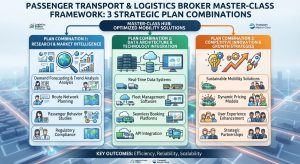
13.1 The three-master-class research model
This framework combines three complementary approaches.
MASTER CLASS 1
Scientific and technological research
Investigate semiconductor architecture, algorithms, robotics, physics, computing, data and machine learning.
MASTER CLASS 2
Economic and industrial research
Investigate productivity, employment, capital investment, industrial development, supply chains and market structures.
MASTER CLASS 3
Competitive innovation and strategic research
Investigate business opportunities, new products, research commercialisation, national competitiveness and human capital.
13.2 Research questions
A comprehensive research programme should investigate:
- Which industries will experience the highest AI adoption?
- Which human tasks can be automated reliably?
- Which occupations will experience the greatest transformation?
- What new employment opportunities will emerge?
- How will AI affect national productivity?
- What computing infrastructure will be required?
- How will AI affect global trade and supply chains?
- How will AI influence education and human capital?
- What cybersecurity and governance frameworks are necessary?
- How can developing economies benefit from AI?
13.3 Mathematical and statistical research
Researchers can use several methods.
Regression analysis
To examine the relationship between AI adoption and productivity:
\[ P_i=\beta_0+\beta_1 AI_i+\beta_2 K_i+\beta_3 L_i+\epsilon_i \]
Where:
- \(P_i\) = productivity of organisation \(i\).
- \(AI_i\) = AI adoption level.
- \(K_i\) = capital investment.
- \(L_i\) = labour input.
- \(\beta\) = estimated model coefficients.
- \(\epsilon_i\) = unexplained factors.
Cost-benefit analysis
\[ ROI=\frac{\text{Financial Benefits}-\text{Total Costs}} {\text{Total Costs}}\times100 \]
Scenario modelling
Develop low-adoption, medium-adoption and high-adoption scenarios to examine how different assumptions affect economic outcomes.
Researchers should distinguish correlation from causation. A business that adopts AI may also have better management, more capital or a more skilled workforce, all of which can influence productivity.
CHAPTER 14: The Competitive Advantage of Nations in the AI Economy
The next decade will not be determined solely by which countries develop the most advanced AI models.
It will also depend on which countries successfully integrate AI into their economic infrastructure.
14.1 The seven pillars of national AI competitiveness
Why Sanil Electric’s Stock Soared 100% Amid AI Investment Boom | Aju Press
| Pillar | National development priority |
|---|---|
| 1. Education | AI-capable human capital |
| 2. Research | Universities and scientific laboratories |
| 3. Computing | Data centres and processors |
| 4. Connectivity | Fibre, mobile networks and satellites |
| 5. Industry | AI-enabled manufacturing and services |
| 6. Investment | Research funding and business capital |
| 7. Governance | Security, trust and responsible regulation |
14.2 Opportunities for South Africa
South Africa could develop a more competitive AI economy by concentrating on several strategic areas.
A. Industrial intelligence
Develop AI applications for mining, mineral processing, manufacturing and engineering.
B. Agricultural intelligence
Connect AI with agricultural research, precision farming, livestock, aquaculture and food distribution.
C. Financial intelligence
Strengthen financial technology, accounting systems, payment infrastructure and financial cybersecurity.
D. Infrastructure intelligence
Use AI to support electricity, water, transport, ports and municipal infrastructure management.
E. Scientific intelligence
Expand AI-related research in mathematics, physics, biotechnology, materials science and computational engineering.
F. Human capital
Develop technical education programmes that combine mathematics, science, computing, economics and entrepreneurship.
G. Local innovation
Encourage South African businesses to develop solutions for African economic challenges rather than relying exclusively on imported technology.
A significant opportunity exists in building AI applications that address the practical needs of African businesses, farmers, public institutions and industries.
CHAPTER 15: The Ten Greatest AI Innovation Opportunities, 2026–2036
The following are strategic opportunity areas, rather than guaranteed investment returns.
Data Center Builders and Suppliers Drive AI Infrastructure Expansion | Investing Point
1. AI computing infrastructure
Data centres, semiconductor systems, networking and computational services.
NeurOSmart: KI, Sensorik und Neuromorphic Computing für sicheres Mensch-Roboter-Teamwork
2. Intelligent industrial automation
Robotics, machine vision and smart manufacturing.
Smart Sensors and AI for Sustainable Farming | Informatix.Systems
3. AI agricultural technology
Precision farming, crop monitoring and food production.
OpenAI Researcher Miles Wang Eyes $2B AI Drug Discovery Startup | The Tech Buzz
4. Computational biotechnology
Genomics, molecular research and drug discovery.
AI in Energy: Powering the Future with Intelligent Solutions | by AI Tech Daily | Medium
5. Intelligent energy systems
Electricity forecasting, grid management and storage optimisation.
India’s UPI Chief Sees AI as Key to Next Payment Wave | The Tech Buzz
6. Intelligent financial technology
Accounting, fraud detection, financial analysis and payment systems.
7. AI cybersecurity
Intelligent threat detection, security monitoring and information protection.
How Robots and AI Are Transforming Warehouse Operations? | Debales AI
8. Intelligent supply chains
Freight coordination, inventory management and logistics analytics.
9. AI educational systems
Personalised learning, scientific education and workforce development.
RenX Arc | Architectural Solutions
10. Intelligent infrastructure
Water, electricity, transportation and urban development systems.
CHAPTER 16: The Ultimate Economic Transformation Model
We can now bring together the entire thesis.
The AI revolution is not a single technological event. It is the interaction of several industrial systems.
IA como Tecnologia de Propósito Geral e seus efeitos estratégicos
observatoriodaestrategia.substack.com
16.1 The interconnected AI economic ecosystem
The AI-powered global economy
Scientific knowledge and human capital
Mathematics • Science • Education • Research
Digital infrastructure
Semiconductors • Data • Cloud • Connectivity
Artificial intelligence
Machine learning • Foundation models • AI agents
Intelligent industrial production
Robotics • Automation • Digital twins • Analytics
Agriculture
Healthcare
Manufacturing
Finance
Education
Transportation
Energy
Government
Economic and social outcomes
Productivity • Innovation • Employment • Development • Quality of life
16.2 The five fundamental forces driving the next decade
The transformation can be summarised through five forces:
- Computational power: More powerful and efficient processors.
- Data expansion: Increasing quantities of digital information.
- Algorithmic intelligence: More capable machine-learning systems.
- Physical automation: Greater integration of AI with machinery and robotics.
- Human innovation: New ways of combining scientific knowledge, entrepreneurship and intelligent technology.
Their interaction will determine how quickly and extensively AI transforms the global economy.
FINAL CONCLUSION: The Future of Human Work and Industrial Civilisation
The decade between 2026 and 2036 could represent a major turning point in the relationship between humanity, technology and economic production.
Artificial Intelligence will increasingly influence how businesses operate, how scientists conduct research, how governments administer public services, how farmers produce food, how engineers design infrastructure and how financial institutions manage information.
However, the most important transformation will not be the existence of intelligent machines.
It will be the ability of human societies to organise their knowledge, institutions, capital, infrastructure and productive resources around intelligent technological systems.
Three major conclusions emerge from this thesis.
First: AI will become an essential industrial capability.
Organisations that successfully integrate AI into their operations may gain advantages in productivity, research, efficiency, product development and competitiveness.
Second: human capital will become increasingly important.
Mathematics, science, critical thinking, engineering, economics, creativity and ethical judgement will remain fundamental. AI literacy will increasingly complement these disciplines.
Third: national economic development will depend on technological infrastructure.
Countries that invest in education, electricity, telecommunications, research, computing, industrial development and responsible AI governance will be better positioned to benefit from the emerging economy.
The ultimate objective should not be to create an economy in which machines replace human purpose.
It should be to create an economy in which intelligent technology expands human capabilities, strengthens industries, improves productivity and supports sustainable development.
The defining competitive advantage of the next decade will be the ability to combine human intelligence, artificial intelligence, scientific knowledge and industrial infrastructure into one productive economic ecosystem.
RESEARCH REFERENCES AND FURTHER READING
The following institutional publications provide a foundation for further research.
- OECD (2026) — Skills in the AI Age. Research on skills, businesses, employment and AI adoption.
- OECD (2026) — AI Adoption in Agriculture, Health, Manufacturing and Mobility. Sector-specific industrial analysis.
- OECD (2026) — Digital Economy and Society Outlook 2026. Digital infrastructure and economic adoption.
- OECD (2026) — Foundations for Growth and Competitiveness 2026. AI and productivity estimates.
- World Economic Forum (2025) — Future of Jobs Report 2025. Employment and skills transformation.
- OECD (2026) — AI and Skills: What We Know So Far. Workforce development and adoption barriers.

Be First to Comment