
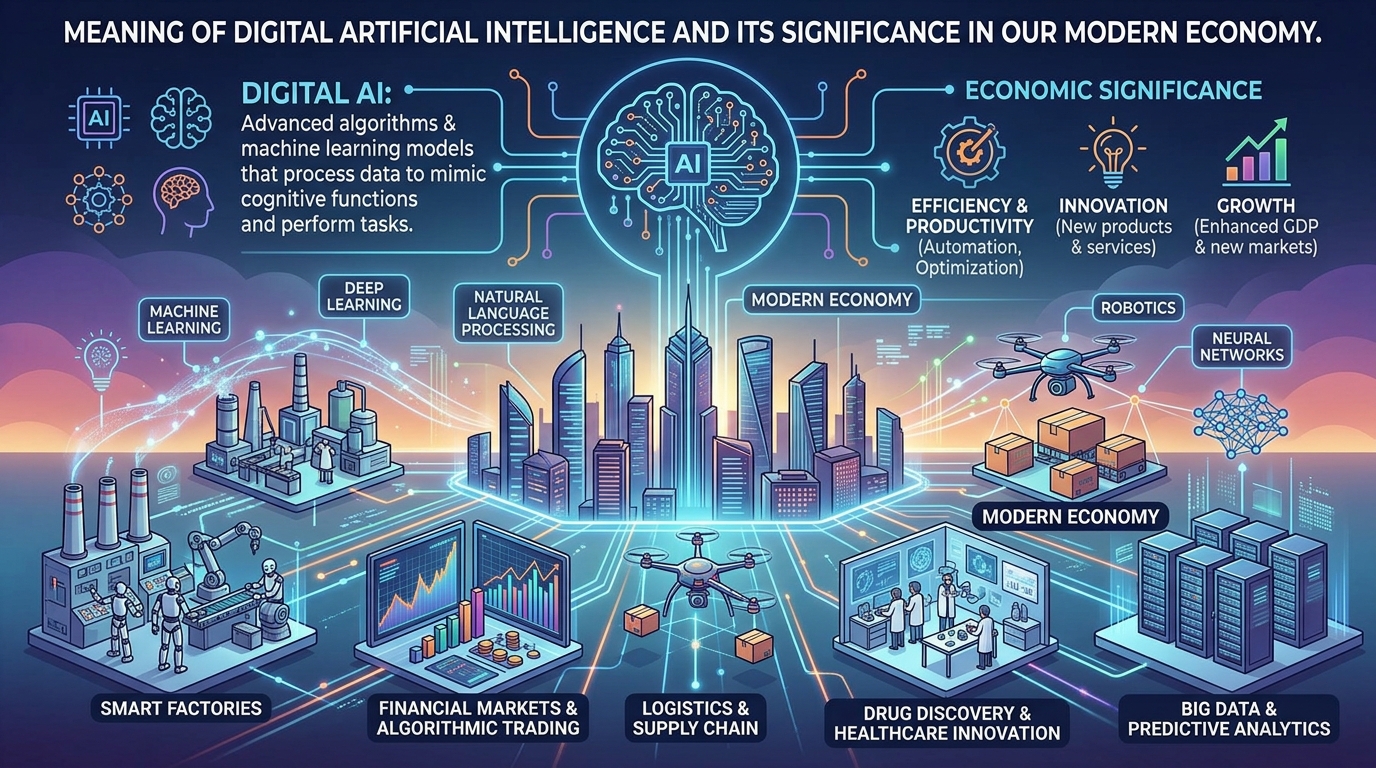
A scientific, technological and economic study of AI — from its fundamental meaning to its role in business, finance, industry, education and the future of human civilisation.
Abstract
Digital artificial intelligence (AI) is one of the most important technological developments shaping the modern world. It combines computer science, mathematics, statistics, data, algorithms, computing infrastructure and, in some systems, machine learning to perform tasks that traditionally require human cognitive abilities.
These tasks include recognising patterns, understanding language, generating content, predicting outcomes, solving problems, supporting decisions and controlling certain automated processes.
However, artificial intelligence is not simply a computer, a website, a robot or the internet. It is a collection of computational methods that enable digital systems to perform particular tasks that appear intelligent.
Its economic significance lies in its ability to transform how societies produce goods, deliver services, manage information, allocate resources, educate people and develop new businesses.
This thesis examines the actual meaning of digital AI, how it works, the infrastructure supporting it, its contribution to economic growth, its limitations and the responsibilities required to use it effectively.
Chapter 1: Understanding the actual meaning of digital artificial intelligence
1.1 What does digital artificial intelligence mean?
Let us break the expression into three parts.
1. Digital
Digital means that information is represented, processed and stored using discrete values, commonly binary digits: 0 and 1. Text, pictures, sound, financial records and measurements can all be encoded digitally.
2. Artificial
Artificial means created or engineered by humans rather than arising naturally as a biological system. Artificial does not automatically mean false, useless or independent.
3. Intelligence
In AI, intelligence refers to computational abilities such as learning patterns, reasoning through certain problems, interpreting inputs, generating solutions and adapting outputs to a task. These abilities do not establish that a system possesses human consciousness.
Combining these concepts gives us the following definition:
Digital artificial intelligence is the use of digital computing systems to perform tasks associated with intelligent behaviour by applying algorithms, data-driven models and other computational techniques.
For example, an AI system can analyse thousands of sales transactions, identify purchasing patterns and forecast future demand. A business can use this forecast to plan stock levels, staffing and production.
The computer performs the calculations; the AI model supplies the learned or programmed capabilities; and the business uses the resulting information to make decisions.
1.2 Is artificial intelligence the same as human intelligence?
No. There are important differences.
| Human intelligence | Artificial intelligence |
|---|---|
| Arises from a living biological brain and body | Runs on engineered computing systems |
| Develops through biological, social and personal experience | May learn from datasets, feedback or programmed rules |
| Involves human emotions, bodily experiences and consciousness | Can recognise or generate emotional language without necessarily experiencing emotions |
| Can learn from relatively few examples in some situations | May require large datasets or extensive training, depending on the task |
| Operates within human social, physical and biological life | Operates within its design, available data, tools and computing environment |
Modern AI can outperform people on particular narrowly defined tasks, while struggling with other tasks that humans find straightforward. Its capabilities depend on the model, training, context and environment.
Therefore, we should distinguish task performance from general human understanding and consciousness.
1.3 Three important levels of AI

Level 1: Narrow AI
Systems designed for particular tasks, such as detecting defects, recommending products, recognising speech, translating languages or identifying suspicious transactions.
This is the dominant form of deployed AI today.

Level 2: Generative and foundation-model AI
Systems trained on broad datasets that can generate text, code, images and other outputs, and can be adapted to many different tasks.

Level 3: Artificial general intelligence (AGI)
A proposed level of AI with broad capabilities across many intellectual tasks comparable to human general competence. Definitions vary, and whether any existing system meets a given AGI definition remains contested.
These categories are useful distinctions, but they are not three consecutive stages that every AI product must pass through.
Chapter 2: The architecture of digital artificial intelligence
To understand AI properly, we must examine the technological system behind it. AI is not one physical object. It is an interconnected architecture of hardware, software, mathematical models, data and human-designed objectives.
Human needs and objectives
Problems to solve, questions to answer and goals to achieve
Data layer
Documents, transactions, images, measurements and records
AI model and algorithms
Learn patterns, calculate probabilities, classify information or generate outputs
Computing infrastructure
Processors, memory, storage, networks and data centres
Outputs and decisions
Predictions, reports, recommendations, generated content or automated actions
Conceptual architecture. In practice, these stages interact, and AI systems may use external tools, databases and feedback loops.
2.1 The six fundamental building blocks
1. Data: The information used to train a model, provide context or evaluate its outputs. Data may come from transactions, scientific experiments, text, sensors or other legitimate sources.
2. Algorithms: The mathematical procedures used to process information, learn patterns, optimise parameters or solve problems.
3. AI models: Computational structures that embody learned patterns or programmed relationships. A trained model can receive new information and produce an output.
4. Computing hardware: CPUs, GPUs, specialised AI accelerators, memory and storage carry out the calculations.
5. Software and infrastructure: Operating systems, programming frameworks, cloud platforms, networks and databases make the system usable.
6. Human oversight: People define objectives, assess performance, correct errors, establish permissions and take responsibility for important decisions.
These components work together. Powerful hardware without useful software is not an effective AI service; an advanced model without reliable data can produce poor results; and a technically impressive system without a meaningful economic purpose may not generate value.
2.2 How does an AI model learn?
Consider a business that wants to predict how many school notebooks it will sell next month.
- Collect data: Gather previous sales, prices, seasons and stock records.
- Prepare the data: Correct errors, handle missing information and organise the records.
- Train the model: Use an appropriate learning algorithm to find relationships between historical information and sales.
- Test its predictions: Compare forecasts with data that was not used for training.
- Deploy the model: Use it to estimate future demand.
- Monitor and improve: Compare forecasts with actual sales and update the system when conditions change.
The model does not need to understand notebooks as a human does. It needs to identify useful relationships in the available data and produce sufficiently reliable forecasts.
A simplified mathematical representation is:
\[ \hat{y}=f_{\theta}(x) \]
Where:
- \(x\) represents the input information.
- \(f\) represents the model’s computational process.
- \(\theta\) represents the model’s learned parameters.
- \(\hat{y}\) represents its prediction or output.
During training, many models adjust their parameters to reduce a defined error or loss function. Once deployed, they use those learned parameters to process new inputs. Not every AI system learns in this way; rule-based systems, for example, can operate without training on a dataset.
2.3 The difference between AI, machine learning and deep learning
Artificial intelligence — the broad field
Includes methods for building systems that perform tasks associated with intelligent behaviour.
Machine learning — a major branch of AI
Methods that learn useful patterns from data rather than relying entirely on manually specified rules.
Deep learning — a branch of machine learning
Uses multilayer neural networks to learn complex patterns in information such as images, sound, language and scientific measurements.
Generative AI — a category of AI systems
Produces new content, including text, images, audio, video or computer code. Many modern generative systems use deep learning, although generative AI is not synonymous with all deep learning.
The distinction matters because not every AI application requires an enormous model. A small forecasting algorithm or a well-designed machine-learning system may be more affordable, efficient and reliable for a particular business task.
Chapter 3: The historical development of artificial intelligence
AI did not suddenly appear when conversational AI became popular. It developed through decades of mathematics, computer science, engineering and scientific research.

1940s–1950s: Mathematical foundations
The development of electronic computers, formal computation and early research into machine intelligence established foundations for the field. Alan Turing was one of its influential thinkers.

1950s–1970s: Early AI
Researchers developed symbolic reasoning, search algorithms, early neural networks and systems for solving carefully defined problems. Progress was limited by computing power, data and the difficulty of generalising.

1980s–2000s: Expert systems and specialised AI
Rule-based expert systems found commercial uses. Statistical machine learning, improved hardware and specialised systems advanced areas such as speech recognition and strategic games.

2010s: Deep-learning expansion
Large datasets, more powerful processors and improved neural-network methods drove major progress in image recognition, translation, speech and scientific applications.

2020s: Foundation models and generative AI
Large language models, image generators and multimodal systems made AI capabilities accessible through conversational interfaces and software tools. Businesses increasingly began integrating AI into everyday workflows.
The broader lesson is that major AI advances depend not only on clever algorithms but also on computing capacity, quality data, scientific research, engineering, investment and practical adoption.
Chapter 4: The significance of AI in the modern economy
The economy is the system through which people, businesses and governments produce, distribute, exchange and consume goods and services.
Artificial intelligence matters because it can change the efficiency with which economic resources are used. It can help a business produce more with the same resources, reduce errors, develop products and make better-informed decisions.
The OECD describes AI as a technology with the potential to act as a general-purpose technology, affecting productivity and growth across many industries. However, the size of the benefits depends on how organisations implement it.
OECD
+1
4.1 Ten major economic contributions of AI

1. Industrial production
AI can monitor equipment, detect manufacturing defects, forecast maintenance needs and help factories plan production. This can reduce downtime and material waste.

2. Banking and financial technology
Banks can use AI to identify unusual transactions, assist customers, analyse financial records and assess certain risks. Human review and safeguards remain essential for consequential financial decisions.

3. Agriculture and food security
AI can interpret crop images, estimate harvests, identify potential plant diseases and support irrigation planning. These capabilities may help farmers use water, land and fertiliser more efficiently.

4. Transport and supply chains
Demand forecasting, inventory management, route planning and equipment monitoring can help goods move more efficiently from producers to customers.

5. Education and human capital
AI can explain concepts, support language learning, assist teachers in preparing materials and provide practice exercises. It can expand access to learning, although it cannot replace every role of a teacher.

6. Healthcare and biotechnology
AI can help analyse medical images, organise clinical information and identify promising areas for scientific investigation. Medical decisions require appropriate professional oversight and validation.

7. Entrepreneurship and small business
Entrepreneurs can use AI to research markets, draft product descriptions, organise customer enquiries, analyse sales and develop prototypes with fewer initial resources.

8. Infrastructure and engineering
AI can support building design, electricity demand forecasting, predictive maintenance and the monitoring of roads, water networks and public infrastructure.

9. Accounting and business management
AI can help classify transactions, identify inconsistencies, summarise reports and support budgeting. Accountants must still verify figures, comply with regulations and exercise professional judgement.

10. Scientific discovery and innovation
Researchers can use AI to explore molecular structures, analyse large datasets, develop engineering designs and generate hypotheses for further testing.
4.2 AI as an engine of productivity
Productivity measures how efficiently labour, capital, materials and other inputs are converted into goods and services.
A simplified measure of labour productivity is:
\[ \text{Labour productivity} =\frac{\text{Output}}{\text{Hours worked}} \]
Suppose a small company produces 100 completed orders in 50 working hours.
Its productivity is:
\[ \frac{100}{50}=2 \]
That is two completed orders per working hour.
If, after introducing an effective AI-assisted workflow, it produces 130 orders in the same 50 hours, productivity becomes 2.6 orders per hour — a 30% increase.
This is an illustrative example, not a guaranteed AI outcome. The business must account for the cost of software, implementation, errors, training and any additional work required.
The deeper economic principle is that productivity improvements can allow a society to produce more goods and services without increasing every resource input proportionally.
4.3 What does the latest economic evidence tell us?
The Stanford AI Index Report 2026 reports that:
- Global corporate AI investment more than doubled in 2025.
- 88% of surveyed organisations reported using AI in at least one business function in 2025.
- Generative AI was reported in at least one business function by 70% of surveyed organisations.
- Reported productivity gains were strongest in certain structured tasks where outputs are comparatively easy to measure.
Stanford HAI+1
These figures indicate rapid investment and adoption, but they need careful interpretation. The adoption figures come from surveyed organisations; they do not mean that 88% of every business worldwide has adopted AI. Reported productivity improvements also vary by task, study and implementation.
The central economic lesson: widespread AI adoption does not automatically guarantee widespread prosperity. The important question is whether AI creates measurable value, whether its benefits exceed its costs, and who receives those benefits.
Chapter 5: Artificial intelligence, employment and the future of work
One of the most important questions in the modern economy is whether AI will replace human workers or make them more productive.
The scientifically responsible answer is that AI can automate some tasks, augment many others, create new forms of work and change the skills employers need. The outcome differs across occupations, industries and countries. The International Monetary Fund has examined these effects, including the possibility that productivity gains could coexist with greater income inequality.
International Monetary Fund
+1
5.1 Three ways AI affects employment
A. Task automation
AI performs certain tasks previously completed by people, such as extracting information from documents, classifying standard enquiries or preparing routine summaries.
B. Human augmentation
AI helps workers complete their existing jobs. An accountant might use it to identify unusual transactions, while retaining responsibility for checking evidence and approving the final report.
C. New occupations and industries
AI creates demand for work in data engineering, AI evaluation, cybersecurity, model integration, digital infrastructure, technical support and responsible AI governance.
5.2 Jobs consist of multiple tasks
A job title does not tell us whether an occupation can be fully automated.
Consider an accountant. The role may include:
- Collecting and organising records.
- Reconciling transactions.
- Interpreting accounting standards.
- Investigating discrepancies.
- Advising management.
- Explaining financial results.
- Taking professional responsibility.
AI may assist with some of these activities while leaving others dependent on professional judgement, communication, accountability and contextual understanding.
The same principle applies to teachers, engineers, farmers, technicians, business owners and government employees.
5.3 Which skills become more important?
Mathematics and statistics
Understand quantities, probabilities, patterns, uncertainty and the difference between correlation and causation.
Logic and critical thinking
Test AI answers, identify contradictions, examine evidence and recognise when a conclusion does not follow from the facts.
Digital and AI literacy
Understand how to use digital tools, protect information, evaluate generated content and choose suitable software for a task.
Business and financial literacy
Understand revenue, costs, profit, cash flow, investment, productivity and customer needs.
Communication and human judgement
Explain decisions, work collaboratively, understand social context and take responsibility for outcomes.
The objective should not be to compete with computers at every task. It should be to develop the knowledge and judgement needed to use technology effectively while remaining capable of working independently.
Chapter 6: The economics of AI — how it creates and distributes value
AI is a technology, but its economic impact depends on how it interacts with the traditional factors of production.
The four useful introductory categories are:
- Labour: human time, skills and effort.
- Capital: machinery, buildings, computers and other productive assets.
- Land and natural resources: physical space, water, minerals and energy.
- Entrepreneurship and organisation: the coordination of resources, risk-taking and the creation of new products and services.
AI can change the productivity of labour and capital, but it also requires resources of its own.
6.1 The AI production model
A simplified economic model is:
\[ Y=A\cdot F(K,L,D,S) \]
Where:
- \(Y\) = economic output.
- \(A\) = overall efficiency or productivity.
- \(K\) = physical and computing capital.
- \(L\) = labour.
- \(D\) = usable data.
- \(S\) = skills, software and organisational capability.
This is an illustrative framework rather than a universal production law. The relationship between these variables depends on the industry and the technology being used.
The important insight is that AI is rarely productive in isolation. Its performance depends on the surrounding economic system.
For example, a farm may have an advanced crop-monitoring model but still struggle to improve harvests if it lacks reliable electricity, irrigation, suitable equipment or access to markets.
6.2 Where does the economic value go?
AI investment
Hardware, software, data, training and integration
Operational improvement
Less wasted time, better forecasts, new products or improved service
Economic value created
Lower costs, higher output, improved quality or additional revenue
Businesses
Potential profits and reinvestment
Workers
Potentially higher wages or changed workloads
Consumers
Potentially lower prices or better services
Government
Potential tax revenue and better public services
AI value-distribution model. These benefits are possible outcomes, not automatic results; the gains may be distributed unevenly.
6.3 Why economic growth can coexist with inequality
Imagine two companies:
- Company A has reliable electricity, modern computers, high-quality data, skilled employees and sufficient capital to deploy AI.
- Company B has limited connectivity, little technical expertise and insufficient money to integrate new systems.
Company A may improve its productivity rapidly, while Company B falls further behind.
The same pattern can occur between countries, regions, large corporations and small businesses. The IMF and OECD identify uneven adoption, access to infrastructure and the distribution of productivity gains as important economic concerns.
IMF eLibrary
+1
Therefore, the goal of economic policy should not merely be to encourage AI investment. It should also help more people and businesses acquire the skills, infrastructure and opportunities required to benefit from it.
Chapter 7: Digital AI and the South African economy


10
For South Africa, AI presents an opportunity to develop productive industries, strengthen small businesses, improve public services and build new technical skills. However, success will depend on addressing local economic conditions rather than simply importing technology.
7.1 Six strategic opportunities

1. Small businesses and entrepreneurship
Local businesses can use AI for customer service, stock forecasting, digital marketing, bookkeeping support and online sales. This can help entrepreneurs test ideas before making large investments.

2. Mining and mineral processing
AI can help monitor machinery, identify maintenance needs, analyse geological data and improve resource efficiency. Safety-critical applications require engineering validation and appropriate oversight.

3. Agriculture and rural development
Digital advisory services can support crop monitoring, weather-informed planning, livestock management and supply-chain coordination. Offline access and affordable devices matter in rural areas.

4. Energy and infrastructure
AI can forecast electricity demand, support renewable-energy integration and help prioritise maintenance of water, transport and electricity infrastructure.

5. Education and technical skills
Schools, colleges and training centres can introduce AI literacy, programming, mathematics, data analysis and applied engineering. Access must not depend entirely on a learner’s household income.

6. Banking and digital financial services
Financial institutions can use AI to identify unusual transactions, support customer enquiries and improve operational processes, subject to privacy, fairness and financial-sector requirements.
7.2 What South Africa needs to build
A competitive AI economy requires more than access to an AI chatbot.
- Reliable electricity: computing infrastructure and businesses need dependable power.
- Affordable connectivity: broadband and mobile networks must reach underserved communities.
- Digital infrastructure: data centres, cloud services, secure networks and computing capacity are important foundations.
- Mathematics and science education: advanced technology depends on a strong foundation in mathematics, physics, statistics and computer science.
- Technical training: businesses need software developers, technicians, data specialists, cybersecurity professionals and skilled AI users.
- Local innovation: South African businesses should develop solutions for local languages, agriculture, healthcare, mining, education and public services.
- Responsible governance: personal information, consumer rights, security and accountability must be protected.
The long-term opportunity is to move beyond being only a consumer of imported AI services and develop the skills, businesses, research and infrastructure needed to create locally relevant digital products.
Chapter 8: AI and the creation of new business models
One of the most significant changes in the digital economy is that individuals and small organisations can now use computational capabilities that previously required larger teams or substantial technical resources.
AI can lower some barriers to starting a business, although it does not remove the need for capital, market research, quality control, customer trust or sound financial management.
8.1 Five possible AI-enabled business models

Educational content and digital publishing
Develop original tutorials, educational guides, research summaries and training materials. Human review, accuracy and clear differentiation are essential.

AI-assisted online retail
Use AI to draft product descriptions, organise catalogues, answer routine enquiries and analyse demand. Inventory, fulfilment and customer satisfaction remain critical.

Digital services and software
Develop business dashboards, document-processing systems, workflow automation and reporting tools for clients with identifiable problems.

Agricultural technology services
Offer digital recordkeeping, farm-management support, crop-monitoring analysis and inventory coordination to farmers and agricultural enterprises.

Data and business analysis
Help organisations organise their information, build reports, understand operating costs and develop evidence-based forecasts.
8.2 How to evaluate whether an AI business is economically viable
A useful starting point is to calculate the value created for customers and compare it with all the costs of providing the service.
\[ \text{Net benefit} =\text{Economic benefit}-\text{Total cost} \]
For a small business, total costs may include:
- AI subscriptions and computing expenses.
- Software development and integration.
- Employee time and training.
- Data protection and cybersecurity.
- Quality assurance and human review.
- Marketing, support and administration.
A business should not adopt AI merely because the technology is fashionable. It should adopt it when it solves a real problem more effectively than the available alternatives.
Chapter 9: The risks, limitations and ethical responsibilities of AI
AI has substantial potential, but an economically mature approach must consider both its benefits and its costs.
| Risk | What it means | Appropriate response |
|---|---|---|
| Incorrect outputs | AI may generate convincing but false information | Verify important claims against reliable evidence |
| Bias and discrimination | Models may reproduce unfair patterns in their data or design | Test performance across affected groups and review consequential decisions |
| Privacy | Personal or confidential data may be exposed or improperly processed | Minimise data collection, control access and follow applicable law |
| Cybersecurity | AI systems can introduce new vulnerabilities and be abused | Apply security testing, monitoring and access controls |
| Job disruption | Some tasks or roles may shrink or change | Support retraining, job transitions and new employment opportunities |
| Concentration of economic power | Expensive computing and infrastructure can favour large organisations | Encourage competition, interoperability and wider access |
| Environmental costs | Training and operating AI consume electricity and hardware resources | Measure energy use and improve efficiency |
| Overdependence | People may rely on AI without developing their own skills | Retain human learning, independent judgement and verification |
The OECD’s work on AI productivity and growth highlights the importance of managing distributional challenges, market concentration and the risks associated with deployment.
OECD
+1
9.1 Why AI cannot be treated as an unquestionable authority
AI models can make errors even when their responses are grammatically correct and logically presented.
A model may:
- Use outdated or incomplete information.
- Misinterpret a question.
- Generate an incorrect mathematical explanation.
- Miss important local circumstances.
- Produce a forecast that fails when economic conditions change.
In accounting, engineering, healthcare, law and public administration, incorrect outputs can have serious consequences.
A sensible operating principle is:
Use AI to accelerate analysis, but use evidence, testing, professional expertise and accountability to establish whether its output should be trusted.
Chapter 10: A practical framework for implementing AI in an organisation
The following framework can help a business, school, public institution or community enterprise move from general interest in AI to a measurable project.
1
Identify the problem
Choose a specific difficulty, such as excessive paperwork, frequent stock shortages, long customer-response times or avoidable equipment downtime.
2
Measure current performance
Record time, cost, error rates, service quality and other relevant indicators before introducing AI.
3
Select the appropriate solution
Compare ordinary software, simple automation, machine learning and generative AI. The simplest suitable solution may be the best.
4
Run a controlled pilot
Test the system on a limited, appropriate task. Protect sensitive information and keep people responsible for important decisions.
5
Evaluate the economics
Compare improvements with the full cost of implementation, ongoing operation, maintenance and human supervision.
6
Train people and expand carefully
Train staff, monitor errors, establish accountability and expand only when the evidence supports doing so.
10.1 Example: AI in a small retail business
Suppose a shop spends many hours each week counting stock and preparing orders.
The owner could test an AI-assisted stock-analysis system that uses historical sales to estimate future demand.
The owner should compare:
- The time spent managing stock before and after implementation.
- The number of stock shortages and excess-stock incidents.
- The cost of the software and any additional equipment.
- The accuracy of the forecasts.
- Whether the system improves customer service and overall profitability.
If the system does not produce a meaningful improvement, the owner should modify it, select a simpler solution or stop using it.
This is the difference between technology adoption and sound economic management.
Chapter 11: The future of AI in the global economy
The next stage of AI development is likely to involve increasingly integrated systems rather than isolated chat interfaces.

1. AI agents and workflow automation
Systems will increasingly be designed to carry out sequences of digital tasks using approved tools, subject to permissions, testing and supervision. Reliable autonomous operation remains a technical and governance challenge.

2. AI connected to physical infrastructure
Sensors, robotics and industrial control systems can combine AI with real-world measurements to improve manufacturing, logistics, agriculture and energy management.

3. Multimodal AI
Models increasingly process combinations of text, images, audio, video and other data, creating new possibilities for communication, analysis and accessibility.

4. AI-assisted scientific discovery
Researchers can use computational models to investigate materials, biological systems, climate patterns and engineering problems, with experiments and independent validation remaining essential.

5. More efficient AI infrastructure
Progress in specialised chips, model design, cooling, data-centre engineering and energy management may reduce some operating costs while expanding computing capabilities.
These developments create opportunities, but the timing and economic consequences remain uncertain. Technical progress alone does not guarantee that an application will be affordable, safe, commercially successful or socially beneficial.
Chapter 12: A comprehensive model for understanding AI and economic development
We can bring the entire subject together through one central relationship:
Human knowledge
Mathematics, science, engineering, economics and experience
Digital infrastructure and data
Networks, computing, storage and reliable information
Artificial intelligence
Pattern recognition, prediction, content generation and decision support
Human skills and responsible institutions
Education, oversight, accountability and sound management
Potential economic and social progress
Higher productivity, innovation, better services and new opportunities
This is a conceptual framework, not a mathematical equation. Its components must work together for AI investment to translate into lasting benefits.
The model explains why no single country, company or individual can build a successful AI economy through algorithms alone. Sustainable progress also requires education, electricity, communications, capital, institutions, markets and human judgement.
Conclusion: What is the actual significance of digital AI?
Digital artificial intelligence is a computational capability that allows machines to perform selected tasks associated with intelligent behaviour. Its importance extends beyond the technology industry because it can influence how nearly every other industry operates.
Its fundamental economic significance can be understood through seven principles:
- Productivity: AI can help people and organisations produce more value from available resources.
- Knowledge: AI can make information easier to analyse, organise and apply.
- Innovation: AI can help researchers and entrepreneurs explore new ideas and develop products.
- Business transformation: AI can change production, accounting, customer service, logistics and management.
- Employment transformation: AI can automate certain tasks, augment workers and create new skill requirements.
- Economic competition: Access to computing, data, infrastructure and expertise can influence the competitiveness of businesses and countries.
- Human responsibility: The long-term value of AI depends on accuracy, fairness, accountability and the distribution of its benefits.
The most important distinction is between possessing AI technology and using AI to create real economic value. A country can import powerful AI tools without developing a strong domestic technology industry. A business can automate tasks without improving profitability. An individual can generate large amounts of information without acquiring reliable knowledge.
Real progress occurs when AI is combined with scientific understanding, practical skills, responsible management and solutions to genuine human problems.
For South Africa and other developing economies, the strategic objective should be to build an inclusive digital economy in which people do not merely consume AI products, but also understand them, develop them, apply them and create businesses around them.
The ultimate purpose of artificial intelligence should be to expand human capability and improve economic and social wellbeing—not to treat technology itself as the final measure of progress.
Selected academic references and further reading
These sources provide a foundation for deeper university-level research.
1. Organisation for Economic Co-operation and Development (OECD). (2024). Explanatory memorandum on the updated OECD definition of an AI system. Read the OECD definition and explanation.
2. Filippucci, F., Gal, P., Jona-Lasinio, C., Leandro, A., & Nicoletti, G. (2024). The impact of Artificial Intelligence on productivity, distribution and growth: Key mechanisms, initial evidence and policy challenges. OECD. Read the OECD economic research.
3. Cazzaniga, M., et al. (2024). Gen-AI: Artificial Intelligence and the Future of Work. International Monetary Fund. Read the IMF research on AI and employment.
4. Stanford Institute for Human-Centered Artificial Intelligence. (2026). AI Index Report 2026: Economy. Read the latest economic analysis.
5. International Monetary Fund. Artificial Intelligence: Overview and economic implications. Explore the IMF’s AI research.





Be First to Comment