
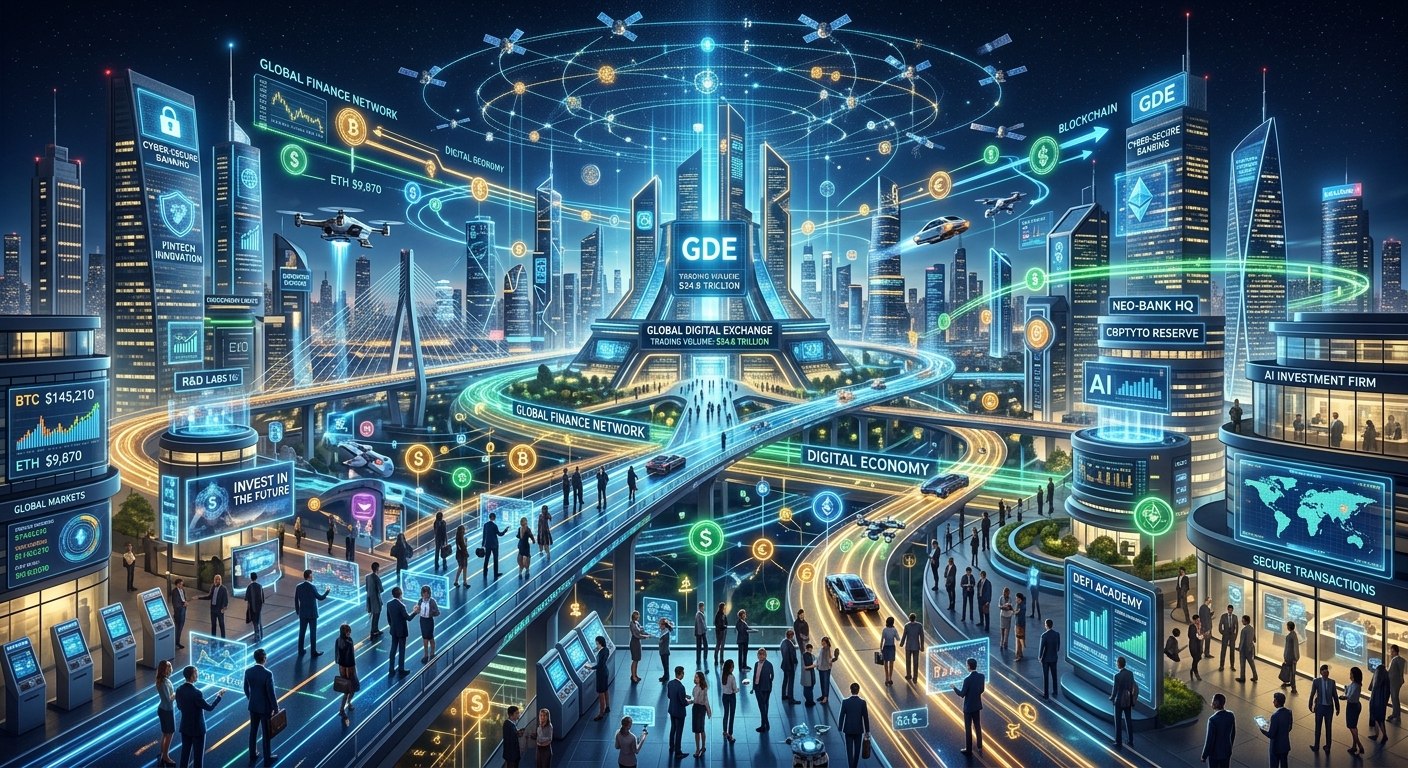
A Comprehensive Essay on the Architecture, Technologies, Institutions and Economic Transformation of Finance
Abstract
The futuristic digital financial ecosystem economy is the emerging economic environment in which money, banking, payments, investment, insurance, taxation, trade, business finance and government financial services become increasingly connected through digital infrastructure.
Rather than thinking of finance as a collection of separate banks, stock exchanges, payment companies and government departments, the future can be understood as a single interconnected financial ecosystem in which people, businesses, machines, governments and financial institutions exchange value through secure digital networks.
Its foundations include digital identity, mobile connectivity, cloud computing, artificial intelligence, blockchain and distributed ledgers, real-time payments, programmable money, tokenised assets, cybersecurity, digital currencies, automated accounting, open banking and advanced data analytics.
The ultimate transformation is not simply “banking becoming digital.” It is the transformation of the economic architecture through which value is created, measured, transferred, invested and governed.
1. Introduction: From Traditional Finance to a Digital Economy
For centuries, financial systems were built around physical institutions.
A typical economic transaction required:
Person → bank → payment network → merchant → accounting system
The process depended heavily on paper documents, physical branches, human verification and centralised databases.
The internet fundamentally changed this architecture.
Today:
Person → smartphone → digital identity → financial platform → payment network → merchant
The next stage goes further.
A future transaction could become:
Human or machine → digital identity → AI financial agent → real-time payment infrastructure → programmable settlement → automated accounting → regulatory verification
This represents a profound economic transformation.
The future financial system will increasingly operate as an always-connected digital ecosystem.
2. What Is a Digital Financial Ecosystem?
A digital financial ecosystem is a network of interconnected technologies, institutions, markets and users that enables financial value to move digitally.
It contains several layers.
Layer 1 — Human beings
Individuals are the ultimate participants in the economy.
They:
- earn income
- save
- borrow
- invest
- purchase goods
- pay taxes
- insure themselves
- transfer money
- own assets.
Layer 2 — Businesses
Businesses:
- receive payments
- pay employees
- purchase inputs
- borrow capital
- invest
- export and import
- manage financial risks.
Layer 3 — Financial institutions
These include:
- commercial banks
- central banks
- investment banks
- insurance companies
- pension funds
- asset managers
- fintech companies
- payment providers
- securities exchanges.
Layer 4 — Digital infrastructure
This includes:
- telecommunications networks
- internet infrastructure
- data centres
- cloud computing
- databases
- cybersecurity systems
- digital identity infrastructure.
Layer 5 — Intelligence
Artificial intelligence increasingly becomes the analytical layer of the financial economy.
AI can process:
- transactions
- market information
- accounting data
- credit information
- economic indicators
- supply-chain information
- fraud signals.
Layer 6 — Monetary and settlement infrastructure
This includes:
- bank deposits
- central-bank money
- instant payment systems
- electronic transfers
- card networks
- digital currencies
- tokenised assets.
Together these layers create the digital financial ecosystem.
3. The Architecture of the Future Financial Economy
A useful conceptual architecture is:
                    FUTURE DIGITAL ECONOMY
                             │
             ┌───────────────┴───────────────┐
             │                               │
          PEOPLE                          MACHINES
             │                               │
             └───────────────┬───────────────┘
                             │
                     DIGITAL IDENTITY
                             │
                    DIGITAL INTERFACES
                  ┌──────────┼──────────┐
                  │          │          │
                Mobile      Web         AI
                  │          │          │
                  └──────────┼──────────┘
                             │
                     FINANCIAL PLATFORMS
                             │
        ┌────────────┬───────┼────────┬────────────┐
        │            │       │        │            │
      Banking     Payments Investing Insurance   Credit
        │            │       │        │            │
        └────────────┴───────┼────────┴────────────┘
                             │
                     SETTLEMENT SYSTEMS
                             │
             ┌───────────────┼────────────────┐
             │               │                │
          Banks          Central Banks      Markets
             │               │                │
             └───────────────┼────────────────┘
                             │
                    GLOBAL ECONOMIC NETWORK
The important concept is interoperability.
The future financial system will increasingly depend on different systems being able to communicate with one another.
4. Digital Identity: The New Financial Foundation
One of the most important building blocks will be trusted digital identity.
Traditional financial identification relies on documents such as:
- passports
- identity cards
- driver’s licences
- certificates
- paper statements.
Digital economies increasingly require identities that can be verified electronically.
A digital identity could allow an individual to prove:
“I am this person.”
without necessarily revealing every piece of personal information.
This creates the possibility of digital know-your-customer systems, electronic signatures and automated onboarding.
However, digital identity also creates major responsibilities concerning:
- privacy
- surveillance
- identity theft
- cybersecurity
- consent
- data ownership.
Therefore, the future must combine digital convenience with individual rights.
5. The Smartphone as a Financial Terminal
The smartphone is becoming one of the most important financial devices in the world.
A single device can potentially provide:
- banking
- payments
- investing
- insurance
- budgeting
- accounting
- financial education
- digital identity
- business management.
This changes the economics of financial inclusion.
A person does not necessarily need a traditional bank branch to participate in sophisticated financial services.
The financial institution increasingly comes to the customer through a connected device.
6. Artificial Intelligence and the Financial Economy
Artificial intelligence may become one of the most transformative components of the future financial ecosystem.
Traditional financial analysis requires humans to examine large quantities of information.
AI can process enormous datasets rapidly.
For example:
Economic Data
     +
Market Data
     +
Customer Data
     +
Transaction Data
     +
Business Data
     ↓
Artificial Intelligence
     ↓
Analysis
     ↓
Prediction
     ↓
Decision Support
     ↓
Financial Action
AI could assist with:
- fraud detection
- financial forecasting
- credit assessment
- portfolio analysis
- accounting
- tax administration
- risk management
- customer support
- compliance
- financial education.
But AI should not automatically become the unquestioned decision-maker.
Important financial decisions require:
AI intelligence + human accountability + regulation + transparency.
7. AI Financial Agents
A particularly important futuristic concept is the AI financial agent.
Instead of a person manually performing every financial task, an authorised AI system could help organise finances.
For example:
Income
 ↓
AI Financial Agent
 ↓
Bills ──→ Payments
 ↓
Savings ──→ Investment
 ↓
Taxes ──→ Government
 ↓
Insurance ──→ Risk Protection
The agent could potentially monitor authorised financial information and provide recommendations.
In more advanced systems, software agents could interact with businesses and financial institutions automatically.
This creates a new economic question:
When machines can participate in financial transactions, what constitutes economic agency?
That will become increasingly important.
8. Real-Time Payments
Traditional financial systems often process transactions through batches and intermediaries.
Modern payment systems increasingly aim for near-instant settlement and confirmation.
The future financial ecosystem could therefore approach:
24 hours × 7 days × global connectivity × near-real-time settlement.
This has major economic consequences.
A small business could potentially receive payment immediately after completing a transaction.
A worker could receive wages more frequently.
A supplier could receive payment as soon as contractual conditions are fulfilled.
This reduces the amount of time money remains trapped inside payment processes.
9. Programmable Money
One of the most futuristic concepts is programmable money.
Ordinary digital money records value.
Programmable financial systems can attach conditions to transactions.
Conceptually:
IF condition is satisfied
        ↓
release payment
ELSE
        ↓
hold payment
For example, a commercial contract could specify that payment occurs after verified delivery.
This could reduce:
- administrative delays
- disputes
- reconciliation costs
- manual processing.
However, programmable money introduces important questions about who controls the rules embedded in financial systems.
10. Tokenisation of Assets
Tokenisation refers broadly to representing ownership or claims on assets digitally.
Potentially tokenised assets could include:
- securities
- funds
- bonds
- real estate interests
- commodities
- intellectual property rights
- invoices
- other financial claims.
The conceptual transformation is:
Physical/legal asset → digital representation → programmable financial infrastructure
Tokenisation could make certain assets easier to divide, transfer, record and settle.
But a digital token does not automatically create legal ownership. The underlying legal framework remains essential.
11. Blockchain and Distributed Ledger Technology
Blockchain is one approach to maintaining a shared digital ledger across a network.
Traditional architecture:
Customer
   ↓
Bank database
   ↓
Payment processor
   ↓
Merchant database
A distributed-ledger architecture can instead involve multiple participants maintaining synchronised records.
Potential advantages include:
- shared records
- programmable transactions
- automated settlement
- traceability
- reduced reconciliation.
But blockchain is not a universal replacement for databases.
Different financial applications require different combinations of:
- speed
- privacy
- scalability
- governance
- legal enforceability
- energy efficiency.
Therefore, the future financial ecosystem will likely contain multiple technologies rather than one universal ledger.
12. Central Bank Digital Currency
Central bank digital currencies, or CBDCs, represent another possible component of future monetary infrastructure.
The basic concept is:
Central-bank money → digital form
A CBDC could potentially provide digital access to central-bank liabilities in ways that differ from ordinary commercial-bank deposits.
Possible objectives include:
- modernising payments
- improving settlement
- increasing competition
- supporting financial inclusion
- enabling innovation.
But CBDCs also raise questions involving:
- privacy
- cybersecurity
- monetary policy
- banking-system stability
- government access to financial information.
The design of such systems therefore matters enormously.
13. Open Banking and Financial Data
Open banking changes the traditional relationship between banks and customer data.
Instead of financial information remaining inside one institution, authorised systems can allow customers to share data with other providers.
Conceptually:
Customer
   │
   ├── Bank A
   ├── Bank B
   ├── Fintech
   ├── Investment Platform
   └── Financial AI
The customer becomes increasingly central to data portability.
This can encourage competition because financial services no longer need to be completely controlled by one institution.
14. Embedded Finance
Another major development is embedded finance.
Financial services increasingly become integrated directly into non-financial platforms.
For example:
Shopping platform + payment
Transport platform + insurance
Business software + accounting
E-commerce + working-capital finance
Agricultural platform + payments + insurance
Finance therefore becomes less visible as a separate industry.
Instead, it becomes an infrastructure layer embedded inside the broader economy.
15. The Internet of Things and Machine-to-Machine Finance
The future economy may contain billions of connected devices.
Examples include:
- vehicles
- agricultural equipment
- industrial machines
- smart buildings
- energy systems
- logistics systems.
These devices can generate economic information.
A future machine could potentially:
measure → communicate → verify → trigger an authorised transaction.
For example:
Smart machine
      ↓
Reports production
      ↓
System verifies output
      ↓
Contract condition satisfied
      ↓
Payment system triggered
      ↓
Accounting automatically updated
This represents a transition from a predominantly human-to-human economy toward a combined:
human + machine economic ecosystem.
16. Digital Accounting
Accounting is one of the areas likely to experience enormous automation.
Traditional accounting:
Transaction → receipt → bookkeeping → reconciliation → reporting
Future accounting:
Transaction → digital record → automated classification → real-time ledger → continuous reporting
This could move accounting from periodic reporting toward continuous financial visibility.
Businesses could potentially see financial conditions almost immediately.
17. Digital Taxation
Governments are also becoming part of the digital financial ecosystem.
A highly integrated future could connect:
business transaction → accounting → tax calculation → tax reporting → government system
This could reduce tax administration costs.
It could also improve tax compliance.
However, governments must establish clear safeguards around:
- privacy
- data security
- due process
- access controls
- algorithmic decisions.
18. Cybersecurity: The Immune System of Digital Finance
The larger the digital financial ecosystem becomes, the greater the importance of cybersecurity.
Financial infrastructure requires protection against:
- fraud
- identity theft
- malware
- account compromise
- data breaches
- payment manipulation
- infrastructure attacks.
A useful analogy is:
Cybersecurity = immune system of the digital economy.
The system needs multiple defensive layers:
Identity Security
       ↓
Authentication
       ↓
Encryption
       ↓
Transaction Monitoring
       ↓
Fraud Detection
       ↓
Network Security
       ↓
Incident Response
       ↓
Recovery
No digital financial ecosystem can be considered mature without strong cybersecurity.
19. Digital Credit
Traditional lending depends heavily on historical financial records and formal banking relationships.
Digital ecosystems can potentially use a much broader set of authorised information.
Credit systems may increasingly analyse:
- cash-flow patterns
- business transactions
- repayment history
- verified income
- business performance.
AI can assist with risk assessment.
However, financial systems must avoid unfair discrimination and opaque automated decisions.
A future credit system must therefore balance:
access + accuracy + fairness + privacy.
20. The Digital Investment Economy
Investment is also becoming increasingly digital.
Individuals can access:
- shares
- bonds
- funds
- ETFs
- retirement products
- other financial instruments.
Digital platforms reduce some traditional barriers to market participation.
AI may further assist investors by organising information and analysing portfolios.
Nevertheless, technology does not eliminate investment risk.
The fundamental principles remain:
risk → return → time → diversification → liquidity → uncertainty.
21. Insurance in the Digital Ecosystem
Insurance can become increasingly data-driven.
Connected devices may provide information about:
- vehicles
- industrial equipment
- agricultural systems
- property.
AI can analyse patterns and assist with:
- underwriting
- claims processing
- fraud detection
- risk assessment.
This could shift insurance from predominantly reactive compensation toward more continuous risk management.
22. Global Trade
The digital financial ecosystem has enormous implications for international trade.
A future trade transaction could connect:
Buyer
 ↓
Digital Contract
 ↓
Supplier
 ↓
Logistics
 ↓
IoT Verification
 ↓
Customs
 ↓
Payment
 ↓
Accounting
 ↓
Tax
The financial transaction becomes connected to the physical movement of goods.
This could dramatically improve supply-chain visibility.
23. The Future of the Bank
The traditional bank has historically been:
branch + employees + deposits + loans + payments
The future bank may increasingly become:
digital platform + data infrastructure + AI + payments + financial services + risk management
Branches may remain important for some services, but the centre of financial interaction increasingly shifts toward digital channels.
The bank of the future may resemble a technology company with a regulated financial balance sheet.
24. Fintech and Traditional Banks
The future is unlikely to be simply:
fintech replaces banks.
A more realistic possibility is:
banks + fintech + telecommunications + cloud + AI + payment infrastructure become interconnected.
Fintech companies can specialise in:
- payments
- lending
- investing
- accounting
- identity
- financial interfaces.
Banks retain important functions involving:
- deposits
- credit creation
- regulated financial infrastructure
- risk management
- settlement.
The ecosystem therefore becomes more collaborative and competitive simultaneously.
25. Financial Inclusion
One of the greatest opportunities is extending sophisticated financial services to populations historically excluded from formal finance.
Digital systems can reduce the importance of physical distance.
A person in a rural community could potentially access:
- payments
- savings
- insurance
- agricultural finance
- education
- investment services.
This is particularly significant for developing economies.
The challenge is ensuring access to:
electricity + connectivity + affordable devices + digital literacy + trustworthy institutions.
Digital financial inclusion therefore depends on broader infrastructure.
26. The Digital Financial Ecosystem in Africa
Africa has an unusual opportunity because many economies can leapfrog older financial infrastructure.
Instead of building enormous physical banking networks first, countries can develop:
mobile-first financial infrastructure.
A possible African architecture is:
Mobile Network
      ↓
Digital Identity
      ↓
Mobile Wallet
      ↓
Instant Payments
      ↓
Banking
      ↓
Savings & Investment
      ↓
Insurance
      ↓
Business Finance
      ↓
Regional Trade
The long-term objective could be a more integrated African digital economic market.
This would require interoperability across national systems.
27. South Africa’s Potential Position
South Africa has several important foundations for a digital financial ecosystem:
- sophisticated financial institutions
- telecommunications infrastructure
- developed payment capabilities
- capital markets
- fintech activity
- substantial corporate infrastructure.
The opportunity is to connect these capabilities more deeply with:
- small businesses
- rural economies
- agriculture
- manufacturing
- education
- logistics
- government services.
The result could be a more integrated digital productive economy, rather than simply a digital consumption economy.
28. Digital Financial Infrastructure as National Infrastructure
Historically, nations invested in:
- roads
- railways
- ports
- electricity
- telecommunications.
The future requires another category:
Digital economic infrastructure
This includes:
- broadband
- cloud infrastructure
- data centres
- payment networks
- digital identity
- cybersecurity
- digital public infrastructure
- financial interoperability.
These systems increasingly become as economically important as physical infrastructure.
29. The Data Economy
Modern finance is increasingly a data-intensive industry.
Every financial transaction can generate information.
A simplified cycle is:
Economic activity → data → analysis → decision → transaction → new data
This creates a feedback loop.
ECONOMY
   ↓
DATA
   ↓
AI / ANALYTICS
   ↓
DECISIONS
   ↓
FINANCIAL ACTION
   ↓
NEW ECONOMIC ACTIVITY
   ↓
NEW DATA
Data therefore becomes an important economic resource.
But unlike oil, data can be copied, combined and processed repeatedly.
Its value depends heavily on:
quality + context + security + lawful access + analytical capability.
30. Digital Trust
The most important invisible asset in a financial system may be trust.
People must believe that:
- balances are accurate
- transactions are authentic
- institutions are solvent
- identities are protected
- contracts are enforceable
- systems are secure.
Therefore:
Digital finance is ultimately an infrastructure of trust.
Technology provides mechanisms for trust, but institutions, laws and social legitimacy remain essential.
31. The Economic Benefits
A mature digital financial ecosystem could produce several major benefits.
1. Lower transaction costs
Automation can reduce administrative expenses.
2. Faster payments
Near-real-time settlement can improve cash flow.
3. Greater financial inclusion
Digital platforms can reach underserved communities.
4. Better economic information
Real-time data can improve decision-making.
5. More competition
Open financial infrastructure can enable new providers.
6. Automated compliance
Software can continuously monitor financial activity.
7. Improved business productivity
Accounting, payments and financial management can become integrated.
8. Greater international connectivity
Digital systems can facilitate cross-border commerce.
32. The Risks
The futuristic financial ecosystem also introduces serious risks.
Cybersecurity risk
A cyberattack could affect enormous numbers of people simultaneously.
Systemic risk
Highly interconnected systems can transmit failures rapidly.
Privacy risk
Financial data is extremely sensitive.
Algorithmic bias
AI systems can make unfair decisions.
Digital exclusion
People without connectivity or digital skills could be left behind.
Concentration of power
A small number of technology platforms could become extremely influential.
Technology dependency
Financial systems may become vulnerable to infrastructure failures.
Regulatory challenges
Technology can evolve faster than laws.
33. Financial Sovereignty
A critical question for nations is:
Who controls the infrastructure through which money moves?
If payment networks, cloud infrastructure, financial platforms and digital identities become concentrated in a small number of organisations or foreign jurisdictions, countries may become dependent on external infrastructure.
Therefore, digital financial sovereignty may involve maintaining national capabilities in:
- payment infrastructure
- cybersecurity
- digital identity
- data governance
- telecommunications
- financial regulation
- critical computing infrastructure.
34. The Future Economic Pyramid
The traditional economic pyramid can be reinterpreted digitally.
                 GLOBAL ECONOMY
                       ▲
                  CAPITAL MARKETS
                       ▲
                   BANKING
                       ▲
               PAYMENT SYSTEMS
                       ▲
                DIGITAL IDENTITY
                       ▲
               CONNECTIVITY
                       ▲
                COMPUTING POWER
                       ▲
                    ENERGY
This reveals an important principle:
Digital finance cannot exist independently of physical infrastructure.
Behind every financial application are:
- electricity
- semiconductor chips
- networks
- data centres
- cables
- satellites
- computers
- human institutions.
The digital economy therefore remains fundamentally connected to the physical economy.
35. The Energy–Computing–Finance Connection
The future economy increasingly rests upon a three-way relationship:
Energy
powers computation.
Computing
processes information.
Finance
allocates economic resources.
Therefore:
Energy → Computing → Information → Finance → Investment → Economic production
This means future financial infrastructure cannot be designed separately from energy and technology policy.
36. A 2030–2050 Development Path
A possible conceptual progression is:
2020s
- mobile finance
- fintech
- instant payments
- cloud banking
- AI financial analysis
- open banking
- digital identity.
2030s
- increasingly automated financial operations
- widespread AI financial assistants
- greater tokenisation
- machine-to-machine payments
- increasingly integrated digital government finance
- continuous accounting.
2040s
- highly interconnected financial agents
- automated supply-chain finance
- sophisticated machine economies
- deeper integration between physical and digital assets.
2050 and beyond
Potentially:
Human economy + machine economy + AI economy + programmable financial infrastructure
The exact path is uncertain, but the direction toward greater digital integration is clear.
37. The New Economic Unit: The Digital Transaction
The fundamental unit of the traditional economy was often considered the monetary transaction.
The future may increasingly treat a transaction as a bundle of information:
WHO?
  +
WHAT?
  +
HOW MUCH?
  +
WHEN?
  +
WHERE?
  +
WHY?
  +
UNDER WHAT CONTRACT?
  +
VERIFIED BY WHOM?
A digital transaction can therefore become simultaneously:
payment + identity + accounting + contract + compliance + data.
This is one of the most important conceptual transformations.
38. The Digital Economy as a Living Network
A useful analogy is the human body.
| Human body | Digital economy |
|---|---|
| Brain | AI/computation |
| Nervous system | Telecommunications |
| Blood | Money/liquidity |
| Heart | Financial institutions |
| DNA | Data/information |
| Immune system | Cybersecurity |
| Skeleton | Infrastructure |
| Hormonal signalling | Economic incentives |
| Organs | Economic sectors |
This analogy should not be taken literally, but it illustrates the interconnected nature of modern economic systems.
A failure in one major component can affect others.
39. The Future Role of Government
Government will not disappear from the financial ecosystem.
Its role may evolve toward:
- regulation
- monetary stability
- digital identity governance
- cybersecurity standards
- consumer protection
- competition policy
- financial inclusion
- digital infrastructure
- taxation
- systemic-risk management.
The challenge is finding the correct balance:
innovation without chaos
and
regulation without preventing innovation.
40. The Human Being Must Remain at the Centre
The most important principle of the futuristic digital economy is that technology is a means, not the final objective.
The purpose of financial systems should remain:
- productive investment
- economic opportunity
- savings
- responsible consumption
- business development
- poverty reduction
- resilience
- social prosperity.
The ultimate question is therefore not:
“How advanced can financial technology become?”
It is:
“How can advanced financial technology improve the productive capacity and quality of life of society?”
41. A Complete Futuristic Digital Financial Ecosystem
We can now combine the major components:
                         HUMANITY
                            │
                            ▼
                     DIGITAL IDENTITY
                            │
                            ▼
                       CONNECTIVITY
                            │
              ┌─────────────┼─────────────┐
              ▼             ▼             ▼
            BANKING      PAYMENTS       AI
              │             │             │
              └─────────────┼─────────────┘
                            ▼
                     FINANCIAL DATA
                            │
                            ▼
                  COMPUTING / CLOUD
                            │
                            ▼
                    DIGITAL LEDGERS
                            │
             ┌──────────────┼──────────────┐
             ▼              ▼              ▼
          CREDIT        INVESTMENT      INSURANCE
             │              │              │
             └──────────────┼──────────────┘
                            ▼
                   DIGITAL CONTRACTS
                            │
                            ▼
                 PROGRAMMABLE SETTLEMENT
                            │
                            ▼
                  BUSINESS & GOVERNMENT
                            │
                            ▼
                    GLOBAL ECONOMY
This represents finance evolving from a collection of isolated institutions into an interconnected economic operating system.
42. Conclusion
The futuristic digital financial ecosystem economy is much more than electronic banking.
It represents the convergence of:
finance + computing + telecommunications + artificial intelligence + digital identity + data + cybersecurity + economics + law + physical infrastructure.
The central transformation is the movement from:
financial institutions that process transactions
toward:
interconnected digital ecosystems that continuously coordinate economic activity.
Money becomes digital.
Identity becomes digital.
Contracts become increasingly digital.
Accounting becomes increasingly automated.
Markets become increasingly connected.
Financial analysis becomes increasingly AI-assisted.
Assets can increasingly receive digital representations.
Machines can increasingly participate in authorised economic processes.
And financial services increasingly become embedded inside everyday economic activity.
Yet the future should not be judged solely by technological sophistication. The strongest financial ecosystem will be the one that combines innovation, security, inclusion, competition, privacy, accountability and productive economic development.
Ultimately, the futuristic digital financial economy can be expressed in one equation:
Digital Identity + Connectivity + Data + Computing + AI + Money + Trust + Regulation = Digital Financial Ecosystem
And its broader economic objective can be expressed as:
Better financial infrastructure → lower friction → greater economic participation → more productive investment → stronger economic development.
The future financial system will therefore not simply be a digital version of today’s banking system. It has the potential to become a foundational layer of the entire economy—connecting individuals, businesses, governments, markets and increasingly intelligent machines into one continuously operating economic network.





Be First to Comment