
Focusing on Active Curiosity, Diverse Learning, and Structured Innovation
Abstract
Business innovation is not simply the ability to invent a new product. It is the disciplined capacity to notice opportunities, ask better questions, learn from different fields, connect apparently unrelated ideas, experiment, solve problems, and convert knowledge into useful economic value.
In a modern economy shaped by artificial intelligence, digital platforms, automation, global competition, climate pressures and rapidly changing consumer behaviour, businesses need people who can think beyond established procedures. Innovation therefore becomes a cultivated capability rather than an occasional moment of inspiration.
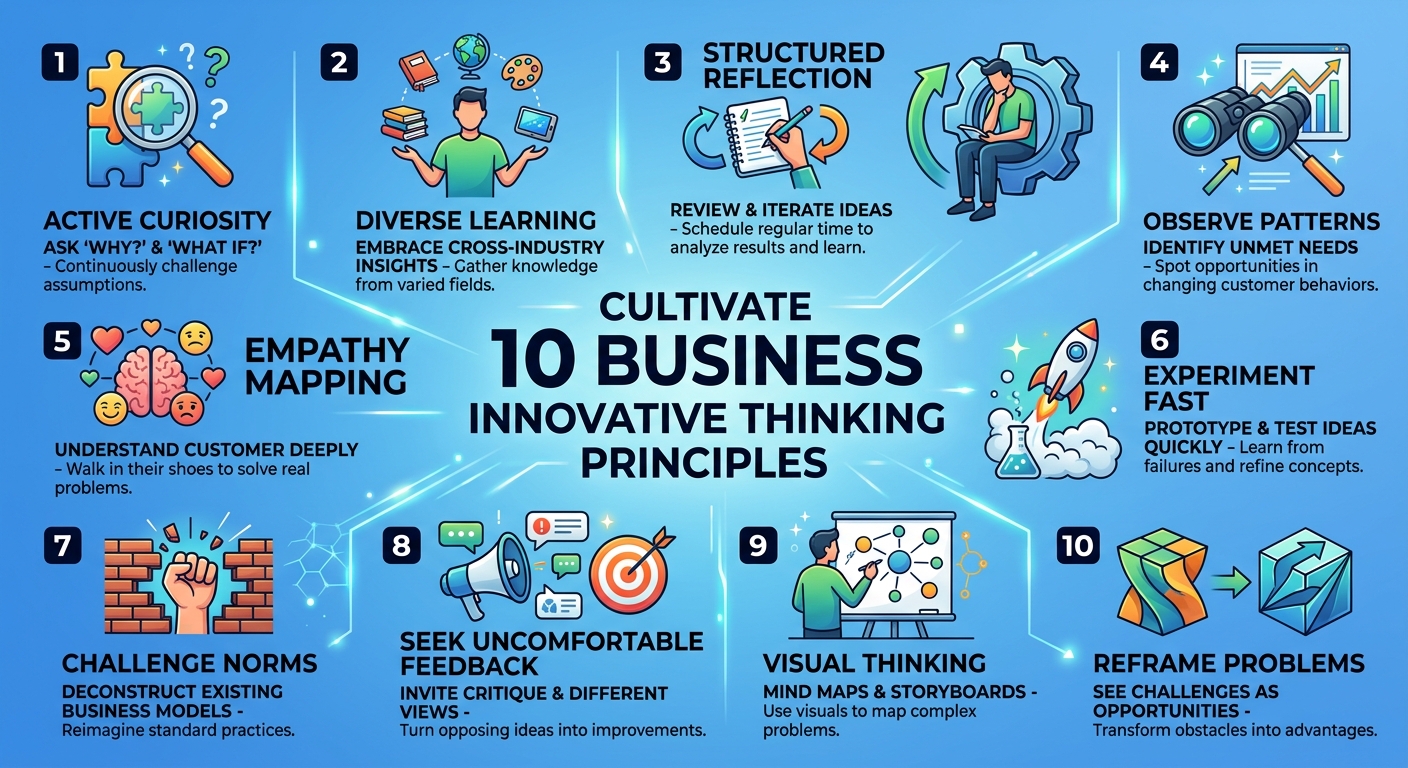
This thesis proposes 10 practical mechanisms for cultivating business-innovative thinking, organised around three foundations:
- Active curiosity — continuously asking, observing and investigating.
- Diverse learning — deliberately acquiring knowledge from different disciplines, industries and cultures.
- Structured innovation — transforming ideas into tested, measurable and economically useful solutions.
1. Introduction: What Is Business-Innovative Thinking?
Business-innovative thinking is the ability to look at an existing situation and ask:
“Can this be done differently, better, faster, cheaper, safer, more intelligently, or in a completely new way?”
It combines several intellectual activities:
Observation → Questioning → Learning → Connecting → Creating → Testing → Improving → Scaling
A conventional business may ask:
“How do we continue doing what we have always done?”
An innovative business asks:
“What problem is emerging, what opportunity is hidden inside it, and what could we build to solve it?”
This distinction is fundamental.
Innovation does not necessarily begin with technology. It can begin with a question.
2. The Three Pillars of Innovative Thinking
Pillar 1 — Active Curiosity
Active curiosity means deliberately investigating the world rather than passively accepting it.
It asks:
- Why does this process exist?
- Who benefits from it?
- Who experiences the problem?
- Why is it expensive?
- Why is it slow?
- Why do customers complain?
- What has changed?
- What could eliminate this problem?
- What technology could improve it?
- What assumption might be wrong?
Curiosity converts ordinary observations into potential business opportunities.
Pillar 2 — Diverse Learning
Innovation becomes stronger when knowledge comes from multiple disciplines.
A businessperson should not learn only about business.
They can combine:
Business + mathematics + science + engineering + psychology + economics + computing + design + history + sociology + agriculture + law
For example:
Agriculture + sensors + AI + telecommunications + accounting
can produce a completely different agricultural business model from traditional farming.
The innovative thinker therefore becomes a knowledge connector.
Pillar 3 — Structured Innovation
Curiosity generates questions.
Learning generates knowledge.
But structure converts knowledge into results.
A useful innovation system is:
Problem → Research → Idea → Hypothesis → Prototype → Test → Measurement → Improvement → Business Model → Scale
Without structure, creativity can become endless brainstorming.
3. The Ten Mechanisms
Mechanism 1: Develop an Active-Curiosity Engine
The first discipline is to cultivate the habit of asking questions.
Instead of merely seeing:
“The customer is waiting.”
ask:
“Why is the customer waiting?”
Then:
“Where exactly does the delay occur?”
Then:
“Can technology remove the delay?”
Then:
“Can removing the delay create economic value?”
This produces a question chain.
The Five-Why Method
When you encounter a problem, ask “why?” repeatedly.
Problem: Customers abandon an online purchase.
Why?
The checkout process is complicated.
Why?
Too much information is required.
Why?
The company designed the process around internal administration rather than customer convenience.
The innovation opportunity may therefore be process redesign, not simply more advertising.
Curiosity equation
A useful conceptual model is:
Innovation potential ≈ Questions × Knowledge × Experimentation
The more meaningful questions a person investigates, the larger the opportunity for discovering new solutions.
4. Mechanism 2: Build a Diverse Learning Portfolio
Do not construct your education around a single subject.
Build a knowledge portfolio.
| Knowledge area | Business contribution |
|---|---|
| Mathematics | Measurement and modelling |
| Economics | Markets and incentives |
| Accounting | Financial discipline |
| Science | Understanding physical systems |
| Engineering | Building solutions |
| Computer science | Digital systems |
| AI | Intelligent automation |
| Psychology | Understanding behaviour |
| Sociology | Understanding society |
| History | Learning from previous systems |
| Design | User experience |
| Communication | Persuasion and collaboration |
The objective is not to become an expert in everything.
The objective is to understand enough different fields to connect knowledge intelligently.
Example
Consider a small poultry business.
Traditional thinking:
Buy chickens → feed chickens → sell chickens.
Innovative thinking:
Poultry + IoT sensors + data analytics + automated feeding + digital payments + logistics + customer database + predictive demand forecasting.
The business has transformed from merely raising animals into a technology-enabled production system.
5. Mechanism 3: Create a “Problem Radar”
Innovators train themselves to notice problems.
Every day, record:
- customer frustrations;
- inefficiencies;
- wasted resources;
- expensive processes;
- unnecessary paperwork;
- delays;
- poor-quality services;
- inaccessible information;
- unused assets;
- environmental problems;
- educational gaps.
Create a simple Problem Opportunity Register.
| Problem | Who experiences it? | Current solution | Weakness | Possible innovation |
|---|---|---|---|---|
| Long queues | Customers | Physical waiting | Time loss | Digital booking |
| Expensive transport | Rural users | Private transport | High cost | Shared logistics |
| Food waste | Retailers | Disposal | Lost value | Redistribution platform |
| Poor farm monitoring | Farmers | Manual inspection | Limited data | Sensor system |
This changes the mind from:
“I have no business idea.”
to:
“There are thousands of problems waiting for better solutions.”
6. Mechanism 4: Practice Cross-Industry Thinking
Some of the greatest innovations emerge when an idea from one industry is transferred into another.
Ask:
“Where else does this problem exist, and how is it solved there?”
For example:
Banking
Uses identity verification, transaction monitoring and risk analysis.
Healthcare
Uses patient records and diagnostic systems.
Agriculture
Can borrow these ideas to develop:
- digital farmer identities;
- farm transaction histories;
- agricultural risk scoring;
- crop-monitoring databases.
This is called cross-domain innovation.
A powerful innovation question is:
“What can my industry learn from an entirely different industry?”
7. Mechanism 5: Convert Curiosity Into Hypotheses
An idea becomes more useful when it becomes testable.
Instead of saying:
“People might want an agricultural app.”
formulate a hypothesis:
“Small farmers will use a mobile platform if it reduces the time required to obtain agricultural information.”
Now it can be tested.
Innovation hypothesis structure
If we provide X, then Y will happen because Z.
Example:
If farmers receive automated weather and crop information through a mobile application, then they will make better planting decisions because they have timely information.
This is much stronger than simply saying:
“We should build an app.”
8. Mechanism 6: Develop Structured Experimentation
Innovation requires experimentation.
Do not spend enormous resources building a perfect product before discovering whether people actually want it.
Use the principle:
Small experiment → Evidence → Learning → Improvement
This can produce a Minimum Viable Product (MVP).
An MVP is not necessarily a poor-quality product. It is the smallest practical version capable of testing an important assumption.
Example
Instead of immediately constructing a complex delivery platform:
- Identify 20 potential customers.
- Determine their delivery needs.
- Manually coordinate deliveries.
- Measure demand.
- Identify recurring problems.
- Develop software only after validating the business process.
The business learns before making large investments.
9. Mechanism 7: Develop Systems Thinking
Businesses are systems.
A product is connected to:
Suppliers → Production → Finance → Employees → Technology → Logistics → Customers → Regulation → Environment
Changing one component can affect the others.
For example, reducing product price may increase demand.
But increased demand can create:
More orders → more production → more raw materials → more logistics → higher working-capital requirements.
Therefore, innovation should not optimise only one part of a business.
It should ask:
“What happens to the entire system if we change this component?”
Systems-thinking model
Input → Process → Output → Feedback → Adaptation
This is particularly important in modern digital businesses.
10. Mechanism 8: Build a Culture of Continuous Improvement
Innovation does not end when a product launches.
The process becomes:
Build → Measure → Learn → Improve
After implementation, ask:
- What worked?
- What failed?
- Why?
- What surprised us?
- What did customers actually do?
- What did customers say?
- What should be removed?
- What should be improved?
- What should be automated?
This creates an organisation that learns continuously.
Incremental innovation
Not every innovation needs to be revolutionary.
A business can improve:
- speed by 10%;
- quality by 15%;
- cost by 8%;
- customer satisfaction by 20%;
- energy efficiency by 12%.
Small improvements accumulated over time can produce enormous competitive advantages.
11. Mechanism 9: Combine Technology With Human Intelligence
Modern innovation should not become an exercise in using technology merely because technology exists.
The correct question is:
“What human or economic problem can this technology solve?”
For example:
AI
Can support:
- analysis;
- prediction;
- summarisation;
- pattern recognition;
- automation;
- decision support.
Cloud computing
Can provide:
- scalable infrastructure;
- data storage;
- collaboration;
- digital services.
IoT
Can provide:
- real-time measurements;
- monitoring;
- automation.
Blockchain
Can potentially support certain forms of:
- distributed recordkeeping;
- transaction verification;
- traceability.
The innovative thinker connects technology to specific economic problems.
12. Mechanism 10: Develop an Innovation-to-Income Pipeline
The final mechanism is transforming innovation into economic value.
A useful pipeline is:
Knowledge → Idea → Problem → Solution → Prototype → Customer → Revenue → Scale
An idea becomes a business only when it creates value that someone is willing to support economically.
Four fundamental questions
For every innovation, ask:
- What problem am I solving?
- Who experiences the problem?
- Why is my solution better?
- How can the solution become economically sustainable?
This prevents innovation from becoming merely intellectual entertainment.
13. The 10 Mechanisms as One Integrated Architecture
The entire framework can be represented as:
                    INNOVATIVE MIND
                          │
              ┌───────────┴───────────┐
              │                       │
        ACTIVE CURIOSITY       DIVERSE LEARNING
              │                       │
              └───────────┬───────────┘
                          │
                   PROBLEM RADAR
                          │
                  CROSS-INDUSTRY
                    CONNECTIONS
                          │
                     HYPOTHESIS
                          │
                   EXPERIMENTATION
                          │
                  SYSTEMS THINKING
                          │
                CONTINUOUS IMPROVEMENT
                          │
             TECHNOLOGY + HUMAN INTELLIGENCE
                          │
                  BUSINESS VALUE
                          │
                       SCALE
This creates a closed learning-and-innovation loop.
14. The Innovative Thinking Cycle
A businessperson can use the following cycle every week:
Step 1 — Observe
Look carefully at customers, markets and society.
Step 2 — Question
Ask why existing systems work the way they do.
Step 3 — Learn
Study multiple disciplines.
Step 4 — Connect
Combine knowledge from different fields.
Step 5 — Define
Clearly describe the problem.
Step 6 — Hypothesise
Propose a possible solution.
Step 7 — Experiment
Test the smallest practical version.
Step 8 — Measure
Collect evidence.
Step 9 — Improve
Modify the solution.
Step 10 — Scale
Expand only when evidence supports expansion.
15. A Daily Innovation Practice
A person can cultivate innovative thinking without waiting for a formal business meeting.
Morning
Ask:
What problem could be solved better today?
During the day
Record three observations.
Evening
Ask:
- What did I learn?
- What surprised me?
- What problem did I notice?
- What assumption was challenged?
- What idea emerged?
- What other industry has solved something similar?
After several months, this produces an innovation knowledge database.
16. The 70–20–10 Learning Principle
A practical learning structure can be:
70% — Core field
Learn deeply about your business or professional domain.
20% — Adjacent fields
Study technologies and industries related to your field.
10% — Completely different fields
Explore subjects apparently unrelated to your business.
That final category can be surprisingly valuable because innovation often comes from unexpected connections.
17. The Difference Between Creativity and Innovation
These concepts should not be confused.
Creativity
Produces possibilities.
Innovation
Turns useful possibilities into implemented value.
Therefore:
Creativity = generating possibilities
Innovation = implementing valuable possibilities
A person may have hundreds of creative ideas but little innovation if none are tested or implemented.
18. The Economics of Innovative Thinking
Innovation has economic consequences.
A successful innovation may produce:
Higher productivity
→ more output per unit of input.
Lower costs
→ greater efficiency.
Higher quality
→ stronger customer value.
New markets
→ additional revenue.
New industries
→ employment and investment.
New business models
→ entirely different ways of creating and capturing value.
This is why innovation is not merely a technological concept.
It is an economic development mechanism.
19. Innovation and the African Economy
For developing economies, innovative thinking is particularly important because innovation does not always require enormous capital.
A community can innovate around:
- agriculture;
- water;
- energy;
- transport;
- education;
- telecommunications;
- healthcare;
- financial services;
- logistics;
- manufacturing;
- construction;
- tourism;
- waste management.
The most powerful question is often:
“What resources already exist here that are currently underutilised?”
Innovation can therefore mean transforming local problems into local enterprises.
For example:
Agricultural waste → raw material → processing → product → market
or:
Unused building → training centre → digital education → skills development → employment ecosystem
20. Measuring Innovative Thinking
Innovation should eventually become measurable.
Possible indicators include:
| Indicator | Question |
|---|---|
| Questions | How many useful questions are being generated? |
| Experiments | How many ideas are being tested? |
| Learning | What new knowledge was acquired? |
| Problems identified | How many opportunities were discovered? |
| Prototypes | How many solutions were built? |
| Customer feedback | What evidence was obtained? |
| Improvements | What changed after testing? |
| Revenue | Did innovation create economic value? |
| Productivity | Did efficiency improve? |
| Scale | Can the solution expand? |
The goal is not to maximise the number of ideas.
The goal is to maximise the number of valuable ideas successfully transformed into results.
21. The 10 Questions Every Innovative Entrepreneur Should Ask
- What problem am I actually solving?
- Why does this problem exist?
- Who experiences it most strongly?
- How is the problem currently solved?
- What is inefficient about the existing solution?
- What can I learn from another industry?
- What technology could improve the situation?
- What is the smallest experiment I can conduct?
- What evidence would prove that my idea works?
- How could the solution create sustainable economic value?
These questions form a practical innovation-thinking toolkit.
22. Conclusion
The ability to innovate is not an inherited gift reserved for a small number of entrepreneurs, scientists or technology companies. It can be cultivated deliberately.
The central architecture is:
Active Curiosity + Diverse Learning + Structured Experimentation = Business-Innovative Thinking
The ten mechanisms are:
- Active-curiosity engine
- Diverse learning portfolio
- Problem radar
- Cross-industry thinking
- Hypothesis development
- Structured experimentation
- Systems thinking
- Continuous improvement
- Technology + human intelligence
- Innovation-to-income pipeline
The deepest principle is simple:
Do not train yourself merely to find answers. Train yourself to discover better questions, learn from many domains, test your assumptions, and turn knowledge into useful value.
That is the foundation of an innovative modern business mind.
A compact formula
Observe → Question → Learn → Connect → Imagine → Test → Measure → Improve → Create Value → Scale
A modern economy rewards organisations that can learn faster than circumstances change. Therefore, cultivating innovative thinking is ultimately not just a business strategy—it is a long-term capability for economic adaptation, entrepreneurship and development.



Be First to Comment