
Abstract
A human sperm cell, or spermatozoon, is one of the most highly specialized cells in the human body. Unlike a typical cell, whose architecture is designed for long-term survival, growth, protein production, and many different cellular activities, a mature sperm cell is highly streamlined for one primary biological mission: transporting a haploid set of paternal chromosomes to an oocyte and participating in fertilization.
Its architecture can be understood like a miniature biological engineering system consisting of:
plasma membrane → head → genetic-information system → acrosome → neck/connector → energy system → mechanical propulsion system → structural support system → tail.
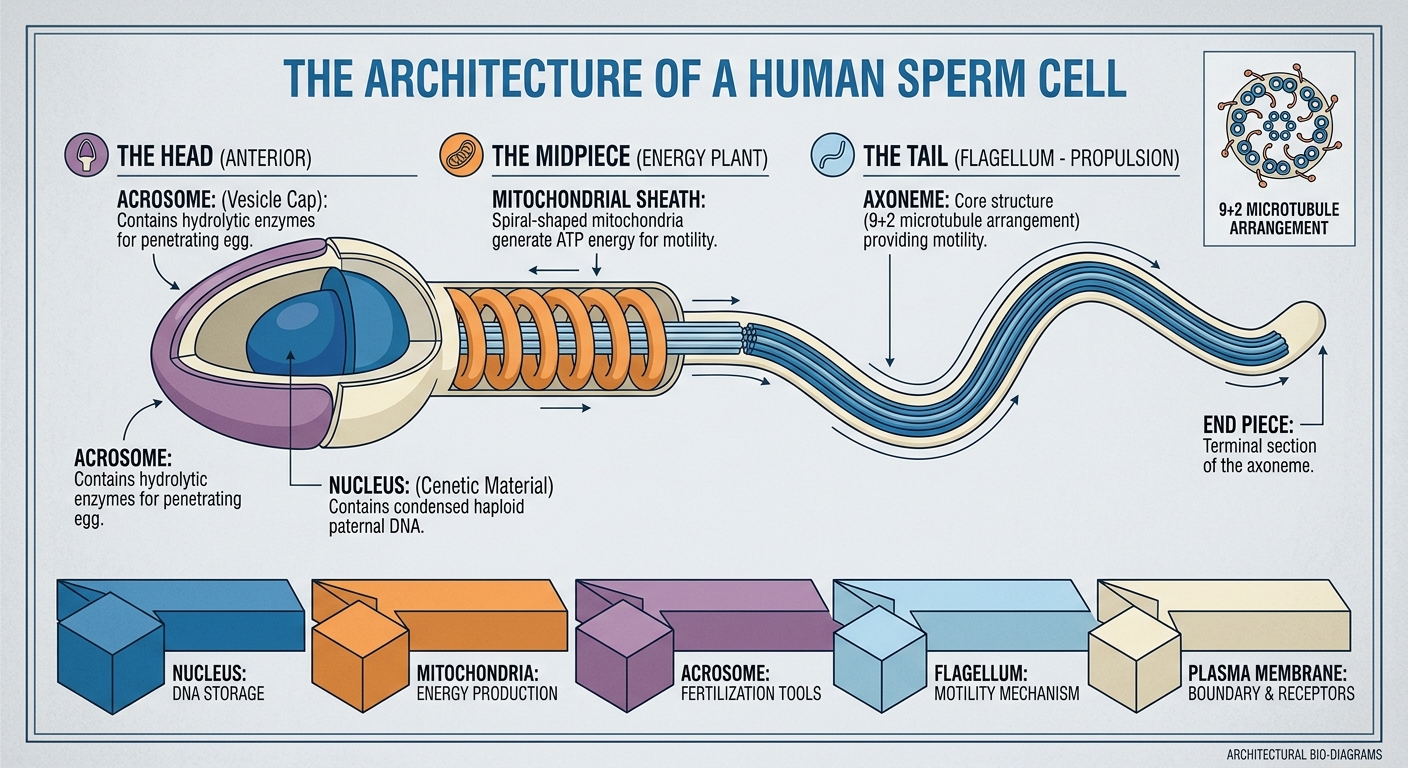
The sperm’s head protects and transports DNA, while its flagellum contains the machinery required for movement. The most important mechanical component of the tail is the axoneme, whose characteristic 9+2 microtubule arrangement works with dynein motor proteins to convert chemical energy from ATP into movement. (PubMed Central (PMC))
1. What Is a Human Sperm?
A sperm cell is the mature male gamete produced through spermatogenesis in the testes.
It is a haploid cell, meaning it contains one set of chromosomes rather than the two sets found in most human body cells.
A simplified information architecture is:
23 chromosomes → DNA → genes → paternal genetic information
When fertilization occurs, the sperm’s genetic contribution combines with the oocyte’s genetic contribution, restoring the diploid chromosome number.
The sperm is therefore not simply a “tiny cell.” It is a highly specialized genetic-delivery and propulsion system.
2. The Overall Architecture
The mature human sperm can broadly be divided into two major regions:
A. Head
Contains:
- nucleus
- highly condensed DNA
- acrosome
- perinuclear structures
- plasma membrane
- specialized surface proteins
B. Flagellum
The flagellum is commonly called the tail and contains:
- connecting piece/neck
- midpiece
- principal piece
- end piece
These regions contain different structural components and perform different jobs. (PubMed Central (PMC))
A simplified architecture is:
                  HUMAN SPERM

                     HEAD
              ┌───────────────┐
              │   ACROSOME    │
              │───────────────│
              │    NUCLEUS    │
              │  condensed    │
              │      DNA      │
              └───────┬───────┘
                      │
                    NECK
               / CONNECTOR
                      │
              ┌───────▼───────┐
              │   MIDPIECE    │
              │ mitochondria  │
              │  + axoneme    │
              └───────┬───────┘
                      │
              PRINCIPAL PIECE
              │ axoneme       │
              │ fibrous sheath│
              └───────┬───────┘
                      │
                  END PIECE
                      │
                      ▼
3. The Plasma Membrane — The Outer Boundary
The entire sperm cell is enclosed by a plasma membrane.
This membrane is not merely packaging.
It is a dynamic biological interface containing proteins and lipids involved in:
- communication with the surrounding environment
- ion movement
- recognition of the oocyte
- regulation of sperm activation
- membrane fusion during fertilization
- maintenance of cellular integrity
Thus:
membrane = boundary + communication system + molecular interface.
The sperm membrane also undergoes important biochemical changes as the sperm becomes capable of fertilization.
4. The Head — The Information Package
The sperm head is engineered around a fundamental requirement:
Protect and transport the paternal genome.
The head contains two major structures:
1. Nucleus
2. Acrosome
The sperm head is highly streamlined compared with ordinary cells. Much of the cytoplasm and many organelles normally found in cells have been removed during sperm development. (PubMed Central (PMC))
This is an example of biological specialization through simplification.
5. The Nucleus — The Genetic Storage System
The nucleus is arguably the most important information component of the sperm.
It contains the paternal genome.
However, sperm DNA is organized very differently from DNA in an ordinary body cell.
During sperm development, DNA becomes extraordinarily compact.
Why?
The sperm must transport its genetic material within a very small head.
Instead of remaining relatively open and transcriptionally active, sperm chromatin becomes highly condensed through replacement of many histones with protamines.
Conceptually:
Ordinary cell:

DNA
 ↓
histones
 ↓
chromatin
 ↓
relatively accessible genome


Mature sperm:

DNA
 ↓
very tightly packed chromatin
 ↓
protamines
 ↓
highly compact genetic package
This produces a very dense genetic payload.
The extreme compaction also contributes to protection of DNA, although sperm have limited capacity for DNA repair because mature sperm have discarded much of the cellular machinery needed for ordinary gene expression and protein synthesis. (PubMed Central (PMC))
6. DNA as the Information Layer
The sperm’s DNA is analogous to the information layer of a computer system.
It contains:
- genes
- regulatory sequences
- chromosome structures
- inherited genetic information
But an important distinction is necessary:
DNA is not literally a computer program.
The comparison is useful only as an analogy.
DNA is a biological information-storage molecule whose sequence contributes to biological development and function.
The mature sperm transports this information rather than actively reading large portions of it.
7. The Acrosome — The Specialized Fertilization Compartment
Covering the anterior region of the sperm nucleus is the acrosome.
The acrosome is a specialized membrane-bound structure derived during sperm development.
It contains molecules and enzymes involved in the fertilization process.
When an appropriately activated sperm interacts with the oocyte, it can undergo the acrosome reaction, involving changes in the acrosomal membranes and release/exposure of its contents.
The acrosome therefore functions somewhat like a specialized biochemical tool compartment rather than a simple storage vesicle. (PubMed Central (PMC))
8. The Perinuclear Theca — The Structural Shell
Around the sperm nucleus is a specialized structural layer called the perinuclear theca.
It contributes to:
- mechanical stability
- organization of the sperm head
- attachment of structures associated with the acrosome
- maintaining the highly specialized head architecture
The sperm head therefore contains several nested structural layers.
A simplified model is:
Plasma membrane
      ↓
Acrosomal / specialized membrane regions
      ↓
Perinuclear structures
      ↓
Nuclear envelope
      ↓
Highly condensed chromatin
      ↓
DNA
This is a sophisticated layered architecture.
9. The Neck — The Engineering Connector
The sperm head cannot simply be attached to a tail like two unrelated components.
It requires a specialized connecting piece, commonly called the neck.
This region mechanically connects the head with the flagellum.
The connecting piece contains specialized centriolar and structural components, including the proximal and distal centriolar structures and associated connecting structures. (PubMed Central (PMC))
The neck can therefore be thought of as:
mechanical connector + structural transition zone + flagellum assembly region.
10. The Centrioles — The Structural Organizers
Centrioles are cylindrical microtubule-based structures.
During sperm development, the centriolar system plays important roles in organizing the developing flagellum.
The distal centriole is particularly important because it serves as a foundation for assembly of the sperm’s axoneme.
This illustrates an important biological engineering principle:
A complex structure often begins with an organizing template.
The sperm flagellum is not assembled randomly. Its internal architecture is organized through highly controlled cellular processes. (PubMed Central (PMC))
11. The Flagellum — The Propulsion System
The flagellum is the sperm’s major mechanical system.
It allows the cell to move through fluid.
It contains:
- axoneme
- mitochondria
- outer dense fibers
- fibrous sheath
- regulatory proteins
- ion channels
- motor proteins
The flagellum is divided into:
connecting piece → midpiece → principal piece → end piece. (PubMed Central (PMC))
12. The Axoneme — The Central Mechanical Machine
The axoneme is the fundamental mechanical structure running through the sperm flagellum.
Its classical architecture is:
9 + 2
That means:
- 9 peripheral microtubule doublets
- 2 central microtubules
Diagrammatically:
          ○ ○
       ○       ○
     ○           ○
    ○      ●●     ○
     ○           ○
       ○       ○
          ○ ○

       9 + 2 system
The exact microscopic geometry is more complex than this simplified representation.
The 9+2 organization is an ancient and highly conserved design found in many eukaryotic cilia and flagella. (NCBI)
13. Dynein — The Molecular Motor
The axoneme contains dynein motor proteins.
Dynein uses chemical energy derived from ATP.
The fundamental sequence is:
ATP chemical energy → dynein activity → microtubule sliding → bending → flagellar movement
This is one of the most remarkable examples of molecular-scale mechanical engineering in biology.
The microtubules themselves do not simply contract like muscles.
Instead, motor proteins generate forces between neighboring microtubule structures, and the architecture of the axoneme converts these forces into bending of the flagellum. (PubMed Central (PMC))
14. ATP — The Energy Currency
ATP, or adenosine triphosphate, provides immediately usable chemical energy for many cellular processes.
In the sperm flagellum, ATP powers molecular motors and other processes associated with motility.
The basic energy relationship can be represented as:
ATP → ADP + phosphate + usable chemical energy
That energy is captured by molecular machinery.
This is analogous to:
Fuel
 ↓
Energy conversion
 ↓
Motor
 ↓
Mechanical movement
except that the sperm performs this process at molecular scale.
15. The Midpiece — The Energy Region
Immediately behind the neck is the midpiece.
The midpiece contains a highly specialized mitochondrial arrangement surrounding the axoneme.
Human sperm mitochondria form a helical mitochondrial sheath around the flagellar core. (PubMed Central (PMC))
Simplified:
       Plasma membrane
       ┌───────────────┐
       │ mitochondria  │
       │  mitochondria │
       │   ┌───────┐   │
       │   │axoneme│   │
       │   └───────┘   │
       │ mitochondria  │
       └───────────────┘
The mitochondrial region is therefore positioned close to the machinery requiring energy.
16. Mitochondria — Biological Power Stations
Mitochondria produce ATP through metabolic pathways, particularly oxidative phosphorylation.
They are therefore an important component of sperm energy metabolism.
However, an important modern biological nuance is that sperm energy production is not simply “mitochondria make all the ATP.”
Different regions of the flagellum possess different metabolic systems. Research indicates that mitochondria are especially important in the midpiece, while glycolytic machinery associated with the principal piece can also contribute substantially to ATP production. (PubMed Central (PMC))
Thus the sperm has something resembling a distributed energy architecture.
17. Outer Dense Fibers — Structural Reinforcement
Around the axoneme in the midpiece and portions of the principal piece are outer dense fibers.
These structures help provide:
- mechanical strength
- elasticity
- structural protection
- resistance to mechanical stresses generated during flagellar movement
They act somewhat like reinforcement beams around the central mechanical apparatus.
Research describes them as contributing to the tensile strength and integrity of the flagellum. (PubMed Central (PMC))
18. The Annulus — The Boundary Ring
The annulus is a specialized proteinaceous ring marking the transition between the midpiece and principal piece.
It effectively represents an architectural boundary between two differently organized sections of the flagellum.
This illustrates another principle of biological design:
different functional zones require different structural architectures.
19. The Principal Piece — The Main Propulsion Section
The principal piece is the longest major section of the sperm flagellum.
Its internal architecture includes:
- axoneme
- outer dense fibers in the proximal region
- fibrous sheath
- molecular motors
- metabolic machinery
The fibrous sheath provides structural support around the axoneme and participates in organization of signaling and metabolic proteins. (PubMed Central (PMC))
The principal piece is therefore not simply an empty “tail.”
It is a sophisticated mechanical and biochemical platform.
20. The Fibrous Sheath
The fibrous sheath surrounds much of the axoneme in the principal piece.
It performs several roles, including:
- mechanical support
- organization of signaling molecules
- organization of metabolic enzymes
- structural stabilization
It can be compared conceptually to a framework surrounding a machine’s central drive shaft.
21. The End Piece
At the distal end is the end piece.
The architecture becomes progressively simpler.
The axoneme extends into the end piece, while many of the additional supporting structures present farther back disappear.
This produces a structural transition:
Midpiece
   ↓
many supporting structures
   ↓
Principal piece
   ↓
fewer supporting structures
   ↓
End piece
   ↓
axonemal terminal region22. A Complete Building-Block Hierarchy
We can now construct the sperm architecture from the molecular level upward.
Level 1 — Molecules
- DNA
- protamines
- proteins
- lipids
- ATP
- ions
↓
Level 2 — Molecular machines
- dynein motors
- ion channels
- ATP-producing systems
- microtubule-associated proteins
↓
Level 3 — Cytoskeletal structures
- microtubules
- axoneme
- outer dense fibers
- fibrous sheath
- centriolar structures
↓
Level 4 — Organelles/compartments
- nucleus
- acrosome
- mitochondria
- specialized membrane domains
↓
Level 5 — Anatomical regions
- head
- neck
- midpiece
- principal piece
- end piece
↓
Level 6 — Whole spermatozoon
A specialized mobile genetic-delivery cell.
23. The Sperm as an Integrated Engineering System
The most interesting way to understand sperm architecture is to stop viewing each component independently.
Instead, consider the entire system:
| Component | Engineering analogy | Biological function |
|---|---|---|
| DNA | Information storage | Genetic information |
| Nucleus | Protected data container | Stores paternal genome |
| Acrosome | Specialized biochemical module | Participates in fertilization |
| Plasma membrane | Interface | Environmental interaction |
| Neck | Connector | Links head and flagellum |
| Centrioles | Assembly organizers | Organize flagellar structures |
| Mitochondria | Energy system | ATP production |
| Axoneme | Drive mechanism | Generates flagellar movement |
| Dynein | Molecular motor | Converts ATP energy into force |
| Outer dense fibers | Reinforcement | Mechanical strength |
| Fibrous sheath | Structural framework | Support and organization |
| Flagellum | Propulsion system | Cell movement |
This is why the sperm is such an extraordinary example of cellular architecture.
24. Information, Energy and Motion
The entire sperm can be reduced conceptually to three interconnected systems:
1. Information
DNA
↓
2. Energy
ATP metabolism
↓
3. Motion
Dynein + microtubules + axoneme
Together:
             SPERM CELL
                 │
       ┌─────────┼─────────┐
       │         │         │
 INFORMATION   ENERGY    MOTION
       │         │         │
      DNA       ATP     AXONEME
       │         │         │
    Nucleus   Mitochondria Dynein
       │         │         │
       └─────────┼─────────┘
                 │
          Fertilization
This is an excellent example of how information, energy and mechanical function are integrated within a single biological system.
25. How the Architecture Is Built
The mature sperm does not appear fully formed.
It develops through spermatogenesis.
Broadly:
spermatogonial cells → spermatocytes → spermatids → elongated spermatids → spermatozoa
During the final differentiation process, called spermiogenesis, enormous structural changes occur.
The developing cell:
- condenses its nucleus
- forms the acrosome
- develops the flagellum
- reorganizes mitochondria
- removes much of its cytoplasm
- establishes the specialized head-tail architecture
The result is a radically remodeled cell optimized for its reproductive role. (PubMed Central (PMC))
26. Why Does the Sperm Lose So Much Cellular Machinery?
A typical cell contains numerous systems for:
- protein synthesis
- intracellular transport
- metabolism
- growth
- repair
- cell division
The mature sperm is dramatically different.
It is highly specialized and has discarded much of the cellular machinery unnecessary for its immediate reproductive mission. (NCBI)
This produces an important biological principle:
Specialization can involve subtraction as well as addition.
The sperm becomes effective partly because it becomes simpler and more specialized.
27. The Sperm as a Nanotechnology System
At microscopic and molecular scales, sperm architecture resembles a biological nanotechnology system.
Consider the hierarchy:
DNA
 ↓
nanometre-scale proteins
 ↓
microtubules
 ↓
molecular motors
 ↓
axoneme
 ↓
flagellum
 ↓
whole cell
The components are not manufactured in a human factory.
They are assembled through genetically controlled biological processes involving thousands of molecular interactions.
28. The Most Important Architectural Principle
The sperm’s architecture follows a remarkably clear division of labor:
HEAD
Carry and protect information
ACROSOME
Participate in fertilization
NECK
Connect head and propulsion system
MIDPIECE
Provide specialized energy infrastructure
AXONEME
Provide mechanical movement
PRINCIPAL PIECE
Generate and control much of the propulsive structure
END PIECE
Complete the flagellum
Thus:
information + protection + energy + mechanical force + communication = functional sperm cell.
29. A Systems-Engineering Interpretation
From a systems perspective, the sperm can be represented as:
Where:
Information system
DNA and chromatin
Energy system
Mitochondria + glycolytic machinery + ATP
Mechanical system
Axoneme + dynein + microtubules
Interface system
Plasma membrane + receptors + signaling proteins + acrosomal structures
This systems architecture allows an extremely small cell to perform a complex biological task.
30. Why the 9+2 Architecture Is So Important
The 9+2 arrangement is more than a microscopic pattern.
It represents a mechanical architecture.
Nine microtubule doublets form a ring around two central microtubules.
Dynein motors associated with the peripheral microtubules generate forces.
Those forces produce controlled sliding between microtubule structures.
Because the microtubules are mechanically constrained within the axoneme, sliding is converted into bending.
Repeated, coordinated bending produces the flagellar waveform.
Therefore:
31. The Sperm as a Miniature Autonomous Machine
Calling sperm a “machine” is only an analogy, but it highlights something important.
A sperm contains:
Energy production
Mechanical motor
Structural framework
Information storage
Sensors/signaling systems
External interface
all integrated into a single microscopic cell.
Unlike a manufactured machine, however, the sperm is a living biological system capable of regulated molecular interactions.
32. Final Architectural Model
The entire structure can be summarized as:
                    HUMAN SPERM
                         │
        ┌────────────────┴────────────────┐
        │                                 │
       HEAD                            FLAGELLUM
        │                                 │
   ┌────┴─────┐             ┌─────────────┼──────────────┐
   │          │             │             │              │
Nucleus   Acrosome       Neck        Midpiece       Principal/
   │          │             │             │          End piece
   │          │             │             │              │
DNA       enzymes       centrioles    mitochondria     axoneme
   │          │             │          + ODFs          + sheath
   │          │             │             │              │
Condensed  fertilization  connector   ATP supply      propulsion
chromatin   processes         │             │              │
   │                          └─────────────┴──────────────┘
   │                                        │
   └────────────────────────────────────────┘
                         │
                  Specialized cell
                         │
                    Fertilization
Conclusion
The human sperm is a remarkable example of biological architecture through specialization. Its design is based on a very clear functional separation: the head protects and transports genetic information, the acrosome contributes to fertilization, the neck connects the two major compartments, the midpiece houses a specialized energy system, and the flagellum contains the molecular machinery responsible for propulsion. (PubMed Central (PMC))
At the deepest level, the sperm demonstrates a fundamental principle of biology:
A living system can achieve remarkable function by organizing information, energy and mechanical forces into a precisely coordinated architecture.
The sperm is therefore not simply a reproductive cell; it is a particularly clear model for studying cellular engineering, molecular motors, cytoskeletal architecture, energy conversion, biological information storage and nanoscale mechanical systems.





Be First to Comment