
A Comprehensive Thesis and Practical Tutorial
Abstract
Innovation is one of the central mechanisms through which individuals, businesses, governments, universities, and societies create new economic value. In the modern economy, innovation is no longer limited to inventing a completely new machine or scientific discovery. It includes discovering problems, improving existing systems, combining existing technologies in new ways, reducing costs, increasing productivity, creating better services, and converting knowledge into useful economic activity.
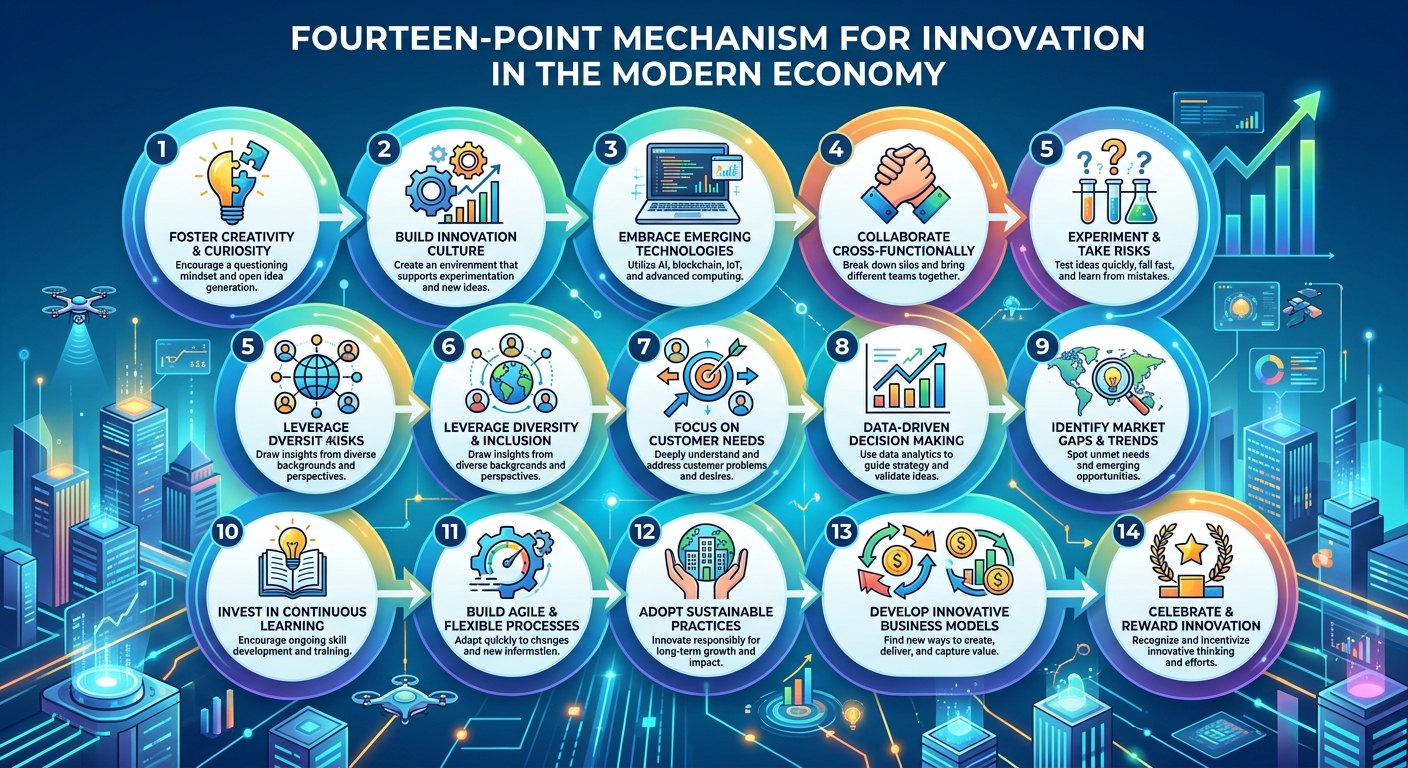
This thesis proposes a Fourteen-Point Innovation Mechanism—a practical framework for moving from observation → knowledge → problem identification → ideas → experimentation → technology → implementation → value creation → economic growth.
The central proposition is:
Innovation is the systematic conversion of knowledge, imagination and problem-solving into useful improvements that create measurable value.
1. Introduction: What Is Innovation?
Innovation is often confused with invention.
They are related but different.
Invention creates something that did not previously exist.
Innovation takes an idea, technology, process, product, service, business model, or organisational method and turns it into something useful and valuable.
For example:
- The invention of the computer was an invention.
- Using computers to automate accounting is innovation.
- Developing cloud accounting is another innovation.
- Using AI to automatically analyse financial transactions is further innovation.
Therefore:
Innovation = New or improved idea + implementation + usefulness + value
A simple economic representation is:
Innovation becomes economically important when it produces one or more of the following:
- higher productivity;
- lower costs;
- better quality;
- new markets;
- new businesses;
- new employment;
- better resource utilisation;
- improved living standards.
2. The Fourteen-Point Innovation Mechanism
The fourteen points are:
- Develop curiosity
- Observe problems
- Acquire multidisciplinary knowledge
- Think scientifically
- Understand technology
- Connect unrelated ideas
- Generate many possible solutions
- Experiment rapidly
- Use failure as information
- Build prototypes
- Use digital tools and AI
- Collaborate and transfer knowledge
- Convert innovation into economic value
- Continuously improve and scale
These fourteen mechanisms form a cycle rather than a straight line.
POINT 1 — DEVELOP CURIOSITY
The beginning of innovation
Innovation begins with a question.
A person who constantly asks:
Why?
eventually begins asking:
Why does this work this way?
and then:
Can it work better?
Curiosity is therefore an intellectual engine.
Children naturally ask questions. Innovative education should preserve this ability rather than replacing it with memorisation alone.
Important questions
An innovative person constantly asks:
- Why does this system exist?
- Who created it?
- What problem was it designed to solve?
- What does it do well?
- What does it do badly?
- Can it be cheaper?
- Can it be faster?
- Can it be safer?
- Can technology improve it?
- Can two different systems be combined?
Economic significance
Curiosity creates the first stage of the innovation pipeline:
Without questions, there is little reason to search for improvement.
POINT 2 — OBSERVE PROBLEMS
Problems are economic opportunities
One of the most important principles of modern innovation is:
Do not begin by asking what technology you want to build. Begin by asking what problem needs solving.
Every economy contains thousands of unresolved problems.
Examples include:
- expensive transportation;
- unreliable electricity;
- inefficient agriculture;
- food waste;
- poor logistics;
- inadequate healthcare access;
- financial exclusion;
- cybersecurity threats;
- inefficient government administration;
- educational inequality;
- water shortages;
- inefficient manufacturing.
An entrepreneur who identifies an important problem has already discovered the beginning of an innovation opportunity.
The Problem Equation
A small problem affecting millions of people can therefore become a major market.
POINT 3 — ACQUIRE MULTIDISCIPLINARY KNOWLEDGE
Modern innovation increasingly occurs between disciplines.
The most powerful innovations often combine:
- mathematics;
- physics;
- biology;
- computing;
- engineering;
- economics;
- accounting;
- psychology;
- design;
- agriculture;
- communications;
- materials science.
For example, modern smartphones combine:
Physics + semiconductor engineering + mathematics + software + telecommunications + materials science + economics + industrial design.
This creates an important principle:
The boundary between disciplines is often where new opportunities appear.
The T-shaped innovator
A useful model is the T-shaped person.
The vertical part represents deep expertise.
The horizontal part represents broad knowledge.
             BROAD KNOWLEDGE
     ─────────────────────────────
              │
              │
              │
        DEEP EXPERTISE
              │
              │
              │
A modern economy needs both.
POINT 4 — THINK SCIENTIFICALLY
Innovation should not depend entirely on intuition.
Scientific thinking provides a disciplined mechanism:
Observe
↓
Ask a question
↓
Form a hypothesis
↓
Experiment
↓
Measure
↓
Analyse
↓
Improve
This is essentially an innovation engine.
Suppose a farmer wants to increase crop productivity.
Instead of simply saying:
“I think this fertiliser will work.”
the innovative approach is:
Hypothesis: Fertiliser X under conditions Y will increase productivity.
Then:
- establish measurements;
- create a controlled comparison;
- collect data;
- analyse results;
- modify the approach.
Innovation becomes more reliable when ideas are tested against reality.
POINT 5 — UNDERSTAND TECHNOLOGY
Technology is one of the major instruments of modern innovation.
However, innovation does not mean simply buying the newest technology.
The innovator asks:
What capability does this technology provide?
For example:
| Technology | Capability |
|---|---|
| AI | Prediction, generation, analysis, automation |
| Cloud computing | Scalable computing and storage |
| IoT | Connecting physical objects to data |
| 5G/6G | High-speed connectivity |
| Robotics | Physical automation |
| Blockchain | Distributed recordkeeping |
| Satellites | Global observation and communication |
| Sensors | Measurement |
| Biotechnology | Manipulation and analysis of biological systems |
| 3D printing | Flexible manufacturing |
The innovation comes from applying the capability to a meaningful problem.
POINT 6 — CONNECT UNRELATED IDEAS
One of the most powerful mechanisms of innovation is combination.
Many innovations are not created from nothing.
They emerge by combining existing ideas.
For example:
Similarly:
This suggests a powerful innovation question:
What happens if I connect these two systems?
POINT 7 — GENERATE MANY POSSIBLE SOLUTIONS
Do not immediately fall in love with the first idea.
Generate alternatives.
Suppose the problem is expensive rural transportation.
Possible solutions might include:
- route optimisation;
- shared transport;
- electric vehicles;
- demand-based scheduling;
- mobile booking;
- logistics consolidation;
- autonomous systems in the future;
- satellite-based tracking.
The objective is to create an idea portfolio.
A useful formula is:
rather than:
POINT 8 — EXPERIMENT RAPIDLY
An idea is not yet an innovation.
It must be tested.
This is where experimentation becomes important.
Instead of spending enormous resources building the final system immediately, create a smaller experiment.
For software this might be:
- a simple application;
- a website;
- a simulation;
- an AI prototype.
For manufacturing:
- a physical model;
- a small production run.
For agriculture:
- a small experimental plot.
For education:
- a pilot course.
The principle is:
Test the smallest useful version before building the largest version.
POINT 9 — USE FAILURE AS INFORMATION
Failure is not automatically evidence that innovation has failed.
A failed experiment can produce valuable information.
Suppose:
The wrong interpretation is:
“Everything was wasted.”
The better interpretation is:
“The experiment has eliminated one possible pathway.”
This creates a learning cycle:
However, responsible innovation must distinguish between productive experimentation and reckless behaviour. Experiments should be designed with appropriate safety, ethics and financial controls.
POINT 10 — BUILD PROTOTYPES
A prototype is a simplified version of a proposed solution.
It allows innovators to move from:
abstract idea → tangible system
For example:
Idea
“Create an intelligent agricultural monitoring system.”
Prototype
A small system containing:
- soil sensor;
- temperature sensor;
- moisture measurement;
- mobile application;
- basic data dashboard.
Then the system can be tested.
Prototype cycle
This cycle is central to modern product development.
POINT 11 — USE DIGITAL TOOLS AND AI
The modern innovator has access to an extraordinary collection of tools.
Artificial intelligence can assist with:
- research;
- programming;
- data analysis;
- simulation;
- writing;
- design;
- forecasting;
- translation;
- education;
- automation;
- customer analysis;
- documentation.
But AI should be viewed as an innovation amplifier, not as a replacement for human judgment.
A useful model is:
The human identifies the objective and evaluates consequences.
AI can help explore the solution space much faster.
POINT 12 — COLLABORATE AND TRANSFER KNOWLEDGE
Modern innovation is rarely produced by one person working completely alone.
Major innovation ecosystems connect:
- universities;
- companies;
- entrepreneurs;
- engineers;
- scientists;
- investors;
- governments;
- customers;
- communities.
This produces a knowledge network.
University
     ↓
Research
     ↓
Technology
     ↓
Startup / Company
     ↓
Product
     ↓
Market
     ↓
Customer
     ↓
Feedback
     ↓
Further Research
This is an innovation ecosystem.
Knowledge transfer is especially important for developing economies because research has greater economic impact when it can move from laboratories into businesses and communities.
POINT 13 — CONVERT INNOVATION INTO ECONOMIC VALUE
This is where innovation becomes connected to the economy.
An invention or clever idea is not necessarily economically successful.
Economic innovation must eventually answer:
Who benefits, and how is value created?
A simple innovation-value chain is:
Revenue is only one form of value.
Innovation can also create:
- productivity;
- employment;
- exports;
- intellectual property;
- infrastructure;
- social benefits;
- environmental improvements;
- national competitiveness.
Example
A farmer develops a better irrigation-monitoring system.
The system can create value through:
- reduced water consumption;
- increased crop productivity;
- lower labour requirements;
- better planning;
- sale of the technology to other farmers.
The original idea therefore becomes an economic asset.
POINT 14 — CONTINUOUSLY IMPROVE AND SCALE
Innovation does not end when a product reaches the market.
Markets change.
Technology changes.
Customers change.
Competitors change.
Therefore:
Instead:
The cycle becomes:
Observe → Think → Build → Test → Measure → Learn → Improve → Scale → Observe again
This is one of the most important characteristics of innovative organisations.
3. The Complete Fourteen-Point Innovation Architecture
The entire mechanism can be represented as follows:
                 CURIOSITY
                     ↓
                OBSERVATION
                     ↓
              PROBLEM DISCOVERY
                     ↓
          MULTIDISCIPLINARY KNOWLEDGE
                     ↓
             SCIENTIFIC THINKING
                     ↓
            TECHNOLOGY UNDERSTANDING
                     ↓
             IDEA COMBINATION
                     ↓
             MULTIPLE SOLUTIONS
                     ↓
               EXPERIMENTATION
                     ↓
                  LEARNING
                     ↓
                PROTOTYPING
                     ↓
             DIGITAL + AI TOOLS
                     ↓
                COLLABORATION
                     ↓
              ECONOMIC VALUE
                     ↓
                 SCALING
                     ↓
              CONTINUOUS INNOVATION
                     ↺
4. The Innovation Equation
We can conceptualise the process mathematically:
Where:
- = innovation potential;
- = knowledge;
- = creativity;
- = experimentation;
- = technology capability;
- = market implementation.
The multiplication is important conceptually.
A person can possess enormous knowledge but produce little innovation if they never experiment.
Likewise:
- creativity without knowledge can lack feasibility;
- technology without a problem can become technology for its own sake;
- ideas without implementation remain ideas;
- products without customers may not create sustainable economic value.
5. Innovation and the Modern African Economy
For African economies, innovation has particular importance.
Africa has enormous innovation opportunities in:
Agriculture
- precision agriculture;
- irrigation;
- agricultural data;
- food processing;
- logistics;
- cold-chain systems.
Energy
- solar power;
- batteries;
- smart grids;
- distributed energy systems.
Financial services
- digital payments;
- financial inclusion;
- financial education;
- fraud detection.
Education
- digital learning;
- AI-assisted tutoring;
- technical education;
- scientific education.
Healthcare
- diagnostics;
- medical logistics;
- health information systems;
- remote healthcare technologies.
Manufacturing
- local production;
- automation;
- advanced materials;
- semiconductor-related industries.
Infrastructure
- intelligent transport;
- water management;
- telecommunications;
- smart cities.
The objective should not simply be to consume imported technology.
A stronger economic objective is:
Learn, adapt, develop, manufacture, export and continuously improve technology.
6. Innovation Requires a New Educational Philosophy
A modern innovation economy requires education that develops more than memorisation.
Students should learn:
- mathematics;
- science;
- computing;
- engineering principles;
- economics;
- accounting;
- communication;
- logic;
- critical thinking;
- creativity;
- entrepreneurship;
- practical problem-solving.
The ideal educational sequence becomes:
This changes education from simply receiving knowledge into producing knowledge and solutions.
7. The Individual Innovation Toolkit
An individual wishing to become more innovative can develop fourteen habits corresponding to the mechanism:
| Point | Habit |
|---|---|
| 1 | Ask better questions |
| 2 | Look for real problems |
| 3 | Study multiple disciplines |
| 4 | Test assumptions |
| 5 | Learn technology |
| 6 | Combine ideas |
| 7 | Generate alternatives |
| 8 | Experiment |
| 9 | Learn from mistakes |
| 10 | Build prototypes |
| 11 | Use AI and digital tools |
| 12 | Work with others |
| 13 | Create economic value |
| 14 | Improve continuously |
8. Innovation Is More Than Technology
One of the most important conclusions is that innovation does not necessarily require advanced technology.
Innovation can occur in:
- management;
- accounting;
- education;
- agriculture;
- logistics;
- manufacturing;
- government;
- finance;
- construction;
- healthcare;
- community organisation.
For example, redesigning a complicated government process from twenty steps to five steps can be a major innovation even without inventing a new machine.
Therefore:
but more precisely:
9. Innovation, Entrepreneurship and Economic Growth
Innovation and entrepreneurship are closely connected but are not identical.
Innovation creates or improves a solution.
Entrepreneurship organises resources to bring solutions into economic activity.
Therefore:
This can generate:
- startups;
- industries;
- employment;
- exports;
- tax revenue;
- productivity;
- investment;
- wealth creation.
At the national level:
10. The Greatest Innovation Principle
The deepest principle of the fourteen-point mechanism is this:
Do not ask only, “What can I invent?” Ask, “What problem can I understand deeply enough to solve better?”
That changes the entire mindset.
Instead of starting with technology:
Technology → Find a use
the innovator starts with:
Problem → Understand → Design → Technology → Solution
This approach reduces wasted resources and increases the probability that innovation will produce genuine value.
Conclusion
The modern economy is increasingly a knowledge economy, digital economy, technological economy and innovation economy simultaneously.
The most innovative individuals and organisations are not necessarily those with the most money or the newest technology. They are often those capable of seeing problems clearly, learning rapidly, combining knowledge, experimenting intelligently, using technology effectively, collaborating with others and continuously improving their solutions.
The proposed fourteen-point mechanism can therefore be summarised as:
1. Be curious.
2. Observe problems.
3. Learn broadly.
4. Think scientifically.
5. Understand technology.
6. Connect ideas.
7. Generate alternatives.
8. Experiment.
9. Learn from failure.
10. Prototype.
11. Use AI and digital tools.
12. Collaborate.
13. Create economic value.
14. Improve and scale continuously.
The ultimate objective is not simply to have innovative ideas.
It is to create a society in which knowledge continuously becomes solutions, solutions become productive enterprises, enterprises create value, and value improves human life.
That is the fundamental mechanism through which innovation can become an engine of a modern economy.




Be First to Comment