
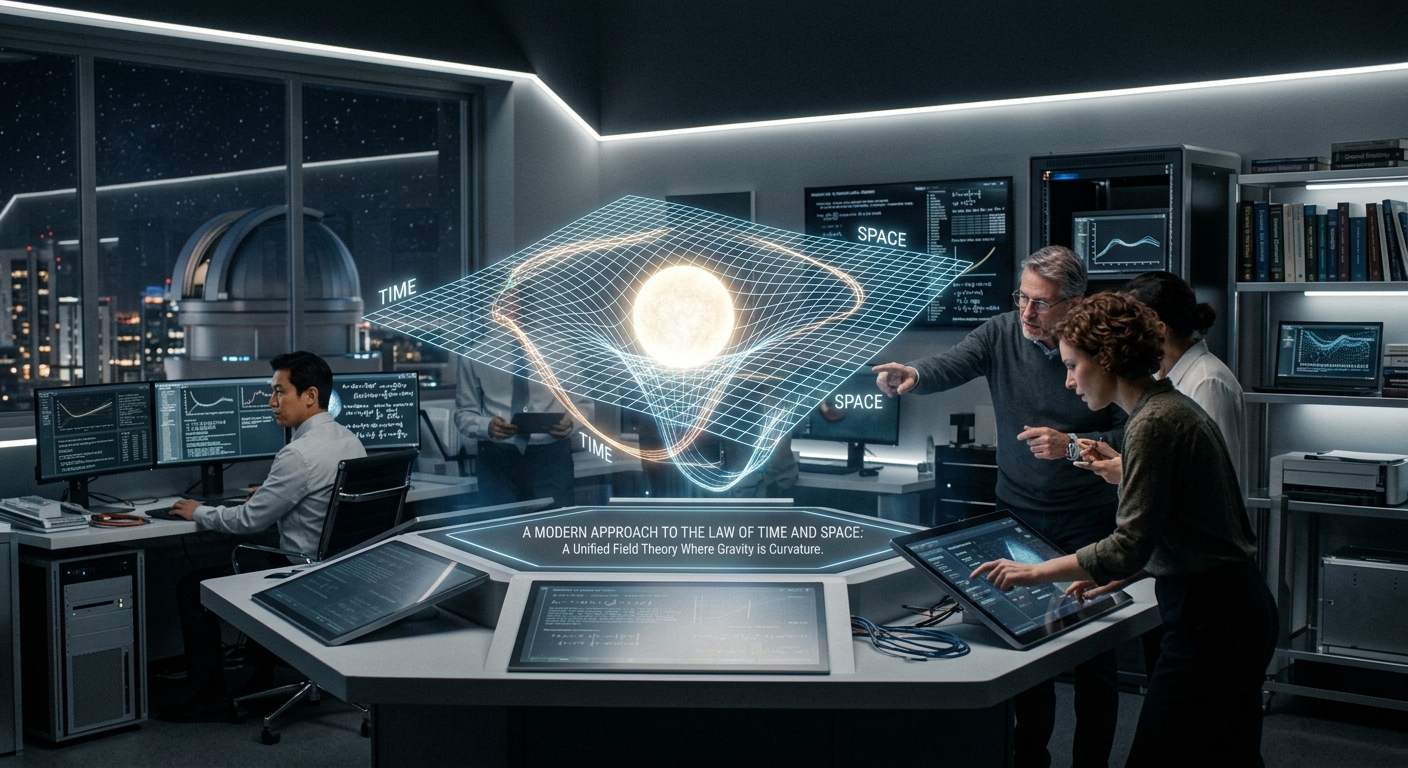
Understanding Space, Time, Motion, Gravity and Spacetime in Simple Detail
Abstract
Time and space are among the most fundamental concepts in science. Everything we observe happens somewhere and at some time. A person walks through space during a period of time; Earth travels through space around the Sun; light travels across the universe; stars form and disappear over enormous periods.
For centuries, scientists treated space and time largely as separate concepts. The modern scientific approach changed dramatically through Albert Einstein’s theory of special relativity (1905) and general relativity (1915).
Modern physics describes space and time together as spacetime. Matter and energy influence the geometry of spacetime, while that geometry influences how matter and light move.
In simple terms:
Matter tells spacetime how to curve, and curved spacetime tells matter how to move.
This does not mean that time is an illusion or that space is simply disappearing. It means that measurements of distance and time are connected to motion, gravity and the observer’s reference frame.
CHAPTER 1 — WHAT IS SPACE?
1.1 Simple definition
Space is the physical framework in which objects have positions, distances and directions.
For example, when we say:
- Johannesburg is north of another location,
- the Moon is approximately 384,000 km from Earth,
- Earth is approximately 150 million km from the Sun,
we are describing relationships in space.
Space allows us to describe:
- length,
- width,
- height,
- distance,
- direction,
- position,
- movement.
We normally describe ordinary physical space using three dimensions:
x = left/right
y = forward/backward
z = up/down
Therefore:
3-dimensional space = x + y + z
CHAPTER 2 — WHAT IS TIME?
Time provides a way of ordering events and measuring durations.
For example:
Event A → Event B → Event C
A seed is planted.
↓
The plant grows.
↓
The plant produces a flower.
Time allows us to describe the interval between these events.
We measure time using:
- seconds,
- minutes,
- hours,
- days,
- years,
- centuries.
Modern physics uses the second as the fundamental SI unit of time.
CHAPTER 3 — THE OLD VIEW: ABSOLUTE SPACE AND ABSOLUTE TIME
Before Einstein, classical mechanics was dominated by the framework associated with Isaac Newton.
Newtonian physics effectively treated space and time as universal backgrounds.
Imagine a gigantic invisible stage:
SPACE = the stage
TIME = the universal clock
Objects move across the stage while the universal clock continues ticking.
Under this classical view, if two observers have accurate clocks, they should fundamentally agree about the passage of time.
For everyday speeds, this model works extremely well.
That is why Newtonian mechanics remains extremely important for:
- construction,
- engineering,
- ordinary vehicles,
- buildings,
- machines,
- bridges,
- many industrial calculations.
But something changes when velocities become extremely high or gravity becomes extremely strong.
CHAPTER 4 — EINSTEIN’S REVOLUTION
Einstein introduced two revolutionary theories.
Special Relativity — 1905
Deals primarily with:
- motion,
- light,
- high velocities,
- space,
- time,
- reference frames.
General Relativity — 1915
Deals primarily with:
- gravity,
- spacetime,
- matter,
- energy,
- curved spacetime,
- planetary and cosmic motion.
Together they transformed our understanding of space and time.
CHAPTER 5 — THE SPEED OF LIGHT
One of the foundations of modern relativity is the speed of light in vacuum.
It is approximately:
299,792,458 metres per second
or approximately:
300,000 km/s
The remarkable discovery is that the measured speed of light in vacuum is the same for all inertial observers.
This produces consequences that seem strange from an everyday perspective.
If an object moves extremely fast, measurements of:
- time,
- distance,
- simultaneity
can differ between observers.
CHAPTER 6 — SPACE AND TIME BECOME SPACETIME
Einstein’s theory showed that space and time should not be regarded as completely independent.
They form a unified structure:
SPACETIME
A simplified representation is:
Spacetime = 3 dimensions of space + 1 dimension of time
Therefore:
(x, y, z, t)
describes an event.
For example, saying:
“A spacecraft was at this location at this particular time”
requires both spatial and temporal information.
That is an event in spacetime.
CHAPTER 7 — WHAT DOES “RELATIVITY” REALLY MEAN?
Relativity does not simply mean that “everything is relative.”
It means that measurements of certain physical quantities depend on the observer’s reference frame.
Different observers can disagree about:
- how much time passed,
- how far apart events occurred,
- whether two spatially separated events happened simultaneously.
Yet the laws of physics remain consistent.
This is one of the deepest ideas in modern physics.
CHAPTER 8 — TIME DILATION
One of the most famous consequences of special relativity is time dilation.
Imagine two highly accurate clocks.
Clock A remains relatively stationary.
Clock B travels at a very high speed.
When the clocks are compared after the journey, less proper time can have elapsed for the rapidly moving clock.
The effect becomes significant when the speed approaches the speed of light.
The simplified equation is:
Δt = γΔτ
where:
γ = 1 / √(1 − v²/c²)
Here:
- v = relative velocity,
- c = speed of light,
- Δτ = proper time,
- Δt = time measured in another inertial frame.
You do not need advanced mathematics to understand the principle:
The faster an object moves relative to an observer, the greater the relativistic difference in elapsed time.
At ordinary human speeds, this effect is extremely small.
At speeds approaching light speed, it becomes enormous.
CHAPTER 9 — GRAVITATIONAL TIME DILATION
Time is also affected by gravity.
According to general relativity, clocks in different gravitational environments do not necessarily tick at identical rates.
A clock closer to a massive gravitational source runs differently from one farther away.
This is called:
Gravitational time dilation
For example, clocks at different altitudes on Earth experience slightly different gravitational conditions.
The effect is tiny in everyday life but measurable with extremely precise clocks.
This is not merely theoretical.
Modern technologies such as satellite navigation require relativistic corrections.
CHAPTER 10 — SPACE CAN ALSO BE MEASURED DIFFERENTLY
Special relativity predicts another effect called length contraction.
For an object moving rapidly relative to an observer, its length measured along the direction of motion is shorter than its rest length.
The simplified equation is:
L = L₀/γ
where:
- L₀ = proper length,
- L = measured length,
- γ = Lorentz factor.
Again, the effect becomes important only at very high relative speeds.
CHAPTER 11 — SIMULTANEITY
One of the most surprising ideas is that two events that appear simultaneous to one observer may not be simultaneous to another observer moving relative to the first.
This is called:
Relativity of simultaneity
Imagine two lightning strikes occurring at different locations.
An observer standing between them may judge the strikes to have occurred simultaneously.
Another observer moving relative to the first may determine that one occurred before the other.
This happens because space and time measurements are interconnected.
CHAPTER 12 — THE SPACETIME INTERVAL
Although observers can disagree about particular measurements of space and time, relativity identifies an important quantity that remains invariant.
The spacetime interval can be written, depending on convention, as:
s² = c²Δt² − Δx² − Δy² − Δz²
The signs can be arranged differently depending on the mathematical convention.
The important concept is:
Different observers can measure different distances and times while agreeing on the underlying spacetime interval.
This is one of the mathematical foundations of special relativity.
CHAPTER 13 — GENERAL RELATIVITY: THE MODERN THEORY OF GRAVITY
Newton described gravity as a force between masses.
Einstein developed a deeper description.
General relativity says that matter and energy influence the geometry of spacetime.
A popular simplified expression is:
Matter and energy curve spacetime, and curved spacetime determines the motion of matter and light.
The central equation is Einstein’s field equation:
Gμν + Λgμν = (8πG/c⁴)Tμν
This equation connects:
Geometry
Gμν
with
Matter and energy
Tμν
and includes the cosmological constant:
Λ
The equation is extraordinarily compact, but its physical meaning is profound.
CHAPTER 14 — WHAT DOES “CURVED SPACE” MEAN?
Imagine placing a heavy ball on a stretched rubber sheet.
The sheet bends around the ball.
If a smaller ball rolls nearby, its path is influenced by the deformation.
This is only an analogy—it is not a complete representation of general relativity.
Actual spacetime curvature is four-dimensional and cannot be perfectly represented by a rubber sheet.
Nevertheless, the analogy helps explain the central idea:
Mass-energy → affects spacetime geometry
and
spacetime geometry → affects motion
CHAPTER 15 — GRAVITY AS GEOMETRY
In Newtonian physics:
Mass → gravitational force → acceleration
In general relativity:
Mass-energy → spacetime curvature → natural motion
An object in free fall is following the geometry of spacetime.
This leads to an important conceptual shift.
Gravity is not merely something pulling objects downward.
Instead, the geometry of spacetime determines the natural paths followed by freely moving objects.
These paths are called:
Geodesics
A geodesic is essentially the “straightest possible path” through curved spacetime.
CHAPTER 16 — WHY DOES AN APPLE FALL?
Under Newton’s description:
Earth’s mass produces a gravitational force that accelerates the apple downward.
Under Einstein’s description:
Earth changes the geometry of spacetime around it, and the apple follows a natural path through that curved spacetime.
Both descriptions predict the familiar falling apple extremely accurately within their appropriate domains.
Einstein’s theory, however, provides a deeper framework that also handles strong gravity and relativistic effects.
CHAPTER 17 — EARTH’S ORBIT AROUND THE SUN
A common misconception is that the Sun simply “pulls” Earth like an invisible rope.
In general relativity, the Sun’s mass-energy changes spacetime geometry.
Earth moves through that geometry.
The resulting trajectory is an orbit.
A simplified picture is:
Sun’s mass-energy
↓
Curved spacetime
↓
Earth follows a geodesic
↓
Orbital motion
CHAPTER 18 — LIGHT AND SPACETIME
One of the most important predictions of general relativity is that gravity affects the path of light.
Light follows the geometry of spacetime.
Therefore, massive objects can bend the apparent path of light.
This phenomenon is called:
Gravitational lensing
A galaxy or galaxy cluster can act as a gravitational lens.
The light from a more distant object can be:
- magnified,
- distorted,
- duplicated,
- stretched into arcs.
Astronomers use this phenomenon to study distant galaxies and the distribution of matter, including dark matter.
CHAPTER 19 — BLACK HOLES
A black hole represents an extreme gravitational environment.
When enough mass-energy is concentrated into a sufficiently compact region, spacetime can become structured so that an event horizon forms.
The event horizon is a boundary beyond which light cannot escape to distant observers.
A black hole is therefore not simply an extremely dark ordinary object.
It is an extreme region of spacetime.
CHAPTER 20 — TIME NEAR A BLACK HOLE
Gravity near a black hole can produce extremely strong gravitational time dilation relative to distant observers.
This does not mean that a person locally experiences time as simply “stopping.”
Locally, their own clock continues to behave normally.
The difference appears when measurements are compared between observers in different gravitational environments.
This distinction between:
local experience
and
comparison between reference frames
is essential for understanding relativity.
CHAPTER 21 — THE UNIVERSE ITSELF HAS SPACETIME
General relativity is not only about planets and stars.
It provides the mathematical foundation for modern cosmology.
The universe contains:
- galaxies,
- stars,
- planets,
- gas,
- radiation,
- dark matter,
- dark energy,
- spacetime itself.
Modern cosmology therefore asks:
How does spacetime evolve on the largest scales?
The answer involves the expansion of the universe.
CHAPTER 22 — EXPANDING SPACE
The expansion of the universe is often misunderstood as galaxies simply flying outward through pre-existing empty space.
A better simplified picture is that the distances between sufficiently distant galaxies increase because the scale of space itself evolves.
This is why cosmologists speak about:
Expansion of spacetime
The Big Bang model describes the universe as having evolved from an extremely hot, dense early state.
It is not best understood as an ordinary explosion occurring at one location inside already-existing empty space.
Instead, the model describes the evolution of space itself.
CHAPTER 23 — SPACE IS NOT AN EMPTY BOX
Modern physics does not treat space as merely nothing.
Space has physical and geometric properties.
Modern theories involve:
- spacetime geometry,
- gravitational fields,
- electromagnetic fields,
- quantum fields,
- vacuum energy,
- quantum fluctuations.
Therefore, the modern scientific picture is considerably richer than:
“Space is simply empty.”
CHAPTER 24 — TIME IS NOT JUST A CLOCK
A clock is an instrument that measures elapsed time.
Time itself is a deeper physical concept.
Different observers can measure different amounts of elapsed time between events.
This means that there is no universal cosmic clock that necessarily ticks identically everywhere under all conditions.
Instead, physics describes time through:
- clocks,
- worldlines,
- proper time,
- reference frames,
- spacetime geometry.
CHAPTER 25 — THE WORLDLINE
Every physical object traces a path through spacetime.
This path is called its:
Worldline
Imagine your entire life represented mathematically.
At birth:
Event 1
↓
Growing up:
Event 2
↓
School/work:
Event 3
↓
Later events:
Event 4, Event 5, Event 6…
Together, these events form a trajectory through spacetime.
The same concept applies to:
- planets,
- spacecraft,
- photons,
- particles,
- stars.
CHAPTER 26 — PROPER TIME
Proper time is the time measured by a clock travelling along its own worldline.
This is particularly important in relativity.
If two clocks follow different paths through spacetime and later meet again, they may have accumulated different amounts of proper time.
This is the deeper foundation behind the famous “twin paradox.”
CHAPTER 27 — THE TWIN PARADOX IN SIMPLE TERMS
Imagine two identical twins.
One remains on Earth.
The other travels on a very fast spacecraft and later returns.
Because of the different spacetime paths followed by the two twins, they can have experienced different amounts of elapsed proper time.
The travelling twin can therefore return younger than the Earth-bound twin.
This is not a contradiction.
The twins followed different paths through spacetime.
CHAPTER 28 — TIME TRAVEL: WHAT DOES SCIENCE ACTUALLY SAY?
Relativity permits a form of “travel into the future” in the sense that someone can experience less elapsed time than another person and therefore arrive in the other’s future.
High-speed travel and strong gravitational fields can produce differences in elapsed time.
However, science does not currently provide a practical method for humans to travel arbitrarily into the past.
Ideas involving wormholes and other exotic spacetime structures occur in theoretical physics, but they should not be confused with established practical technology.
CHAPTER 29 — WHY GPS NEEDS RELATIVITY
One of the clearest real-world examples is satellite navigation.
GPS satellites carry precise clocks.
Their clocks experience:
- special-relativistic effects because satellites move relative to Earth;
- general-relativistic effects because they experience a different gravitational environment.
These effects must be accounted for.
Without relativistic corrections, positioning systems would accumulate significant errors.
This demonstrates an important principle:
Relativity is not merely philosophical. It has practical technological consequences.
CHAPTER 30 — THE MODERN APPROACH TO TIME AND SPACE
The modern scientific framework can be summarized as follows:
Classical approach
Space + absolute time + Newtonian gravity
Einsteinian approach
Space + time → spacetime
and
Matter-energy → spacetime curvature
and
spacetime geometry → motion
This is the fundamental conceptual transition.
CHAPTER 31 — A SIMPLE SPACETIME MAP
Think of reality as:
                  SPACETIME
                     │
          ┌──────────┴──────────┐
          │                     │
        SPACE                  TIME
          │                     │
     x, y, z dimensions       t dimension
          │                     │
          └──────────┬──────────┘
                     │
                  EVENTS
                     │
                  MOTION
                     │
             WORLDLINES
                     │
              GRAVITATION
                     │
             CURVED SPACETIME
Everything that happens is an event located somewhere in spacetime.
CHAPTER 32 — THE FOUR-DIMENSIONAL VIEW
We commonly experience:
3 spatial dimensions
plus
1 temporal dimension
giving:
4-dimensional spacetime
Mathematically:
(x, y, z, t)
This does not mean that time behaves exactly like ordinary spatial dimensions.
Time has a different mathematical role in spacetime geometry.
That distinction is extremely important.
CHAPTER 33 — CAUSE AND EFFECT
Relativity also provides a structure for understanding causality.
No ordinary information or physical influence can propagate locally faster than light in vacuum.
Spacetime can therefore be divided conceptually into regions representing:
- possible causal influence,
- events that cannot causally influence one another,
- the observer’s past,
- the observer’s future.
This leads to the idea of a:
Light cone
A light cone represents the possible paths that light—and therefore causal signals—can take through spacetime from an event.
CHAPTER 34 — THE LIGHT CONE
A simplified diagram:
                  FUTURE
                    ▲
                   / \
                  /   \
                 /     \
                /       \
               /         \
              ●           ← Present event
               \         /
                \       /
                 \     /
                  \   /
                   \ /
                    ▼
                   PAST
The central point represents an event.
The upper cone represents possible future light signals.
The lower cone represents possible past light signals.
This provides a powerful way of understanding causality.
CHAPTER 35 — WHAT DOES GRAVITY DO TO TIME?
The simple relationship is:
More gravitational potential difference
↓
Different clock rates
This is why modern precision clocks can detect tiny differences in elapsed time at different elevations.
At ordinary Earth conditions, the effect is very small.
Near extremely compact objects such as black holes, it can become enormous.
CHAPTER 36 — WHAT DOES MOTION DO TO TIME?
Again, the simplified relationship is:
Greater relative velocity
↓
Greater relativistic time difference
As:
v → c
the Lorentz factor:
γ → very large values
But an object with mass cannot simply be accelerated to exactly the speed of light.
The energy required grows without bound as its speed approaches c.
Light itself travels at c in vacuum because photons are massless particles.
CHAPTER 37 — WHY CAN’T A MASSIVE OBJECT REACH LIGHT SPEED?
Relativity gives the energy relationship:
E = γmc²
where:
- E = relativistic energy,
- m = rest mass,
- c = speed of light,
- γ = Lorentz factor.
As velocity approaches c, γ increases dramatically.
Therefore, accelerating a massive object closer and closer to c requires increasingly enormous energy.
This creates a fundamental speed limit for ordinary matter.
CHAPTER 38 — SPACE AND TIME ARE MEASUREMENTS OF RELATIONSHIPS
An important philosophical lesson from modern physics is that measurements are relational.
We ask:
- Where is the object?
- When did the event happen?
- How far apart are the events?
- How much proper time passed?
- What is the observer’s reference frame?
Therefore, modern physics does not simply ask:
“What is the absolute time?”
It asks:
“What does each physical observer measure, and how are those measurements related?”
CHAPTER 39 — NEWTON AND EINSTEIN ARE NOT ENEMIES
It is incorrect to say that Einstein simply “destroyed” Newton.
Newtonian physics is an extremely accurate approximation under ordinary conditions.
For example:
Low speeds + ordinary gravity → Newtonian mechanics works exceptionally well.
But:
Very high speeds + strong gravity + cosmological scales → relativity becomes essential.
Therefore:
Newton → excellent approximation
Einstein → deeper relativistic framework
This is how science often progresses.
A newer theory can contain the older theory as an approximation within a particular range.
CHAPTER 40 — QUANTUM PHYSICS AND THE NEXT PROBLEM
Modern physics has two extraordinarily successful frameworks:
General relativity
Describes:
- gravity,
- spacetime,
- planets,
- stars,
- black holes,
- cosmology.
Quantum mechanics
Describes:
- atoms,
- particles,
- quantum fields,
- microscopic interactions.
The major unresolved challenge is developing a fully satisfactory theory of:
Quantum gravity
Such a theory would attempt to describe gravity and spacetime consistently at quantum scales.
Possible research areas include:
- string theory,
- loop quantum gravity,
- quantum field theory in curved spacetime,
- emergent spacetime,
- holographic approaches.
These remain active areas of theoretical research rather than established final answers.
CHAPTER 41 — THE MODERN SCIENTIFIC HIERARCHY
Our understanding can be organized like this:
CLASSICAL MECHANICS
        │
        ▼
SPECIAL RELATIVITY
        │
        ▼
GENERAL RELATIVITY
        │
        ▼
MODERN COSMOLOGY
        │
        ▼
QUANTUM FIELD THEORY
        │
        ▼
SEARCH FOR QUANTUM GRAVITY
Each stage addresses a broader or more demanding physical domain.
CHAPTER 42 — THE FIVE KEY PRINCIPLES
The modern approach to time and space can be remembered through five principles.
Principle 1 — Space has dimensions
Objects have positions and distances.
Principle 2 — Time orders events
Events occur along temporal relationships.
Principle 3 — Space and time are interconnected
They form spacetime.
Principle 4 — Motion affects measurements
Relative motion changes measured time and length.
Principle 5 — Gravity affects spacetime geometry
Matter and energy influence spacetime, and spacetime influences motion.
CHAPTER 43 — SIMPLE EVERYDAY ANALOGY
Imagine a giant four-dimensional road system.
Every object travels along its own route.
A car has:
- a location,
- a direction,
- a speed,
- a time.
Now imagine the road itself can change shape.
A massive object changes the geometry of the road.
The car then follows the changed geometry.
This is a rough analogy for general relativity.
The important difference is that real spacetime is not a physical rubber sheet or ordinary road. It is a four-dimensional geometric structure.
CHAPTER 44 — WHY TIME HAS A DIRECTION
Physics distinguishes between the equations describing many microscopic processes and our macroscopic experience of time.
We experience:
past → present → future
One important concept connected with this is the:
Arrow of time
The thermodynamic arrow of time is associated with the tendency of entropy to increase in macroscopic isolated systems.
For example:
A neatly organized system can naturally become more disordered.
This gives us an important physical distinction between:
the geometry of spacetime
and
the thermodynamic direction of time.
Understanding why time has the direction we experience remains an important scientific and philosophical subject.
CHAPTER 45 — TIME, SPACE AND HUMAN CIVILIZATION
Our understanding of time and space affects modern civilization directly.
It supports:
- satellite navigation,
- telecommunications,
- astronomy,
- space exploration,
- satellite timing,
- high-energy physics,
- astrophysics,
- cosmology,
- precision measurement,
- modern engineering.
The theory that began as an abstract investigation into space and time became part of modern technological infrastructure.
CHAPTER 46 — A SIMPLE COMPARISON
| Question | Classical Newtonian View | Modern Relativistic View |
|---|---|---|
| Space | Absolute background | Part of spacetime |
| Time | Universal | Depends on spacetime path/reference frame |
| Gravity | Force | Spacetime geometry |
| Light | Special but within mechanics | Fundamental invariant speed |
| High velocity | Classical equations | Relativistic equations |
| Strong gravity | Newtonian approximation | General relativity |
| Universe | Static background in classical model | Dynamical spacetime |
CHAPTER 47 — THE MOST IMPORTANT EQUATIONS
Newtonian gravity
F = Gm₁m₂/r²
Gravity is represented as a force between masses.
Special relativity
E = mc²
Mass and energy are deeply related.
Lorentz factor
γ = 1/√(1 − v²/c²)
Describes relativistic effects associated with velocity.
Einstein field equation
Gμν + Λgμν = (8πG/c⁴)Tμν
Connects spacetime geometry with matter and energy.
These equations represent different layers of our understanding of physical reality.
CHAPTER 48 — THE CENTRAL IDEA IN ONE DIAGRAM
                 MATTER
                    +
                 ENERGY
                    │
                    ▼
          ┌─────────────────┐
          │     SPACETIME   │
          │                 │
          │  SPACE + TIME   │
          └─────────────────┘
                    │
             GEOMETRY CHANGES
                    │
                    ▼
              GRAVITATION
                    │
                    ▼
          MOTION OF MATTER
                    │
                    ▼
             OBSERVABLE EVENTS
This represents the central idea of general relativity.
CHAPTER 49 — WHAT “THE LAW OF TIME AND SPACE” REALLY MEANS
Strictly speaking, physics does not have one single equation officially called “the Law of Time and Space.”
Instead, our modern understanding comes from several interconnected theories and principles:
- Classical mechanics
- Special relativity
- General relativity
- Quantum mechanics
- Quantum field theory
- Cosmology
- Thermodynamics
Together they provide a progressively deeper description of time, space, matter, energy and physical interactions.
The most important modern framework for gravity and spacetime is general relativity.





Be First to Comment