
Abstract
Education is not a single activity. Human beings learn through many different relationships, methods, environments, and stages of development. The words teacher, tutor, lecturer, instructor, trainer, mentor, and coach are often used interchangeably, yet each represents a different educational function.
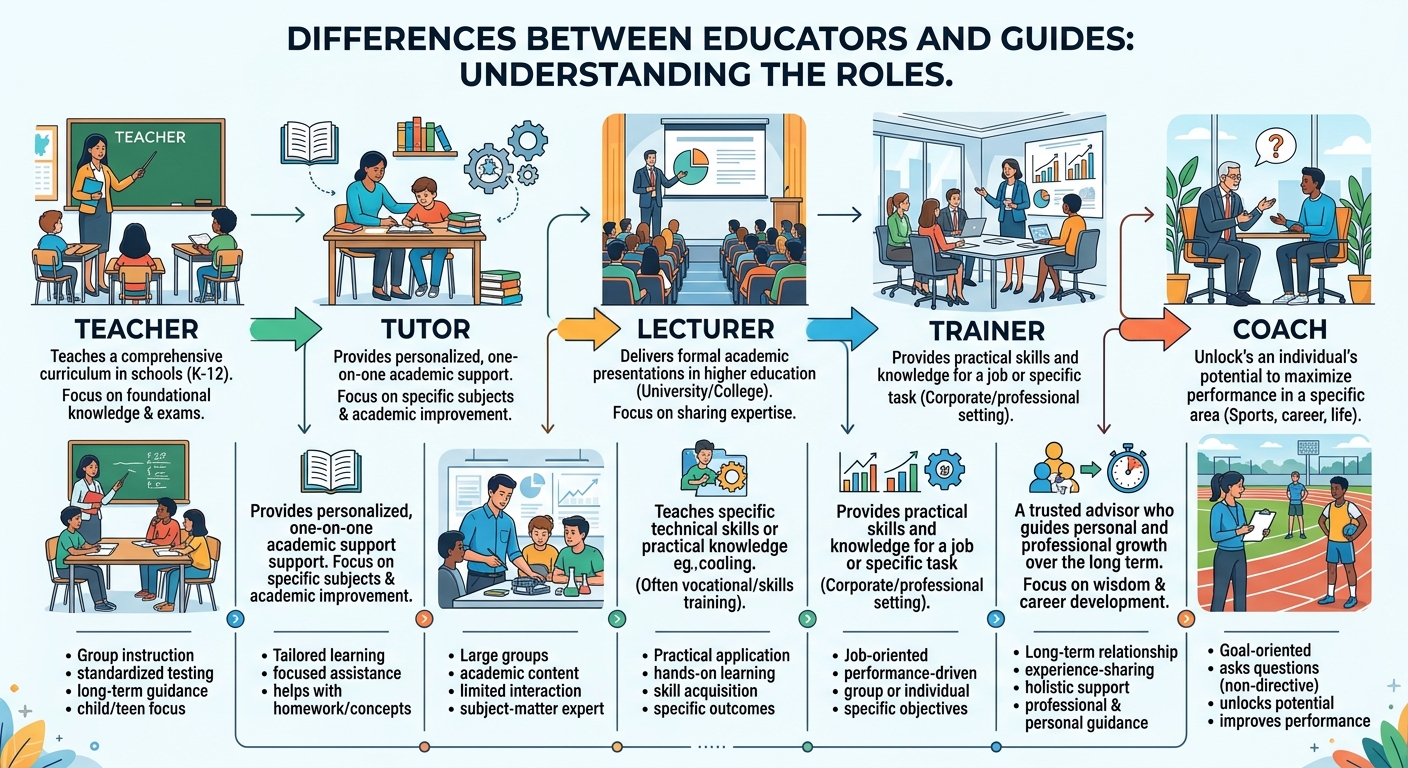
A teacher generally develops broad knowledge, understanding, values, and intellectual foundations. A tutor provides more individualized academic support. A lecturer primarily communicates advanced knowledge, often within higher education. An instructor teaches a defined skill, procedure, or competency. A trainer develops practical performance through repeated practice. A mentor provides long-term guidance based on experience and personal development. A coach helps a learner or performer improve performance by establishing goals, observing performance, asking questions, providing feedback, and developing strategies.
These roles overlap, but they are not identical. Understanding their architecture is important for schools, universities, businesses, technical institutions, sports, professional development, and lifelong learning.
Chapter 1 — The Fundamental Meaning of Education
Education can be understood as the organized process through which a person develops:
- Knowledge — knowing facts and concepts
- Understanding — knowing why something works
- Skills — knowing how to perform something
- Judgment — knowing what decision to make
- Experience — learning from real situations
- Character — developing responsible behavior
- Creativity — producing new ideas
- Confidence — becoming capable of acting independently
- Wisdom — applying knowledge appropriately
Therefore, education is much larger than simply transferring information.
A useful model is:
Information → Knowledge → Understanding → Skill → Experience → Judgment → Wisdom
Different educational professionals operate at different points along this pathway.
Chapter 2 — The Seven Educational Roles
| Role | Primary purpose | Main question |
|---|---|---|
| Teacher | Develop knowledge and understanding | “What should you understand?” |
| Tutor | Provide individualized academic assistance | “Where are you struggling?” |
| Lecturer | Communicate advanced/systematic knowledge | “What does the field of knowledge tell us?” |
| Instructor | Teach a specific skill or procedure | “How do you perform this correctly?” |
| Trainer | Build practical competence through practice | “Can you perform this reliably?” |
| Mentor | Guide long-term development | “What kind of person/professional are you becoming?” |
| Coach | Improve performance toward defined goals | “How can you perform better?” |
The boundaries are not absolute. One person can perform several of these roles simultaneously.
Chapter 3 — The Teacher
3.1 Definition
A teacher is an educational professional who helps learners acquire knowledge, understanding, skills, attitudes, and intellectual habits.
The teacher is usually associated with structured education.
Teachers may work in:
- primary schools
- secondary schools
- vocational institutions
- adult education
- special education
- community education
- online education
3.2 The teacher’s architecture
A teacher normally operates through:
Curriculum → Lesson → Explanation → Activity → Assessment → Feedback → Improvement
The teacher does not merely deliver information.
A good teacher asks:
“How can I make this learner understand?”
That distinction is extremely important.
Example
A teacher explaining mathematics does not simply say:
2 + 2 = 4.
The teacher may explain:
- what numbers represent;
- what addition means;
- how quantities combine;
- why the answer is 4;
- how addition relates to subtraction;
- how the learner can apply it to real life.
The objective is understanding, not memorization alone.
Chapter 4 — The Tutor
4.1 Definition
A tutor normally provides more focused and individualized educational assistance.
The tutor’s work often begins with a specific problem:
“The learner understands some of the material but needs additional support.”
Tutoring may be:
- one-to-one;
- small-group;
- subject-specific;
- remedial;
- examination-oriented;
- enrichment-oriented.
4.2 Teacher versus tutor
A teacher may work with:
30 learners → one curriculum → common lesson
A tutor may work with:
1 learner → specific difficulty → customized explanation
For example, a classroom teacher may teach algebra to an entire class.
A tutor might discover:
“This learner understands equations but has difficulty with negative numbers.”
The tutor can then concentrate specifically on that weakness.
Core difference
Teacher = broad educational development
Tutor = targeted educational assistance
Chapter 5 — The Lecturer
5.1 Definition
A lecturer traditionally refers to someone who delivers formal academic instruction, particularly at colleges and universities.
The lecturer is often responsible for communicating:
- theories;
- models;
- research;
- academic literature;
- analytical frameworks;
- specialized knowledge.
A university lecturer may teach hundreds of students through lectures, seminars, tutorials, laboratory sessions, or digital platforms.
5.2 The lecture model
The traditional lecture follows approximately:
Expert knowledge → presentation → student interpretation → independent study → assessment
The lecturer therefore often operates at a more advanced level of specialization.
Example
A school teacher may introduce:
“What is gravity?”
A university lecturer in physics may examine:
- Newtonian gravitational theory;
- gravitational fields;
- potential energy;
- orbital mechanics;
- general relativity;
- mathematical models;
- experimental evidence.
The distinction is primarily about educational context and level, rather than simply professional status.
A lecturer can also be a teacher.
Chapter 6 — The Instructor
6.1 Definition
An instructor teaches a defined subject, technique, procedure, or competency.
The word is particularly common when instruction has a practical component.
Examples include:
- driving instructor;
- computer instructor;
- laboratory instructor;
- aviation instructor;
- swimming instructor;
- technical instructor;
- military instructor.
The instructor frequently answers:
“How do you do this correctly and safely?”
6.2 Instructional architecture
A common instructional sequence is:
Demonstrate → Explain → Practice → Observe → Correct → Repeat → Assess
For example, a computer instructor teaching spreadsheet skills might demonstrate:
- opening a spreadsheet;
- entering data;
- creating formulas;
- formatting cells;
- creating charts;
- saving the document.
The learner then practices.
Chapter 7 — The Trainer
7.1 Definition
A trainer focuses strongly on developing performance and competence through practice.
Training is particularly important in:
- companies;
- manufacturing;
- healthcare;
- technology;
- emergency services;
- sports;
- military organizations;
- vocational education;
- professional certification.
Training frequently follows:
Teach → Practice → Measure → Correct → Repeat → Perform
7.2 Instructor versus trainer
The distinction can be subtle.
An instructor may teach the procedure.
A trainer often concentrates on whether the learner can repeatedly perform that procedure to an acceptable standard.
Example: software
An instructor might teach:
“Here is how to use the accounting system.”
A trainer might then give employees realistic accounting tasks and evaluate whether they can complete them accurately and efficiently.
Thus:
Instruction = learning the method
Training = developing reliable performance
Chapter 8 — The Mentor
8.1 Definition
A mentor provides guidance based significantly on experience, perspective, and long-term development.
Mentoring is usually less about teaching a particular lesson and more about helping someone navigate a larger journey.
A mentor may discuss:
- career decisions;
- professional ethics;
- leadership;
- personal development;
- strategic thinking;
- mistakes;
- opportunities;
- organizational culture;
- long-term goals.
8.2 Mentor’s central question
The mentor asks:
“Where are you going, and what do you need to become capable of getting there?”
This makes mentoring particularly important during transitions.
For example:
Student → graduate → professional → leader
A mentor can help the person understand what each stage requires.
Chapter 9 — The Coach
9.1 Definition
A coach helps an individual or team improve performance toward specific objectives.
Coaching is strongly associated with:
- sports;
- business;
- leadership;
- executive development;
- performance improvement;
- skills development;
- personal goal achievement.
A coach does not necessarily provide all the answers.
Instead, coaching often involves:
- questioning;
- observation;
- feedback;
- goal-setting;
- strategy;
- accountability;
- reflection;
- performance analysis.
9.2 Coaching architecture
A useful model is:
Goal → Current Performance → Gap → Strategy → Practice → Feedback → Adjustment → Goal
For example:
A basketball coach may observe that a player has difficulty making decisions under pressure.
Instead of merely saying “play better,” the coach might identify the performance problem, design practice situations, observe the player, provide feedback, and measure improvement.
Chapter 10 — Teacher vs Tutor vs Lecturer vs Instructor vs Trainer vs Mentor vs Coach
The differences become clearer when we examine their primary objectives.
Teacher
Primary objective: education
Main focus: knowledge and understanding
Typical relationship: learner + curriculum
Tutor
Primary objective: academic assistance
Main focus: individual learning needs
Typical relationship: tutor + learner
Lecturer
Primary objective: advanced knowledge communication
Main focus: academic/specialized knowledge
Typical relationship: lecturer + class/cohort
Instructor
Primary objective: teach a defined skill or procedure
Main focus: correct method
Typical relationship: instructor + trainee/learner
Trainer
Primary objective: develop competence and performance
Main focus: practice and measurable capability
Typical relationship: trainer + trainee
Mentor
Primary objective: long-term development
Main focus: experience, judgment, career, personal/professional growth
Typical relationship: experienced person + developing person
Coach
Primary objective: improve performance
Main focus: goals, feedback, strategy, accountability
Typical relationship: coach + performer/team
Chapter 11 — The Knowledge-to-Performance Pyramid
These roles can be represented as a developmental pyramid:
                         WISDOM
                           ▲
                       ┌─────────┐
                       │ MENTOR  │
                       └────┬────┘
                            │
                      JUDGMENT/GROWTH
                            │
                       ┌────▼────┐
                       │ COACH   │
                       └────┬────┘
                            │
                       PERFORMANCE
                            │
                      ┌─────▼─────┐
                      │  TRAINER  │
                      └─────┬─────┘
                            │
                        COMPETENCE
                            │
                     ┌──────▼──────┐
                     │ INSTRUCTOR  │
                     └──────┬──────┘
                            │
                         SKILL
                            │
                  ┌─────────▼─────────┐
                  │ TEACHER / TUTOR   │
                  └─────────┬─────────┘
                            │
                  KNOWLEDGE & UNDERSTANDING
This is not a rigid hierarchy. Rather, it illustrates different educational functions.
Chapter 12 — One Person Can Perform All Seven Roles
One of the most important insights is that these categories describe functions, not necessarily separate people.
Consider an experienced engineering professor.
The same person could be:
Teacher
Explains engineering principles.
Lecturer
Delivers university-level engineering theory.
Tutor
Helps a student who is struggling with mathematics.
Instructor
Demonstrates how to use engineering software.
Trainer
Runs practical engineering simulations.
Mentor
Advises students about becoming engineers.
Coach
Helps a student improve their research and presentation performance.
Therefore:
One educator can contain seven educational functions.
Chapter 13 — The Educational Lifecycle
A complete educational ecosystem might look like:
              DISCOVERY
                  │
                  ▼
              TEACHER
                  │
                  ▼
              UNDERSTANDING
                  │
                  ▼
               TUTOR
                  │
                  ▼
            CLARIFICATION
                  │
                  ▼
             LECTURER
                  │
                  ▼
         ADVANCED KNOWLEDGE
                  │
                  ▼
             INSTRUCTOR
                  │
                  ▼
                SKILL
                  │
                  ▼
              TRAINER
                  │
                  ▼
             COMPETENCE
                  │
                  ▼
               COACH
                  │
                  ▼
             PERFORMANCE
                  │
                  ▼
              MENTOR
                  │
                  ▼
        EXPERIENCE + JUDGMENT
                  │
                  ▼
              INDEPENDENCE
The ultimate objective should not be permanent dependence upon educators.
It should be:
Learner → Competent Practitioner → Independent Thinker → Contributor → Potential Teacher/Mentor
Chapter 14 — The Difference in Questioning
Each role tends to ask a different central question.
| Role | Characteristic question |
|---|---|
| Teacher | What do you need to understand? |
| Tutor | What are you finding difficult? |
| Lecturer | What does the accumulated knowledge of this field tell us? |
| Instructor | Can you perform the procedure correctly? |
| Trainer | Can you perform it consistently under realistic conditions? |
| Coach | How can your performance improve? |
| Mentor | What are you becoming, and where are you going? |
This gives us a powerful educational framework.
Chapter 15 — Knowledge, Skills, Performance and Wisdom
The seven roles can also be mapped onto four major dimensions.
1. Knowledge
Primarily developed through:
Teacher + Lecturer
2. Skill
Primarily developed through:
Instructor + Tutor
3. Performance
Primarily developed through:
Trainer + Coach
4. Wisdom and development
Primarily supported through:
Mentor
But there is considerable overlap.
Chapter 16 — The Modern Digital Transformation
Artificial intelligence, online education, simulations, virtual laboratories, learning-management systems, and digital collaboration are changing these roles.
A modern educational system can combine:
Human educator + AI + digital content + simulation + assessment + data
For example:
                  LEARNER
                     │
          ┌──────────┼──────────┐
          ▼          ▼          ▼
       TEACHER       AI       CONTENT
          │          │          │
          └──────────┼──────────┘
                     ▼
                UNDERSTANDING
                     │
                  PRACTICE
                     │
          ┌──────────┼──────────┐
          ▼          ▼          ▼
      INSTRUCTOR   TRAINER    SIMULATION
          │          │          │
          └──────────┼──────────┘
                     ▼
                 PERFORMANCE
                     │
               COACH + MENTOR
                     │
                     ▼
                INDEPENDENCE
AI can therefore assist with explanation, practice, feedback, personalization, and assessment, while human educators remain particularly important for judgment, relationships, context, ethics, leadership, and mentorship.
Chapter 17 — Education Is More Than Information Transfer
One of the biggest mistakes in modern education is assuming:
Education = transferring information.
It is much broader.
A sophisticated educational system transfers:
Information
↓
Knowledge
↓
Understanding
↓
Skill
↓
Practice
↓
Competence
↓
Performance
↓
Experience
↓
Judgment
↓
Wisdom
This explains why the seven roles are valuable.
A lecturer can give someone knowledge.
An instructor can teach the technique.
A trainer can develop competence.
A coach can improve performance.
A mentor can help develop judgment.
A teacher can help establish the intellectual foundation.
A tutor can help overcome specific learning barriers.
Chapter 18 — The Ideal Educator of the Future
The most powerful educator of the future may not fit into one category.
Instead, the ideal educational professional may become a:
Teacher + Tutor + Lecturer + Instructor + Trainer + Coach + Mentor
Such an educator could:
- explain fundamental concepts;
- personalize learning;
- introduce advanced theories;
- demonstrate practical skills;
- organize deliberate practice;
- measure performance;
- provide feedback;
- develop critical thinking;
- guide career development;
- develop leadership;
- encourage independent research;
- eventually help the learner become an educator themselves.
This creates an educational ecosystem rather than a single teaching event.
Chapter 19 — From Learner to Knowledge Producer
The highest level of education is not simply producing people who can pass examinations.
It is producing people who can:
- ask important questions;
- investigate problems;
- analyze evidence;
- calculate;
- experiment;
- build;
- create;
- communicate;
- collaborate;
- solve problems;
- challenge incorrect assumptions;
- generate new knowledge.
The progression becomes:
Learner → Practitioner → Problem Solver → Innovator → Knowledge Producer → Mentor
That is particularly important for science, mathematics, engineering, medicine, technology, economics, agriculture, and other knowledge-intensive fields.
Chapter 20 — Final Comparative Summary
| Role | Core function | Time horizon | Typical emphasis |
|---|---|---|---|
| Teacher | Educates | Medium/long | Knowledge & understanding |
| Tutor | Supports | Short/medium | Individual learning |
| Lecturer | Communicates advanced knowledge | Course/academic cycle | Theory & scholarship |
| Instructor | Demonstrates and teaches | Short/medium | Technique & procedure |
| Trainer | Develops competence | Medium | Practice & performance |
| Coach | Improves performance | Short/medium/long | Goals & feedback |
| Mentor | Develops the person | Long | Experience & wisdom |
The simplest distinction
If we reduce everything to seven sentences:
A teacher helps you understand.
A tutor helps you overcome what you do not understand.
A lecturer exposes you to advanced and systematic knowledge.
An instructor shows you how to do something.
A trainer helps you become competent through practice.
A coach helps you perform better.
A mentor helps you grow into the person or professional you can become.
The deepest conclusion
These roles should not be viewed as competing professions. They are complementary components of the architecture of human development.
A modern education system becomes strongest when it connects them:
Teacher → Tutor → Lecturer → Instructor → Trainer → Coach → Mentor → Independent Thinker
And eventually the learner reaches the most important transition:
From receiving knowledge to creating knowledge, applying knowledge, sharing knowledge, and transferring knowledge to the next generation.
That is the ultimate purpose of education: not merely to produce people who know, but people who can understand, do, think, create, lead, and teach others.



Be First to Comment