
Abstract
Budget deficits are among the most important indicators of the financial condition of a modern state. A government records a budget deficit when its expenditures exceed its revenues during a specified fiscal period. Deficits can finance infrastructure, education, healthcare, defense, social protection, technological development, economic stabilization, and emergency responses. However, persistent deficits can also increase public debt, interest costs, refinancing requirements, and vulnerability to economic shocks.
This thesis examines the relationship between economic size and fiscal deficits among the world’s largest economies. It explains the structure of government revenue and expenditure, the difference between budget deficits and public debt, the economic purposes of borrowing, the causes of persistent deficits, and the mechanisms governments use to manage fiscal sustainability.
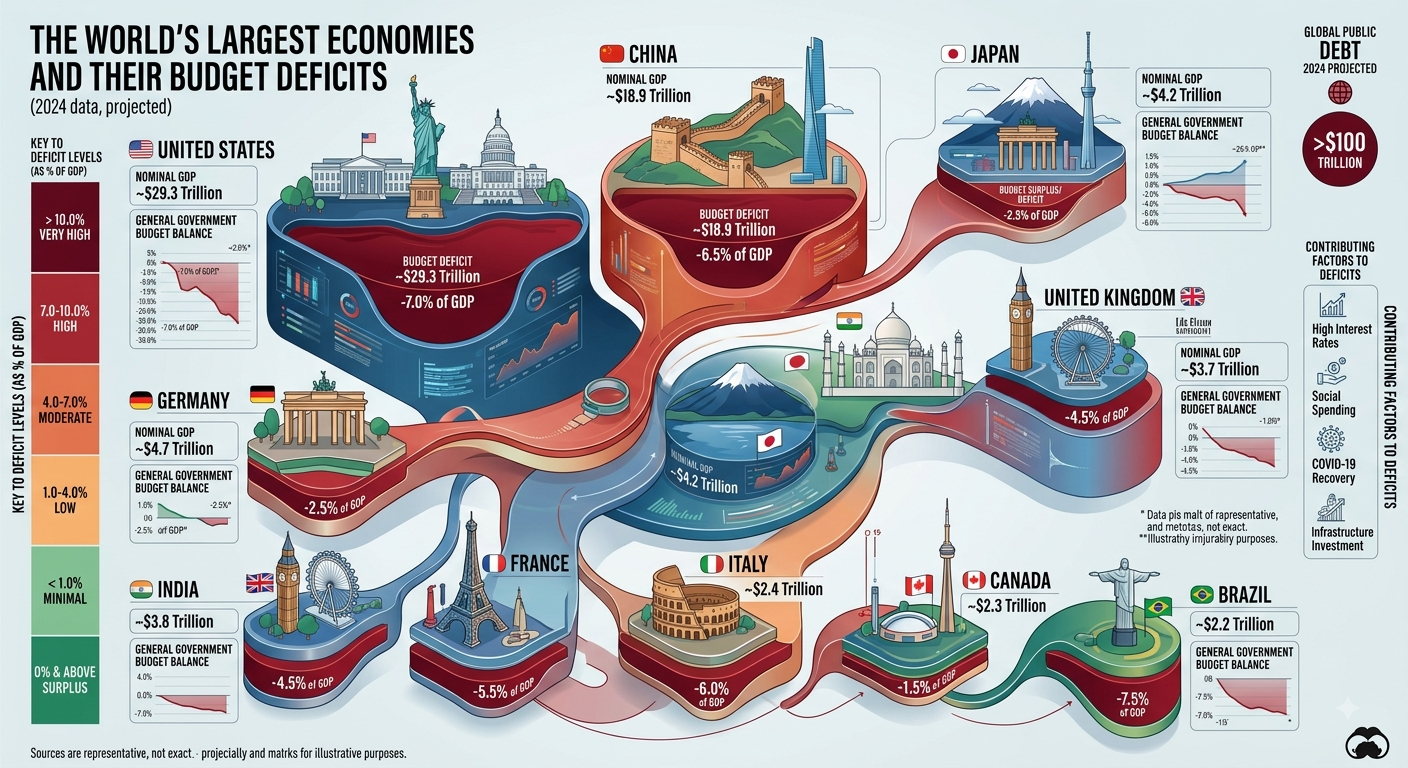
The analysis considers major economies including the United States, China, Germany, Japan, India, the United Kingdom, France, Italy, Canada, Brazil, Russia, and other economically significant countries. Particular attention is given to the distinction between nominal deficit values and deficits measured as percentages of GDP. A large economy can have a very large deficit in monetary terms while maintaining a relatively moderate deficit-to-GDP ratio, whereas a smaller economy can experience a much smaller nominal deficit but a much more serious fiscal burden relative to its economic output.
The contemporary global fiscal environment is characterized by elevated public debt, higher interest costs, defense requirements, demographic pressures, infrastructure needs, technological investment, and geopolitical uncertainty. The IMF reported that the global fiscal deficit remained around 5% of GDP in 2025, while global public debt approached 94% of GDP.
1. Introduction
Modern economies depend upon governments to provide public goods and services that markets alone cannot efficiently provide.
These include:
- roads and transportation systems;
- electricity and energy infrastructure;
- water and sanitation;
- education;
- healthcare;
- public administration;
- courts and legal systems;
- national security;
- environmental protection;
- scientific research;
- social protection;
- economic regulation; and
- emergency response.
Governments finance these activities primarily through taxation and other revenues.
The fundamental fiscal equation is:
Government Revenue − Government Expenditure = Fiscal Balance
When:
Revenue > Expenditure
the government records a surplus.
When:
Revenue < Expenditure
the government records a deficit.
A deficit therefore does not automatically mean that a government is economically failing. Borrowing can be used productively when it finances investments that strengthen future economic capacity.
The critical question is not simply:
“Does the government have a deficit?”
but rather:
“Why does the government have a deficit, how large is it relative to the economy, how is it financed, and can the resulting debt remain sustainable?”
2. Understanding the World’s Largest Economies
Economic size is commonly measured using gross domestic product (GDP).
GDP represents the market value of final goods and services produced within an economy during a specified period.
The world’s largest economies include major powers from North America, Europe, and Asia.
Among the most important are:
- United States
- China
- Germany
- Japan
- India
- United Kingdom
- France
- Italy
- Canada
- Brazil
- Russia
- Mexico
- Australia
- South Korea
- Spain
However, economic ranking and fiscal strength are not the same thing.
A country can possess:
- enormous GDP;
- sophisticated financial markets;
- high government revenues;
- strong institutions;
and still maintain a substantial fiscal deficit.
Conversely, a smaller country can have a comparatively small nominal deficit while facing severe fiscal stress.
3. GDP and the Measurement of Fiscal Deficits
The most useful method of comparing government deficits between countries is the deficit-to-GDP ratio.
The basic equation is:
Fiscal Deficit Ratio = Fiscal Deficit ÷ GDP × 100
For example, suppose:
GDP = $1 trillion
Government expenditure = $250 billion
Government revenue = $220 billion
Then:
Deficit = $250 billion − $220 billion
Deficit = $30 billion
The deficit-to-GDP ratio is:
$30 billion ÷ $1 trillion × 100 = 3%
Thus, the government has a deficit equivalent to 3% of GDP.
This measurement allows economists to compare countries with dramatically different economic sizes.
4. Nominal Deficits Versus Relative Deficits
This distinction is fundamental.
Consider two countries.
Country A
GDP = $30 trillion
Deficit = $1.5 trillion
Deficit/GDP = 5%
Country B
GDP = $500 billion
Deficit = $40 billion
Deficit/GDP = 8%
Country A has a much larger nominal deficit.
However, Country B has the larger fiscal deficit relative to its economic output.
Therefore, fiscal analysis should examine both:
Absolute deficit
and
Deficit as a percentage of GDP.
5. Government Revenue
Government revenue comes from numerous sources.
5.1 Personal Income Tax
Individuals pay taxes on income earned from employment, investments, businesses, and other taxable activities.
5.2 Corporate Tax
Companies pay taxes on taxable profits.
Corporate taxation is particularly important in economies containing large multinational corporations.
5.3 Value-Added Tax
VAT taxes consumption at different stages of production and distribution.
5.4 Sales Taxes
Some countries rely heavily on general sales taxes or state and provincial consumption taxes.
5.5 Customs Duties
Governments collect revenue from imports and, in some circumstances, exports.
5.6 Natural-Resource Revenue
Resource-producing economies may receive substantial government income from:
- petroleum;
- natural gas;
- minerals;
- metals;
- coal;
- and other commodities.
5.7 Social Contributions
Some governments collect mandatory contributions that finance pensions, unemployment insurance, healthcare, or other social programs.
5.8 Government-Owned Enterprises
State-owned companies can generate dividends and other income for governments.
6. Government Expenditure
Government spending can be divided into several major categories.
Social Protection
Includes pensions, unemployment support, family assistance, and other programs.
Healthcare
Governments may finance hospitals, public health programs, medical insurance, medicines, and health infrastructure.
Education
Expenditure includes:
- schools;
- universities;
- teachers;
- research;
- vocational education;
- student support.
Infrastructure
Includes:
- roads;
- railways;
- ports;
- airports;
- electricity;
- telecommunications;
- water systems.
Defense
Defense spending includes personnel, equipment, infrastructure, research, and military operations.
Public Administration
Governments require institutions, civil servants, courts, regulatory agencies, and other administrative structures.
Interest Payments
Interest is the cost of servicing accumulated government debt.
This category is particularly important because it does not necessarily create a new public asset.
7. The United States
The United States possesses the world’s largest national economy and one of the world’s deepest government bond markets.
Its fiscal structure is characterized by substantial expenditure on:
- Social Security;
- healthcare;
- defense;
- interest payments;
- infrastructure;
- federal administration.
The United States has maintained significant fiscal deficits for many years.
According to the IMF’s April 2026 Article IV assessment, the U.S. federal fiscal deficit was 5.9% of GDP in fiscal year 2025, while general-government debt reached 123.9% of GDP. The IMF projected the general-government deficit to remain around 7–7.5% of GDP in the near term.
The United States demonstrates an important principle:
Economic size does not eliminate fiscal pressure.
A government can borrow enormous sums because its economy and financial markets are enormous, but persistent borrowing still produces increasing debt-service obligations.
8. China
China represents a fundamentally different fiscal structure.
Its economy combines:
- central government finance;
- provincial and local government finance;
- state-owned enterprises;
- infrastructure investment;
- industrial policy;
- social spending.
China has historically used public-sector investment extensively to support economic development.
Infrastructure has included:
- high-speed rail;
- highways;
- airports;
- electricity networks;
- telecommunications;
- industrial facilities;
- urban development.
However, the fiscal position has become more complex because local governments have accumulated substantial obligations.
The IMF’s 2026 Fiscal Monitor highlights persistent large primary deficits in China and warns that continued deficits could narrow fiscal space over time.
China therefore illustrates the importance of examining general government and broader public-sector obligations, rather than looking exclusively at the central government’s headline budget.
9. Japan
Japan provides one of the world’s most important examples of long-term public debt accumulation.
Japan has experienced:
- slow population growth;
- population aging;
- substantial social-security expenditure;
- repeated economic stimulus programs;
- prolonged low-interest-rate conditions.
Its debt ratio is exceptionally high compared with most advanced economies.
The important lesson from Japan is that the sustainability of government debt depends not only on the size of debt but also on:
- interest rates;
- economic growth;
- inflation;
- domestic savings;
- debt maturity;
- institutional credibility;
- and the structure of debt ownership.
10. Germany
Germany has historically emphasized fiscal discipline more strongly than some other major economies.
Its fiscal policy has been influenced by constitutional rules designed to limit structural borrowing.
However, Germany faces major spending pressures arising from:
- aging demographics;
- defense;
- energy transformation;
- infrastructure;
- industrial competitiveness;
- digitalization.
Germany therefore illustrates another important principle:
Fiscal discipline must coexist with investment requirements.
Excessive borrowing can create risks, but excessive underinvestment can also weaken future productivity.
11. India
India is one of the world’s fastest-growing major economies and has substantial infrastructure and development requirements.
Government spending supports:
- transportation;
- electricity;
- digital infrastructure;
- manufacturing;
- education;
- healthcare;
- social programs;
- urban development.
India’s fiscal challenge is different from that of mature high-income economies.
Its government must balance:
Development spending
against
Debt sustainability.
A developing economy may legitimately run deficits to build productive infrastructure, provided borrowing contributes to future economic capacity and remains financially manageable.
12. United Kingdom
The United Kingdom combines a large advanced economy with significant expenditure on:
- healthcare;
- pensions;
- education;
- defense;
- infrastructure;
- public administration.
The country also faces demographic pressures and substantial debt-service costs.
Fiscal policy therefore involves balancing taxation, expenditure, economic growth, and debt management.
13. France
France has traditionally maintained a relatively large public sector.
Government expenditure encompasses extensive:
- healthcare;
- pensions;
- education;
- social protection;
- infrastructure;
- public administration.
The resulting expenditure structure contributes to persistent fiscal deficits.
The French example demonstrates how social-policy commitments can create long-term structural expenditure requirements.
14. Italy
Italy presents a different fiscal challenge.
The country has:
- a large existing public debt;
- relatively slow long-term growth;
- substantial pension expenditure;
- significant interest costs.
The combination of high debt and modest growth can make fiscal adjustment particularly difficult.
When:
Interest Rate > Economic Growth Rate
debt stabilization becomes more demanding unless the government maintains sufficiently strong primary balances.
15. Canada
Canada’s fiscal position benefits from:
- a large resource sector;
- diversified economic activity;
- developed financial institutions;
- relatively strong public institutions.
However, Canada still faces fiscal pressures associated with:
- healthcare;
- infrastructure;
- housing;
- demographic changes;
- climate-related investment;
- defense.
Its experience illustrates the importance of maintaining fiscal flexibility before major economic shocks occur.
16. Brazil
Brazil is one of the world’s largest emerging-market economies.
Its fiscal structure is influenced by:
- social expenditure;
- pensions;
- public-sector wages;
- infrastructure requirements;
- taxation;
- interest costs.
Brazil demonstrates the challenges faced by large emerging economies where borrowing costs can be substantially more sensitive to inflation and investor confidence.
17. Russia
Russia’s fiscal position is strongly influenced by:
- energy exports;
- commodity prices;
- defense expenditure;
- sanctions;
- exchange rates;
- external trade conditions.
Resource dependence can provide governments with significant revenue during commodity booms.
However, it can also expose public finances to sharp fluctuations when commodity prices or export conditions change.
18. What Causes Budget Deficits?
Budget deficits can originate from several mechanisms.
18.1 Recession
During a recession:
- tax revenue declines;
- unemployment increases;
- social spending rises.
The deficit can therefore expand automatically.
18.2 Fiscal Stimulus
Governments may deliberately increase spending or reduce taxes to stimulate economic activity.
18.3 Infrastructure Investment
Large infrastructure programs can temporarily increase borrowing while creating assets intended to support future productivity.
18.4 Defense
Geopolitical tensions can substantially increase government spending.
The IMF’s 2026 research finds that major defense spending increases are frequently financed partly through higher deficits and can materially increase public debt.
18.5 Demographics
An aging population can increase:
- pension spending;
- healthcare spending;
- long-term-care costs.
18.6 Interest Costs
Higher interest rates increase the cost of refinancing government debt.
18.7 Natural Disasters and Emergencies
Governments may borrow to respond to:
- pandemics;
- floods;
- droughts;
- earthquakes;
- wars;
- financial crises.
19. Budget Deficit Versus Public Debt
These terms must not be confused.
Budget Deficit
The deficit is a flow measured over a period.
Public Debt
Debt is a stock accumulated over time.
A simplified relationship is:
New Debt ≈ Previous Debt + Current Deficit
Therefore, repeated deficits normally increase the government’s debt stock.
If a government runs a $100 billion deficit this year, its debt does not automatically equal $100 billion.
Instead, the $100 billion becomes an addition to an already existing debt stock, subject to other accounting adjustments.
20. Primary Deficit
The primary balance excludes interest payments.
The relationship can be expressed as:
Overall Fiscal Balance = Primary Balance − Net Interest Payments
A country can therefore have:
- a primary surplus but an overall deficit; or
- a primary deficit that becomes even larger after interest costs.
This distinction is essential when evaluating debt sustainability.
21. The Debt-GDP Relationship
One of the central concepts of public finance is the debt-to-GDP ratio.
Debt-to-GDP = Government Debt ÷ GDP × 100
Suppose:
Government debt = $2 trillion
GDP = $1 trillion
Debt-to-GDP = 200%.
The country owes an amount equivalent to twice its annual economic output.
However, a high ratio does not automatically mean immediate default.
The sustainability of debt also depends upon:
- interest rates;
- economic growth;
- inflation;
- maturity structure;
- currency denomination;
- investor confidence;
- tax capacity;
- institutional quality.
22. Why Governments Borrow
Government borrowing can serve legitimate economic purposes.
Counter-Cyclical Policy
Borrowing can support the economy during recessions.
Infrastructure
Borrowing can finance assets that produce economic benefits over decades.
Emergency Response
Governments can borrow during extraordinary crises.
Human Capital
Education and healthcare investments can increase future productivity.
Scientific and Technological Development
Research and development can generate long-term economic benefits.
The key principle is:
Borrowing is more defensible when it creates or protects productive economic capacity.
23. The Dangers of Persistent Deficits
Persistent deficits can create several risks.
Rising Debt
Repeated deficits accumulate.
Higher Interest Payments
More debt can mean greater interest obligations.
Reduced Fiscal Space
A highly indebted government may have less ability to respond to future crises.
Inflationary Pressure
Large fiscal expansions can contribute to inflation when economic capacity is constrained.
Higher Borrowing Costs
Investors may demand greater interest rates if they perceive increasing fiscal risk.
Crowding Out
Government borrowing can compete with private borrowers for financial resources.
Currency Pressure
In vulnerable economies, fiscal instability can contribute to exchange-rate depreciation.
24. When Deficits Can Be Productive
A deficit should not be evaluated purely by its existence.
Consider two governments.
Government A
Borrowing finances:
- productive infrastructure;
- education;
- research;
- electricity;
- transportation.
Government B
Borrowing finances:
- persistent consumption;
- inefficient subsidies;
- unsustainable administrative costs.
Both governments have deficits.
But their long-term economic consequences may be dramatically different.
Therefore, fiscal analysis must examine the quality of expenditure, not merely its quantity.
25. The Global Fiscal Situation in 2026
The international fiscal environment has become increasingly demanding.
The IMF’s April 2026 Fiscal Monitor reported global public debt of just under 94% of GDP in 2025, with a projection of approximately 100% of GDP by 2029.
The IMF identifies several forces behind the deterioration:
- social spending pressures;
- defense requirements;
- strategic autonomy;
- rising interest burdens;
- geopolitical risks;
- and weaker fiscal buffers.
The IMF’s July 2026 outlook also emphasizes that policymakers need to rebuild fiscal space while navigating geopolitical and technological changes.
26. The Interest-Rate Problem
Interest rates are critical to fiscal sustainability.
Suppose a government has:
$10 trillion of debt
and pays an average interest rate of:
5%
Annual interest expenditure would be approximately:
$500 billion
If the average rate rises to 7%, annual interest becomes:
$700 billion
That represents an additional:
$200 billion per year.
This demonstrates why refinancing conditions can transform a manageable fiscal position into a difficult one.
27. Economic Growth and Debt
Economic growth can make debt easier to manage.
If GDP grows rapidly while debt grows slowly:
Debt/GDP falls.
If debt grows faster than GDP:
Debt/GDP rises.
This is why productivity is fundamentally connected to fiscal sustainability.
Productivity improvements can increase:
- wages;
- profits;
- tax revenues;
- investment;
- exports;
- GDP.
Technology, infrastructure, education, energy security, and efficient institutions can therefore have fiscal consequences beyond their immediate budgets.
28. Inflation and Government Debt
Inflation has a complicated relationship with public debt.
Higher inflation can reduce the real value of existing fixed-rate nominal debt.
However, inflation also creates risks:
- investors may demand higher interest rates;
- government borrowing costs may rise;
- households lose purchasing power;
- inflation expectations may become entrenched.
Therefore, governments cannot treat inflation as a simple debt-reduction mechanism.
29. Central Banks and Government Debt
Central banks and governments perform different functions.
The government determines fiscal policy:
- taxation;
- expenditure;
- borrowing.
The central bank generally manages:
- monetary policy;
- interest rates;
- liquidity;
- inflation conditions.
In some countries, central banks also hold government securities as part of monetary-policy operations.
The relationship between fiscal and monetary policy is therefore extremely important.
30. Fiscal Rules
Many governments establish fiscal rules to control deficits and debt.
Examples include limits involving:
- deficit-to-GDP;
- debt-to-GDP;
- expenditure growth;
- structural balances.
Fiscal rules can improve credibility.
However, rules must also accommodate exceptional circumstances such as:
- severe recessions;
- wars;
- pandemics;
- natural disasters.
31. Fiscal Consolidation
Fiscal consolidation means reducing the structural gap between government revenue and expenditure.
It can involve:
Revenue Measures
- broader tax bases;
- improved tax collection;
- reduced tax evasion;
- revised tax rates.
Expenditure Measures
- reducing inefficient subsidies;
- improving procurement;
- reforming public-sector systems;
- targeting social programs more effectively.
Growth Measures
- infrastructure investment;
- productivity reforms;
- education;
- technology;
- business-environment improvements.
The strongest fiscal strategies generally combine expenditure efficiency, appropriate revenue policy, and economic growth.
32. Why Cutting Everything Is Not the Solution
An excessively aggressive reduction in government expenditure can weaken economic activity.
If government cuts:
- infrastructure;
- education;
- healthcare;
- research;
too deeply, the country may reduce its future productive capacity.
Therefore, fiscal consolidation should distinguish between:
productive expenditure
and
low-value expenditure.
33. The Infrastructure Paradox
Infrastructure illustrates the complexity of fiscal policy.
Borrowing to build:
- railways;
- electricity networks;
- ports;
- water systems;
- digital infrastructure;
may increase debt today.
But if these assets increase productivity, they can enlarge future GDP and tax revenue.
Therefore:
Debt-financed productive investment can potentially strengthen long-term fiscal capacity.
The challenge is ensuring that projects are economically justified and efficiently implemented.
34. Defense and Fiscal Policy
Defense expenditure has become increasingly important in contemporary fiscal planning.
Governments face pressures to invest in:
- military equipment;
- cybersecurity;
- intelligence;
- space systems;
- communications;
- border security;
- strategic supply chains.
The fiscal effect can be significant.
The IMF’s April 2026 analysis estimates that major defense-spending booms can substantially worsen fiscal balances and increase debt over subsequent years.
This creates a policy trade-off between:
security
and
fiscal sustainability.
35. Aging Populations
Demographic change is one of the greatest long-term fiscal challenges.
As populations age:
- pension expenditure can increase;
- healthcare demand can increase;
- the working-age population may grow more slowly;
- the tax base may expand more slowly.
Governments can respond through combinations of:
- productivity improvements;
- pension reform;
- labor-force participation;
- immigration policy;
- healthcare efficiency;
- retirement-age adjustments.
36. Artificial Intelligence and Future Public Finances
Artificial intelligence introduces a new dimension to fiscal policy.
AI can potentially improve:
- tax administration;
- fraud detection;
- public procurement;
- healthcare administration;
- government services;
- infrastructure planning;
- economic forecasting.
At the same time, AI-driven transformation may disrupt labor markets and change the tax base.
The fiscal challenge will therefore involve determining how governments capture part of the economic gains generated by rising productivity while supporting workers and industries undergoing structural change.
The IMF’s July 2026 outlook specifically identifies AI-driven demand as an important factor supporting growth in economies integrated into global technology value chains.
37. The Fiscal Technology Stack
A modern government’s fiscal system can be understood as a technological architecture:
Citizens and Businesses
↓
Economic Activity
↓
Income, Consumption, Production and Trade
↓
Tax Collection
↓
Government Revenue
↓
Budget Allocation
↓
Public Expenditure
↓
Deficit or Surplus
↓
Borrowing or Debt Repayment
↓
Public Debt
↓
Interest Payments
↓
Future Fiscal Capacity
Digital technology increasingly connects every layer of this system.
38. Comparing the World’s Major Economies
A useful analytical framework is to examine each economy across ten dimensions:
| Dimension | Question |
|---|---|
| GDP | How large is the economy? |
| Revenue | How much does government collect? |
| Expenditure | How much does government spend? |
| Deficit | How much does spending exceed revenue? |
| Debt | How much has government accumulated? |
| Debt/GDP | How large is debt relative to economic output? |
| Interest | How much does debt servicing cost? |
| Growth | How rapidly is GDP expanding? |
| Demographics | What future spending pressures exist? |
| Fiscal Space | How much borrowing capacity remains? |
This framework is more informative than simply ranking countries by deficit.
39. A Simplified Fiscal Sustainability Equation
A simplified debt-dynamics framework can be expressed as:
Change in Debt/GDP ≈ (Interest Rate − GDP Growth Rate) × Debt/GDP − Primary Balance
This relationship shows why growth and interest rates matter so much.
If economic growth exceeds the effective interest rate, debt dynamics can become more favorable.
If interest rates remain above economic growth for a prolonged period, governments generally need stronger primary balances to stabilize debt.
40. The Global Fiscal Challenge
The central global challenge is not simply excessive government spending.
It is the simultaneous appearance of several pressures:
High debt
High interest costs
Defense requirements
Demographic aging
Infrastructure requirements
Climate and energy investment
Technological transformation
Geopolitical uncertainty
This combination makes fiscal management considerably more difficult.
41. Lessons for Developing Economies
Developing countries face a particularly difficult fiscal equation.
They must finance:
- infrastructure;
- education;
- healthcare;
- electricity;
- water;
- transport;
- industrialization;
- digital connectivity.
Yet they often have:
- smaller tax bases;
- higher borrowing costs;
- weaker currencies;
- greater exposure to commodity prices;
- less access to international capital.
Consequently, fiscal efficiency is especially important.
42. Lessons for Africa
African economies can benefit from a fiscal strategy centered on expanding productive capacity.
Priority areas include:
- electricity;
- transport;
- water;
- digital infrastructure;
- education;
- healthcare;
- manufacturing;
- agriculture;
- mineral beneficiation;
- technology.
The objective should be to transform borrowing from a mechanism that merely finances consumption into a mechanism that helps create future productive assets.
The IMF’s April 2026 regional analysis projected median fiscal deficits in African economies at approximately 3.2% of GDP in 2026, although conditions vary substantially between countries.
43. South Africa as a Case Study
South Africa illustrates many of the fiscal challenges faced by middle-income economies.
Its fiscal policy must balance:
- public debt;
- infrastructure;
- electricity;
- transportation;
- healthcare;
- education;
- social protection;
- public-sector compensation;
- economic growth.
A central challenge is improving the relationship between:
Government expenditure
and
economic productivity.
The more effectively public spending contributes to infrastructure, human capital, productive enterprise, and economic growth, the greater the potential future tax base.
44. A Hierarchy of Fiscal Quality
Government expenditure can be evaluated through a five-level hierarchy.
Level 1 — Essential Consumption
Basic government operations and emergency support.
Level 2 — Social Protection
Support for vulnerable populations.
Level 3 — Public Services
Healthcare, education, policing, courts, and administration.
Level 4 — Productive Investment
Infrastructure, technology, research, and human capital.
Level 5 — Transformational Investment
Projects capable of substantially increasing long-term national productivity.
The objective is not necessarily to eliminate Level 1–3 expenditure, but to ensure that the economy also maintains sufficient productive investment.
45. The Difference Between Good and Bad Debt
There is no universally perfect definition of “good debt.”
Nevertheless, borrowing tends to be more economically defensible when it:
- creates productive assets;
- increases future productivity;
- protects economic capacity during crises;
- finances investments with long useful lives.
Debt becomes more problematic when it repeatedly finances expenditure without strengthening future revenue capacity or economic productivity.
46. Fiscal Transparency
Governments require transparent fiscal reporting.
Citizens and investors should be able to understand:
- government revenue;
- expenditure;
- borrowing;
- debt;
- guarantees;
- public enterprises;
- pension obligations;
- contingent liabilities.
Without transparency, headline deficit figures can conceal important risks.
47. Why Investors Watch Budget Deficits
Investors monitor fiscal policy because government finances affect:
- bond yields;
- currencies;
- inflation;
- interest rates;
- economic growth;
- taxation;
- financial stability.
Government bonds are also major components of global financial markets.
Therefore, fiscal policy has consequences far beyond government accounting departments.
48. Budget Deficits and Financial Markets
A government financing a deficit generally issues debt securities.
The process can be simplified:
Government Deficit
↓
Government Borrowing Requirement
↓
Bond Issuance
↓
Investors Purchase Bonds
↓
Government Receives Funds
↓
Government Finances Expenditure
↓
Future Interest + Principal Payments
This creates an intergenerational financial relationship.
49. Intergenerational Fiscal Responsibility
Government debt can transfer part of today’s spending obligations into the future.
This creates a major ethical and economic question:
Are future generations receiving assets and productive capacity that justify the liabilities they inherit?
Borrowing for productive infrastructure may leave future generations with both:
- debt;
- and valuable infrastructure.
Borrowing purely for consumption can leave future generations primarily with the liability.
50. The Future of Government Finance
The fiscal systems of the world’s largest economies are likely to become increasingly digital.
Future governments may use:
- artificial intelligence;
- real-time tax systems;
- digital identity;
- automated compliance;
- advanced economic models;
- satellite data;
- blockchain-based records;
- digital currencies;
- automated procurement;
- predictive expenditure systems.
This could improve tax collection and reduce waste.
However, technological systems must also protect:
- privacy;
- cybersecurity;
- accountability;
- transparency;
- civil rights.
51. A Framework for Fiscal Reform
A comprehensive fiscal-reform strategy can be organized around ten principles:
- Increase productive economic growth.
- Strengthen tax administration.
- Reduce unnecessary expenditure.
- Protect essential social services.
- Prioritize productive infrastructure.
- Control debt-service costs.
- Improve public procurement.
- Strengthen fiscal transparency.
- Build fiscal reserves during strong economic periods.
- Use technology to improve government efficiency.
52. The Central Fiscal Equation of the 21st Century
The modern fiscal challenge can be summarized as:
Revenue + Economic Growth + Productivity
must ultimately support:
Public Services + Investment + Social Protection + Debt Service.
If expenditure consistently grows faster than the economy and revenue base, debt tends to increase.
If productivity and economic growth expand faster than debt, fiscal sustainability becomes easier.
53. Conclusion
The world’s largest economies demonstrate that economic size and fiscal strength are related but fundamentally different concepts.
The United States, China, Japan, Germany, India, the United Kingdom, France, Italy, Canada, Brazil, Russia, and other major economies all operate under different fiscal structures.
Some have enormous economies but large persistent deficits.
Others maintain stricter fiscal rules.
Some possess high public debt but benefit from deep domestic financial markets.
Others have lower debt but face higher borrowing costs and greater external vulnerability.
The most important lesson is therefore that a budget deficit cannot be evaluated in isolation.
A serious fiscal analysis must consider:
GDP
Revenue
Expenditure
Fiscal deficit
Primary balance
Public debt
Debt-to-GDP
Interest rates
Economic growth
Inflation
Demographics
Productivity
Public investment
Institutional quality
and
Fiscal credibility.
The global fiscal environment entering the latter half of the 2020s is challenging. The IMF’s 2026 Fiscal Monitor projects global public debt approaching 100% of GDP by 2029 and emphasizes that rising spending pressures and interest burdens are narrowing fiscal space.
Yet deficits are not inherently destructive.
A government can borrow to survive a crisis, build infrastructure, develop human capital, protect economic stability, or finance technological transformation.
The fundamental question is therefore not:
“How can every government eliminate its deficit?”
It is:
“How can governments construct fiscal systems in which today’s borrowing strengthens tomorrow’s productive capacity, while maintaining sustainable debt, credible institutions, and sufficient fiscal space for future generations?”
That question lies at the heart of modern public finance.
Selected Research Foundation
The principal contemporary sources for this analysis include the International Monetary Fund’s April 2026 Fiscal Monitor, its April 2026 World Economic Outlook, its July 2026 World Economic Outlook Update, and country-specific Article IV assessments. The IMF’s April Fiscal Monitor provides the central global fiscal framework, while the July WEO provides the most recent 2026 global growth outlook available in the sources reviewed here.






Be First to Comment