
Introduction
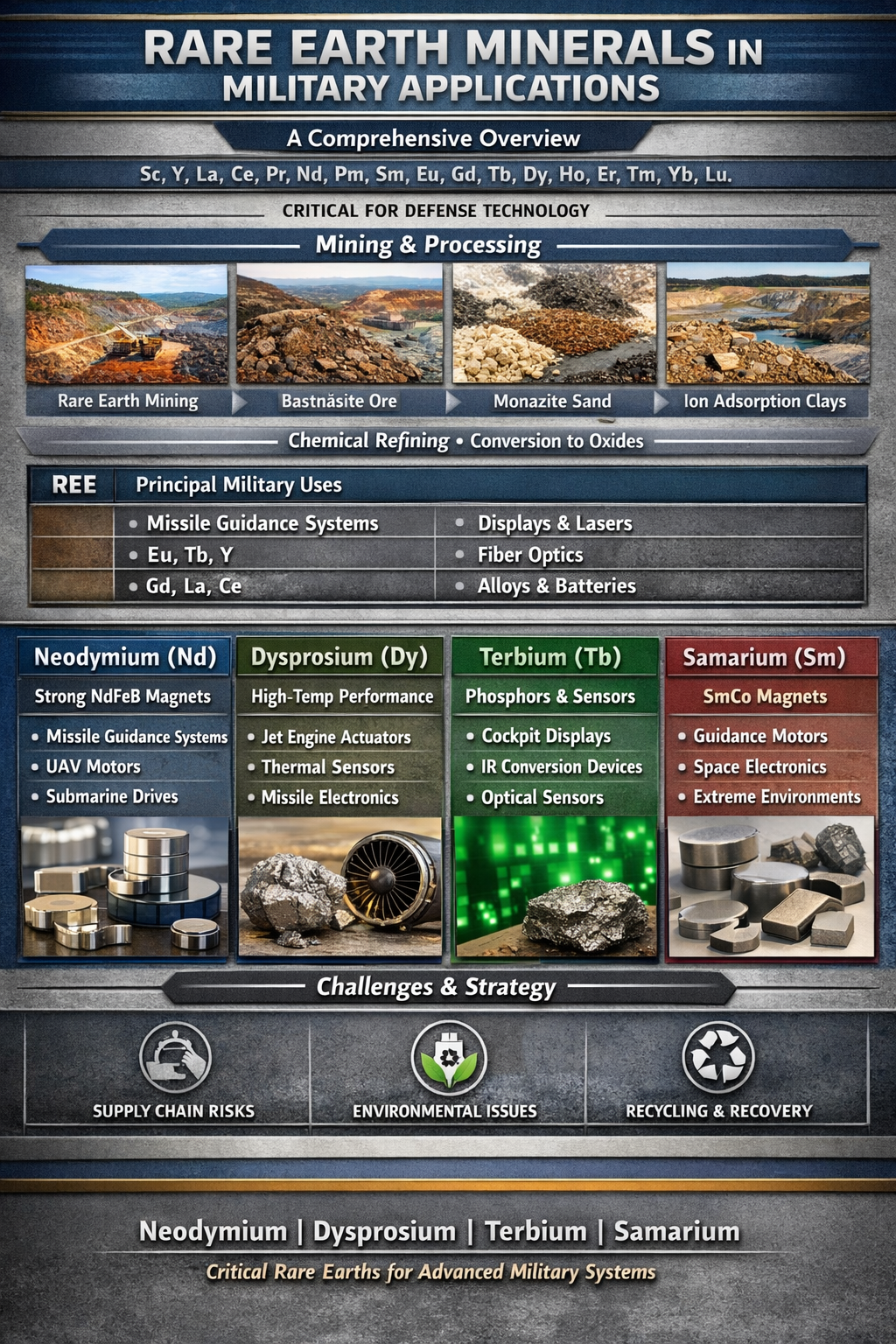
Rare earth elements (REEs) have become indispensable to modern military technology, serving as the hidden enablers of advanced weapon systems, precision guidance, electronic warfare capabilities, and next-generation defense platforms. These seventeen chemically similar elements—comprising the fifteen lanthanides plus scandium and yttrium—possess unique magnetic, luminescent, and electrochemical properties that cannot be replicated by other materials. While constituting a small fraction by weight of most military systems, their absence would render much of today’s advanced weaponry inoperable.
The strategic importance of rare earths in defense applications has elevated these materials from industrial commodities to matters of national security. Modern military forces depend on REE-enabled technologies for everything from fighter jet engines and missile guidance systems to night vision equipment and naval sonar arrays. This dependency has created vulnerabilities in defense supply chains, particularly given the concentrated nature of global REE production and processing.
The Seventeen Rare Earth Elements
The rare earth family consists of:
Light Rare Earth Elements (LREEs): Lanthanum, cerium, praseodymium, neodymium, promethium, samarium, europium, and gadolinium
Heavy Rare Earth Elements (HREEs): Terbium, dysprosium, holmium, erbium, thulium, ytterbium, lutetium, plus scandium and yttrium (grouped with HREEs due to similar chemical properties)
Despite their name, most rare earths are relatively abundant in the Earth’s crust—more common than gold or platinum. The “rare” designation stems from the difficulty of finding economically viable concentrations and the complex, environmentally challenging extraction and separation processes required to produce pure elements.
Processing Rare Earth Elements for Military Applications
Mining and Concentration
Military-grade rare earth processing begins at the mine, where ore bodies containing REE-bearing minerals like bastnäsite, monazite, or ion-adsorption clays are extracted. The concentration process involves:
Crushing and grinding the ore to liberate REE-containing minerals from waste rock. Particle sizes are reduced to optimize subsequent separation stages.
Physical separation using gravity, magnetic, or electrostatic methods to concentrate REE minerals. Magnetic separation is particularly effective for separating paramagnetic rare earth minerals from non-magnetic gangue materials.
Flotation processes that exploit differences in surface chemistry to further upgrade the concentrate, often achieving 60-70% rare earth oxide (REO) content.
Chemical Processing and Separation
The concentrated ore undergoes aggressive chemical treatment to break down mineral structures and separate individual rare earth elements. This is where military specifications begin to diverge from commercial processing:
Acid digestion or alkaline roasting converts REE minerals into forms amenable to separation. Sulfuric acid digestion is common for bastnäsite, while monazite often requires caustic cracking at high temperatures followed by acid leaching.
Solvent extraction represents the most critical and sophisticated stage. Individual rare earths are separated through dozens or even hundreds of counter-current extraction stages, where organic solvents selectively extract specific elements from aqueous solutions. Military applications demand exceptional purity levels—often 99.9% to 99.999%—requiring additional extraction cycles beyond commercial standards.
Ion exchange chromatography provides an alternative separation method, particularly for heavy rare earths and when ultra-high purity is required. This technique is more expensive but can achieve the stringent specifications needed for advanced military electronics and optical systems.
Purification for Military Standards
Defense applications impose purity requirements that exceed most commercial uses. Trace contaminants can compromise performance in critical applications:
Precipitation and calcination convert purified rare earth solutions into oxides, the most stable form for storage and further processing. Multiple precipitation cycles may be employed to eliminate residual impurities.
Reduction to metal for elements like neodymium and dysprosium involves metallothermic reduction (typically using calcium or lanthanum) in inert atmospheres or molten salt electrolysis. The resulting metal must be free from oxygen, carbon, and other interstitials that would degrade magnetic or mechanical properties.
Zone refining and vacuum melting achieve the highest purity levels, essential for single-crystal growth or high-performance alloy production. These processes are conducted in ultra-clean environments to prevent contamination.
Quality Control and Certification
Military specifications require rigorous testing and documentation throughout processing. Advanced analytical techniques verify composition, including:
- Inductively coupled plasma mass spectrometry (ICP-MS) for trace element analysis at parts-per-million or parts-per-billion levels
- X-ray fluorescence for rapid elemental composition verification
- Spark source mass spectrometry for ultra-trace impurity detection
- Crystallographic analysis to confirm proper phase composition
Chain-of-custody documentation tracks materials from mine to finished product, essential for defense applications where material provenance affects security clearances and export controls.
Neodymium: The Magnetic Powerhouse
Properties and Military Significance
Neodymium stands as perhaps the most strategically important rare earth for modern militaries. This silvery metal, atomic number 60, possesses exceptional magnetic properties that enable the most powerful permanent magnets known to science. Neodymium-iron-boron (NdFeB) magnets generate magnetic fields substantially stronger than any alternative, with energy products reaching 50-55 MGOe (mega-gauss-oersteds) in military-grade materials.
The military applications of neodymium stem from a fundamental requirement of modern warfare: doing more with less weight and volume. Every kilogram saved in a precision weapon system translates to extended range, improved maneuverability, or increased payload capacity. Neodymium magnets deliver unmatched power density, making them irreplaceable in weight-critical military applications.
Processing for Military Applications
Alloy development: Military-grade neodymium magnets incorporate specific alloying additions beyond the basic Nd-Fe-B composition. Dysprosium or terbium additions (typically 2-10% by weight) dramatically improve temperature stability and coercivity—critical for magnets operating in the extreme thermal environments of jet engines, missile motors, or desert combat conditions. Cobalt additions improve corrosion resistance for naval applications.
Powder metallurgy: The highest-performance military magnets are produced through sophisticated powder metallurgy routes. Neodymium alloy ingots are hydrogen-decrepitated (hydrogen absorption causes the material to fracture into coarse powder), then jet-milled in inert atmospheres to produce particles 3-5 microns in diameter. This fine powder is compacted in powerful magnetic fields to align the crystal structure, then sintered at carefully controlled temperatures (1000-1100°C) in vacuum or inert atmospheres.
Grain boundary engineering: Cutting-edge military magnet production employs grain boundary diffusion processes, where heavy rare earths like dysprosium or terbium are diffused into the surface layers of sintered magnets. This technique concentrates expensive HREEs where they’re most effective—at grain boundaries where magnetic reversal initiates—while minimizing overall HREE content. The process requires precision control of temperature, atmosphere, and diffusion time to achieve optimal magnetic properties.
Protective coatings: Neodymium magnets corrode rapidly in hostile environments. Military specifications mandate multi-layer coating systems: typically nickel-copper-nickel or nickel-copper-epoxy combinations applied through electroplating or physical vapor deposition. These coatings must withstand salt spray testing (hundreds or thousands of hours), thermal cycling, and mechanical shock without delamination.
Critical Military Systems
Precision-guided munitions: Every GPS-guided bomb, cruise missile, and smart artillery round contains multiple neodymium magnets. Miniature NdFeB motors drive control surface actuators that steer weapons to targets with meter-level precision. The JDAM (Joint Direct Attack Munition) kit converts conventional bombs into precision weapons partly through neodymium-motor-driven tail fins. A single cruise missile may contain 50-100 pounds of rare earth materials, with neodymium magnets comprising a substantial fraction.
Electric drive systems: The U.S. Navy’s shift toward all-electric warship propulsion depends entirely on neodymium. The Zumwalt-class destroyer employs permanent magnet motors generating 36.5 megawatts—equivalent to the power consumption of a small city—propelling the 15,000-ton vessel at speeds exceeding 30 knots. These motors are substantially smaller and more efficient than conventional systems, freeing internal volume for weapons and sensors while reducing thermal signatures that could betray ship positions.
Similar technology powers electric actuators throughout military aircraft, replacing hydraulic systems. The F-35 Lightning II fighter employs neodymium-based electromechanical actuators for flight control surfaces, landing gear operation, and weapons bay doors. These systems offer faster response, reduced maintenance, and elimination of hydraulic fluid fire hazards.
Communications and radar systems: Miniaturized neodymium motors position satellite communication antennas, radar arrays, and electro-optical sensors with extraordinary precision. Phased array radar systems on ships and aircraft use thousands of neodymium-containing components to steer radar beams electronically, enabling simultaneous tracking of hundreds of targets without mechanical scanning.
Power generation in remote systems: Forward-deployed sensors, autonomous systems, and special operations equipment often rely on compact, high-efficiency generators employing neodymium permanent magnet alternators. These systems convert mechanical energy from small engines or portable turbines into electrical power with minimal weight penalty.
Strategic Vulnerabilities
Neodymium’s military criticality creates strategic dependencies. A single F-35 fighter contains approximately 920 pounds of rare earth materials, much of it neodymium. Virginia-class submarines require over 9,000 pounds of rare earths. Interruption of neodymium supplies would halt production of virtually all advanced weapon systems within months as existing inventories depleted.
Dysprosium: The High-Temperature Enabler
Properties and Strategic Role
Dysprosium, element 66, represents the military’s answer to heat. This heavy rare earth metal dramatically improves the temperature stability of neodymium magnets, enabling operation at temperatures where standard NdFeB magnets would fail catastrophically. Dysprosium’s high magnetic anisotropy and substantial magnetic moment allow magnets to maintain coercivity—resistance to demagnetization—at temperatures exceeding 200°C.
The strategic importance of dysprosium cannot be overstated. It is among the rarest and most supply-constrained of militarily significant rare earths, with production concentrated in southern China’s ion-adsorption clay deposits. Yet it is absolutely essential for weapon systems operating in thermally extreme environments.
Processing and Application
Extraction challenges: Dysprosium occurs naturally in low concentrations, typically 0.05-0.1% in rare earth ores, though ion-adsorption clays may contain somewhat higher percentages. Separation from neighboring elements like terbium and holmium requires extensive solvent extraction stages. Military-grade dysprosium oxide must achieve 99.9%+ purity, with particularly strict controls on magnetic impurities.
Alloying methodologies: Dysprosium enters military magnets through two primary routes. Traditional alloying mixes dysprosium directly into the neodymium-iron-boron melt, distributing it uniformly throughout the magnet structure. While effective, this approach consumes large quantities of expensive dysprosium (5-10% of magnet weight).
Advanced grain boundary diffusion processes dramatically reduce dysprosium requirements. Dysprosium fluoride or hydride coatings are applied to sintered neodymium magnets, then diffused into the surface through controlled heating. Dysprosium concentrates at grain boundaries—exactly where increased coercivity is needed—while the grain interiors remain dysprosium-lean. This technique can reduce dysprosium consumption by 60-80% while achieving superior high-temperature performance.
Microstructure optimization: Military magnet producers employ sophisticated microstructural engineering to maximize dysprosium effectiveness. Controlled additions of elements like copper, aluminum, and gallium modify grain boundary phase composition, creating pathways for dysprosium diffusion while suppressing formation of non-magnetic phases. Thermal treatment schedules are precisely programmed to optimize grain boundary thickness and composition.
Military Applications
Aerospace propulsion: Jet engine environments subject materials to brutal combinations of high temperature, vibration, and corrosive conditions. Electric motors in advanced fighter aircraft engine control systems must function reliably at temperatures exceeding 180°C. Dysprosium-enhanced magnets enable permanent magnet motors that replace hydraulic actuators for fuel metering, variable vane positioning, and bleed valve control. These systems improve engine efficiency while reducing maintenance requirements.
Next-generation hybrid-electric aircraft propulsion systems under development for military applications will depend even more heavily on dysprosium. Distributed electric propulsion concepts—where multiple electric motors drive propellers or fans across the airframe—require motors that combine maximum power density with thermal resilience. Dysprosium-bearing magnets represent the only current solution.
Missile systems: Tactical and strategic missiles experience extreme acceleration forces and aerodynamic heating. Hypersonic weapons, capable of speeds exceeding Mach 5, subject onboard electronics and actuators to sustained temperatures above 200°C. Control surface actuators must function flawlessly despite these conditions, requiring dysprosium-stabilized magnets. The development of hypersonic weapons is fundamentally constrained by availability of appropriate materials, with dysprosium supply representing a critical bottleneck.
Armored vehicle systems: Modern main battle tanks and infantry fighting vehicles incorporate numerous electric subsystems: turret drives, gun elevation systems, automatic targeting mechanisms, and active protection systems that intercept incoming projectiles. These systems operate in environments ranging from arctic cold to desert heat exceeding 60°C ambient—meaning internal component temperatures far higher. Dysprosium-enhanced magnets ensure reliable operation across this temperature spectrum.
Directed energy weapons: Emerging laser and electromagnetic weapons generate enormous waste heat. Cooling system pumps, beam steering mechanisms, and power conditioning equipment all require motors that function in high-temperature environments. As directed energy weapons transition from experimental to operational status, dysprosium-stabilized magnets will be essential enabling technologies.
Supply Chain Concerns
Dysprosium presents perhaps the most acute supply chain vulnerability among military rare earths. Annual global production totals only 1,500-2,000 metric tons, with demand growing rapidly. The concentration of supply in regions of geopolitical concern has prompted urgent efforts to develop alternative sources, recycling capabilities, and substitution strategies. However, no near-term alternative to dysprosium for high-temperature magnet applications has emerged, making it a critical strategic material.
Terbium: Precision and Phosphorescence
Unique Properties
Terbium, element 65, serves dual critical military roles. First, like dysprosium, it stabilizes neodymium magnets at elevated temperatures through alloying additions. Second and perhaps more uniquely, terbium compounds produce brilliant green luminescence under excitation, making them indispensable for specialized military optical systems, displays, and sensors.
Terbium’s fluorescent properties arise from its electronic structure. When excited by ultraviolet light or electron bombardment, terbium ions emit intensely at 545 nanometers—a green wavelength to which the human eye is maximally sensitive. This characteristic has made terbium essential for high-performance phosphors in military applications requiring maximum visibility, color accuracy, or low-light operation.
Processing Specifications
Separation complexity: Terbium is among the most difficult rare earths to separate, occurring between dysprosium and gadolinium with similar chemical properties to both. Military-grade terbium oxide requires dozens of solvent extraction stages to achieve 99.99% purity. Contamination by other rare earths can significantly degrade optical properties or magnetic performance.
Oxide to metal reduction: For magnetic applications, terbium oxide must be reduced to metallic form through metallothermic processes using calcium or lanthanum as reductants, conducted under inert atmospheres at high temperatures. The resulting metal requires careful handling as it oxidizes readily in air.
Compound synthesis: Phosphor applications require synthesis of specific terbium compounds, most commonly terbium-activated oxides or oxysulfides. Terbium-doped yttrium, gadolinium, or lanthanum oxysulfides produce the green phosphors used in military displays and image intensifiers. Synthesis requires precise stoichiometry, temperature control, and atmosphere management to achieve optimal luminescent properties.
Military Applications
Night vision technology: Terbium-activated phosphors play crucial roles in night vision intensifier tubes that allow soldiers to operate in near-total darkness. While not the photocathode material itself, terbium phosphors may be used in components of image intensification systems, particularly in older generations of technology. Modern phosphors for the output screen often use terbium-doped materials to convert amplified electron patterns back into visible green images with maximum brightness and minimal persistence (afterglow).
Solid-state lasers: Terbium-doped fiber lasers and solid-state lasers operating at green wavelengths have specialized military applications in underwater communications (green light penetrates seawater more effectively than other visible wavelengths), laser designators, and rangefinders. The specific energy level structure of terbium ions enables efficient laser operation at wavelengths difficult to achieve with other materials.
Magnetostrictive devices: Terfenol-D, an alloy of terbium, dysprosium, and iron, exhibits extraordinary magnetostriction—changing dimensions substantially in response to magnetic fields. This property enables ultrasonic transducers for naval sonar systems. When exposed to varying magnetic fields, Terfenol-D elements expand and contract, generating powerful sound waves for submarine detection and underwater communications. The material’s high power density and broad frequency response make it superior to traditional piezoelectric transducers for many applications.
Naval sonar arrays aboard destroyers, submarines, and anti-submarine warfare aircraft employ Terfenol-D transducers that must function reliably for years in corrosive seawater. The material’s performance depends critically on the purity and proper stoichiometry of the terbium and dysprosium components.
Radiation detection: Terbium-doped scintillation crystals detect gamma rays and X-rays for nuclear material detection, treaty verification, and radiation safety monitoring. When high-energy photons strike terbium-activated scintillators, they produce characteristic green light flashes detected by photomultiplier tubes. These systems help prevent nuclear materials smuggling and verify arms control agreements.
High-temperature magnets: Similar to dysprosium, terbium additions significantly improve the temperature stability of neodymium magnets. Terbium is actually more effective per unit weight than dysprosium but is employed less frequently due to even more constrained supply and higher cost. In the most demanding applications—components in jet engines or hypersonic vehicles—terbium alloying may be justified despite the expense.
Supply Limitations
Terbium production is even more limited than dysprosium, with annual output around 1,000-1,500 metric tons globally. The combination of limited supply, difficult separation chemistry, and dual-use criticality (both magnetic and optical applications) makes terbium another acute strategic vulnerability. Military planners increasingly worry about scenarios where terbium shortages could constrain production of both precision weapons and advanced sensor systems simultaneously.
Samarium: The Original Military Magnet
Historical Significance
Before neodymium magnets revolutionized the field in the 1980s, samarium-cobalt magnets represented the pinnacle of permanent magnet technology. Element 62, samarium formed alloys with cobalt that dramatically outperformed all previous magnetic materials. While neodymium magnets eventually displaced samarium-cobalt in many applications due to superior magnetic properties and lower cost, samarium retains critical military niches where its unique characteristics prove irreplaceable.
Samarium-cobalt magnets offer exceptional temperature stability without requiring heavy rare earth additions like dysprosium or terbium. They maintain magnetic properties at temperatures up to 300-350°C and demonstrate superior corrosion resistance compared to neodymium magnets. These attributes make samarium-cobalt the preferred choice for the most thermally extreme military applications despite higher material costs.
Processing for Military Specifications
Alloy compositions: Military-grade samarium-cobalt magnets come in two primary types. SmCo5 magnets, the original composition, offer moderate magnetic properties but exceptional temperature stability and simple processing. Sm2Co17 magnets, a more complex family of compositions including additions of iron, copper, and zirconium, provide significantly higher performance but require more sophisticated processing.
Production methodology: Sm2Co17 magnet production for military applications follows exacting procedures. Induction melting combines samarium, cobalt, iron, copper, and zirconium in precise proportions under inert atmospheres. The resulting ingot is solution heat-treated at 1150-1200°C to homogenize the alloy, then slow-cooled through critical temperature ranges to precipitate specific phases in the microstructure.
After homogenization, the alloy is hydrogen-decrepitated and jet-milled to powder. Magnetic compaction aligns particles crystallographically, followed by sintering at 1150-1200°C. Critical to military-grade magnets is the final aging heat treatment at 800-850°C, which forms a cellular microstructure of samarium-cobalt phases separated by copper-rich cell walls. This structure directly determines magnetic properties.
Quality assurance: Military samarium-cobalt magnets undergo rigorous testing for magnetic properties, temperature stability, corrosion resistance, and structural integrity. Thermal cycling between temperature extremes verifies stability. Accelerated aging tests project decades-long performance. Non-destructive inspection ensures freedom from cracks or voids that could cause mechanical failure under extreme acceleration forces.
Current Military Applications
Space and satellite systems: The space environment combines temperature extremes, vacuum conditions, and radiation exposure. Samarium-cobalt magnets maintain properties from -200°C to +200°C without degradation, making them ideal for satellite momentum wheels, antenna positioning systems, and sensor mechanisms. Virtually all military satellites contain samarium-cobalt components. The magnets must function flawlessly for mission durations exceeding 15-20 years without possibility of maintenance.
Traveling wave tube amplifiers (TWTs): These specialized vacuum tubes amplify microwave signals in satellite communications, electronic warfare systems, and high-power radar. TWTs employ samarium-cobalt magnets to focus electron beams, generating the powerful radio-frequency signals needed for long-range communications or radar detection. The operational temperatures inside TWTs exceed what neodymium magnets could tolerate.
Missile seeker heads: Infrared seekers that guide heat-seeking missiles to targets contain sophisticated gyroscopes and scanning mechanisms employing samarium-cobalt magnets. These components must function through extreme acceleration at launch (potentially thousands of g-forces), flight through atmospheric heating, and terminal maneuvering. Samarium-cobalt’s thermal and mechanical stability proves essential.
Aircraft engine sensors: Gas turbine engines require continuous monitoring of shaft speed, temperature, and vibration. Magnetic speed sensors employing samarium-cobalt magnets function reliably in environments where temperatures exceed 300°C and vibration levels would destroy electronic alternatives. These sensors provide critical data for engine control systems and maintenance diagnostics.
Radiation-hardened systems: Nuclear-hardened military electronics designed to function through electromagnetic pulse (EMP) events or in radiation environments employ samarium-cobalt magnets rather than neodymium. Samarium-cobalt demonstrates superior resistance to radiation-induced demagnetization, critical for strategic systems like ballistic missile components or nuclear weapons electronics.
Traveling wave tube amplifiers: These vacuum tube devices amplify radio frequency signals for satellite communications, radar, and electronic warfare systems. Internal samarium-cobalt magnets focus electron beams, enabling high-power microwave generation. The operational environment inside TWTs high vacuum, elevated temperatures, and intense electromagnetic fields, makes samarium-cobalt the only viable option.
Sustained Strategic Importance
Despite being partially superseded by neodymium magnets in moderate-temperature applications, samarium retains permanent military importance. Applications requiring sustained operation above 180-200°C, long-term reliability in space, or radiation hardness will continue demanding samarium-cobalt magnets indefinitely. The approximately 3,000-4,000 metric tons of samarium produced annually globally must support both military requirements and various commercial applications, creating potential supply tensions as space-based systems proliferate.
Additional Military-Critical Rare Earths
Lanthanum
Lanthanum enables night vision technology through its use in image intensifier tubes. Lanthanum hexaboride cathodes emit electrons when stimulated by faint light, beginning the amplification process that allows soldiers to see in near-darkness. Lanthanum is also used in specialized optical glasses with high refractive index and low dispersion, critical for targeting systems, periscopes, and precision optics. Military requirements consume substantial lanthanum tonnage, though supply is generally adequate as lanthanum is the most abundant rare earth.
Cerium
Cerium polishing compounds produce the ultra-smooth optical surfaces required for advanced targeting systems, reconnaissance cameras, and laser components. Military-specification optics require surface finishes measured in angstroms, achievable only through cerium oxide polishing. Cerium also appears in specialized steel alloys for armor applications and as a dopant in scintillation detectors for radiation monitoring.
Praseodymium
Praseodymium strengthens magnesium alloys used in aircraft components, reducing weight while maintaining structural integrity. It also appears in specialized optical filters that protect personnel and sensors from laser weapons. Praseodymium-doped glasses selectively absorb specific laser wavelengths while remaining transparent to other light, essential for laser safety equipment.
Europium
Europium produces red and blue phosphors that complement terbium’s green emission in color displays for aircraft cockpits, command centers, and portable communication devices. Europium’s brilliant red fluorescence also enables specialized optical targeting systems and laser rangefinders operating at wavelengths where europium absorption is optimal.
Gadolinium
Gadolinium improves the working characteristics of samarium-cobalt and other magnetic alloys. It also appears in neutron absorption applications for nuclear reactor control and portable radiation shielding. Gadolinium’s exceptionally high neutron capture cross-section makes it valuable in nuclear weapons systems and reactor safety mechanisms.
Yttrium
Yttrium enables several critical military technologies. Yttrium aluminum garnet (YAG) crystals form the gain medium for high-power solid-state lasers used in rangefinding, target designation, and increasingly in directed energy weapons. Yttrium iron garnet materials provide microwave signal processing in radar and communications systems. Yttrium oxide coatings protect jet engine components from oxidation and thermal degradation, extending service life in the demanding environment inside gas turbines.
Erbium
Erbium-doped fiber amplifiers enable long-distance optical communications for military networks, including connections to forward-deployed forces and between naval vessels. Erbium’s optical properties also make it useful in laser rangefinders operating at eye-safe wavelengths that won’t blind personnel or optical sensors.
Lutetium
Though among the rarest and most expensive rare earths, lutetium finds specialized use in scintillation detectors for radiation monitoring and nuclear material detection. Lutetium oxyorthosilicate scintillators offer exceptional energy resolution for identifying specific radioactive isotopes, critical for nuclear forensics and arms control verification.
Supply Chain Vulnerabilities and Strategic Implications
Geographic Concentration
The global rare earth supply chain exhibits dangerous concentration. China produces approximately 60% of the world’s rare earths and controls over 85% of processing and separation capacity. More critically, China dominates production of heavy rare earths like dysprosium and terbium, which have few alternative sources. Southern China’s ion-adsorption clay deposits contain the world’s richest concentrations of heavy rare earths.
This concentration creates acute strategic vulnerability for Western military forces. Disruption of supplies whether through geopolitical tension, trade restrictions, natural disasters, or deliberate action could halt production of advanced weapon systems within months. Existing inventory stockpiles might sustain production temporarily, but sophisticated weapons systems require continuous rare earth supply.
Processing Bottlenecks
Even when rare earth ores are mined outside China, they often ship to China for separation and processing. The complex chemistry required to separate individual rare earths to military specifications demands specialized facilities, environmental controls, and technical expertise that has largely concentrated in China over the past three decades. Reconstituting this processing capacity elsewhere requires substantial capital investment, environmental permitting, and years of construction and commissioning.
The United States, once a rare earth leader, saw its last significant rare earth mine and processing facility close in the early 2000s. While the Mountain Pass mine in California has restarted operations, the ore still ships to China for separation. Recent efforts to build domestic processing capability have encountered regulatory, environmental, and economic challenges.
Defense Industrial Base Implications
Rare earth supply constraints could dramatically affect military procurement. Without adequate supplies of neodymium, dysprosium, terbium, and samarium, production of fighter aircraft, precision missiles, naval vessels, and satellites would cease. Even if designs could be modified to eliminate rare earth dependencies, the engineering effort would require years and result in equipment with degraded performance.
The Pentagon has identified rare earths as critical materials requiring supply chain security measures. Initiatives include stockpiling strategic materials, funding domestic mining and processing operations, developing recycling technologies, and researching material substitutes. However, these efforts face significant obstacles and will require sustained commitment and investment.
Environmental and Political Challenges
Rare earth processing generates toxic and radioactive waste streams requiring careful management. Concentrates contain thorium and uranium that must be handled as radioactive materials. Acid leaching produces contaminated wastewater. Separation processes use volatile organic solvents. These environmental challenges have made rare earth operations politically contentious in many Western nations, even as military necessity demands secure supply chains.
Balancing environmental protection with strategic material security represents a persistent tension. Nations must either accept environmental impacts of domestic production, continue dependence on foreign sources, or invest in cleaner technologies that may be more expensive. Each choice involves difficult tradeoffs.
Future Outlook and Alternatives
Material Substitution Research
Defense research agencies fund extensive efforts to reduce or eliminate rare earth dependencies. Alternative permanent magnet materials like manganese-based compounds show promise but lag substantially behind rare earth magnets in performance. Induction motors avoid permanent magnets entirely but sacrifice efficiency and power density. Hybrid designs minimize rare earth content while maintaining acceptable performance.
For optical applications, alternative phosphors and laser materials could potentially replace terbium, europium, and erbium in some applications, though often with performance penalties. Material scientists continue exploring new compounds and structures that might replicate rare earth properties without requiring the elements themselves.
Enhanced Recycling
End-of-life recycling could substantially reduce primary rare earth demand. Military equipment contains substantial rare earth content that current disposal processes don’t recover. Developing efficient recycling technologies for rare earth magnets, optical components, and electronic systems could supplement primary production.
Challenges include collecting sufficient volumes of end-of-life material, separating rare earths from complex assemblies, and purifying recovered materials to military specifications. Nevertheless, recycling represents a critical component of long-term supply security strategies.
Advanced Processing Technologies
New separation technologies could make rare earth processing more economical and environmentally benign. Research directions include selective precipitation methods, biological extraction using engineered microorganisms, and ionic liquid-based separations. Success could enable processing of lower-grade deposits, increase recovery efficiency, and reduce environmental impact.
Breakthrough processing technologies might transform current strategic calculations by making currently non-viable deposits economically attractive or enabling processing in regions with strict environmental standards.
Geopolitical Diversification
Military planners increasingly recognize the need for geographically diversified supply chains. Encouraging rare earth development in allied nations—Australia, Canada, European Union nations, and others—could reduce dependence on any single source region. However, this requires addressing not just mining but the entire supply chain from ore to purified materials and finished components.
International cooperation agreements, joint development projects, and coordinated stockpiling strategies may provide partial solutions. Yet fundamental challenges remain: rare earth deposits rich in heavy elements are geographically limited, and building processing infrastructure requires substantial capital and expertise.
Conclusion
Rare earth elements form the invisible foundation of modern military power. Without neodymium, dysprosium, terbium, and samarium along with their thirteen rare earth siblings—the advanced weapon systems that define 21st-century warfare could not exist. From precision-guided munitions and all-electric warships to night vision equipment and satellite communications, these elements enable capabilities that military forces now consider essential.
The strategic implications of rare earth dependencies extend beyond material science into national security, international relations, and industrial policy. Nations with secure access to these materials gain substantial advantages in military capability. Conversely, supply disruptions could cripple defense production even for nations with advanced industrial bases and sophisticated weapons designs.
Addressing rare earth vulnerabilities requires coordinated efforts across mining, processing, recycling, material science, and international cooperation. Success demands sustained commitment and investment over decades. The alternatives—continued strategic dependency or degraded military capabilities—are equally unacceptable to nations that rely on technological superiority for defense.
As military systems grow increasingly sophisticated, rare earth requirements will intensify. Hypersonic weapons, directed energy systems, autonomous platforms, and next-generation aerospace vehicles will demand even more of these critical materials. Ensuring adequate supplies of neodymium, dysprosium, terbium, samarium, and other rare earths represents not merely an industrial challenge but a strategic imperative for modern defense forces.






Be First to Comment