
Abstract
Human longevity is a complex biological phenomenon produced by interactions among genetics, cellular biology, metabolism, immunity, reproduction, environment, behavior, and social conditions. The X and Y chromosomes occupy a particularly interesting position within this system because they contribute to biological sex determination and contain genes involved in reproduction, development, immunity, cellular regulation, and other physiological processes.
This study examines the X and Y chromosomes as components of the genetic architecture of human aging and longevity. It explores their molecular organization, gene expression, sex-specific biology, chromosome dosage, X-chromosome inactivation, Y-chromosome variation, age-related loss of Y chromosome, disease susceptibility, reproductive biology, immune function, cardiovascular health, neurological processes, metabolism, and interactions with the autosomes and mitochondrial genome.
The central conclusion is that the X and Y chromosomes do not independently determine human lifespan. Rather, they participate in a highly interconnected biological system in which genetic variation, epigenetic regulation, cellular damage, DNA repair, hormonal signaling, immune function, metabolism, reproduction, and environmental exposure collectively influence healthspan and lifespan.
1. Introduction: The Genetic Problem of Human Longevity
Longevity is one of the most remarkable characteristics of human biology. Some individuals live into their tenth decade and beyond while maintaining substantial physiological function, whereas others develop age-related diseases much earlier.
Understanding this variation requires moving beyond the idea that aging is controlled by a single gene or chromosome.
Human aging emerges from interactions among:
- the nuclear genome;
- the mitochondrial genome;
- gene regulation;
- epigenetic mechanisms;
- DNA damage and repair;
- cellular senescence;
- protein maintenance;
- metabolism;
- immune function;
- endocrine signaling;
- reproductive biology;
- environmental exposure;
- nutrition;
- infectious disease;
- socioeconomic conditions;
- medical treatment; and
- random biological variation.
Within this enormous system, the X and Y chromosomes are unusual because they are the two principal human sex chromosomes.
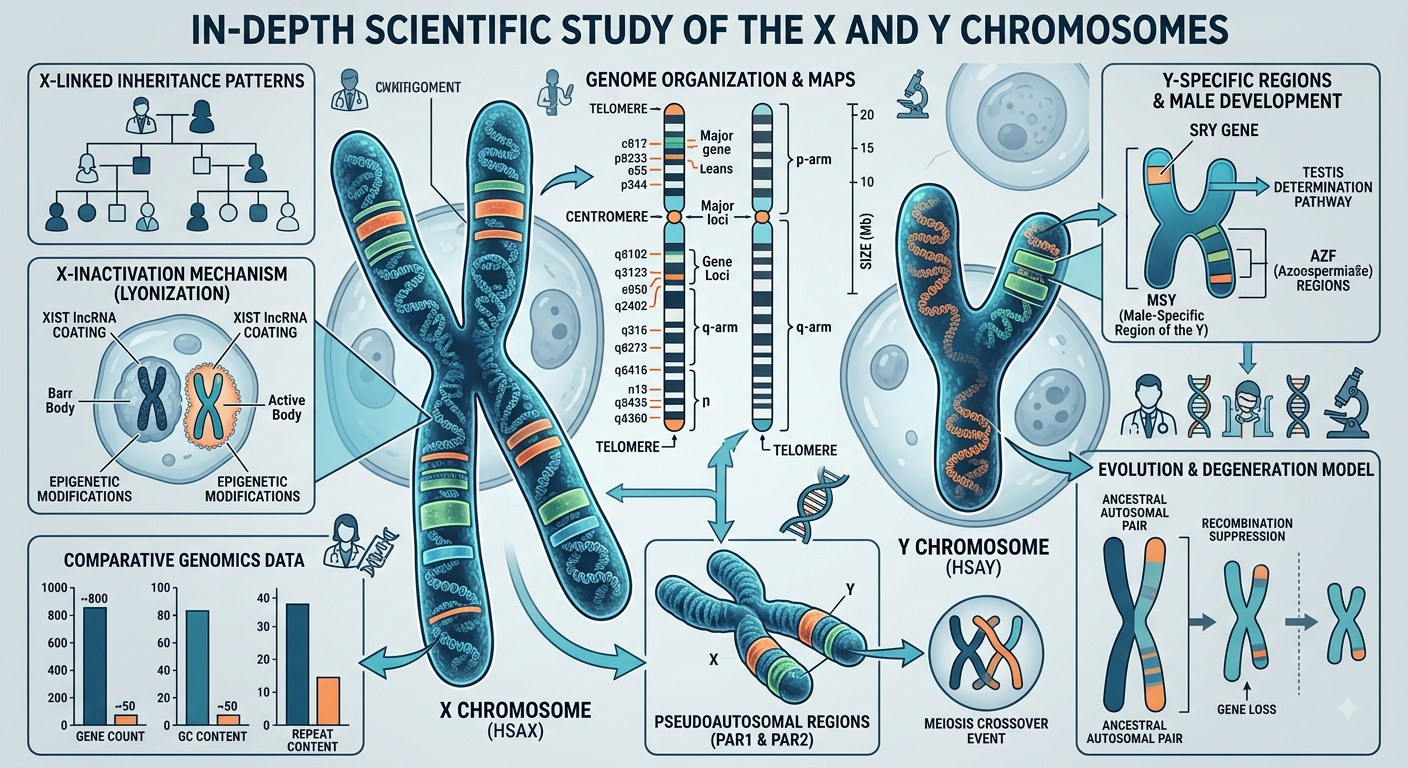
The X chromosome is comparatively large and contains many genes with functions extending far beyond reproduction. The Y chromosome is much smaller and contains a specialized set of genes, including genes associated with sex determination, testicular development, spermatogenesis, and other biological processes.
Their differences create an important biological question:
How does sex-chromosome architecture contribute to differences in aging, disease susceptibility, reproductive function, healthspan, and longevity?
2. The Human Genome: The Foundation of Longevity Biology
Humans normally possess 46 chromosomes arranged into 23 pairs.
Twenty-two pairs are autosomes, while the remaining pair consists of the sex chromosomes.
A typical chromosomal complement is:
46 chromosomes → 22 pairs of autosomes + 1 pair of sex chromosomes
The sex-chromosome combinations commonly associated with human development are:
XX → typically female development
XY → typically male development
However, biological development is considerably more complex than these two combinations alone. Variations in chromosome number, sex-determining genes, hormone signaling, and developmental pathways demonstrate that biological sex is produced through multiple interacting mechanisms.
Longevity therefore cannot be reduced to the XX/XY distinction.
Instead:
Genome + environment + development + physiology + time → aging trajectory
3. The X Chromosome
The X chromosome is one of the largest human chromosomes and contains hundreds of protein-coding genes as well as numerous regulatory elements and non-coding genes.
Its biological importance extends into:
- nervous-system development;
- immune regulation;
- cellular metabolism;
- reproduction;
- development;
- protein production;
- DNA maintenance;
- cardiovascular biology;
- endocrine signaling; and
- disease susceptibility.
Because individuals with two X chromosomes and individuals with one X chromosome have different X-chromosome dosage, mammals have evolved mechanisms to regulate X-linked gene expression.
The most important of these is X-chromosome inactivation.
4. X-Chromosome Inactivation
In cells containing two X chromosomes, one X chromosome is generally subjected to transcriptional silencing early during development.
This process is known as:
X-chromosome inactivation (XCI)
XCI prevents excessive expression of many X-linked genes.
However, XCI is not absolute. Some genes escape inactivation and remain active on both X chromosomes.
This creates an important biological phenomenon:
Two X chromosomes do not necessarily mean simply twice the biological output of one X chromosome.
Instead, gene dosage is regulated through a complex network involving chromosome structure, transcription, epigenetics, and cellular identity.
5. X-Chromosome Inactivation and Aging
X-chromosome inactivation is particularly relevant to aging because epigenetic regulation changes throughout the lifespan.
Aging is associated with alterations in:
- DNA methylation;
- chromatin organization;
- histone modification;
- gene expression;
- cellular identity;
- genomic stability.
As tissues age, the distribution of cells expressing particular X chromosomes may become increasingly uneven.
This phenomenon is sometimes described as age-associated skewing of X-chromosome inactivation.
Such changes may be especially informative in tissues containing populations of cells that undergo selection during aging.
The important scientific question is whether these changes are merely markers of aging or whether some contribute directly to age-related disease.
6. The X Chromosome and Immune Function
The X chromosome contains numerous genes involved in immune regulation.
This has potential significance because the immune system changes substantially with age.
The aging immune system undergoes a process commonly referred to as:
immunosenescence
Major features include changes in:
- lymphocyte populations;
- inflammatory signaling;
- immune surveillance;
- antibody responses;
- innate immunity;
- adaptive immunity.
Sex differences in immune function are observed across the lifespan.
In general, females often demonstrate stronger immune responses than males, although this can also contribute to increased susceptibility to certain autoimmune disorders.
Thus, the X chromosome may contribute to an important biological trade-off:
stronger immune responsiveness ↔ increased risk of inappropriate immune activation
This relationship illustrates why longevity cannot be interpreted simply as “more immune activity is better.”
7. X-Linked Disease Susceptibility
Because many genes are located on the X chromosome, genetic variants affecting X-linked genes can produce distinctive inheritance patterns.
Individuals with only one X chromosome generally have no second X-linked copy that can compensate for a harmful recessive variant.
This contributes to the characteristic inheritance patterns of many X-linked disorders.
Examples include conditions affecting:
- blood clotting;
- muscle function;
- neurological development;
- vision;
- immune function;
- metabolism.
Consequently, X-chromosome biology can influence both healthspan and survival indirectly through disease susceptibility.
8. The Y Chromosome
The Y chromosome is substantially smaller than the X chromosome and contains fewer genes.
Its most famous biological function is associated with the SRY gene, which plays a central role in initiating the developmental pathway toward testes formation.
However, the Y chromosome should not be regarded merely as a “male chromosome.”
It contains genes involved in:
- testicular development;
- sperm production;
- reproductive function;
- gene regulation;
- cellular processes.
Some Y-linked genes are expressed outside reproductive tissues, making the chromosome relevant to broader biological research.
9. The Y Chromosome and Reproduction
Reproduction is one of the principal evolutionary functions associated with the Y chromosome.
Genes on the Y chromosome participate in pathways necessary for male reproductive development and spermatogenesis.
The reproductive system itself is deeply connected to longevity biology.
Reproduction requires substantial biological investment in:
- cellular energy;
- hormonal regulation;
- tissue maintenance;
- DNA integrity;
- gamete production.
This creates an important evolutionary question:
How are reproductive investment and somatic maintenance balanced across the lifespan?
This question connects sex-chromosome biology to broader theories of aging.
10. Y-Chromosome Variation
The Y chromosome has a distinctive inheritance pattern because it is generally transmitted from father to son.
This allows researchers to study paternal lineages and population history.
Y-chromosome variation can therefore provide information about:
- human migration;
- population history;
- ancestry;
- demographic changes;
- paternal lineage.
However, ancestry-associated Y-chromosome differences should not automatically be interpreted as determinants of longevity.
Population longevity is influenced by many genetic and non-genetic factors.
11. Age-Related Loss of Y Chromosome
One of the most important discoveries in modern research on male aging is the phenomenon known as:
mosaic loss of chromosome Y (mLOY)
As some men age, subsets of their blood cells may lose the Y chromosome.
This does not necessarily mean that every cell in the body loses the Y chromosome.
Rather, it can occur in a mosaic pattern, where some cells retain the chromosome and others do not.
The frequency of mLOY generally increases with age.
Researchers have investigated associations between mLOY and several age-related conditions, including cardiovascular disease and other diseases.
However, association does not automatically establish causation.
mLOY may be:
- a consequence of cellular aging;
- a marker of accumulated biological damage;
- a contributor to disease;
- or some combination of these mechanisms.
12. X and Y Chromosomes in Cardiovascular Aging
Cardiovascular disease is one of the major causes of morbidity and mortality worldwide.
Sex differences occur in:
- blood pressure;
- lipid metabolism;
- vascular biology;
- atherosclerosis;
- heart disease;
- stroke risk;
- inflammatory responses.
Sex chromosomes interact with hormones and autosomal genes to produce complex differences in cardiovascular physiology.
The X chromosome may influence cardiovascular biology through immune and metabolic genes, while Y-chromosome alterations have been investigated in relation to cardiovascular disease.
The correct model is therefore:
Sex chromosomes + hormones + autosomes + environment → cardiovascular phenotype
rather than:
X/Y chromosomes → cardiovascular disease
13. X/Y Chromosomes and Neurological Aging
The brain is particularly sensitive to aging.
Age-related changes include alterations in:
- neuronal function;
- synaptic activity;
- vascular supply;
- inflammation;
- mitochondrial performance;
- protein homeostasis.
Because the X chromosome contains many genes expressed in the nervous system, X-linked biology is important in neurological development and disease.
Sex differences also occur in several neurological and psychiatric conditions.
The mechanisms may involve interactions among:
- X-linked genes;
- Y-linked genes;
- autosomal genes;
- sex hormones;
- immune signaling;
- developmental processes.
14. Sex Chromosomes and Metabolism
Aging is closely connected with metabolic regulation.
Important metabolic systems include:
- glucose regulation;
- insulin signaling;
- lipid metabolism;
- mitochondrial energy production;
- appetite regulation;
- energy expenditure.
Sex differences in metabolic disease are well documented.
For example, the risks and timing of certain metabolic disorders can differ between males and females.
The X and Y chromosomes participate in this biology indirectly and directly through genes and regulatory networks.
However, metabolic aging is fundamentally a genome-wide process.
15. Mitochondria and the Sex Chromosomes
Mitochondria are the principal energy-producing organelles of most human cells.
They possess their own small genome.
Mitochondrial function is essential for:
- ATP production;
- metabolism;
- cellular signaling;
- apoptosis;
- reactive oxygen species regulation.
Aging is associated with changes in mitochondrial function.
The relationship between mitochondrial genetics and sex chromosomes is particularly interesting because mitochondrial DNA is normally inherited maternally, while the Y chromosome is transmitted paternally.
This creates two different inheritance pathways:
Mitochondrial genome → predominantly maternal inheritance
Y chromosome → paternal-to-son inheritance
Studying these parallel inheritance systems can provide valuable insight into sex-specific evolutionary biology.
16. Telomeres and Chromosomal Aging
Telomeres are repetitive DNA structures located at chromosome ends.
They help protect chromosomes during cell division.
With repeated cell division, telomeres generally become shorter, although telomere biology is more complex than a simple countdown mechanism.
Telomere shortening is associated with cellular aging and several age-related diseases.
Importantly, telomeres occur on all chromosomes, including the X and Y chromosomes.
Therefore:
X/Y chromosomes + telomere maintenance + DNA repair + cellular replication
form part of a larger chromosomal aging system.
17. DNA Damage and Repair
Every cell experiences DNA damage from endogenous and environmental sources.
DNA damage can result from:
- normal metabolism;
- oxidative processes;
- radiation;
- chemical exposure;
- replication errors;
- environmental stress.
Cells possess sophisticated DNA repair mechanisms.
When repair becomes insufficient, genomic instability can develop.
Genomic instability is considered one of the major biological features associated with aging.
X- and Y-linked genes can participate in cellular pathways that influence DNA maintenance, but most DNA repair machinery is encoded across the entire genome.
18. Epigenetics and the Aging Process
Genetics determines DNA sequence.
Epigenetics helps regulate how genes are expressed.
Important epigenetic mechanisms include:
- DNA methylation;
- histone modifications;
- chromatin remodeling;
- non-coding RNAs.
Epigenetic patterns change throughout life.
Researchers can measure some of these changes using epigenetic clocks, which estimate biological age from patterns of DNA methylation.
Sex chromosomes are part of this epigenetic landscape.
X-chromosome inactivation is itself a major example of epigenetic regulation.
19. The X Chromosome, Y Chromosome, and Hormones
Sex chromosomes influence development of reproductive systems, which subsequently produce sex hormones.
Important hormones include:
- testosterone;
- estrogen;
- progesterone.
Hormones influence:
- muscle;
- bone;
- cardiovascular function;
- metabolism;
- immune activity;
- reproduction;
- brain function.
Therefore, the biological pathway is not simply:
chromosome → aging
It is often closer to:
chromosome → developmental pathway → endocrine system → tissues → physiological phenotype → aging trajectory
This distinction is fundamental.
20. Reproduction and the Evolution of Longevity
Evolutionary biology provides another perspective on aging.
Natural selection strongly affects traits influencing reproductive success, particularly earlier in life.
The biological systems supporting reproduction can therefore interact with systems responsible for maintaining the body.
This is related to evolutionary theories such as:
- mutation accumulation;
- antagonistic pleiotropy;
- disposable soma theory.
These theories provide different explanations for why organisms may evolve compromises between reproduction and long-term maintenance.
The X and Y chromosomes are particularly relevant because they are central to sex-specific reproductive biology.
21. Why Females Often Live Longer Than Males
Across many human populations, females have historically exhibited greater average life expectancy than males, although the size of this difference varies by population and historical period.
Multiple explanations have been proposed.
They include:
- genetic factors;
- immune differences;
- hormonal effects;
- cardiovascular differences;
- behavioral differences;
- occupational exposure;
- violence and injury;
- smoking and alcohol exposure;
- healthcare utilization;
- social conditions.
Sex chromosomes may contribute to the biological component of these differences, but they do not provide a complete explanation.
A useful conceptual model is:
Sex chromosomes + endocrine biology + immune system + behavior + environment + society → sex-specific health outcomes
22. The Two X Chromosomes: Potential Biological Advantages and Complexities
Having two X chromosomes can provide genetic redundancy for some X-linked genes.
However, X-chromosome inactivation means that many genes are not simply expressed at twice the level.
Some genes escape X-inactivation, creating differences in gene dosage.
This may contribute to sex-specific biology.
At the same time, the same biological architecture can increase susceptibility to some X-linked immune disorders and autoimmune diseases.
Thus, chromosome architecture can produce both:
biological advantages
and
biological vulnerabilities
depending on the physiological context.
23. The Y Chromosome: Specialized Architecture
The Y chromosome has undergone substantial evolutionary specialization.
It contains extensive repetitive regions and genes particularly important for male development and reproduction.
Its unique structure also creates challenges for genomic research.
Understanding Y-chromosome biology requires studying:
- gene content;
- repetitive DNA;
- structural variation;
- copy-number variation;
- gene expression;
- mosaicism;
- evolutionary history.
This makes the Y chromosome an important subject in modern genomics.
24. Mosaicism and Aging
Human bodies are composed of enormous numbers of cells.
As cells divide, genetic and epigenetic changes can accumulate.
Consequently, an older person’s body is not necessarily genetically identical at the cellular level.
Different cell populations can acquire different alterations.
This phenomenon is known as somatic mosaicism.
Mosaic loss of Y chromosome is one example.
Other forms of age-associated mosaicism can involve:
- chromosomal abnormalities;
- mutations;
- epigenetic alterations.
Studying mosaicism provides a cellular-level view of aging.
25. Cancer and Sex-Chromosome Biology
Cancer results from accumulated genetic and epigenetic abnormalities that disrupt normal control of cell growth and survival.
Sex chromosomes can influence cancer susceptibility through:
- gene dosage;
- immune regulation;
- tumor-suppressor pathways;
- hormone signaling;
- chromosome instability.
Loss of sex-chromosome material has been observed in some cancers.
However, cancer is fundamentally a genome-wide disease.
Therefore, the X and Y chromosomes should be studied as components of a larger network of oncogenic and tumor-suppressive mechanisms.
26. Immune Aging and Longevity
The immune system is one of the most important systems connecting genetics to longevity.
With age, immune function changes.
Some immune responses become weaker, while chronic low-level inflammation can increase.
This has been called inflammaging.
Sex differences in immunity may be influenced by:
X-linked genes + Y-linked genes + hormones + autosomal genes + environmental exposure
These interactions may help explain some differences in susceptibility to infection, autoimmune disease, and inflammatory disorders.
27. The X/Y Chromosomes and Healthspan
Longevity should not be measured only by the number of years a person remains alive.
A more useful concept is:
Healthspan = years lived with relatively good physical, cognitive, and functional health
Genetic factors can influence healthspan through:
- disease susceptibility;
- immune function;
- cardiovascular biology;
- neurological health;
- metabolic regulation;
- reproductive health;
- cellular maintenance.
The X and Y chromosomes therefore deserve study not merely as determinants of lifespan but as contributors to healthspan architecture.
28. Interaction With the Autosomes
The X and Y chromosomes represent only two chromosomes among the human chromosome complement.
Most human genes are located on autosomes.
Consequently, sex-chromosome effects depend heavily on interactions with autosomal genes.
This can be represented as:
X/Y genes ↔ autosomal genes ↔ hormones ↔ environment
These interactions create complex biological networks.
A single genetic variant may have different consequences depending on:
- genetic background;
- sex;
- age;
- hormone levels;
- environment;
- other variants.
This phenomenon is one reason why predicting individual longevity from genetics remains difficult.
29. Genetic Architecture of Exceptional Longevity
Some individuals reach very advanced ages.
Researchers studying exceptional longevity have identified genetic associations involving pathways related to:
- lipid metabolism;
- cardiovascular protection;
- DNA maintenance;
- inflammation;
- cellular stress responses;
- protein regulation.
The genetics of exceptional longevity are polygenic.
In other words:
many genetic variants → small and interacting effects → longevity phenotype
The X and Y chromosomes may contribute to this architecture, but exceptional longevity cannot be attributed to them alone.
30. Population Genetics and Longevity
Human populations differ in genetic composition.
However, genetic differences must be interpreted carefully.
Longevity statistics are influenced by:
- healthcare systems;
- nutrition;
- sanitation;
- economic conditions;
- education;
- infectious disease;
- occupational exposure;
- environmental pollution;
- cultural practices.
Consequently, population differences in longevity cannot simply be assigned to chromosome differences.
Modern longevity research requires an integrated gene–environment framework.
31. The Genetic–Environmental Equation of Aging
A useful conceptual model is:
Longevity = Genetics × Environment × Lifestyle × Healthcare × Chance
Genetics establishes biological possibilities.
Environment influences exposure.
Lifestyle affects physiological risk.
Healthcare modifies disease outcomes.
Chance contributes unpredictable variation.
The X and Y chromosomes operate within this entire system.
32. From Chromosome to Organism
The biological hierarchy can be represented as:
DNA
↓
Genes
↓
Chromosomes
↓
Gene expression
↓
Proteins
↓
Cellular pathways
↓
Cells
↓
Tissues
↓
Organs
↓
Organ systems
↓
Whole-body physiology
↓
Healthspan
↓
Longevity
This hierarchy demonstrates why chromosome biology cannot be separated from the rest of human physiology.
33. Scientific Methods Used to Study X/Y Chromosome Aging
Modern researchers use numerous technologies to investigate sex chromosomes.
These include:
Genomic sequencing
Determines DNA sequence and genetic variation.
RNA sequencing
Measures gene expression.
Epigenomic analysis
Studies DNA methylation and other regulatory modifications.
Single-cell sequencing
Allows researchers to examine individual cells rather than treating an entire tissue as genetically uniform.
Longitudinal cohort studies
Track individuals over many years.
Genome-wide association studies
Identify statistical associations between genetic variants and traits.
Functional genomics
Tests whether particular genes influence biological processes.
Population genetics
Studies genetic variation across populations and generations.
Together, these technologies allow researchers to investigate how chromosome biology changes over the human lifespan.
34. Artificial Intelligence and Longevity Genetics
Artificial intelligence is increasingly useful for analyzing large biological datasets.
AI can assist researchers in identifying patterns involving:
- genetic variants;
- gene expression;
- epigenetic changes;
- protein interactions;
- disease risk;
- biological age;
- longitudinal health records.
The combination of:
genomics + transcriptomics + epigenomics + proteomics + clinical data + AI
could produce increasingly sophisticated models of biological aging.
However, statistical prediction should not be confused with biological causation.
35. Ethical Considerations
Research into longevity genetics creates important ethical questions.
These include:
- genetic privacy;
- discrimination;
- access to genomic medicine;
- interpretation of genetic risk;
- reproductive decision-making;
- population genetics;
- commercialization of genetic information;
- unequal access to longevity technologies.
A person’s genome should not be treated as a deterministic prediction of their future.
Genetic information generally represents probability and biological susceptibility, not destiny.
36. Major Scientific Questions for Future Research
Several important questions remain open.
Question 1
How does X-chromosome inactivation change throughout human aging?
Question 2
Which X-linked genes contribute most strongly to sex differences in disease?
Question 3
What causes mosaic loss of chromosome Y?
Question 4
Does mLOY directly contribute to disease or primarily serve as a biomarker?
Question 5
How do X/Y chromosomes interact with mitochondrial DNA?
Question 6
How do sex chromosomes influence immune aging?
Question 7
How do sex chromosomes interact with autosomal longevity genes?
Question 8
Can genomic biomarkers accurately predict biological aging?
Question 9
Can interventions preserve cellular genomic stability during aging?
Question 10
Can future medicine increase healthspan without merely increasing lifespan?
37. An Integrated Model of X/Y Chromosome Biology
The entire study can be summarized through the following framework:
X chromosome
→ gene dosage
→ X-inactivation
→ immune regulation
→ neurological biology
→ metabolism
→ disease susceptibility
Y chromosome
→ sex determination
→ testicular development
→ spermatogenesis
→ reproductive biology
→ Y-linked gene expression
→ age-associated mosaic loss
Both interact with:
Autosomal genome
↓
Mitochondrial genome
↓
Epigenetic regulation
↓
Hormonal systems
↓
Immune system
↓
Metabolism
↓
Cellular maintenance
↓
Disease susceptibility
↓
Healthspan
↓
Longevity
38. The Central Thesis
The genetic architecture of longevity should not be understood as a single linear pathway.
It is better represented as an interconnected biological network:
Genome → chromosomes → genes → regulatory systems → proteins → cells → tissues → organs → physiology → disease resistance → healthspan → lifespan
Within this network, the X and Y chromosomes occupy a distinctive position because they influence sex-specific development and interact with numerous biological systems throughout life.
The X chromosome provides a large and diverse collection of genes whose effects extend across immunity, neurological function, metabolism, development, and disease.
The Y chromosome contains a smaller but highly specialized collection of genes, particularly associated with male development and reproduction. Its age-associated loss in some blood-cell populations provides an important model for studying genomic instability and aging.
Neither chromosome independently determines how long a person will live.
39. Conclusion
The X and Y chromosomes are fundamental components of human biological architecture, but their relationship with longevity is complex.
The X chromosome contributes to numerous physiological systems, including immune regulation, neurological function, metabolism, development, and disease susceptibility. Its distinctive dosage-control mechanism, X-chromosome inactivation, creates an unusual form of genomic regulation with important implications for aging.
The Y chromosome is smaller and more specialized, with major roles in sex determination and male reproductive biology. Age-associated mosaic loss of chromosome Y has emerged as an important area of research because of its association with aging and several age-related diseases.
Together, these chromosomes help create biological differences between sexes, but those differences emerge through interactions among chromosomes, genes, hormones, immune mechanisms, metabolism, reproduction, environment, and behavior.
The most scientifically accurate conclusion is therefore:
Human longevity is a systems-level phenotype, not a single-chromosome trait.
The X and Y chromosomes are important components of that system, but they operate within a much larger genomic and physiological network.
The future of longevity research will increasingly depend on understanding that network at multiple levels simultaneously—from DNA sequence and chromosome architecture to single-cell biology, organ function, environmental exposure, and whole-life health.
Ultimately, the scientific objective should not simply be to determine how long humans can live, but to understand the mechanisms that allow humans to maintain healthy biological function for as much of life as possible.
Suggested Research Framework
LEVEL 1 — MOLECULAR
DNA → genes → mutations → epigenetics → gene expression
LEVEL 2 — CHROMOSOMAL
X chromosome → X-inactivation → dosage
Y chromosome → Y-linked genes → mosaic loss
LEVEL 3 — CELLULAR
DNA repair → mitochondria → senescence → apoptosis → cellular regeneration
LEVEL 4 — PHYSIOLOGICAL
Hormones → immunity → metabolism → cardiovascular system → nervous system → reproduction
LEVEL 5 — DISEASE
Cancer → cardiovascular disease → neurodegeneration → metabolic disease → autoimmune disease
LEVEL 6 — POPULATION
Genetic variation → environment → healthcare → socioeconomic conditions → survival
LEVEL 7 — LONGEVITY
Healthspan → aging trajectory → exceptional longevity → lifespan
This seven-level framework provides a foundation for studying the X and Y chromosomes not in isolation, but as components of the complete biological architecture of human longevity.



Be First to Comment