
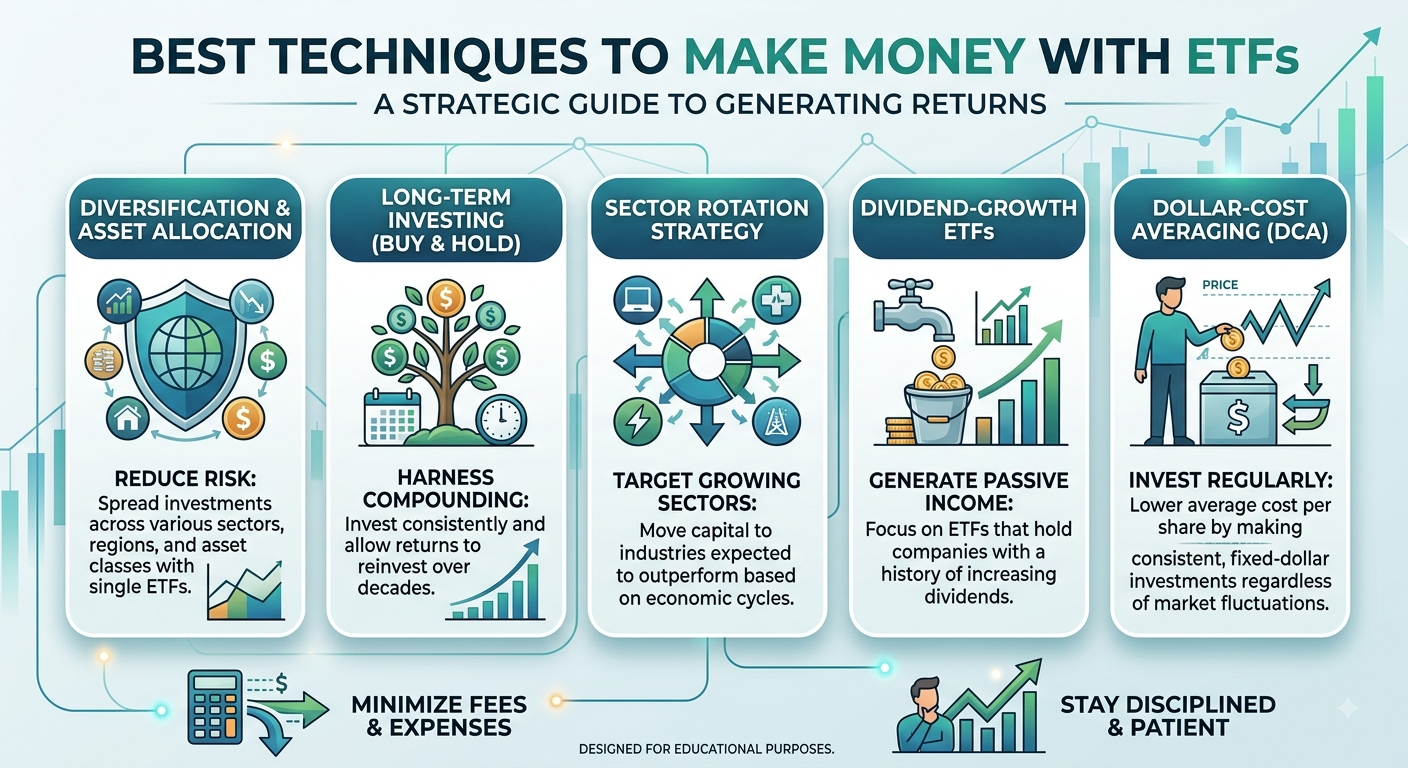
A Comprehensive Educational Thesis on Exchange-Traded Funds, Wealth Creation, Portfolio Construction, Risk, Compounding and Long-Term Investing
Abstract
Exchange-Traded Funds (ETFs) have become one of the most important investment vehicles in modern financial markets. An ETF allows investors to obtain exposure to a portfolio of securities or other assets through a listed investment product that can generally be bought and sold on an exchange in a manner similar to shares. Depending on the ETF, the underlying portfolio may contain equities, bonds, commodities, property securities, or other investments. (JSE)
The central question, however, is not simply “Which ETF will make the most money?” A more useful question is:
How can an investor use ETFs systematically to pursue long-term wealth creation while controlling costs, diversification, risk, taxes and behavioural mistakes?
This thesis develops that framework. It examines the mechanics of ETFs, the sources of investment returns, portfolio construction, diversification, regular investing, dividend reinvestment, compounding, cost management, asset allocation, international diversification, South African considerations, common mistakes, risk management and a practical ETF evaluation framework.
An ETF does not guarantee profit. Its price can fall, and investors can lose money. The JSE likewise emphasizes that investing involves no guarantee of profit. (JSE)
1. Introduction: Understanding the ETF Wealth-Building Concept
Modern investing has progressively moved toward instruments that allow investors to obtain broad market exposure without having to purchase and manage hundreds or thousands of individual securities.
An ETF is one of the most important developments in this evolution.
Instead of purchasing shares in 50, 100, 500 or thousands of companies individually, an investor can purchase a single ETF that represents an interest in a portfolio containing many securities.
The Johannesburg Stock Exchange describes ETFs as listed investment products that track a basket of shares, bonds or commodities, with the FTSE/JSE Top 40 being an example of an underlying index. (JSE)
This creates an important investment principle:
One transaction can provide exposure to many underlying investments.
The ETF therefore becomes a bridge between:
Individual investor → ETF → Portfolio of assets → Economic activity → Investment returns
The wealth-building process can consequently be understood as:
Capital + Time + Investment Return + Reinvestment + Discipline − Costs − Taxes = Potential Wealth
The word potential is important. Investment returns are uncertain.
2. What Is an ETF?
ETF stands for Exchange-Traded Fund.
An ETF pools investor money into a portfolio. The portfolio may contain stocks, bonds, money-market instruments, commodities or combinations of assets, depending on the particular product. (Investor)
An ETF can therefore be viewed as a financial container.
Inside the container are underlying investments.
For example:
ETF
→ Company A
→ Company B
→ Company C
→ Company D
→ Company E
→ …
→ Company N
Instead of managing every underlying security independently, the investor purchases exposure through the ETF.
2.1 ETF versus Individual Share
An individual share represents ownership exposure to one company.
An ETF can represent exposure to an entire group of securities.
Therefore:
One share = concentrated exposure
while:
ETF = potentially diversified exposure
However, diversification depends entirely on the ETF. Some ETFs are extremely broad, while others concentrate on a particular industry, country, theme, commodity or even a very small number of securities. The SEC specifically warns that not all ETFs are equally diversified. (Investor)
3. The Four Fundamental Engines of ETF Wealth Creation
There is no single technique that magically creates ETF wealth.
Instead, successful long-term investing generally comes from several interacting mechanisms.
Engine 1: Capital Appreciation
If the underlying assets increase in value, the ETF’s market value may increase.
Example:
An investor purchases an ETF at:
R100
Later its market price becomes:
R120
The price increase is:
R20
or:
20%
before considering distributions, fees, taxes and other factors.
4. Dividends and Other Distributions
Some ETFs receive dividends or other income from their underlying investments.
That income can either:
- be distributed to investors, or
- in certain structures, be reinvested into the fund.
The JSE notes that some ETFs pay dividends and that certain ETFs automatically reinvest dividends, allowing compounding to operate within the investment. (JSE)
This creates two possible wealth-building pathways:
Income received → investor reinvests → more investment units
or:
Income retained/reinvested within fund → larger underlying investment exposure
5. Compounding: The Mathematical Engine
Compounding is one of the most powerful concepts in investing.
Suppose:
- Initial capital = R10,000
- Average annual return = 8%
- No additional contributions
After one year:
R10,000 × 1.08 = R10,800
After two years:
R10,800 × 1.08 = R11,664
After three years:
R11,664 × 1.08 = R12,597.12
The return begins generating additional returns.
The basic compound-growth equation is:
FV = PV(1 + r)ⁿ
Where:
- FV = future value
- PV = present value
- r = annual rate of return
- n = number of years
But real investors often make regular contributions.
A simplified future-value model for regular contributions is:
FV ≈ Initial Investment Growth + Contribution Growth
This is why time can become as important as the initial amount invested.
6. The Most Powerful Technique: Consistent Investing
One of the most practical ETF techniques is investing regularly.
Instead of attempting to determine the perfect moment to invest, an investor can establish a disciplined contribution system.
For example:
Monthly contribution
→ ETF purchase
→ Additional units
→ Portfolio growth
→ Reinvestment
→ More capital exposed to markets
→ Long-term compounding
This approach can reduce dependence on successfully predicting short-term market movements.
It also creates an important behavioural advantage:
Investment becomes a habit rather than an occasional decision.
7. Dollar-Cost Averaging and Regular Contributions
Regular investing is often called dollar-cost averaging when the same monetary amount is invested at regular intervals.
For a South African investor, the equivalent practical concept can simply be described as regular rand investing.
Suppose an investor contributes:
R1,000 per month
When prices are high, R1,000 purchases fewer units.
When prices are lower, R1,000 purchases more units.
This produces a changing number of units purchased each month.
The strategy does not guarantee profit and does not eliminate market risk.
Its main advantage is behavioural and mechanical:
The investor does not need to make a new market-timing decision every month.
8. The Power of Time
Consider three hypothetical investors.
Investor A
Invests:
R1,000 per month for 10 years
Investor B
Invests:
R1,000 per month for 20 years
Investor C
Invests:
R1,000 per month for 30 years
Even if all three receive exactly the same investment return, Investor C has substantially more time for contributions and previous returns to compound.
This demonstrates a fundamental principle:
The longer investment capital remains productively invested, the greater the opportunity for compounding to influence wealth.
This does not mean markets rise every year. They do not.
It means that long investment horizons can provide more time to experience multiple market cycles.
9. Diversification: One of the Greatest Advantages of ETFs
Diversification is one of the principal reasons investors use ETFs.
Instead of relying on one company, an investor can obtain exposure to a collection of companies or other assets.
For example:
Concentrated portfolio
100% Company A
versus:
Diversified ETF
Company A
Company B
Company C
Company D
Company E
…
Company N
If Company A experiences severe difficulties, the concentrated investor may suffer a major loss.
In a diversified ETF, the impact may be smaller because the other holdings remain part of the portfolio.
The JSE identifies diversification as one of the central benefits of ETFs. (JSE)
However:
Diversification reduces concentration risk; it does not eliminate market risk.
10. Diversification Across Countries
A sophisticated ETF portfolio can potentially include exposure to:
- South Africa
- United States
- Europe
- Asia
- emerging markets
- developed markets
- global markets
International diversification introduces another variable:
Currency
A South African investor may invest in an ETF whose underlying assets are denominated partly or entirely in foreign currencies.
The investor therefore has exposure to both:
Asset performance
and potentially:
Currency movements
Currency movements can increase or decrease the rand value of foreign investments.
11. Diversification Across Asset Classes
ETFs can provide exposure beyond ordinary equities.
Possible categories include:
Equity ETFs
Exposure to companies.
Bond ETFs
Exposure to debt securities.
Commodity ETFs
Exposure to commodities or commodity-related instruments.
Property ETFs
Exposure to listed property securities.
Money-market or cash-related ETFs
Exposure to short-term interest-bearing instruments, depending on the product.
The JSE notes that ETFs can provide exposure to shares, bonds, commodities and other asset classes. (JSE)
12. Broad-Market ETFs
For many long-term investors, the broad-market ETF is conceptually important.
A broad-market ETF attempts to provide exposure to a large portion of a particular market.
Instead of asking:
“Which individual company will become the next major winner?”
the investor effectively asks:
“Can I participate in the growth of a broad group of companies?”
This changes the investment philosophy from company prediction to market participation.
13. Index Investing
Many ETFs are designed to track indexes.
An index may represent:
- major companies
- an entire national market
- a sector
- a geographic region
- bonds
- commodities
- other defined investment groups
An index ETF generally attempts to produce returns close to those of the underlying index before costs.
The SEC explains that passive index strategies generally involve less portfolio trading and can have lower fees than actively managed funds, although this varies by product. (Investor)
14. Active ETFs
Not every ETF is purely passive.
The JSE now also has actively managed ETFs (AMETFs), in which portfolio managers make investment decisions within the ETF structure. (JSE)
This produces an important distinction:
Passive ETF
→ attempts to track an index.
Active ETF
→ portfolio manager actively selects or allocates investments according to the fund’s strategy.
Neither structure automatically guarantees superior performance.
The investor must examine the specific product.
15. The Cost Principle
One of the most underestimated ETF techniques is:
Control unnecessary costs.
Investment costs reduce returns.
They may include:
- management fees
- administration expenses
- brokerage
- bid-ask spreads
- platform fees
- transaction costs
- taxes
- currency conversion costs
- other fund expenses
The SEC’s 2025 investor bulletin emphasizes that even apparently small fees can materially affect investment value over time because money spent on fees is money that is no longer compounding inside the portfolio. (Investor)
16. The Mathematics of Fees
Imagine two hypothetical investments.
Investment A
Annual return before costs:
8%
Annual cost:
0.20%
Approximate return after cost:
7.80%
Investment B
Annual return before costs:
8%
Annual cost:
1.00%
Approximate return after cost:
7.00%
The difference appears small in one year.
Over decades, however, the difference can become substantial because the foregone money also loses its opportunity to compound.
Therefore:
A small recurring cost can become a large lifetime cost.
17. Total Return Is More Important Than Dividend Yield Alone
A common mistake is to search for the ETF with the highest dividend yield.
That can be misleading.
Suppose:
ETF A
Dividend yield = 6%
Price appreciation = 1%
ETF B
Dividend yield = 2%
Price appreciation = 7%
Ignoring taxes, fees and other factors, their simplified total returns would be:
ETF A:
6% + 1% = 7%
ETF B:
2% + 7% = 9%
The investor should therefore examine total return, not simply dividend yield.
18. Reinvesting Dividends
Suppose an ETF distributes income.
An investor who does not need that income immediately may consider reinvesting it.
The mechanism becomes:
Dividend → additional investment → additional units → potential future distributions → additional investment
This creates a feedback loop.
It is one of the simplest illustrations of compounding.
19. The Difference Between Income and Wealth Creation
An ETF paying frequent distributions is not necessarily creating more wealth than an ETF that reinvests income internally.
A distribution is not automatically “free money.”
The correct analysis is:
Total investment value + distributions received/reinvested − costs − taxes
This is why investors should examine the full return structure.
20. Portfolio Construction
A successful ETF strategy should not begin with:
“Which ETF is the best?”
It should begin with:
“What is the purpose of this portfolio?”
Possible purposes include:
- long-term wealth creation
- retirement
- education
- preserving capital
- generating income
- diversification
- international exposure
- inflation protection
- achieving a specific financial objective
The ETF should serve the objective.
21. The Core-and-Satellite Strategy
One possible educational framework is the core-and-satellite model.
Core
A large portion of the portfolio is allocated to broad, diversified investments.
Satellites
Smaller allocations may provide exposure to:
- specific sectors
- countries
- themes
- commodities
- property
- other specialised opportunities
Conceptually:
Core = stability and broad exposure
Satellite = targeted exposure
This structure can help prevent a portfolio from becoming dominated by speculative themes.
22. Growth-Oriented ETF Portfolio
A hypothetical growth-oriented framework might emphasize:
Broad equity exposure
International equity exposure
Smaller specialised allocations
The objective would be long-term capital growth.
The trade-off is that equity markets can experience significant declines.
Therefore, such a portfolio is not appropriate merely because its historical returns may appear attractive.
23. Balanced ETF Portfolio
A balanced framework could combine:
Equities + Bonds + Other diversified assets
The objective is to combine growth potential with risk management.
The exact allocation should depend on the investor’s circumstances, objectives, time horizon and tolerance for losses.
24. Income-Oriented ETF Portfolio
An income-oriented strategy may emphasize ETFs holding assets that generate distributions.
Potential sources include:
- dividends
- bond interest
- property-related income
- other distributions
However, investors should distinguish:
high distribution yield
from:
high-quality sustainable total return.
25. The Importance of Asset Allocation
Asset allocation refers to how investment capital is divided among different asset categories.
For example:
Equities
Bonds
Cash
Property
Commodities
Different assets respond differently to economic conditions.
Asset allocation therefore becomes a risk-management mechanism.
26. Risk and Return
A fundamental investment principle is:
Higher potential return generally comes with higher uncertainty and risk.
An ETF that concentrates on a narrow technology sector may experience substantially different volatility from a broad-market ETF.
Likewise, a bond ETF behaves differently from an equity ETF.
The investor should therefore understand what risk is being purchased.
27. Volatility Is Not the Same as Permanent Loss
Market prices fluctuate.
An ETF can decline:
R100 → R90 → R80
and later potentially recover.
But a permanent loss can occur if an investor sells at a lower value and the capital is not subsequently recovered.
This is one reason investment horizon matters.
However, simply holding an investment does not guarantee recovery. Some securities, sectors or funds may deteriorate permanently.
28. Avoiding Emotional Investing
One of the biggest threats to ETF wealth creation can be investor behaviour.
Common emotional reactions include:
Market rises → Fear of missing out → Buy aggressively
Market falls → Fear → Sell
This can produce:
Buy high → Sell low
A disciplined investment policy attempts to replace emotional decisions with predetermined rules.
29. Market Timing
Market timing attempts to predict when to buy and sell.
The problem is that investors must correctly predict:
- when to exit,
- when to re-enter,
- how much to allocate,
- which asset will perform next.
Missing only a portion of important market recoveries can significantly affect long-term results.
For many long-term investors, a disciplined contribution strategy can be easier to maintain than attempting to predict every market movement.
30. Rebalancing
Over time, different investments grow at different rates.
Suppose a hypothetical portfolio begins with:
60% equities
40% bonds
After a strong equity market, it might become:
75% equities
25% bonds
The investor’s actual risk exposure has changed.
Rebalancing involves bringing the portfolio closer to its intended allocation.
Rebalancing should be systematic rather than driven by emotion.
31. The ETF Selection Framework
Before purchasing an ETF, an investor can examine at least these categories:
1. What does it track?
Understand the underlying index or strategy.
2. What does it own?
Examine the actual holdings.
3. How diversified is it?
Look at company, sector and geographic concentration.
4. What does it cost?
Examine the total cost structure.
5. How liquid is it?
Examine trading activity and spreads.
6. How does it perform relative to its benchmark?
Examine tracking performance.
7. What distributions does it make?
Understand income policy.
8. What risks does it carry?
Read the relevant fund documentation.
9. What is the investment objective?
Determine whether it fits the portfolio.
10. What is the tax treatment?
Understand the relevant jurisdiction and account structure.
32. Tracking Difference
A tracking ETF may not produce exactly the same return as its index.
Suppose:
Index return = 10%
while:
ETF return = 9.7%
The difference may arise from:
- fees
- transaction costs
- taxes
- portfolio construction
- cash holdings
- index-replication methodology
- other operational factors
Therefore, investors should examine how effectively an ETF has historically tracked its benchmark rather than looking only at its headline return.
33. Liquidity and Bid-Ask Spreads
An ETF trades on an exchange.
The investor may encounter:
Bid price
and
Ask price
The difference is the:
Bid-ask spread
A narrower spread can reduce the implicit cost of trading.
Liquidity therefore matters, particularly for investors who trade frequently or invest larger amounts.
34. Premium and Discount to Net Asset Value
An ETF has an underlying portfolio value known as its net asset value (NAV).
The market price can sometimes differ from NAV.
The investor should understand whether the ETF is trading:
above NAV
or:
below NAV
and why.
The relationship between market price and underlying asset value is an important part of ETF mechanics.
35. South African ETF Investing
South Africa has a well-developed listed ETF market.
The JSE states that ETFs can be purchased through authorised JSE equity members, ETF investment plans and financial-service platforms. (JSE)
JSE-listed ETFs are traded and settled in rand, and the exchange publishes ETF listings and related market information. (JSE)
This creates an accessible pathway for South African investors to obtain exposure to:
- South African equities
- global equities
- bonds
- property
- commodities
- other strategies
36. South African Tax Considerations
Tax is an essential part of investment planning.
The JSE explains that investors may encounter taxes associated with investing, including VAT on certain brokerage/STRATE-related charges and dividend withholding tax in applicable circumstances. (JSE)
Tax treatment depends on:
- the ETF
- the investor
- the account
- the source of income
- the nature of the transaction
- applicable South African tax rules
Therefore, tax information should always be verified with SARS or a qualified tax professional before making significant investment decisions.
37. Tax-Free Savings Accounts
South Africa’s Tax-Free Savings Account framework can be relevant to long-term investors.
The JSE explains that qualifying tax-free investments can provide tax advantages on investment returns, including qualifying ETFs. (JSE)
The important principle is:
Tax saved → capital retained → capital continues compounding
However, contribution limits, qualifying products and applicable rules must be checked against current SARS regulations.
38. Local Versus Global ETFs
A South African investor can conceptually divide investment exposure between:
Local exposure
Provides participation in South African companies and the domestic economy.
Global exposure
Provides participation in companies and economies outside South Africa.
The combination can reduce dependence on one country’s economic performance.
However, global investing introduces additional considerations such as:
- currency
- international taxation
- regulatory differences
- foreign market risks
- geopolitical risks
39. Inflation
Inflation reduces the purchasing power of money.
If money grows at:
4%
while inflation averages:
6%
the investor’s nominal balance may increase while its purchasing power declines.
This creates the concept of:
Real return
Approximately:
Nominal return − inflation
More precisely, the real return is:
(1 + nominal return) / (1 + inflation) − 1
Long-term investors should therefore think in terms of purchasing power, not merely account balances.
40. The Three Levels of ETF Wealth Building
A useful framework is:
Level 1 — Save
Create capital.
Level 2 — Invest
Put capital into productive assets.
Level 3 — Compound
Allow investment returns and additional contributions to build upon previous capital.
The transition from:
income → savings → investment → compounding
is fundamental to long-term wealth creation.
41. The Five Rules of ETF Discipline
Rule 1: Invest consistently
Create a repeatable contribution system.
Rule 2: Diversify
Avoid unnecessary concentration.
Rule 3: Control costs
Small costs can compound into large differences.
Rule 4: Think long term
Do not build a strategy around daily market movements.
Rule 5: Understand what you own
Never purchase an ETF simply because its name or recent performance looks attractive.
42. Common ETF Mistakes
Mistake 1: Chasing past performance
An ETF that performed exceptionally well previously may not repeat that performance.
Mistake 2: Buying only because of a high dividend
Yield alone does not measure total return.
Mistake 3: Ignoring costs
Fees reduce the amount available for compounding. (Investor)
Mistake 4: Excessive trading
Frequent trading can create additional costs and behavioural mistakes.
Mistake 5: Concentration
Owning several ETFs does not automatically mean diversification if they all hold the same companies.
Mistake 6: Ignoring taxes
Tax can materially affect the investor’s net return.
Mistake 7: Panic selling
Short-term market declines can trigger emotional decisions.
Mistake 8: Using complicated products without understanding them
Complexity is not automatically sophistication.
43. The Hidden Danger of ETF Overlap
Imagine an investor owns:
ETF A
ETF B
ETF C
At first glance, this looks diversified.
But suppose all three contain the same major companies.
The investor may unknowingly have:
70% exposure to the same underlying companies.
Therefore, diversification must be measured at the underlying holdings level, not merely by counting the number of ETFs.
44. The ETF Portfolio Pyramid
A useful educational model is:
Foundation
Emergency savings and financial stability.
↓
Core
Broad diversified ETFs.
↓
Diversification
Geographic and asset-class exposure.
↓
Satellites
Specialised sectors or themes.
↓
Speculation
Highly concentrated or complex investments.
The higher one moves up the pyramid, the more important risk management becomes.
45. The Mathematics of Long-Term Contributions
Consider a hypothetical investor contributing:
R2,000 per month
for:
20 years
Total contributions:
R2,000 × 12 × 20
= R480,000
The final portfolio value could be substantially higher or lower than R480,000 depending on investment returns, costs, taxes and market conditions.
The important observation is that:
The investor did not need to start with R480,000.
The capital was built progressively.
46. Why Starting Early Matters
Consider two hypothetical investors.
Investor A
Starts investing at age 20.
Investor B
Starts investing at age 40.
Even if Investor B invests larger amounts later, Investor A may benefit significantly from having more years of compounding.
This demonstrates:
Time in the market can be a powerful wealth-building resource.
But it should never be interpreted as a promise that markets will always rise.
47. The Wealth Equation
A comprehensive ETF wealth model can be represented as:
Future Wealth
=
Initial Capital
Regular Contributions
Capital Appreciation
Reinvested Income
Compounding
−
Fees
−
Taxes
−
Investment Losses
This equation illustrates why wealth creation requires multiple disciplines simultaneously.
48. A 10-Step ETF Investment Process
Step 1
Define the financial objective.
Step 2
Define the investment horizon.
Step 3
Determine acceptable risk.
Step 4
Determine appropriate asset allocation.
Step 5
Research ETFs.
Step 6
Compare costs.
Step 7
Examine diversification and underlying holdings.
Step 8
Establish a contribution strategy.
Step 9
Review and rebalance periodically.
Step 10
Avoid unnecessary emotional trading.
49. ETF Research Checklist
Before purchasing, ask:
- What exactly does this ETF own?
- Which index or strategy does it follow?
- How many securities does it contain?
- How concentrated is it?
- What sectors dominate?
- Which countries are represented?
- What are the fees?
- What are the trading costs?
- How liquid is it?
- Does it distribute income?
- Does it reinvest income?
- How closely does it track its benchmark?
- What are its major risks?
- What is the tax treatment?
- Does it fit my investment objective?
50. The Difference Between Investing and Trading
ETF investing
Generally emphasizes:
Long-term ownership
Diversification
Compounding
Regular contributions
Asset allocation
ETF trading
Generally emphasizes:
Short-term price movements
Entry and exit timing
Technical or market analysis
Higher transaction frequency
These are fundamentally different activities.
Someone seeking long-term wealth creation should not automatically adopt a short-term trading mentality.
51. The Psychology of Wealth Creation
Financial mathematics is only one part of investing.
Behaviour is equally important.
An investor may possess an excellent ETF portfolio but still achieve poor results by:
- selling during panic,
- constantly changing strategies,
- chasing trends,
- borrowing excessively to invest,
- abandoning long-term plans,
- concentrating after seeing recent performance.
The ability to remain disciplined through different market environments is therefore an important investment skill.
52. The Role of Education
ETF investing should be approached as a learning process.
An investor should progressively understand:
Economics
→ Markets
→ Companies
→ Indexes
→ ETFs
→ Portfolio construction
→ Risk
→ Tax
→ Compounding
→ Behaviour
The more an investor understands the system, the less dependent they become on advertisements, social-media claims or short-term predictions.
53. What Does “Making Money With ETFs” Really Mean?
The phrase can be misleading.
There is no guaranteed ETF that simply produces money.
A more scientifically accurate interpretation is:
Using ETFs as diversified investment vehicles to obtain exposure to productive assets and pursue long-term capital growth and/or income while controlling risk and costs.
This distinction is crucial.
Investment is not a money-making machine.
It is participation in financial and economic assets whose future values are uncertain.
54. The Long-Term ETF Formula
The most powerful strategy is not necessarily complicated.
It can be summarized as:
Earn
↓
Save
↓
Invest
↓
Diversify
↓
Contribute regularly
↓
Control costs
↓
Reinvest where appropriate
↓
Stay disciplined
↓
Allow time to compound
This is the foundation of the ETF wealth-building philosophy.
55. A Model Educational Portfolio Architecture
A generic educational architecture might look like:
CORE
Broad-market equity ETF
GLOBAL
International equity ETF
STABILITY
Bond or defensive ETF
DIVERSIFICATION
Property/commodity/other suitable exposure
SATELLITE
Limited specialised exposure
The percentages should not automatically be copied by every investor. Asset allocation must reflect objectives, time horizon, financial circumstances and risk tolerance.
56. Risk Management Framework
A comprehensive ETF strategy should monitor five major risks:
1. Market risk
The underlying market declines.
2. Concentration risk
Too much exposure to one company, sector or country.
3. Currency risk
Foreign-currency movements affect returns measured in rand.
4. Liquidity risk
An ETF may have less trading liquidity than expected.
5. Behavioural risk
The investor makes poor decisions during market volatility.
The best portfolio is therefore not necessarily the one with the highest historical return.
It may be the one the investor can actually maintain through difficult market conditions.
57. ETF Wealth Creation Across Economic Cycles
Markets move through different environments:
Expansion
→ economic growth
Peak
→ growth slows
Contraction
→ economic activity declines
Recovery
→ economic activity begins improving
Different asset classes and sectors can respond differently during these periods.
A diversified ETF portfolio can therefore provide exposure across a wider range of economic conditions.
58. The Role of Patience
Patience is not passive behaviour.
A disciplined investor continually:
- monitors the portfolio,
- studies costs,
- understands holdings,
- reviews allocation,
- maintains contributions,
- updates financial knowledge.
But the investor does not necessarily need to trade constantly.
The objective is:
Active thinking + disciplined investing + limited unnecessary trading.
59. ETF Investing as a Modern Financial Technology
ETFs represent an important combination of:
Indexing
Portfolio management
Stock-exchange trading
Technology
Financial markets
Automated administration
This makes ETFs an important component of the modern investment ecosystem.
A single ETF can connect an ordinary investor to a large collection of global economic assets.
60. The Future of ETFs
The ETF industry continues to expand into new areas.
Future developments may include greater use of:
- artificial intelligence
- automated portfolio construction
- thematic strategies
- actively managed ETFs
- environmental and sustainability strategies
- global asset exposure
- alternative assets
- sophisticated risk-management strategies
The JSE’s recent listings of actively managed ETFs illustrate how the ETF structure continues to evolve in South Africa. (JSE)
The underlying principle remains the same:
A listed investment vehicle provides structured access to a portfolio or strategy.
61. The Golden Principles of ETF Investing
A long-term investor can remember the following principles:
Principle 1
Understand before investing.
Principle 2
Diversify intelligently.
Principle 3
Keep unnecessary costs low.
Principle 4
Invest according to objectives.
Principle 5
Use time to your advantage.
Principle 6
Reinvest when appropriate.
Principle 7
Avoid emotional decisions.
Principle 8
Monitor concentration and overlap.
Principle 9
Understand tax implications.
Principle 10
Never assume past performance guarantees future returns.
62. Final Synthesis
The best techniques for building wealth with ETFs are not based on discovering a magical ticker symbol or predicting the next market winner.
They are based on systems.
The system begins with:
Financial discipline
→ saving capital
→ choosing appropriate diversified investments
→ contributing regularly
→ controlling costs
→ managing risk
→ reinvesting income where appropriate
→ maintaining a suitable asset allocation
→ allowing sufficient time for compounding.
The JSE describes ETFs as providing diversified exposure through a single listed product and notes that investors can access ETFs through authorised brokers, investment plans and financial-service platforms. (JSE)
The broader investment lesson is even more important:
ETF investing is not fundamentally about trying to become rich quickly. It is about building a repeatable financial system in which savings are converted into investment capital, investment capital participates in productive assets, returns can be reinvested, and time allows compounding to operate.
The investor’s greatest advantages can therefore be:
Knowledge
Discipline
Diversification
Low unnecessary costs
Regular contributions
Long-term thinking
Risk management
Patience
63. Conclusion: From ETF Ownership to Financial Wealth
An ETF can be thought of as a vehicle.
It is not the destination.
The destination is the investor’s financial objective.
A well-designed ETF strategy therefore connects:
Income
↓
Savings
↓
Investment Capital
↓
ETF
↓
Diversified Assets
↓
Capital Growth + Income
↓
Reinvestment
↓
Compounding
↓
Long-Term Wealth
This framework provides a more realistic definition of “making money with ETFs.”
The objective is not to predict every market movement.
It is to build a robust investment process capable of operating across many market cycles.
ETFs can provide diversification, accessibility and efficient exposure to groups of assets, but they remain investments whose values can rise and fall. The JSE and SEC both emphasize the importance of understanding investment risks, costs and the characteristics of the particular ETF before investing. (JSE)
Educational note: This thesis is for general financial education, not individualized financial advice. A person’s appropriate ETF selection and allocation depend on their circumstances, objectives, time horizon, risk tolerance, tax position and applicable laws.



Be First to Comment